Feeds:
Posts
Comments

Posts Tagged ‘Regulus satrapa’

Sometimes it pays to be lucky (and persistent). Yesterday I visited Occoquan Bay National Wildlife Refuge for this first time in over a week. It was cool (about 45 degrees (7 degrees C) and breezy, so I knew that my focus would be primarily on birds rather than insects.

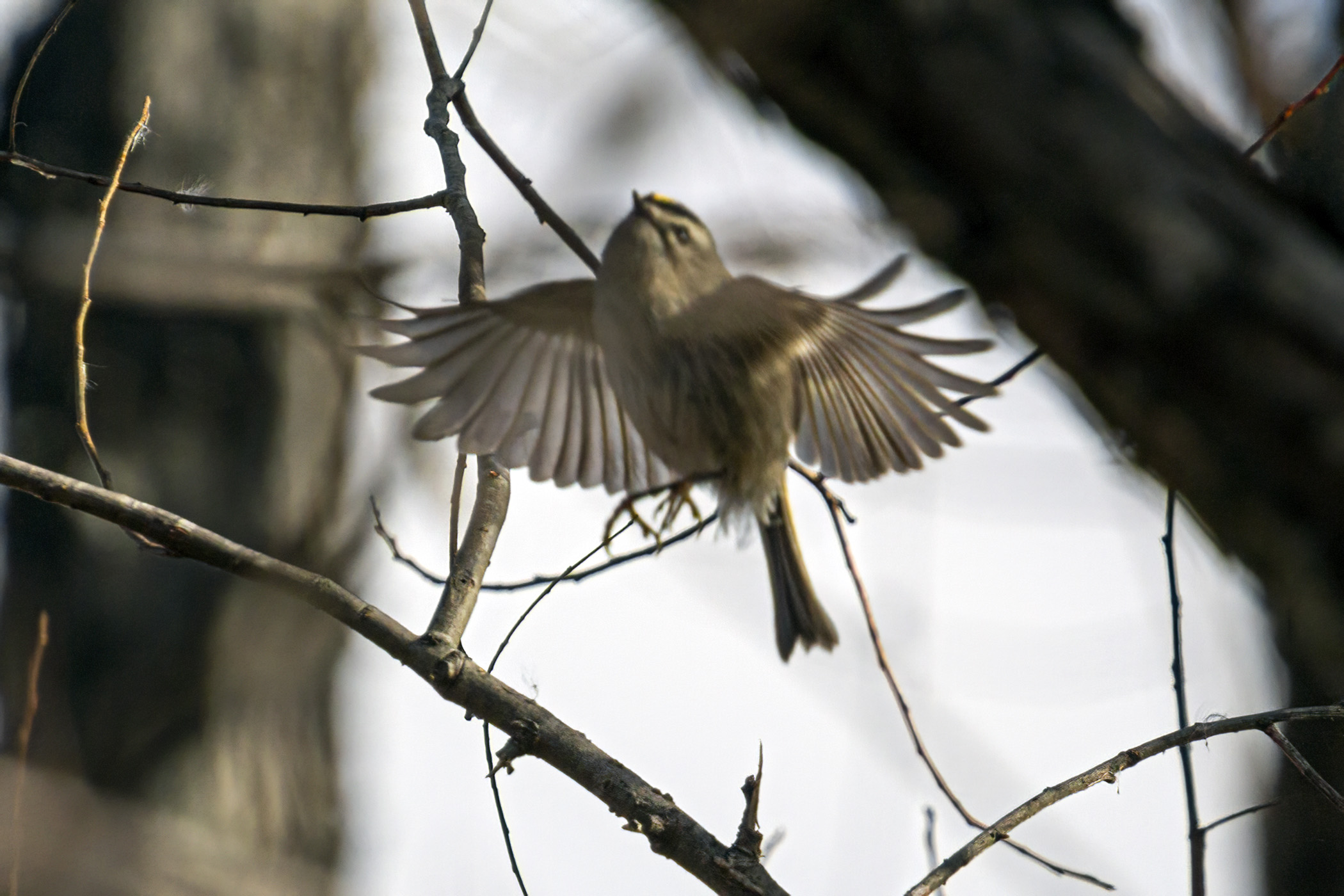
Midway through the morning, I spotted a bird moving about high in the trees and I tried to track it. Eventually I realized that it was a Golden-crowned Kinglet (Regulus satrapa), one of the smallest birds in our area at  only about 3-4 inches in length (8-11 cm). Golden-crowned Kinglets are skittish and do not stay still for very long, so I frantically tried to track this bird as it moved from branch to branch.

I took lots of photos, but in many of them the kinglet was partially hidden by the branches or was out of the frame. My favorite photo of the kinglet is the first one below. The kinglet paused for a moment and lifted it head, allowing me to get a little eye contact with the bird. As I was focusing in on the kinglet’s perch, the kinglet took off and I captured the second photo, a lucky midair shot. The final photo shows the kinglet in one of its many acrobatic poses that it used as it foraged for food.

In case some of you are curious, I did find a few dragonflies yesterday, but I’ll leave those photos for another blog post.

Golden-crowned Kinglet

Golden-crowned Kinglet

Golden-crowned Kinglet

© Michael Q. Powell. All rights reserved.

Read Full Post »

The warmer weather yesterday was a welcome respite from our winter cold—temperatures rose above 50 degrees F (10 degrees C) and it is supposed to be even warmer today. During a lengthy walk at Occoquan Bay National Wildlife Refuge, I was delighted to spot this tiny Golden-crowned Kinglet (Regulus satrapa) on a tree with some visible buds.

Such signs are starting to appear—I can’t wait for spring to arrive with new growth, new colors, and new life.

Golden-crowned Kinglet

© Michael Q. Powell. All rights reserved.

Read Full Post »

Golden-crowned Kinglets (Regulus satrapa) are among the smallest birds in our area of Northern Virginia at about 4 inches (10 cm) in length. These tiny songbirds are also extremely fast and frenetic and they move about high in the trees.

I spotted a Golden-crowned Kinglet this past Monday at Occoquan Bay National Wildlife Refuge on a rare January day with blue skies. When I am tracking kinglets, I usually shoot in short bursts, hoping to capture a moment when the birds are stationary. I often ended up with blurry shots of the back of the head of this kinglet and sometimes the bird moved so quickly that it was already outside of the frame by the time I clicked the shutter.

The favorite two images, as you can see below, show the little bird in motion. In the first photo, the kinglet seemed to hover momentarily as it flitted about among the branches. In the second image, which I cropped significantly, I captured the moment when the kinglet pushed off from one branch and flew downwards towards another prospective perch. I just barely managed to keep the kinglet in the frame—in the original image the kinglet is in the lower third of the image, with its extended wing almost touching the bottom edge.

Patience and persistence helped me get this image, along with fast reflexes from lots of practice. To be honest, though, I must admit that luck played a significant role my success.


Golden-crowned Kinglet

Golden-crowned Kinglet

© Michael Q. Powell. All rights reserved.


Read Full Post »

I had low expectations for capturing images of birds when I set out for a hike this past Tuesday at Prince William Forest Park. I knew from past experience that I was unlikely to see very many birds as I walked up and down then hill at the park and alongside the streams. The birds that I was lucky enough to see or hear were likely to be hidden high in the trees, outside of the reach of the lens that I was carrying. Normally I shoot with a 150-600mm lens, but it is a bit heavy to tote around for hours on end and instead I carried my 18-400mm lens, a lighter and more flexible lens that allows me to take wide-angle and telephoto shots.

I did manage to capture a few photos that I am sharing here. The first one shows a Golden-crowned Kinglet (Regulus satrapa), an elusive species that is one of the smallest birds in our area. I tried to track this bird as it moved about and was happy to get a shot when it poked its head between some branches.

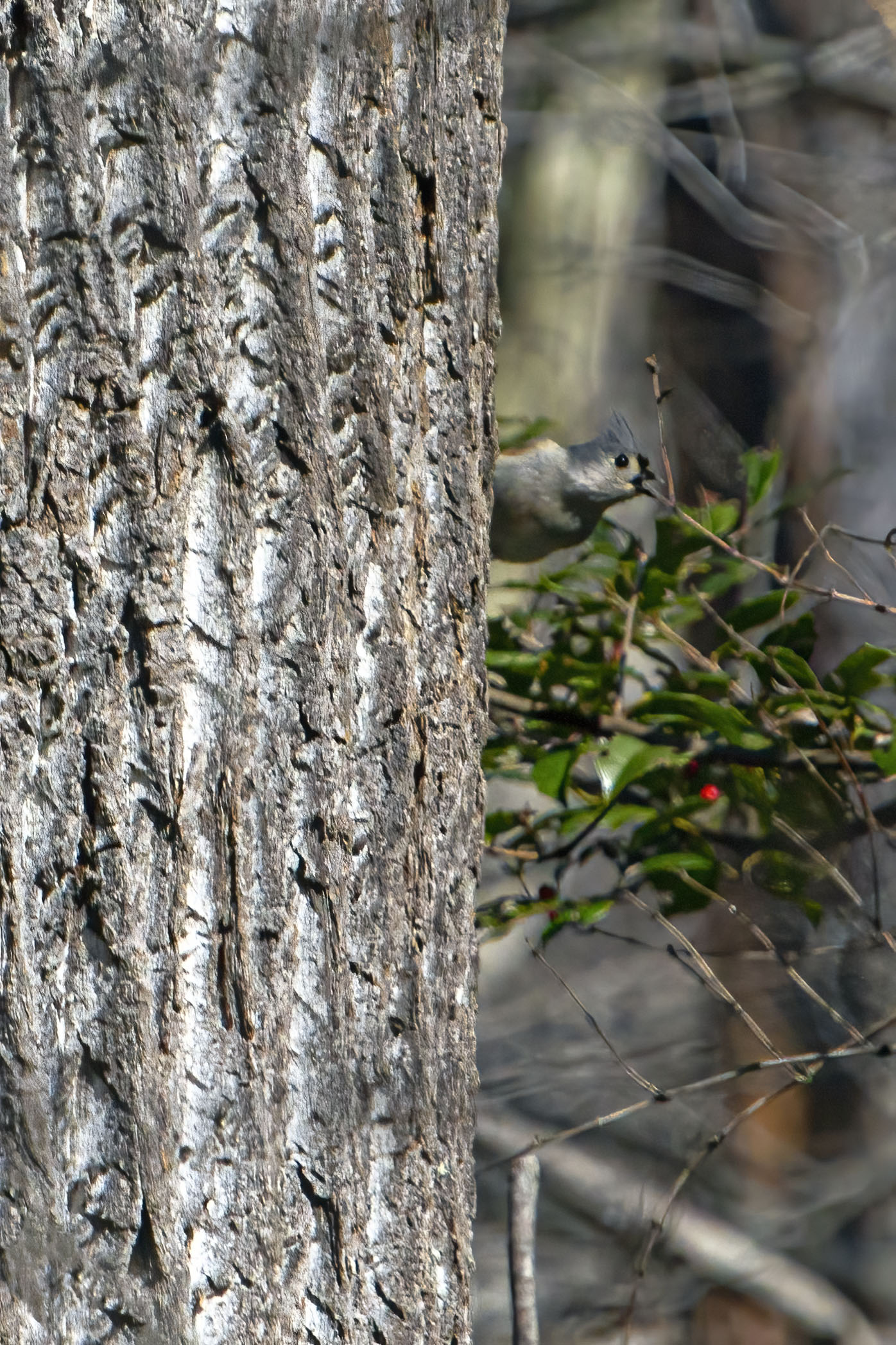
A Tufted Titmouse (Baeolophus bicolor) was also playing a combination of hide-and-seek and peekaboo with me. I captured the second photo below when the titmouse poked its head out from behind a tree trunk.

The final photo shows a Carolina Chickadee (Poecile carolinensis) that perched briefly almost directly overhead. This image has the cleanest composition of the three shots, but does not really give you a sense of the environment in which I found the little bird.

Some days it is nice just to commune with nature, to hear the sound of the rustling leaves and the babbling brooks, to observe the light and the shadows. Any photos that I do manage to capture are simply a bonus.

Golden-crowned Kinglet

Tufted Titmouse

Carolina Chickadee

© Michael Q. Powell. All rights reserved.

Read Full Post »

I am always thrilled when I get a look at the “crown” of a Golden-crowned Kinglet (Regulus satrapa), one of the smallest birds in our area. I photographed this cute little kinglet last Friday at Occoquan Bay National Wildlife Refuge. Golden-crowned Kinglets are frenetically active, so it can be tough to get a decent shot of one.

Surprisingly, the kinglets overwinter with us. According to the Cornell Lab of Ornithology, “The tiny Golden-crowned Kinglet is hardier than it looks, routinely wintering in areas where nighttime temperatures can fall below –40° Fahrenheit (-40 degrees C).”

Golden-crowned Kinglet

Golden-crowned Kinglet

© Michael Q. Powell. All rights reserved.
Read Full Post »

This tiny Golden-crowned Kinglet (Regulus satrapa) seemed pretty excited on Wednesday at the appearance of tender young buds on the trees at Occoquan Bay National Wildlife Refuge. The kinglet has probably had to subsist on a diet of dried-up seeds during the winter, so the buds are undoubtedly a welcome treat.

Golden-crowned Kinglets are energetic and acrobatic and I really enjoyed watching this one feeding, who sometimes seemed to defy gravity. The images reflect only some of the varied poses of the kinglet—in most of my other shots the kinglet had its head down or was looking away.

I particularly like the pose in the final shot in which the kinglet is hanging horizontally and looking right at me. One of my Facebook friends thought that I was lying down and looking upward when I took that shot, but I can assure you that I was standing upright at that moment.

Golden-crowned Kinglet

Golden-crowned Kinglet

Golden-crowned Kinglet

© Michael Q. Powell. All rights reserved.

Read Full Post »

Sometimes I am able to carefully compose my photos and ensure that I have the proper settings on my camera.  Frequently, though, I am forced to react instantaneously and merely point and shoot, with a primary goal of keeping my subject within the frame and hopefully in focus. Landscape and studio photographers may have the luxury of using  a slower, more deliberate process, but wildlife photographers rarely do.

On Thursday I spotted a tiny Golden-crowned Kinglet (Regulus satrapa) in a tree at Occoquan Bay National Wildlife Refuge. The kinglet, which is only about four inches (10 cm) in length, was frenetically moving from branch to branch and I had trouble tracking it in my viewfinder. Suddenly it dropped down to ground-level and was briefing in the open.

I reacted quickly and fired off a short burst of shots. Amazingly, one of them came out pretty well, the first image that you see below. Why do I say “amazingly?’ My Tamron 150-600mm lens was fully extended  to 600mm and the lens is supposed to be “soft” at that focal length. More importantly, the shutter speed was only 1/125th of a second. However, I was able to get away with such a slow shutter speed because I was using a monopod, which helped to steady my camera.

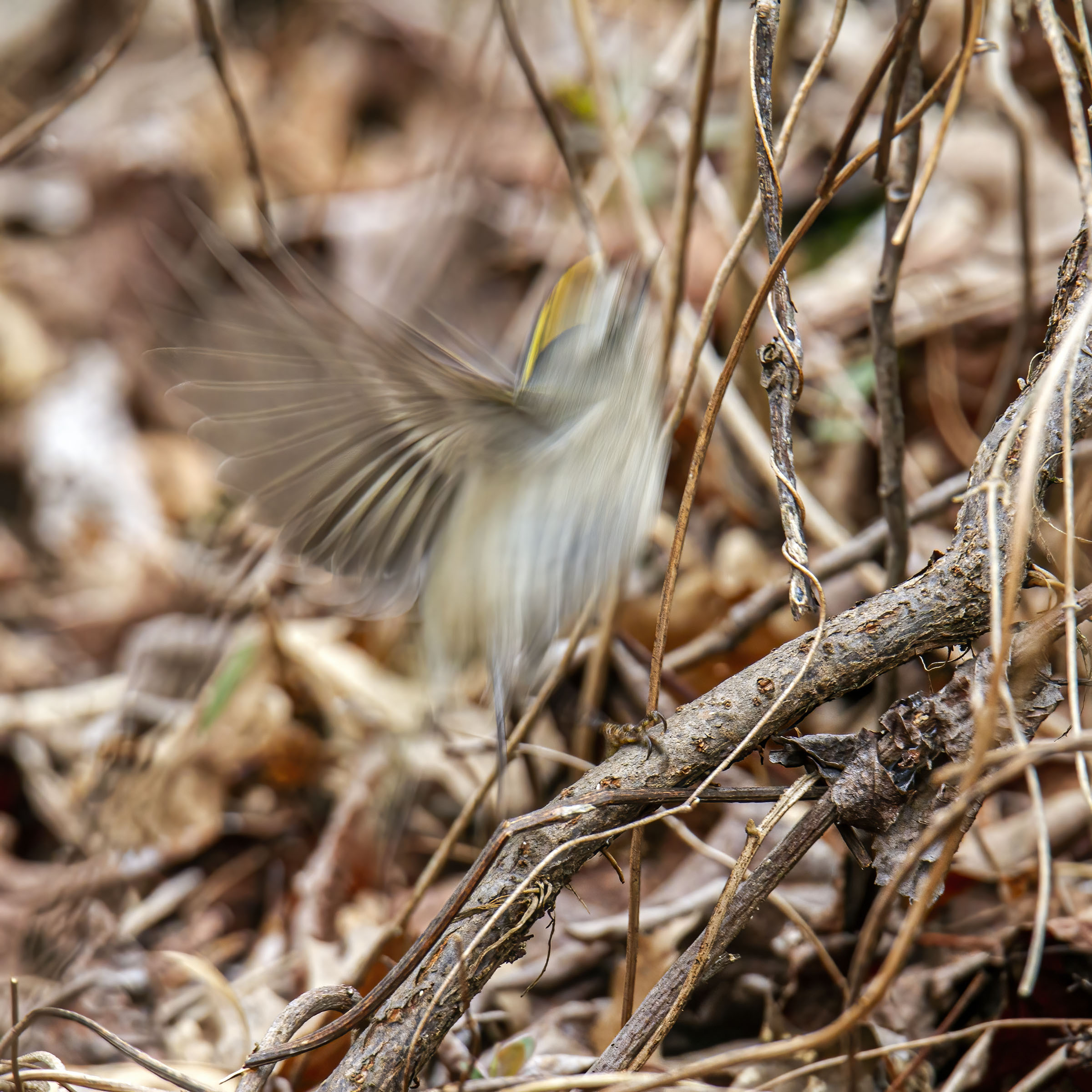
A slow shutter speed may have been ok for a stationary subject, but it was no match for a moving one. A split-second after the first image, I captured the second image below in which the kinglet is almost completely blurry, though the branch on which it is perched is still pretty sharp. Note, however, that one of the kinglet’s feet is still on the branch and is in focus. Apparently I capture the moment when the kinglet was starting to flap its wings, but had not yet pushed off from the branch.

Although I have referred to “my” technique as “point and shoot,” there actually is some pre-planning involved. I am familiar enough with my favorite wildlife refuge that I know which subjects are likely to be found in specific locations. I also try to pay attention to my camera settings and adjust them to the amount of light available to increase the chances of getting a proper exposure for my reactive shots.

Golden-crowned Kinglet

Golden-crowned Kinglet

© Michael Q. Powell. All rights reserved.

Read Full Post »

When the trees are bare in the winter, I have a much better chance of detecting the movement of birds than in the spring and the summer. However, many of the birds that I spot move about frenetically and unpredictably, so it is not easy to photograph. The challenge is additionally complicated by the fact that a number of the birds that spend the winters with us are tiny.

One of the smallest birds is the Golden-crowned Kinglet (Regulus satrapa). It is larger than a chickadee and smaller than a hummingbird and is 3.1-4.3 inches (8-11 cm) in length and weighs 0.1-0.3 ounces (4-8 g). I love the description of the species on the website of the Cornell Lab of Ornithology, “Tiny songbird with nervous, twitchy foraging style, given to hanging acrobatically from thin branches and twigs.”

In most of my photos of Golden-crowned Kinglets, the “crown” is not very visible, for I am generally shooting with my camera pointed upwards at a sharp angle. Last Tuesday at Occoquan Bay National Wildlife Refuge, I was fortunate to get an almost e-level view of a kinglet and captured this shot that shows off its golden crown nicely.

Golden-crowned Kinglet

© Michael Q. Powell. All rights reserved.

Read Full Post »

I love to take photographs of large powerful raptors, like the Bald Eagle and the Red-tailed Hawk that I featured recently in blog postings. However, I am equally happy to capture images of the small birds that I often hear, but have trouble spotting. This past Monday I spotted these little birds as I wandered about at Occoquan Bay National Wildlife Refuge. None of the shots are particularly spectacular, but I find that there is incredible beauty in the details of these little birds.
I can’t help but be reminded of some of the words of a hymn that we occasionally sing at church called “All Things Bright and Beautiful” that was written by Cecil Frances Alexander.
“All things bright and beautiful,
All creatures great and small,
All things wise and wonderful:
The Lord God made them all.
Each little flower that opens,
Each little bird that sings,
He made their glowing colors,
He made their tiny wings.”
You may be familiar with some of these birds, but in case you need a reminder, they are an Eastern Bluebird (Sialia sialis); a Golden-crowned Kinglet (Regulus satrapa); a Yellow-rumped Warbler (Setophaga coronata); and a Carolina Chickadee (Poecile carolinensis).
Eastern Bluebird
Golden-crowned Kinglet
Yellow-rumped Warbler
Carolina Chickadee
© Michael Q. Powell. All rights reserved.

Read Full Post »

It is a fun challenge to try to photograph tiny songbirds, like this Golden-crowned Kinglet (Regulus satrapa) that I spotted last Thursday at Occoquan Bay National Wildlife Refuge. Golden-crowned Kinglets are approximately 3-4 inches (80-100 mm) in length and weigh about 0.1-0.3 ounces (4 to 8 grams) and they move about continuously, often high in the trees.

If you look carefully just above the kinglet’s eye, you can get a tiny glimpse of yellow, a small portion of the yellow “crown” that gives this little bird its name.

Golden-crowned Kinglet

© Michael Q. Powell. All rights reserved.


Read Full Post »

When you look through the photos on my blog, you might get the mistaken impression that I have some magical power over birds, because your view of them is rarely obstructed by branches. I have a confession to make—those photos are not accurate representations of the way that I see birds most of the time. Today’s image of a beautiful little Golden-crowned Kinglet (Regulus satrapa) provides a more typical view of the way that I see birds in the wild as they move about in the thickets and underbrush foraging for food, rarely providing me with a good look.

Despite all of the branches that blocked my view, I managed to capture quite a lot of the kinglet’s details in this shot, including a sliver of its golden “crown,” a close look at its legs and feet as the small bird was hanging from a leaf, and some of the texture of the layers of feathers. I highly encourage you to click on the image to get a better looks at these wonderful detail. As you look at this bird, keep in mind that it is one of the smallest songbirds in my area, with a length of 3.1-4.3 in (8-11 cm) and a weight of 0.1-0.3 oz (4-8 g), according to the Cornell Lab of Ornithology.

I am fond of saying that beauty is everywhere, and I believe that to be true. Sometimes, though, you might not see it at first glance. If you slow down and look beyond those things that threaten to block your view, you may discover beauty hidden among the branches.


Golden-crowned Kinglet

© Michael Q. Powell. All rights reserved.


Read Full Post »

This tiny Golden-crowned Kinglet (Regulus satrapa) seemed to have puffed himself up to look larger and more menacing as he defiantly stared at me from the underbrush last week at Occoquan Bay National Wildlife Refuge. His bright yellow Mohawk hairstyle enhanced his non-conformist vibe—it would not surprise me to learn that he has tattoos and body piercings.

Generally I try to avoid head-on shots of birds, but somehow it worked out pretty well in this case and allowed me to photograph this kinglet with an attitude. I encourage you to click on the image to get a closer look at this cool little bird.

Happy New Year in advance to all of you.

Golden-crowned Kinglet

© Michael Q. Powell. All rights reserved.

Read Full Post »

Although they are barely larger than the hummingbirds that migrate south when the weather turns cold, Golden-crowned Kinglets (Regulus satrapa) spend their winters in my home area of Northern Virginia. In addition to being tiny, Golden-crowned Kinglets often forage high in the trees, which makes them really tough to photograph.

I was really happy to capture this image of a Golden-crowned Kinglet on Tuesday at Occoquan Bay National Wildlife Refuge as it was feeding on a cluster of poison ivy berries. Looking through the branches you can see the bird’s lemon-yellow “crown” and the the beautiful pattern on its wings.

Golden-crowned Kinglet

© Michael Q. Powell. All rights reserved.
 

Read Full Post »

Kinglets are tiny birds, about 4 inches (10 cm) in length, and always seem to be in constant motion in heavily vegetated areas. As a result, they tend to be really hard to photograph. Last week at Occoquan Bay National Refuge I was thrilled to be able to capture images of both kinglet species in our area—the Golden-crowned Kinglet (Regulus satrapa) and the Ruby-crowned Kinglet (Regulus calendula).

It is not hard to guess that the bird in the first shot is a Golden-crowned Kinglet. I was never able to get close to the kinglet, but it did give me a clear view of its beauty when it perched momentarily on a small branch. The Ruby-crowned Kinglet in the second image has a more typical pose, surrounded by vines and branches. I shot over a dozen images of this little bird and this is the only one in which its head is up and visible.

Golden-crowned Kinglet

Ruby-crowned Kinglet

© Michael Q. Powell. All rights reserved.

Read Full Post »

Yesterday at Occoquan Bay National Wildlife Refuge I was thrilled to capture these images of a cute little Golden-crowned Kinglet (Regulus satrapa). Golden-crowned Kinglets are really small, only 3.1-4.3 inches (8-11 cm) in length and weighing 0.1-0.3 ounces (4-8 g), and they very active, which makes them hard to spot and even harder to photograph.

The kinglet posed so nicely that I don’t even have to explain why it is called “Golden-crowned.” In fact, it was the bright yellow streak on its head that initially caught my eye and helped me as I tracked the tiny bird as it moved in and out of the vegetation.

Golden-crowned Kinglet

Golden-crowned Kinglet

© Michael Q. Powell. All rights reserved.

Read Full Post »

Golden-crowned Kinglets (Regulus satrapa) are tiny, but they can be mighty fierce. This one that I spotted yesterday at Occoquan Bay National Wildlife Refuge seemed to be sending me a definite  “Don’t mess with me” message with its intense glare in my direction.

Golden-crowned Kinglet


© Michael Q. Powell. All rights reserved.

Read Full Post »

Despite his diminutive size, this male Golden-crowned Kinglet (Regulus satrapa) seemed to have plenty of attitude when I spotted him on Monday at Occoquan Bay National Wildlife Refuge.

Size is relative, of course, but by almost any standard Golden-crowned Kinglets are tiny. The are about 3-4 inches (8 to 10 cm) in length and weigh only 0.1 to 0.3 ounces (4 to 8 gm). Their small size and hyperactivity make them a fun challenge to photograph.

I particularly like this bird’s combative stance and the way that it provides us with such a good view of its bright yellow “crown.” It is one of the rare occasions when I got an unobstructed shot of a kinglet—normally there are branches blocking at least part of the view.

Golden-crowned Kinglet

© Michael Q. Powell. All rights reserved.

Read Full Post »

Last weekend I again visited the bird banding station at Occoquan Bay National Wildlife Refuge and was thrilled to see the friendly folks there process a pair of Golden-crowned Kinglets (Regulus satrapa), which are among the smallest birds in our area. Bands come in all different sizes and kinglets require the absolutely smallest-sized bands.

Here are some shots of the encounter including the initial processing of the bird; the actual banding of the bird (note its tiny legs); examination of the feathers of the bird; and the moment before the release of one of the little birds by a young visitor.

I love the fact that I was able to get so much closer to the bird and see so many wonderful details about its feathers and coloration than I would ever be able to do in the wild. As the old saying goes, “a bird in the hand is worth two in the bush.”

Golden-crowned Kinglet

Golden-crowned Kinglet

Golden-crowned Kinglet

Golden-crowned Kinglet

© Michael Q. Powell. All rights reserved.


Read Full Post »

Golden-crowned Kinglets (Regulus satrapa) are not woodpeckers, but a tiny kinglet that I spotted this past weekend at Occoquan Bay National Wildlife Refuge seemed to be doing its best imitation of one as it pecked away at a little branchlet.

For those of you who are not familiar with Golden-crowned Kinglets, they are really, really small birds. According to the Cornell Lab of Ornithology website, these kinglets are 3.1-4.3 inches in length ( 8-11 cm) and weigh only 0.1-0.3 oz (4-8 gm). It is always exciting to spot a kinglet and always a challenge to get a unobstructed, in-focus shot of one.

Golden-crowned Kinglet

© Michael Q. Powell. All rights reserved.

Read Full Post »

It is exciting to photograph big birds, but it many ways it is even more of a challenge to get decent shots of the tiny frenetic ones, like this Golden-crowned Kinglet (Regulus satrapa) that I photographed yesterday morning at Occoquan Bay National Wildlife Refuge.

Golden-crowned Kinglets are really small, about 2 to 4 inches in length (8 to 11 cm), which is smaller than a chickadee and larger than a hummingbird. They seem to like to forage deep within the branches of the vegetation, so it was really tough to get an unobstructed shot of one.

I decided yesterday to try shooting with a monopod, which helped me to stay focused on this particular bird as it moved about and be ready when it perched for a split second in the open. My Tamron 150-600mm lens is a little heavy and I think that it helped my steadiness to have the additional support of the monopod, though it did feel a little constraining. I think that I will start using the monopod regularly now and see if my images tend to get sharper.

Golden-crowned Kinglet

© Michael Q. Powell. All rights reserved.

Read Full Post »

It was so dark and gray this morning that I initially couldn’t even see what was fluttering about in the underbrush not far from where I was standing. Finally it perched and eventually I was able identify it as a Golden-crowned Kinglet (Regulus satrapa), one of the few birds that I have encountered that is even smaller than a chickadee—a bit over three inches (8 cm) in length and a weight of .2 ounces (6 g).

Golden-crowned Kinglet

Golden-crowned Kinglet

© Michael Q. Powell. All rights reserved.

Read Full Post »