Feeds:
Posts
Comments

Posts Tagged ‘obelisk posture’

As I watched television coverage of the Olympic Games in Paris, I could not help but notice the numerous handstands in almost all of the gymnastic events for the men. There were handstands on the floor, on the rings, on the parallel bars, the high bar, and even on the pommel horse.

When I spotted this male Blue Dasher dragonfly (Pachydiplax longipennis) doing a handstand last Thursday at Jackson Miles Abbott Wetland Refuge, I immediately thought of those Olympic gymnasts.

This position is sometimes referred to as the “obelisk” pose for dragonflies. Many scientists believe that it is used as a form of thermoregulation to keep the body cooler by reducing the amount of surface exposure to direct sunlight. Several other dragonfly species use this pose, but I observe it most often with the male Blue Dasher dragonflies.

Blue Dasher

© Michael Q. Powell. All rights reserved.

Read Full Post »

What do you do to cope on a hot sunny day? Most of us stay indoors in an air-conditioned space, possibly with a cold beverage. Dragonflies do not have those options, so many of them assume a pose, often known as the obelisk posture, in an attempt to regulate their temperature by reducing exposure to the direct sunlight.

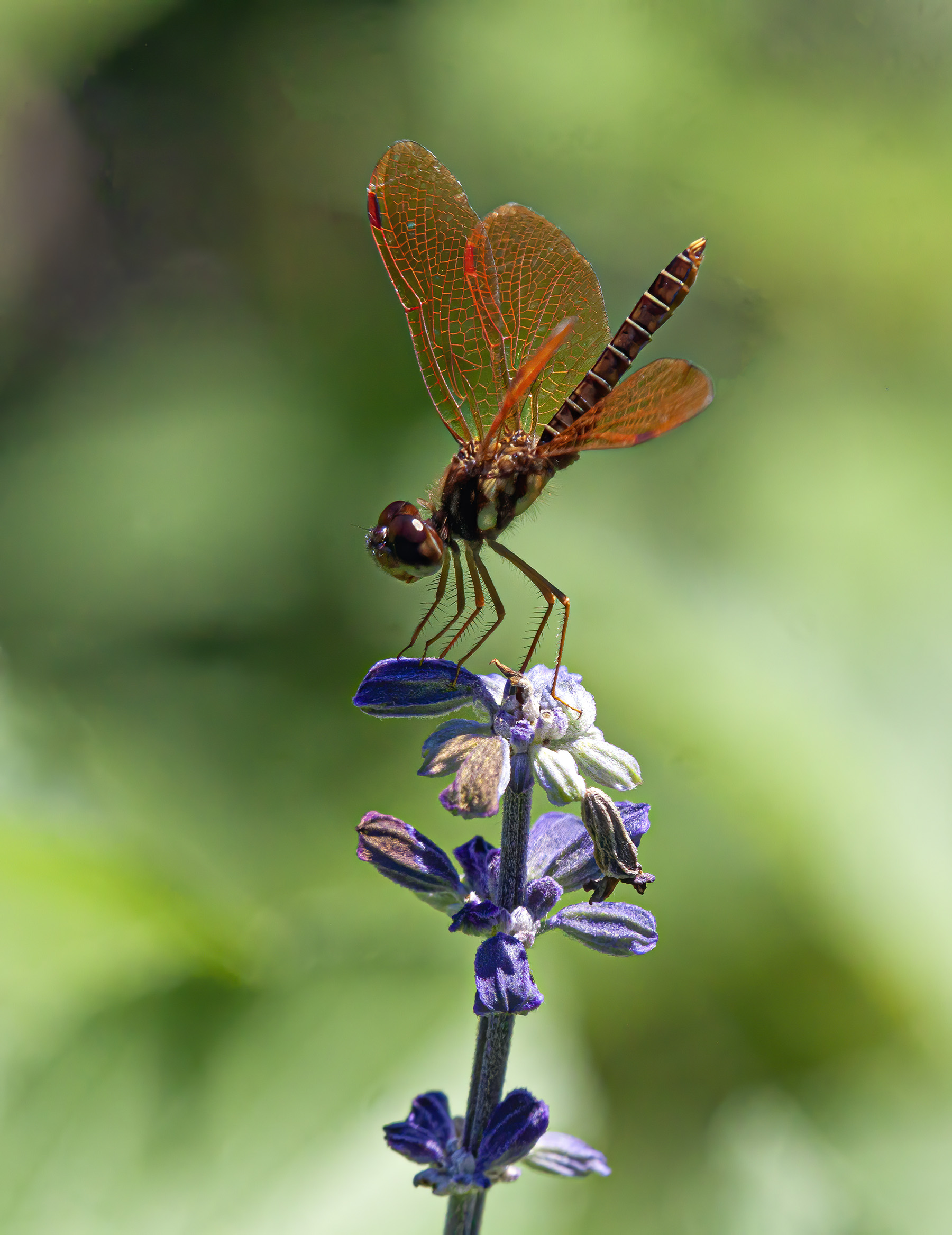
You may seen dragonflies in a handstand-like pose, looking like gymnasts in training—that is the obelisk posture. The dragonfly lifts its abdomen until its tip points to the sun, thereby minimizing the amount of surface area exposed to solar radiation. At noontime, the vertical position of the dragonfly’s body suggest an obelisk, which in my area immediately brings to mind the Washington Monument. According to Wikipedia, scientists have tested this phenomenon in a laboratory by heating Blue Dasher dragonflies with a lamp, which caused them to raise their abdomens and has been shown to be effective in stopping or slowly the rise in their body temperature.

While visiting Green Spring Gardens last week on a hot humid day, I observed obelisking behavior in a male Blue Dasher (Pachydiplax longipennis) and a male Eastern Amberwing (Perithemis tenera). I have always been intrigued by this pose and would love to try it out to see if it works for thermoregulation in humans too. Alas, I lack both the upper-body strength and the lower body flexibility to make a go of it, so I’ll continue to be merely a spectator of these beautiful little acrobats.

Blue Dasher

Eastern Amberwing

© Michael Q. Powell. All rights reserved.


Read Full Post »