Feeds:
Posts
Comments

Posts Tagged ‘metro’

When taking photos, do you ever just point and shoot? Now I realize that there is an entire class of consumer cameras with mostly automatic settings that are referred to as “point and shoot cameras,” but that’s not what I am talking about here. What I am asking is whether you ever just point your camera in the general direction of a subject and engage the shutter without actually framing the shot with the viewfinder or even the LCD on the back of the camera.

Why would you do that? I have a fascination with street photography. Conceptually I like the idea of taking photos of strangers, often at close range, in interesting urban settings. However, I have not been able to overcome my inhibitions and fears about capturing these kinds of images.

As I was returning by Metro back to my Northern Virginia suburb from a trip to the District of Columbia, I noticed  a guy with a bicycle standing in front of me. He had a racing-style bike and was carrying what appeared to be a fully inflated spare tube in his hand. It was an intriguing scene and I decided to try to capture it. With my camera balanced on my camera bag on my lap, I pointed the camera in his direction and took a number of shoots, zooming in and out with my 24-105mm lens. A few times, I peeked at my results and adjusted the angle and direction of my camera. I slightly adjusted the angle of a couple of the shots you see below, but kept the one that was really skewed just like it came out of the camera—I just like the different look that it has.

I felt safe and secure in taking these shots, because the sounds of the moving train more than covered any noise coming from my shutter. I even felt emboldened to take some shots of a young lady sitting across the aisle from me. She had assumed what I consider to be the classic Metro pose. She had headphones on and was sitting upright, absorbed in her own world. There seems to be an unwritten Metro code that strangers do not interact with each other, and usually go to pains not to look each other in the eye.

I think I will try my experiment again to try to get used to the idea of taking photos of strangers, albeit surreptitiously. I am not ready to become the next Cartier-Bresson, but it’s a start.

rider3_blog

rider1_blog

rider4_blog

rider2_blog

© Michael Q. Powell. All rights reserved.

Read Full Post »

Do you ever feel a desire to step outside of your comfort zone in your photography, to capture some images in a completely different way, to return to the basics of our craft? For the last month, I have felt an irresistible urge to shoot some black and white film, something that I haven’t done in over thirty years.

When I told some folks at work that I was planning to shoot some film during a week of vacation, one of them responded by asking if I was making a movie. I patiently explained that I would be putting some black and white film into a non-digital camera. He stared back at me with a look of incredulity and asked if I couldn’t simply convert some of my digital images into black and white.

I still have some analog cameras, but most of them have some electronic assists—I wanted a truly mechanical camera. I found a Nikon F SLR with a 50mm f/1.4 lens on my local Craigslist. The Nikon F introduced in 1959, was Nikon’s first SLR, although this particular camera was produced in 1971, judging from its serial number. The camera is so basic that it requires no battery. When was the last time you took photos with a camera without a battery? The camera has no meter and I ended up using my DSLR as the meter.

Nikon F

What about film? I went to one of the last remaining camera stores in our area and bought a couple of rolls of Ilford HP5+ film, a black and white film with a “box speed” of ISO 400. I ended up shooting it at ISO 200, because it was very sunny and bright the day that I went shooting. (Using the “sunny 16” guidelines, I would have been shooting all day at 1/500 sec and f/16.)

What should I shoot? I decided that an urban environment would be more suitable for my film project than my normal wildlife environment, so I got on the metro and headed into Washington D.C. with my Nikon SLR and my Canon DSLR in tow.

I got off on the elevated outdoor metro platform at Reagan National Airport and my first shot was of the airport’s control tower. I wanted to try to find subjects with shapes and lines that would show up in black and white. (I am including some digital shots of the same subjects at the end of the post. I didn’t try to exactly match the shots, but they give you an idea of the differences in how the cameras rendered the subjects.)

Reagan National Airport

The next shot was of the Metro’s ceiling at the underground station in Rosslyn, Virginia. (You may have already seen a similar shot that I took with my digital camera and posted last week.)

metro

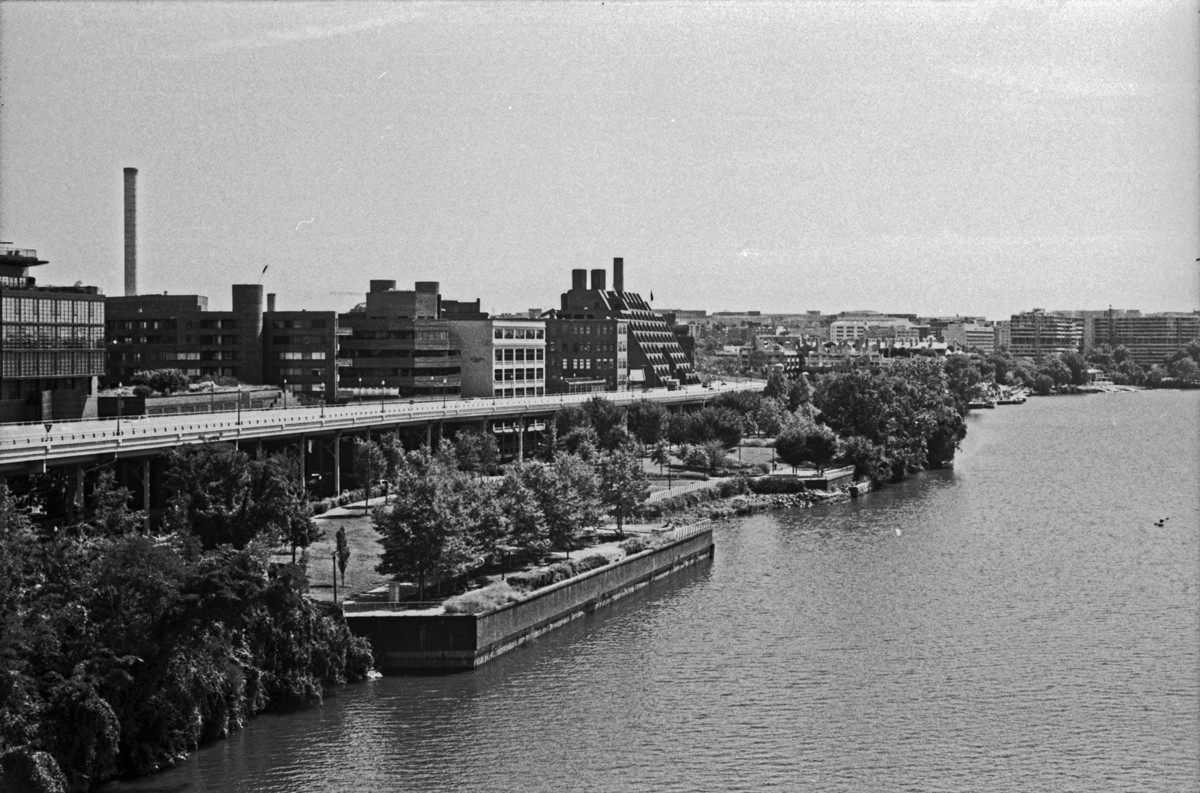
I exited the Metro in Rosslyn and walked across the Key Bridge into Georgetown. From the bridge, I took this shot of part of the waterfront in Georgetown. I like the old time feel of this shot.

Georgetown waterfront

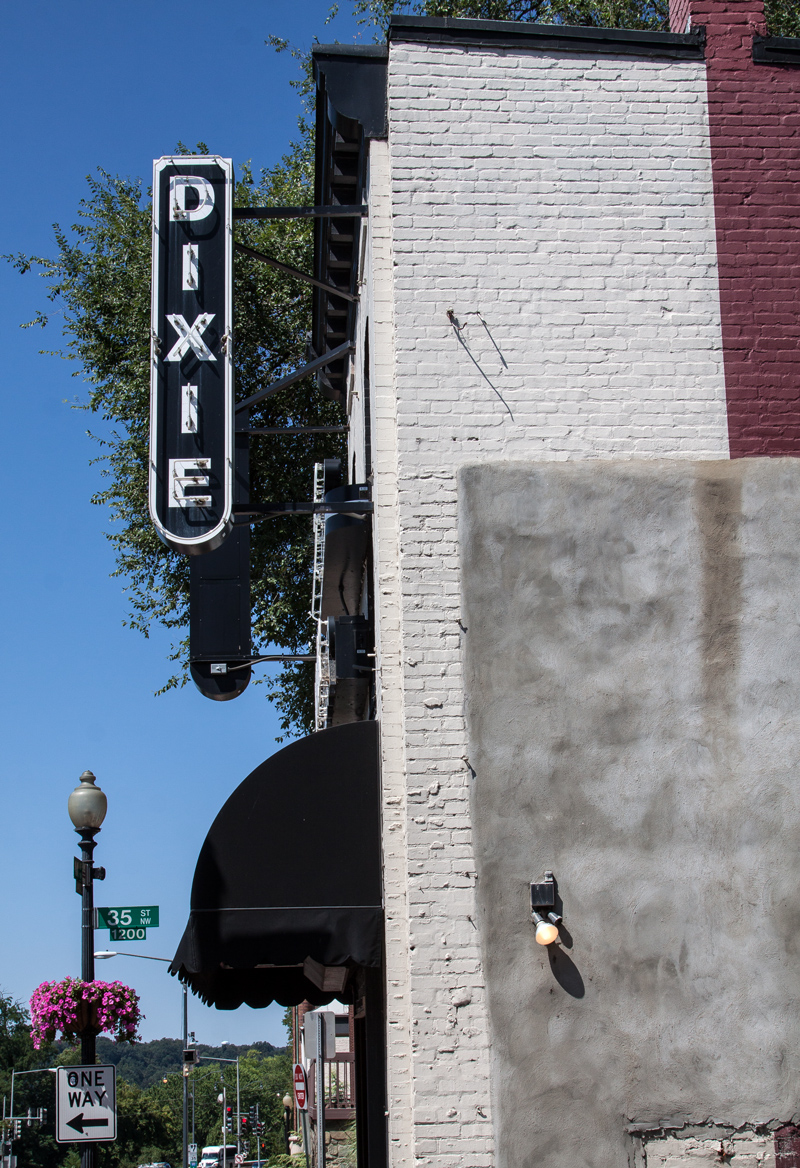
One of the first things that you see when you cross the bridge is Dixie Liquors, an old-fashioned liquor store with a really cool sign that I have always liked.

Dixie Liquors

That was the start of my adventure with film. As I had hoped, I was looking at the world with different eyes and was forced to slow down, knowing I had to input manually the shutter speed and aperture and very conscious of the fact that I had no auto focus to help me. I was also shooting with a fixed focal length lens, so I did not have the luxury of zooming in and out. Most of all, though, I was filled with uncertainty, not knowing for sure if any of my shots would come out, worrying that my old camera might have a light leak or that I would mess up the development of the film.

I’ll continue my saga in another posting or two in the upcoming weeks. As promised, here are some digital shots that I took as I used my Canon DSLR as a meter for my manual Nikon.

control tower Reagan National Airport

metro ceiling

Georgetown waterfront

Dixie Liquors

© Michael Q. Powell. All rights reserved.

Read Full Post »

In its simplest form, photography is about light and darkness, about lines and shapes. That was what I was seeking to capture when I took some shots in a Metro station in Rosslyn, Virginia earlier this week.

I took this week off from work and have spent a considerable amount of time thinking about photography, watching lots of videos, and shooting different subjects in different ways. I have even shot and developed some black and white film—I’ll do a separate posting on that soon.

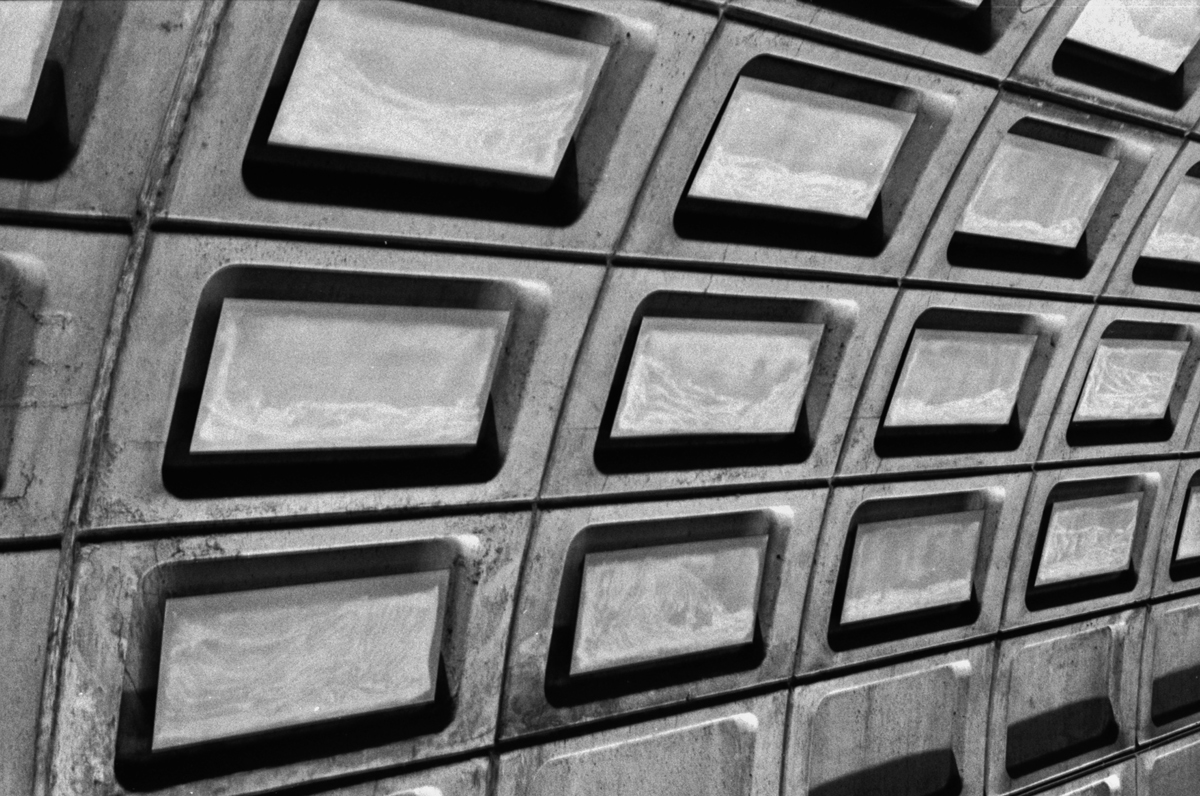
This first shot highlights the distinctive ceilings that are present in many of the stations in the D.C. Metrorail system. I love the geometric patterns and the interplay of light and shadows in this image. I took this 1/3 second exposure by leaning my camera on a railing.

metro ceiling

The Rosslyn station is at a point in the Metro system where the trains pass under the Potomac River. Consequently, the escalators are extremely long. As I rode the escalator up, I was fascinated by the different lights and captured this image when I was approximately at the mid-point between the level of the tracks and the above-ground station.

It was midday on a weekday, which is why you don’t see more people in this shot. Things get really crowded during rush hour and woe to those who do not follow the Metro etiquette of staying to the right on the escalator steps unless passing.

metro escalator

© Michael Q. Powell. All rights reserved.
Read Full Post »