Feeds:
Posts
Comments

Posts Tagged ‘male Belted Kingfisher’

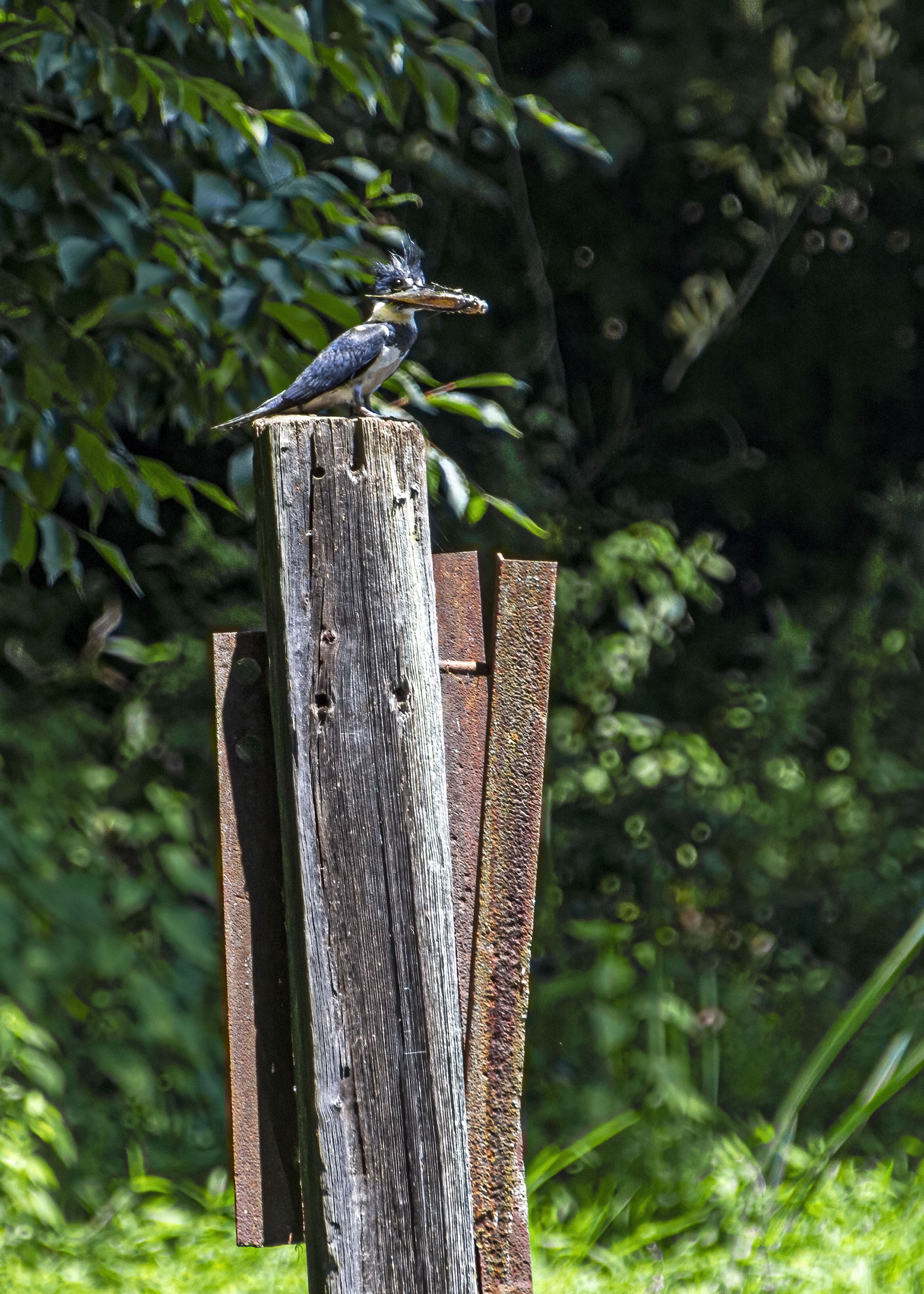
As I was searching the edge of a pond for dragonflies earlier this week I suddenly heard the unmistakable call of a Belted Kingfisher (Megaceryle alcyon). As I lifted my head, the kingfisher flew across my field of view and perched on a wooden post sticking out of the water. Even though the kingfisher was quite far away, I could see that it had a relatively large fish in its bill.

Normally a kingfisher will beat its catch against a branch to subdue it before swallowing it head-first. I was hoping to be able to see if the kingfisher would be successful in swallowing this prey—it looked too big for it to swallow in one gulp, but I have been surprised in the past when herons and cormorant have swallowed large fish.

Alas, the kingfisher flew away before I could see if it would be successful in swallowing its prey.

Belted Kingfisher

© Michael Q. Powell. All rights reserved.


Read Full Post »

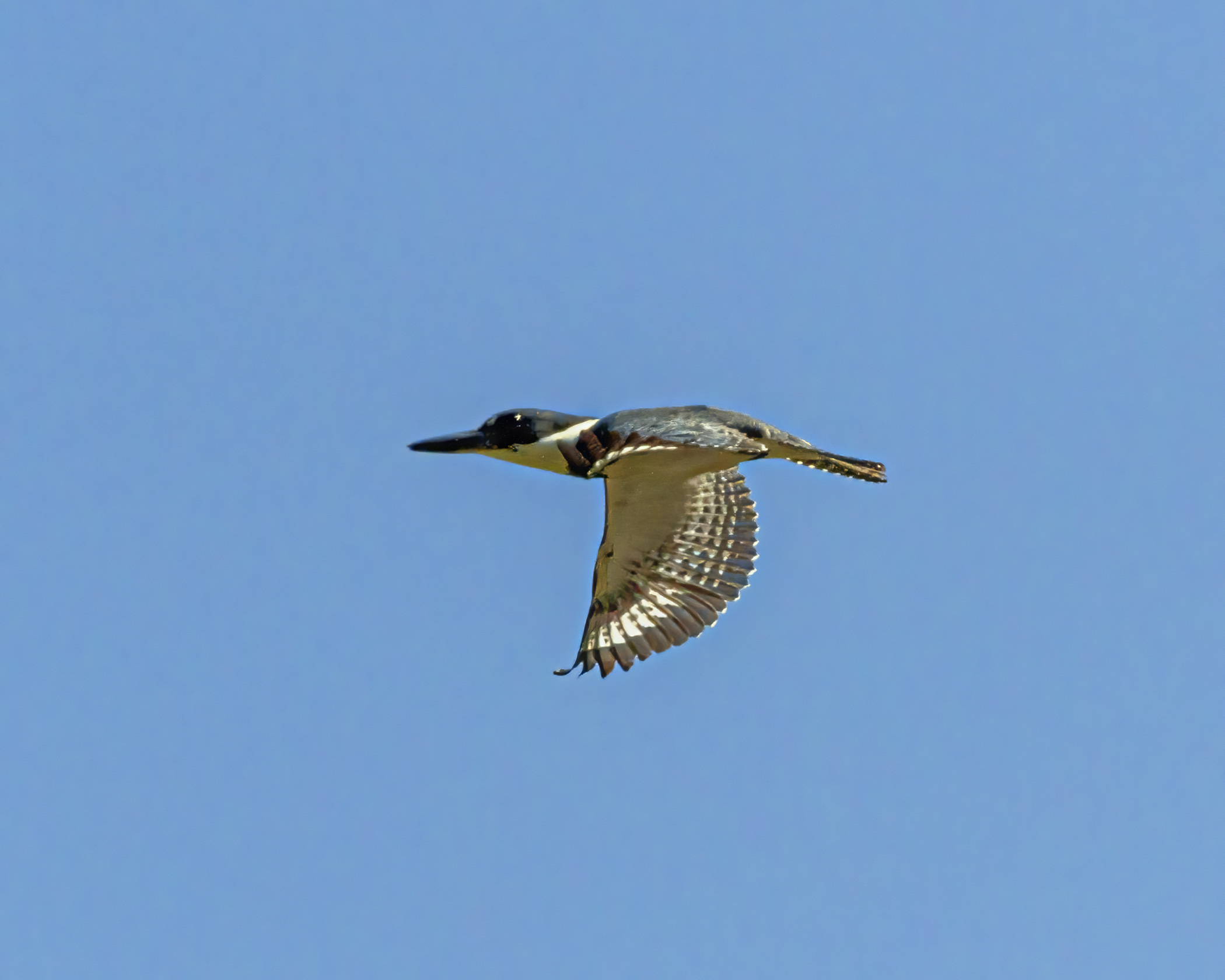
On Monday at Occoquan Regional Park, I was thrilled to capture some shots of this male Belted Kingfisher (Megaceryle alcyon) as he flew by me overhead. Kingfishers are really skittish and quite often I am aware of their presence of these speedy little birds when I hear their rattling call as they fly away from me. This kingfisher, however, flew across my field of view, which allowed me to track it and focus on it as it passed.

How do I know this is a male kingfisher? Normally male birds are more colorful than their female counterparts, but that is not true for Belted Kingfishers—females have a chestnut-colored band across their chests that the males do not have.

Belted Kingfisher

Belted Kingfisher

© Michael Q. Powell. All rights reserved.

Read Full Post »

Belted Kingfishers (Megaceryle alcyon) are one of my nemesis birds. They are small and fast and incredibly skittish. I see (or hear) them quite often, but I am rarely able to get a decent shot of one.

I spent a good amount of time last Friday at Huntley Meadows Park observing a male Belted Kingfisher trying to catch a fish. He was perched on some kind of board sticking out of the water and repeatedly dove into the water and returned to the same post. Eventually he caught a fish, but, alas, flew away with it before I could get a shot of him with his catch.

Unlike an eagle that grabs a fish with its talons without submerging itself, a kingfisher dives headfirst into the water, creating a big splash. According to the Cornell Lab of Ornithology, “When it spots a fish or crayfish near the surface, it takes flight, dives with closed eyes, and grabs the prey in its bill with a pincer motion. Returning with its prize, it pounds the prey against the perch before swallowing it head first.”

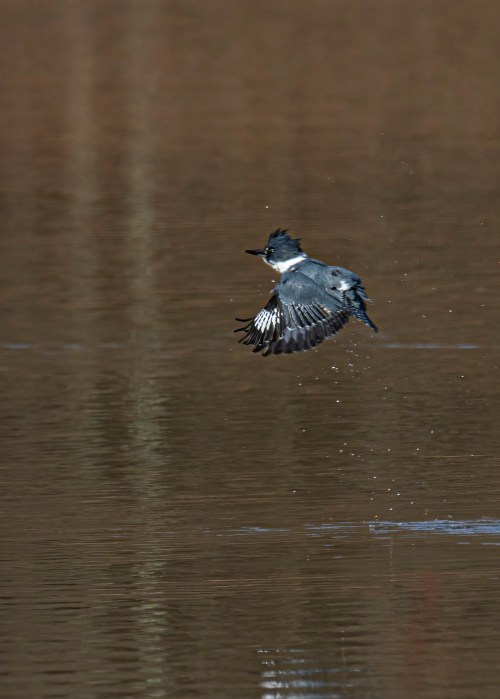
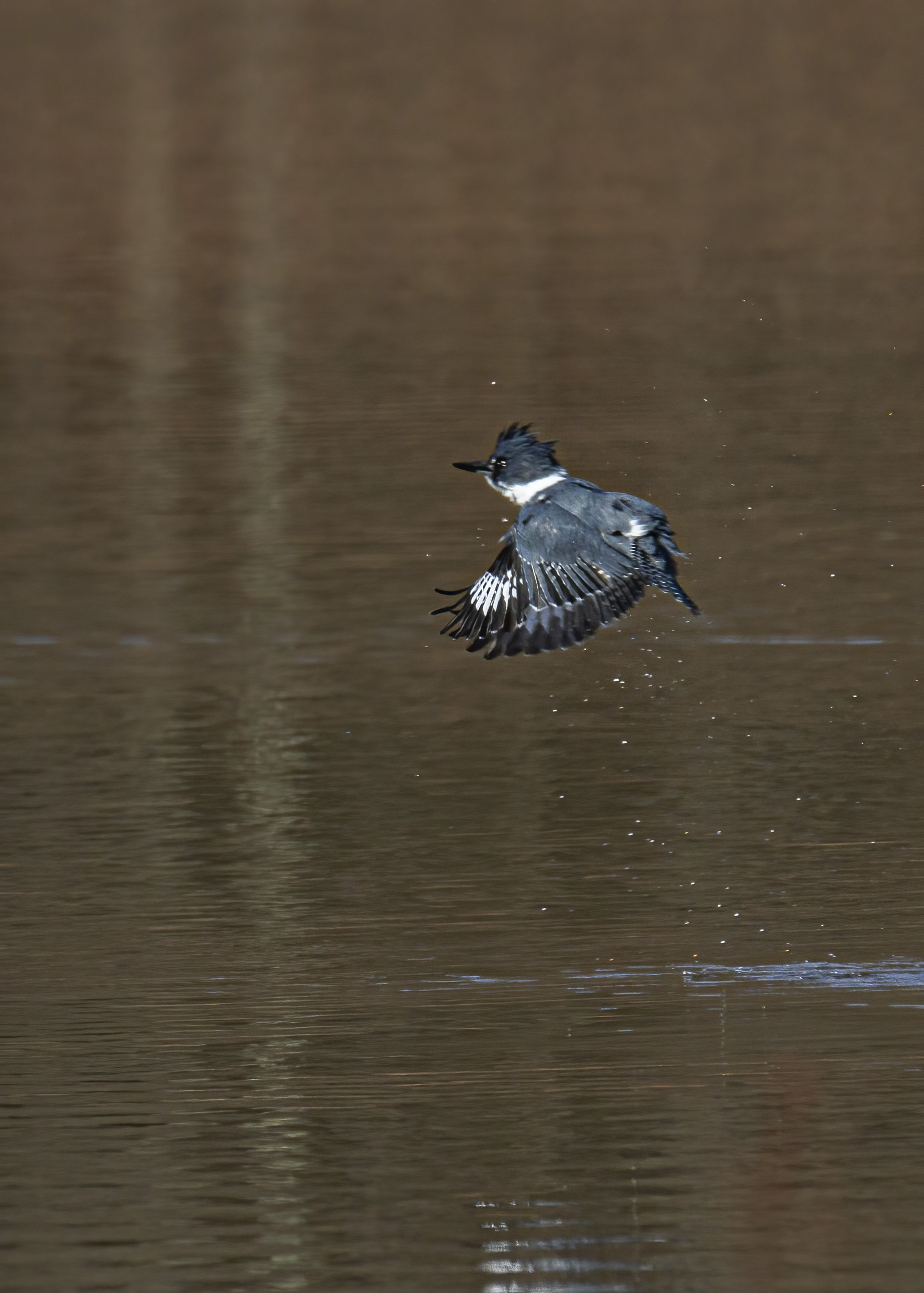
I was perched on am observation platform some distance away, but had a clear line of sight to the kingfisher. Over time I was able to capture some relatively sharp shots of the kingfisher in action. The first shot is my favorite—the kingfisher was rising up out of the water, surrounded by water droplets, after what appeared to have been an unsuccessful attempt.

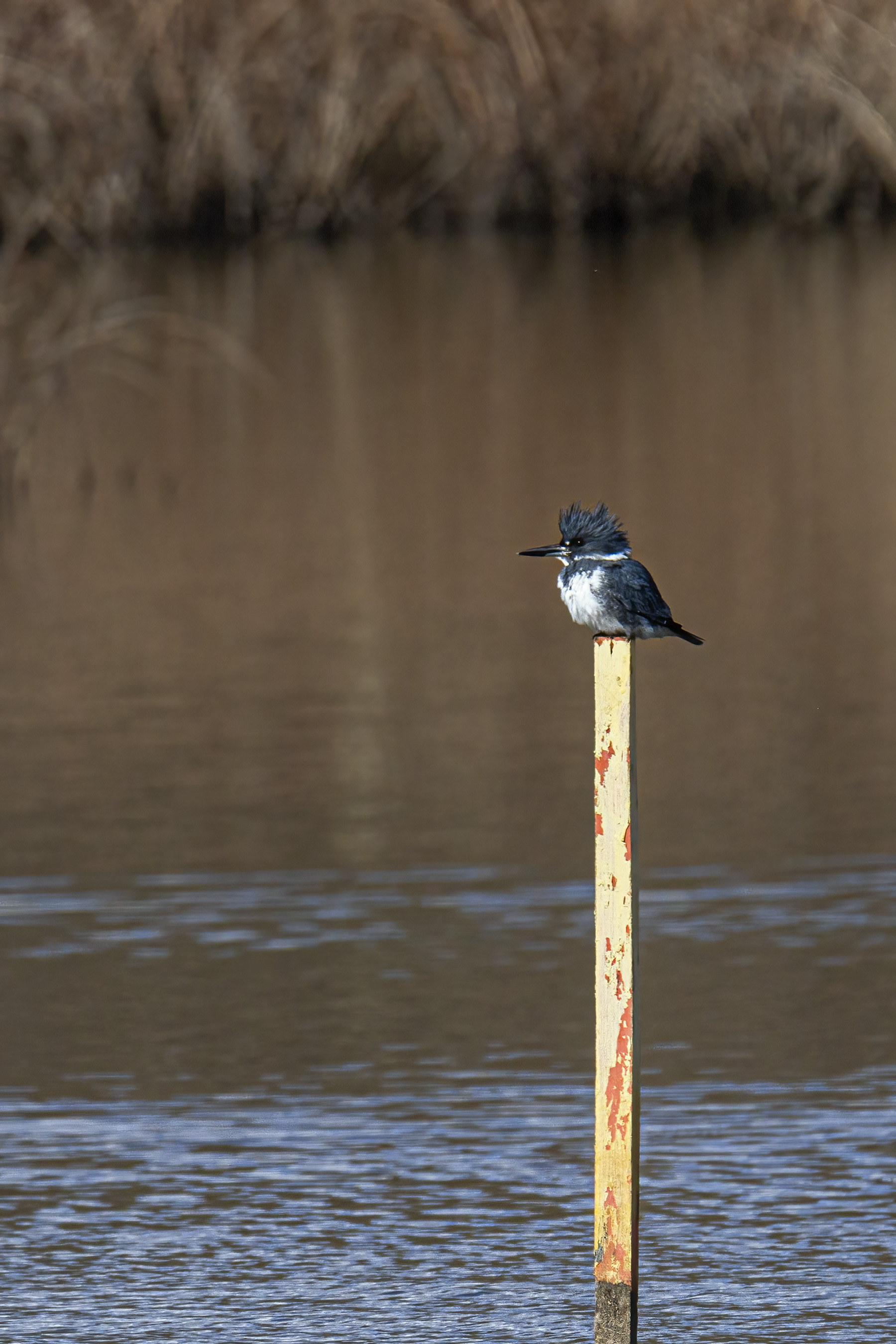
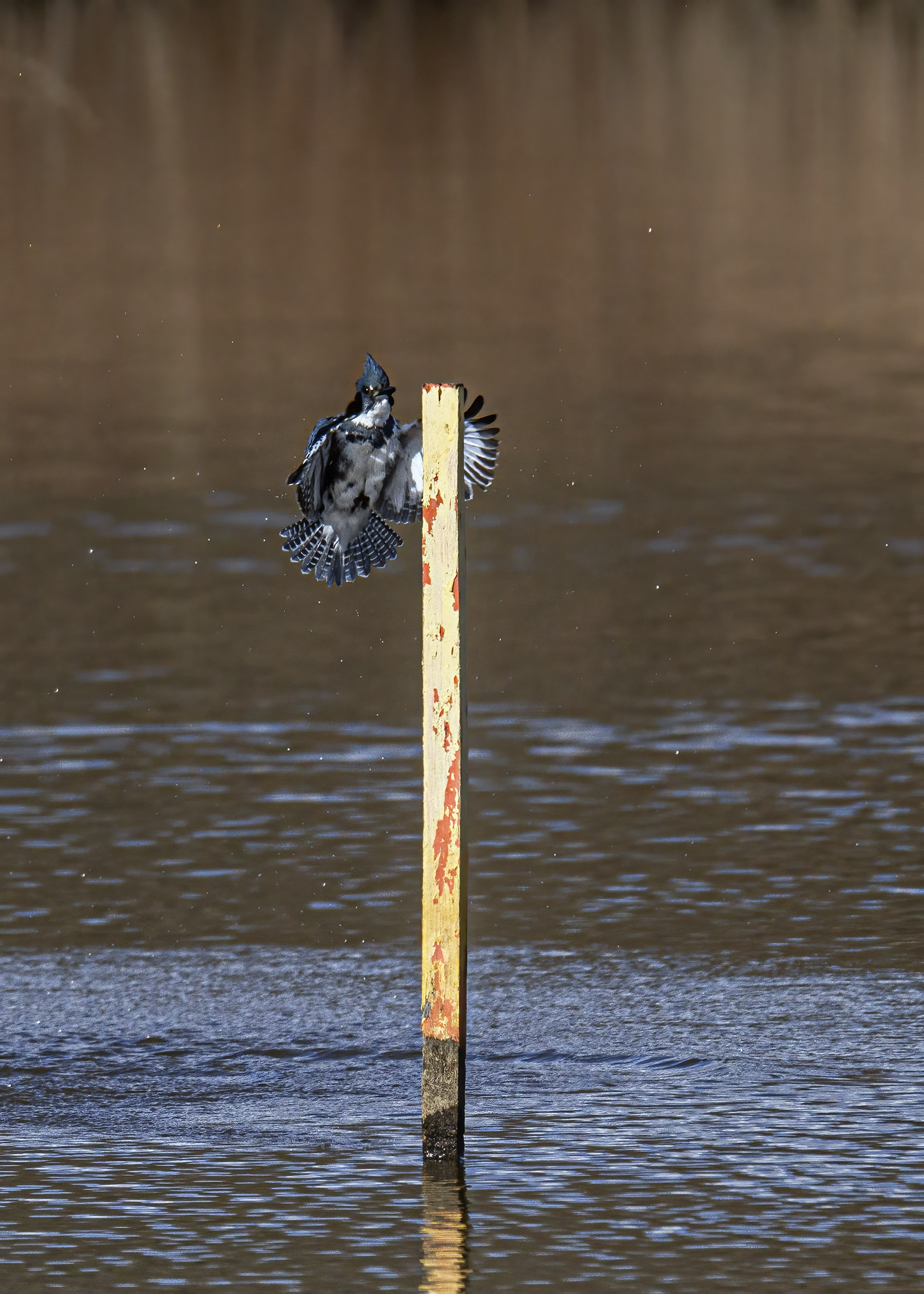
The second photo shows the kingfisher on its perch. I am not sure why this board was sticking out of the water, but noted several similar boards nearby. The subsequent images show the kingfisher in various stages of action. I was fortunate that the kingfisher made several attempts, sometimes diving to the left and sometimes to the right, so I had multiple chances to get shots. Actions shots are a tough, but fun challenge. The kingfisher would take off without warning and after it dove into the water, I was never sure exactly when and where he would reemerge.

Belted Kingfisher

Belted Kingfisher

Belted Kingfisher

Belted Kingfisher

Belted Kingfisher

Belted Kingfisher

© Michael Q. Powell. All rights reserved.


Read Full Post »
I will often strive to photograph my wildlife subjects from as many different angles as I can in order to take advantage of the lighting or to highlight the details of their bodies. When I spot a subject, though, I initially try to capture whatever shot I can before I work to get a better shot—any of my subjects are skittish and there is always the chance that my initial shot will be my only one.

I spotted this perched male Belted Kingfisher (Megaceryle alcyon) last Thursday at Huntley Meadows Park in Alexandria, Virginia and one of my initial shots was the third one below. The perch was sticking out of a pond that was surrounded by a marshy wetland, so there was really no chance for me to get closer to the kingfisher—there was no way to work the angles in my usual way.

So what did I do? In the background I noticed there were some patches of colorful fall foliage, so I decided to see if I could include some of those colors in my images to give them an autumn vibe. By bending, twisting, crouching, and kneeling I was able to vary my shooting angle, while remaining more or less in the same spot, and eventually managed to get some photos that included portions of that autumn foliage. The kingfisher remained in place, but cooperated by changing his head position from time to time.

Belted Kingfisher

Belted Kingfisher

Belted Kingfisher

© Michael Q. Powell. All rights reserved.

Read Full Post »

With stealth and patience I can get relatively close to some birds, but Belted Kingfishers (Megaceryle alcyon) remain elusive, skittish, and difficult to capture. I was fortunate to get some long distance shots of a handsome male kingfisher (males have no chestnut-colored stripe on their chests) last weekend in the trees overlooking Lake Cook in Alexandria, Virginia.

Belted Kingfisher

Belted Kingfisher

© Michael Q. Powell. All rights reserved.

Read Full Post »
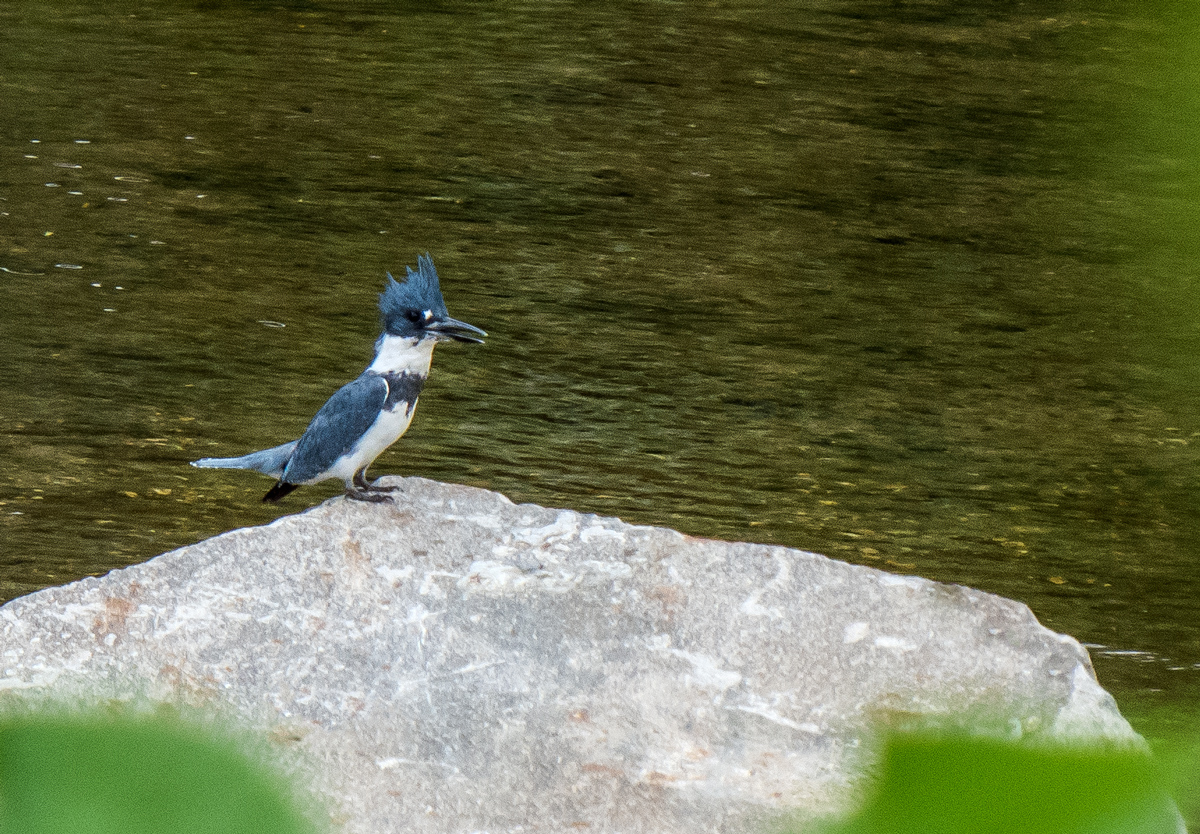
Yesterday I was on a biking/walking trail that follows Cameron Run, a tributary stream of the Potomac River, when I heard the unmistakable  rattling call of a Belted Kingfisher (Megaceryle alcyon). As I moved through the vegetation to investigate, I spotted a kingfisher perched on a rock jutting out of the water. I had my Canon SX50 zoomed out to its maximum length, but it wasn’t enough—I needed to get closer.

As I made my way slowly down a steep slope, my footing gave way and I unceremoniously slid for a short distance on my back side. No surprisingly I spooked the kingfisher. What was surprising was that the kingfisher did not fly up into the trees, but instead he flew to a more distant smaller rock that was barely bigger than he was. (You can tell that it is a male because, unlike the female, he does not have chestnut stripe across his chest.)

The kingfisher soon took to the air and was joined by another one. They proceeded to fly back and forth over a portion of the stream, calling out loudly the entire time. They didn’t actually buzz me, but they did fly in my general direction a couple of times before veering off. What was going on?

I got a somewhat blurry shot of the second kingfisher, a female, that confirmed my suspicion that this was a couple. According to the Cornell Lab of Ornithology website, “During breeding season the Belted Kingfisher pair defends a territory against other kingfishers. A territory along a stream includes just the streambed and the vegetation along it, and averages 0.6 mile long. The nest burrow is usually in a dirt bank near water. The tunnel slopes upward from the entrance, perhaps to keep water from entering the nest. Tunnel length ranges from 1 to 8 feet.”

This behavior suggests to me that there could be baby kingfishers in the area. I certainly didn’t see any babies and suspect that a nest would probably be on the opposite side of the stream from where I took these photos, an area that is more remote and inacessible.

Belted Kingfisher

Belted Kingfisher

© Michael Q. Powell. All rights reserved

Read Full Post »

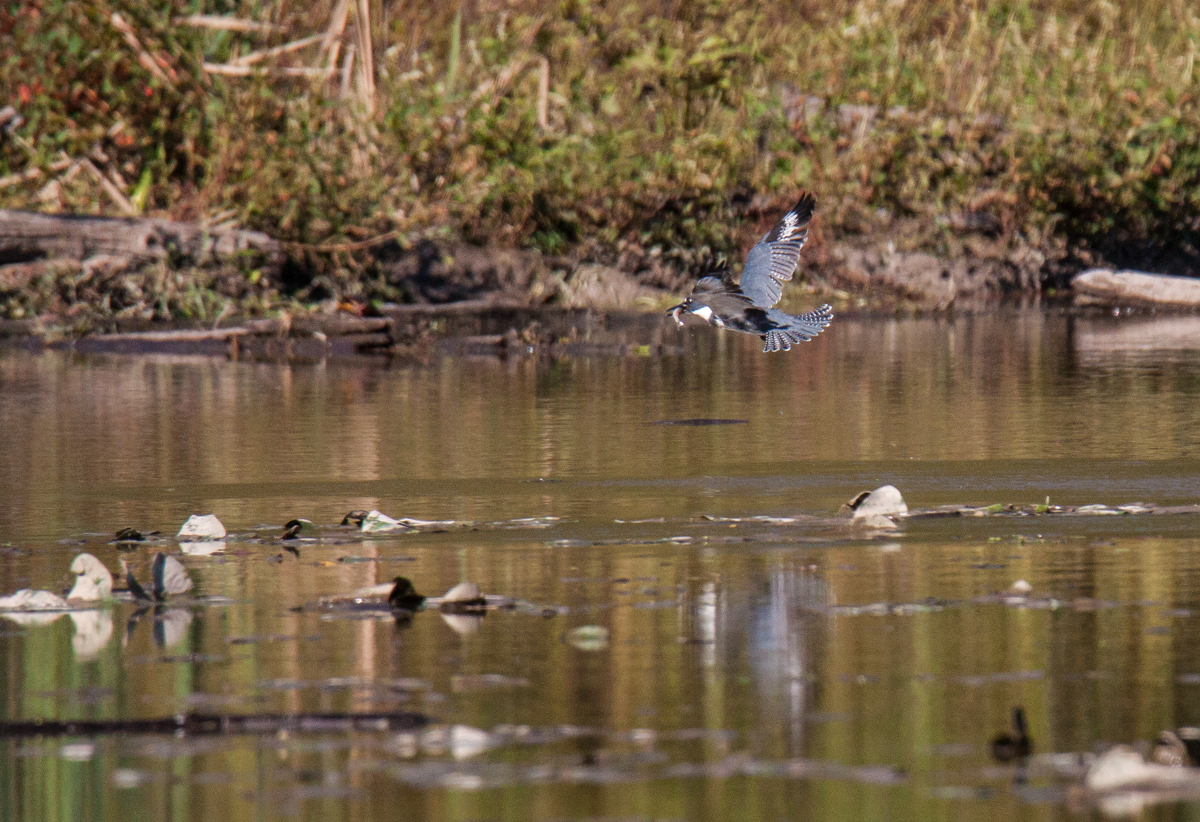
When I spotted a male Belted Kingfisher (Megaceryle alcyon) yesterday, I was really happy, because I have not seen a male in several years. He was pretty far away and I having a hard time getting a sharp shot, so I decided to switch to manual focus.

Just after I had switched, the kingfisher made a long shallow dive off of the rotten tree on which he was perched. Instinctively I tried to track the fast-moving bird as I frantically tried to focus. Not surprisingly, most of my shots were out of focus, but one came out pretty well. It shows the kingfisher just above the surface of the water with what appears to be a fish in his mouth. (You may want to click on the image to get a better look at the kingfisher.)

Belted Kingfisher

A bit later in the day, I took this shot of the male Belted Kingfisher on the same perch that he had been on earlier. He seemed to be in a good mood and almost looked like he was singing. Unlike the female, which has both a chestnut and a blue stripe or her chest, the male Belted Kingfisher has only the blue stripe.

Belted Kingfisher

The kingfisher was happy and I was overjoyed with my shots. It was a wonderful day.

© Michael Q. Powell. All rights reserved.

Read Full Post »