Feeds:
Posts
Comments

Posts Tagged ‘liftoff’

I keep trying to photograph geese and  ducks taking off and landing, using a variety of techniques. Normally I will try to catch the birds in flight, though sometimes I have trouble getting my lens to acquire focus quickly enough. I stumbled onto a panning technique when I tried to photograph geese landing in the early morning. This weekend I experimented using both techniques.

I took this first shot when several geese took off without warning almost directly in front of me. I didn’t intend to cut off the goose to the left, but I like the effect of him entering into the frame. In this image, the action is completely frozen.

Geese takeoff

Geese takeoff

The second image is an example of the panning technique. The geese are not quite in as sharp focus as I would have liked, but you can see some details. I like the way that the background is blurred and provides a sense of motion. This panning was much more deliberate than the photos that I posted previously with motion blur.

Geese liftoff

Geese liftoff

It’s so much fun experimenting with different techniques—photography is still new enough to me that I often feel like a little kid on a voyage of discovery.

© Michael Q. Powell. All rights reserved
Read Full Post »

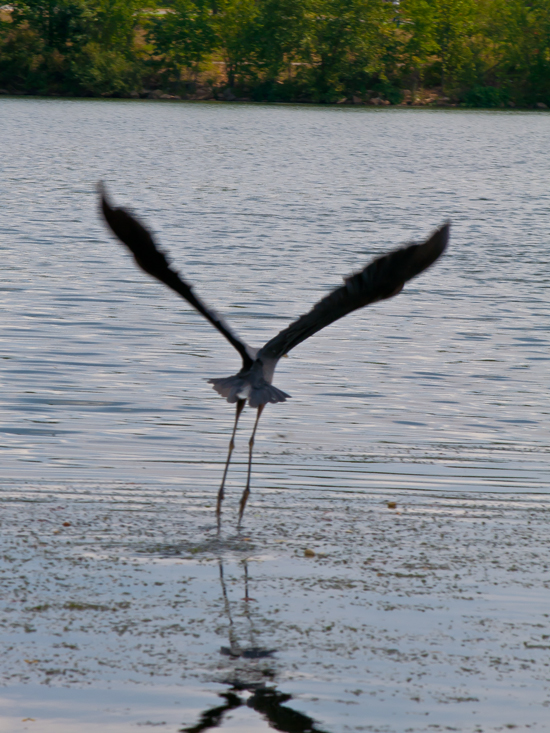
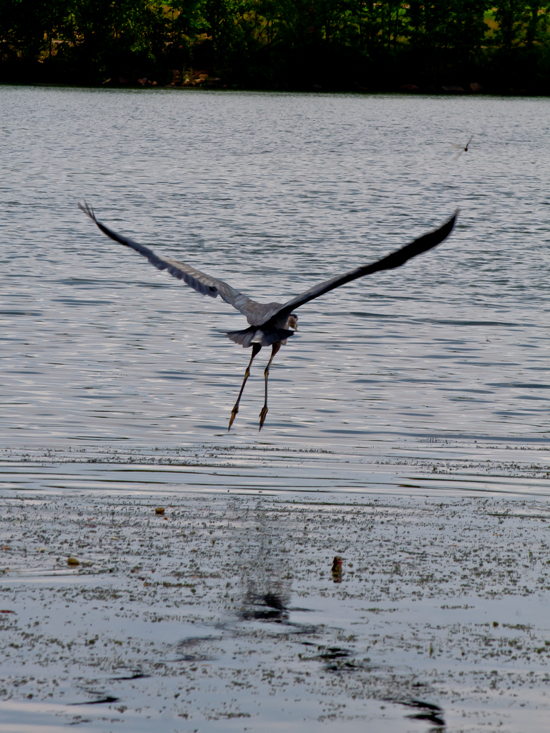
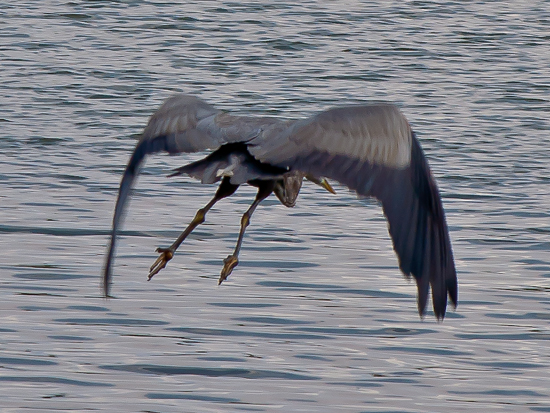
I haven never really paid attention to how birds take off. This past weekend I was photographing a Great Blue heron wading in the water of a nearby pond.  Without any prior indications, he suddenly took to the air. I happened to be in a good position to get a few shots of the different positions his wings assumed as he lifted off from the water. As you can see, I was almost directly behind the heron.

The first photo is my favorite because of the way in which the wings frame the extended legs and the barely visible head. Out of the three photos I have posted here, this was the second one shot.

The photo below shows the heron just as he was taking off from the water. The wings are blurry and are almost like a silhouette. It seems like he had to flap them really hard to lift out of the water. I like the fact that I was able to capture part of his reflection in the water.

Lifting off from the water

This final shot shows his wings in what I consider to be a normal flying position. I haven’t observed herons enough to know if they eventually pull in their legs tighter when they fly higher, but I assume that to be the case. In this photo I managed to get more of a complete reflection in the water than in the previous one.

Spreading his wings

I learned a few things when shooting these photos. First, and perhaps most importantly, I learned how important it is to be ready at all times, because a static situation can become very dynamic very quickly. Secondly, I now understand better why serious wildlife photographers have really big (and expensive) telephoto lens—it’s tough to get in close enough. Finally, I appreciate much more the abilities of those who are able to capture moving subjects like this heron with perfect focus and sharpness. My photos are not very sharp and clear, but I still found them interesting enough to want to share them.

© Michael Q. Powell. All rights reserved.

Read Full Post »