Feeds:
Posts
Comments

Posts Tagged ‘leopard frog’

With the temperature in the 20’s (-5 C) the last few days, it’s hard to remember that we had record-breaking temperatures less than a week ago, when temperatures soared to 72 degrees (22 C).

During a trip to my marsh on one of the warm days last Saturday, I was a little shocked to see some frogs out of the water, which not long before had been covered with a thin sheet of ice. I thought they would be in a hibernation state by now. The frogs were in the reeds and the ones that I could see were Southern Leopard frogs (Lithobates sphenocephalus), like the one in this photo.

I figured that frogs buried themselves completely in the mud like turtles do, but was surprised to learn that is not the case. According to an article in Scientific American, aquatic frogs, like the leopard frog, do hibernate underwater, but they would suffocate if buried in the mud. Instead they remain on top of the mud or only partially buried.

In addition to the frogs, a lot of small turtles took advantage of the unseasonably warm weather and could be seen sunning themselves on logs in the marsh. Unfortunately, there were no cameo appearances by dragonflies—my fellow photographer and blogger Walter Sanford and I searched diligently for Autumn Meadowhawk dragonflies, which we had seen earlier in December, but we came up empty-handed.

frog2_dec_blog

© Michael Q. Powell. All rights reserved

Read Full Post »

Have you ever watched a frog as he was croaking?

Apparently he closes his mouth and nostrils, squeezes his lungs, and his vocal sacs expand, looking a lot like a bubblegum bubble.

Southern Leopard Frogs (Lithobates sphenocephalus) have a vocal sac on either side of their head, although some other frogs have only a single sac under their chin,

Here’s a shot I took on Monday of one as he was croaking. You can see the vocal sac bubble pretty wellif you look closely at the side of the head nearest the camera.

croaking1_blog

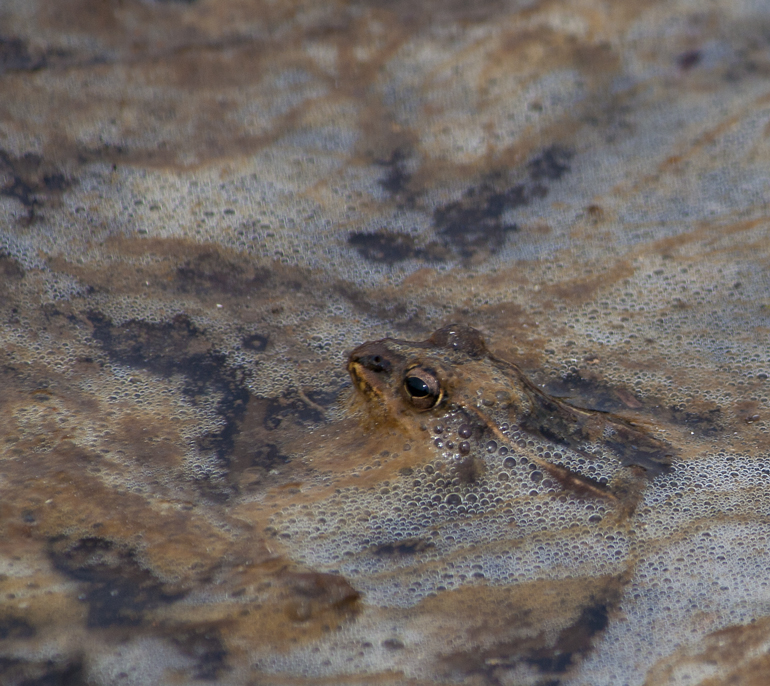
I am including this additional frog photo, because I really like the way that the bubbles surround his head.

bubbles1_blog

© Michael Q. Powell. All rights reserved
Read Full Post »

Yesterday I was out again in the marsh, hoping to photograph frogs as they were croaking.  Of course, the first problem was finding them. I could hear them throughout the marsh, but many of them were hidden from view in the cattails or far out in the water.

Eventually I was able to locate a few frogs that were within the range of my camera and I am still going through those images. What I was looking to capture was the vocal sacs that expand like little bubbles when they make the croaking sound. I am still not sure if I captured that phenomenon well enough, but plan to post some images later.

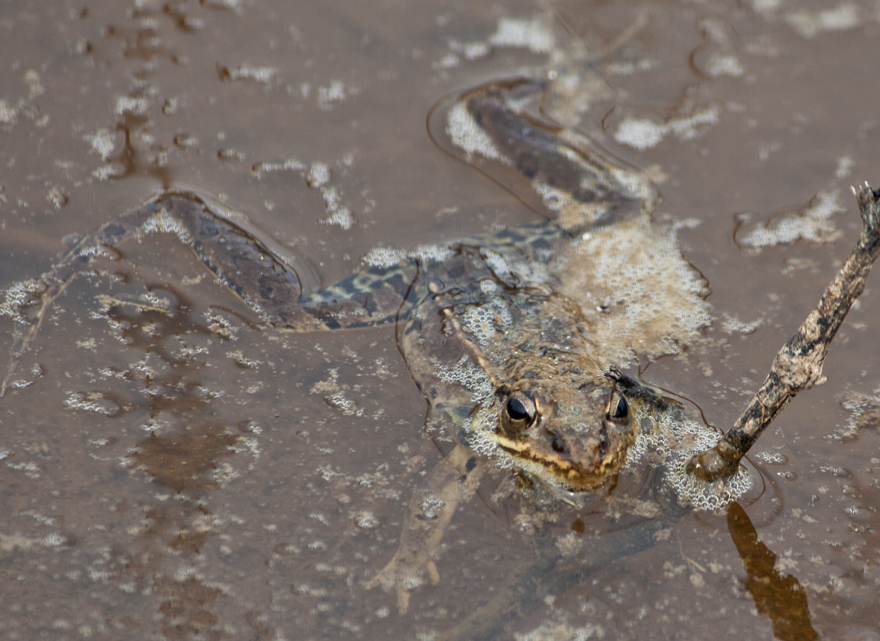
One of the frogs that I spotted, a Southern Leopard Frog (Lithobates sphenocephalus), was apparently unaware of my presence and began swimming slowly in my direction. He seemed to be trying to keep his head above the water and doing a version of what I used to call the “dog paddle”—I may start calling it the “frog paddle” from now on.

This photo shows the swimming frog in mid-stroke, surrounded by lots of bubbles. I am not sure if he is responsible for the bubbles, but they add a nice touch to the photo.

I’m pretty sure that I will be off again soon in search of frogs, snakes, and turtles as me move into spring. Stay tuned, there’s more to come.

frog_paddle_blog

© Michael Q. Powell. All rights reserved
Read Full Post »