One of my earlier post identified my obsession with the red milkweed beetle (Tetraopes tetrophthalmus). As I hang around the milkweed plants, it’s hard not to notice another really colorful creature, especially because this seems to be its prime mating season. After a little research I’ve started to become better acquainted with the large milkweed bug (Oncopeltus fasciatus). Wikipedia provided me with some good information to start and BugGuide added some additional details. I am still getting used to shooting with my macro lens so I apologize in advance that not all of the photos are super sharp. I think they help, though, in explaining some of the traits of these fascinating bugs.
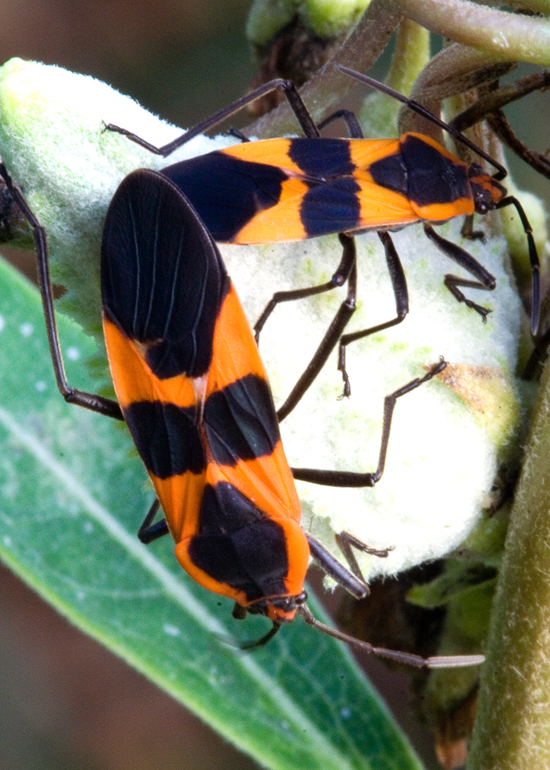
It has been relatively easy to get shots of the mating milkweed bugs and my research identified why. Milkweed bugs while mating can remain connected for up to 10 hours, according to Wikipedia. Yikes! I guess those television commercials about seeing your doctor after four hours don’t apply to these bugs.


What happens after mating? An article from the Life Sciences Depart at the University of Illinois at Urbana noted that a female lays about 30 eggs a day and 2,000 during her lifetime. Egg-laying begins 1 to 15 days after mating and peaks at about 20 days.
A few days ago I came across this group of milkweed bugs. The photo is technically lacking (it was hard to get the needed depth of field) but it gives you an idea of what the large milkweed bug looks like in various stages of development. As a “true” bug, milkweed bugs undergo incomplete metamorphosis. They go through a series of nymph stages, known as instars. For the large milkweed bug there are five instars. Buzzle has an article that explains the bug’s life cycle.
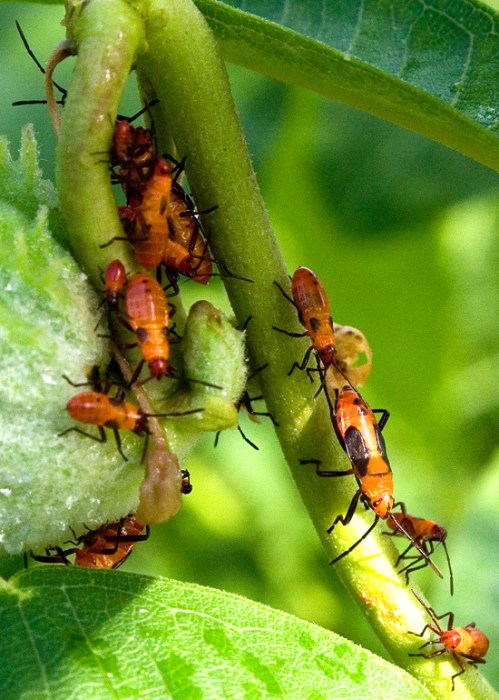
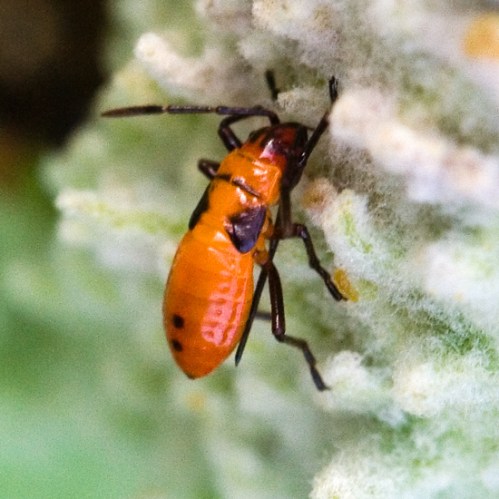
At each stage the bug is covered by an inflexible exoskeleton that constrains its growth. Periodically he bursts out of the exoskeleton and can grow to twice his size in minutes as the new exoskeleton develops and hardens, according to the Buzzle article. Here’s a shot of a bug in one of the earlier nymph stages.
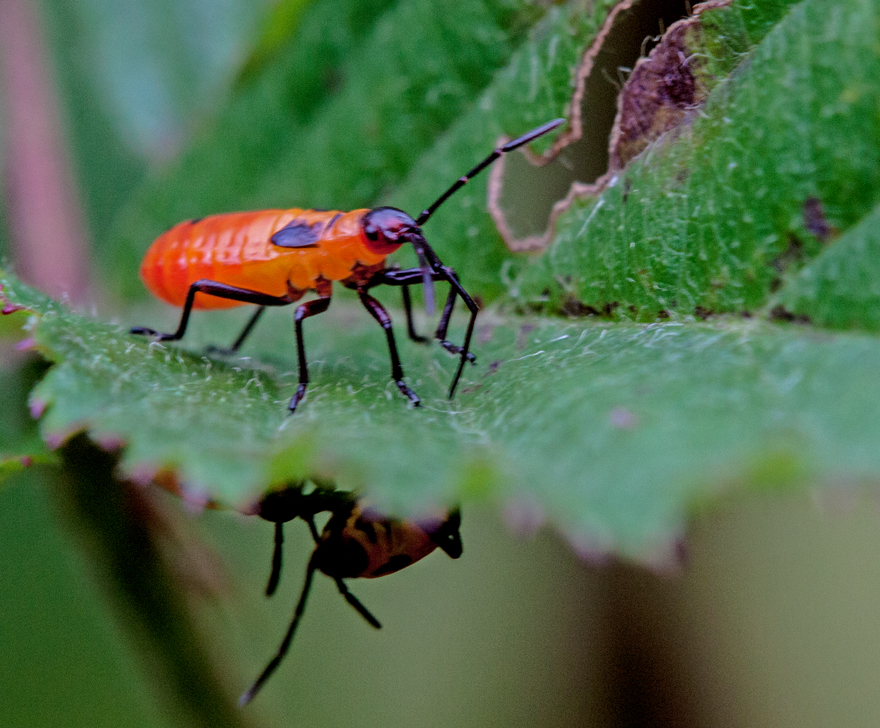
As the milkweed bugs get older the wing pads increase in size in each molt. In the next three photos the wing pads are visible but not yet really prominent.


The wings on this nymph are much more prominent, leading me to think he might almost be an adult. The Buzzle article noted that the entire process of metamorphosis, from egg to adult takes 4-8 weeks, depending on the temperature of the habitat.

Once the large milkweed bug has become and adult (as shown in the last couple of photos) mating begins 5 to 12 days after the last molt for females and two to three days for males, according to the University of Illinois article. And the circle of life continues.


© Michael Q. Powell. All rights reserved.
Read Full Post »




 Mike Powell