Feeds:
Posts
Comments

Posts Tagged ‘kleptoparasitic spider’

Last week I did a posting entitled “Kleptoparasitic Spider that talked of the little spiders that hang around a larger spider’s web and steal or feed on the prey captured by the other spider. Today I managed to take a much clearer shot of one such spider. I am pretty sure the little spider below is of the genus Argyrodes, which are also known as dewdrop spiders.

The spider was positioned in such a way that I was able to get close enough to use my 100mm macro lens, although there was not really enough room for me to shoot with a tripod. I was able to close down only to F10 because I was shooting handheld and wanted to have a shutter speed of 1/200 sec, so depth of field suffered a little. I have found that depth of field is a problem with spiders most of the time because of the length and positioning of their legs.

This spider was really tiny and I am happy that I was able to get this good a photo of it. The portions of the web that are visible help to add an interesting geometric pattern to the background, which I think enhances the image.
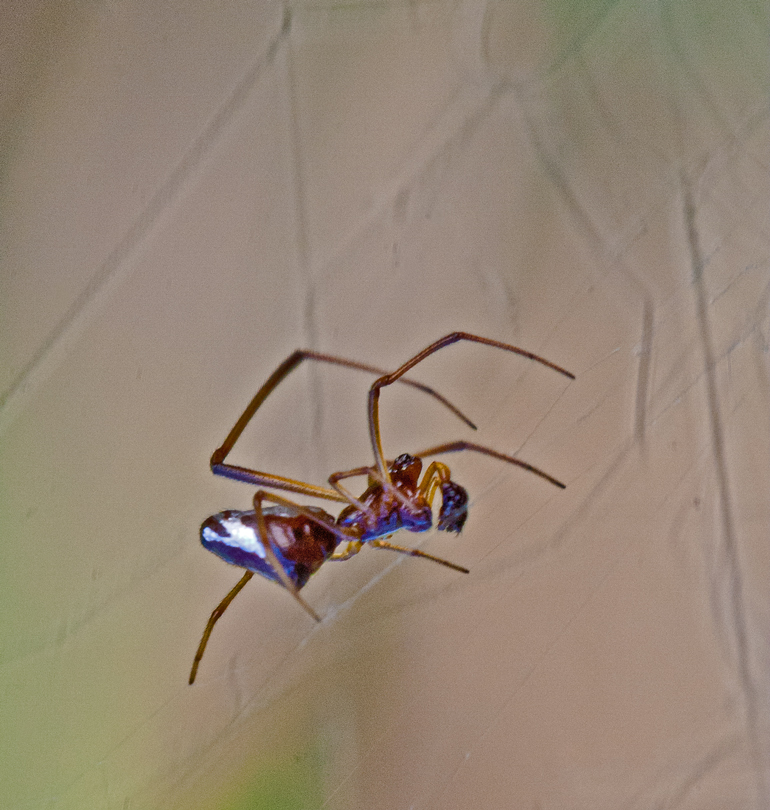
Dewdrop spider (genus Agyrodes)

© Michael Q. Powell. All rights reserved.
Read Full Post »

I have repeatedly observed a small spider or two hanging around the periphery of the web of the large Yellow Garden Orbweaver spiders (Argiope aurantia) that I have been photographing recently. Initially I thought it might be the male of the species, which is considerably smaller than the female, but when I finally took a clear enough photo of one of these small spiders, I realized it was a different species.

My research suggests that this is a kleptoparasitic spider. Let me explain. It may sound like I’m trying to sound like a scientist, but “kleptoparasitism” is a single word that captures the idea that this spider steals or feed on the prey captured by another spider. According to Wikipedia, kleptoparasitic spiders occur in five different families and I am pretty sure the little spider below is of the genus Argyrodes, which are also called dewdrop spiders.

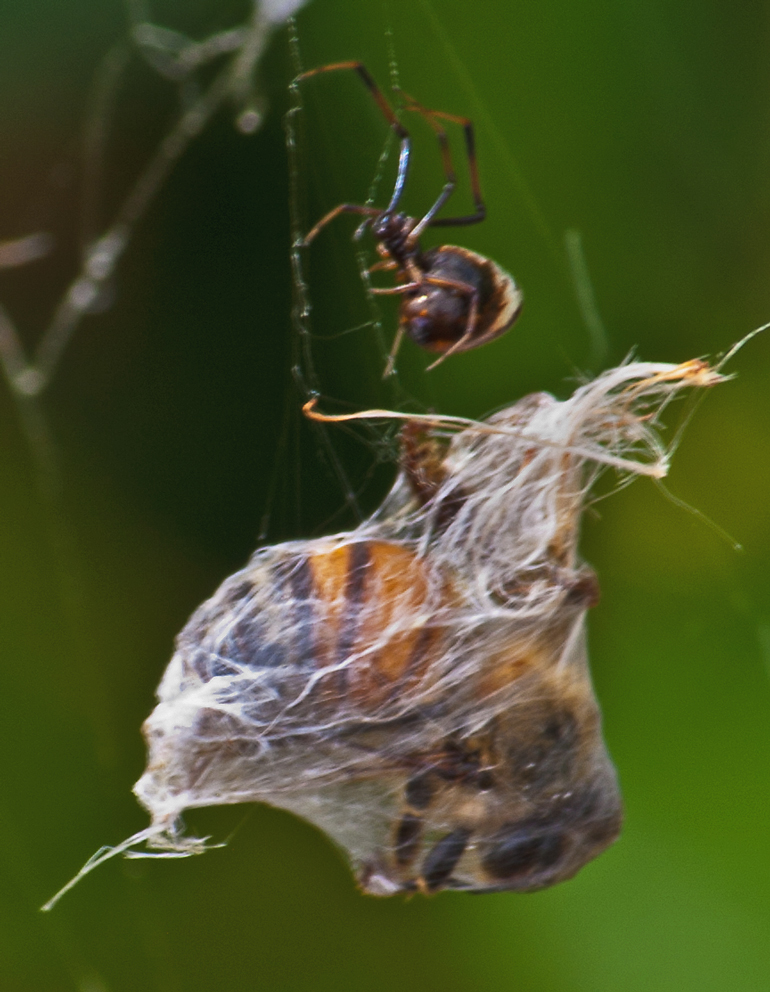
Kleptoparastic spider eyes another spider’s catch

Let me set the scene for you. The much larger Yellow Garden Orbweaver spider caught what looks like a bee and returned to the center of the web, leaving the wrapped bee on the periphery. The little spider moved in and appears to be checking out this potential new food source. Compare the relative size of the spider and the bee—the spider is tiny. That made it tougher to get a clear shot of both the spider and the captured bee. My shot is far from perfect, but it does allow you to see some of the details (and you can get a higher resolution view if you click on the image).

It seems to me that the little spider plays a risky game, living with (and maybe stealing food from) a larger, more dangerous spider. Maybe he’s a thrill-seeker, an adrenaline junkie who enjoys living in a state of constant danger.

© Michael Q. Powell. All rights reserved.

Read Full Post »