Feeds:
Posts
Comments

Posts Tagged ‘Kingstowne Lake’

Hooded Mergansers (Lophodytes cucullatus) are strange-looking ducks—no other ducks that I see regularly look like them. The shape and proportions of their heads and bills are so unusual and cartoonish that they look like they were created at Disney Studios.

Most of the time when I see Hooded Mergansers, they are in small groups, but last week I spotted only a solitary male during a short visit to a suburban pond not far from where I live. The “Hoodie” seemed to be content to swim around alone, not interacting with the other ducks on the pond and not spending any noticeable time fishing—Hooded Mergansers dive for fish, crayfish, and other food, seizing it in their thin, serrated bills.

The weather was cold, gray, and windy on the day I captured these images, conditions that are quite typical during the winter here. Weather forecasters predict that today will be mostly sunny, so I hope to have a chance to get out in nature with my camera and exercise both my body and my soul. As Vincent Van Gogh once wrote in a letter to his brother Theo, ““Always continue walking a lot and loving nature, for that’s the real way to learn to understand art better and better.”


Hooded Merganser

Hooded Merganser

© Michael Q. Powell. All rights reserved.

Read Full Post »

One of the most distinctive ducks that migrates into my area for the winter is the Hooded Merganser (Lophodytes cucullatus). The male has a curious-looking head that is black and the white and the female has an orange-brown hairstyle that literally sticks out.

Sometimes Hooded Mergansers arrive in groups and I have seen some recent photos by local photographers of males competing for the attention of the females. In this case, cover, I spotted only one couple at the small suburban pond not far from where I live. The ducks dozed a bit and occasionally preened their feathers, so there was not a whole lot of action to capture. I was content to capture a few “record” images and hope I will have some more chances to see these little diving ducks in the upcoming months.

Hooded Merganser

Hooded Merganser

Hooded Merganser

© Michael Q. Powell. All rights reserved.

Read Full Post »

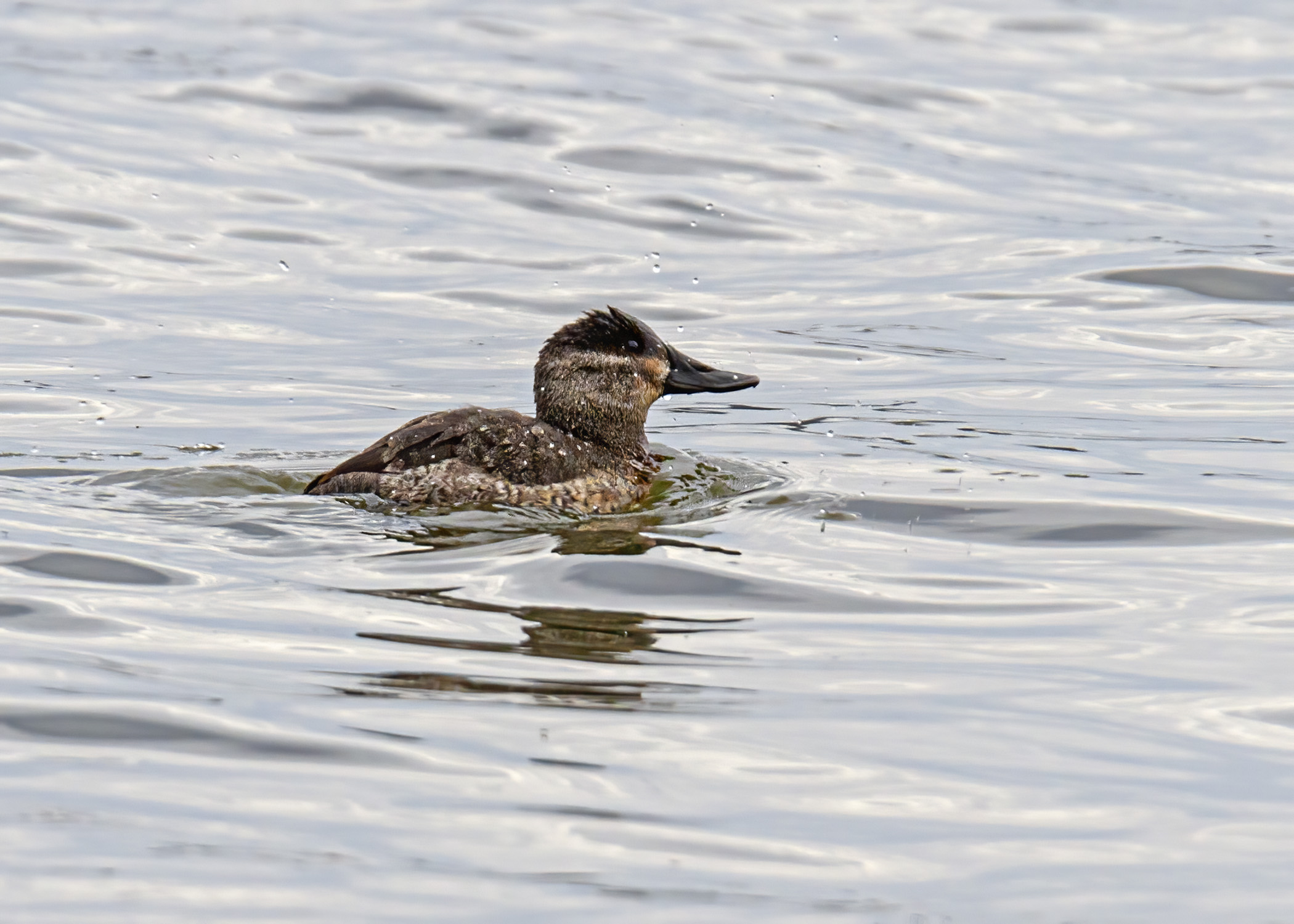
Ruddy Ducks (Oxyura jamaicensis) “feed most actively at night, so you’ll often see Ruddy Ducks sleeping during the day, head tucked under a wing and tail cocked up,” according to the Cornell Lab of Ornithology. I spotted a small group of them, including the sleeping male Ruddy Duck in the first photo, on Tuesday at a small suburban pond in Kingstowne, a community only a couple of miles from where I live.

Earlier this month I spotted a much larger flock of Ruddy Ducks in the waters off of Occoquan Bay National Wildlife Refuge. As you can see in the second photo, many of the ducks were sleeping. The ducks were quite a distance from shore, but the bright white cheek patches on some of the males made them easy to identify. Eventually one of the ducks swam a bit closer and I captured the final image—judging from its coloration, this appears to be either a female or an immature male.

I read on-line that the breeding colors of the male are spectacular, with a sky-blue bill, shining white cheek patch, and gleaming chestnut body, but I have never seen Ruddy Ducks during breeding season. As I read further in the entry for the species on the Cornell Lab of Ornithology website, I could not help but chuckle:

“The bright colors and odd behavior of male Ruddy Ducks drew attention from early naturalists, though they didn’t pull any punches. One 1926 account states, “Its intimate habits, its stupidity, its curious nesting customs and ludicrous courtship performance place it in a niche by itself…. Everything about this bird is interesting to the naturalist, but almost nothing about it is interesting to the sportsman.” ”

UPDATE: A sharp-eyed Facebook friend noted that the position of the duck in the first photo is a bit more upright than it would be if he were sleeping and suggested the duck was in the process of grooming.

Ruddy Duck

Ruddy Ducks

Ruddy Duck

© Michael Q. Powell. All rights reserved.

Read Full Post »

Most of the time when I see Double-crested Cormorants (Phalacrocorax auritus), they are actively fishing, repeatedly diving deep into the water and surfacing after and extended period time under the water. On Tuesday I spotted this cormorant at a small suburban pond and it seemed content to float about amidst a large flock of Ring-billed Gulls. As you can see in the first photo, it made for a strange pairing to have such different-looking birds together.

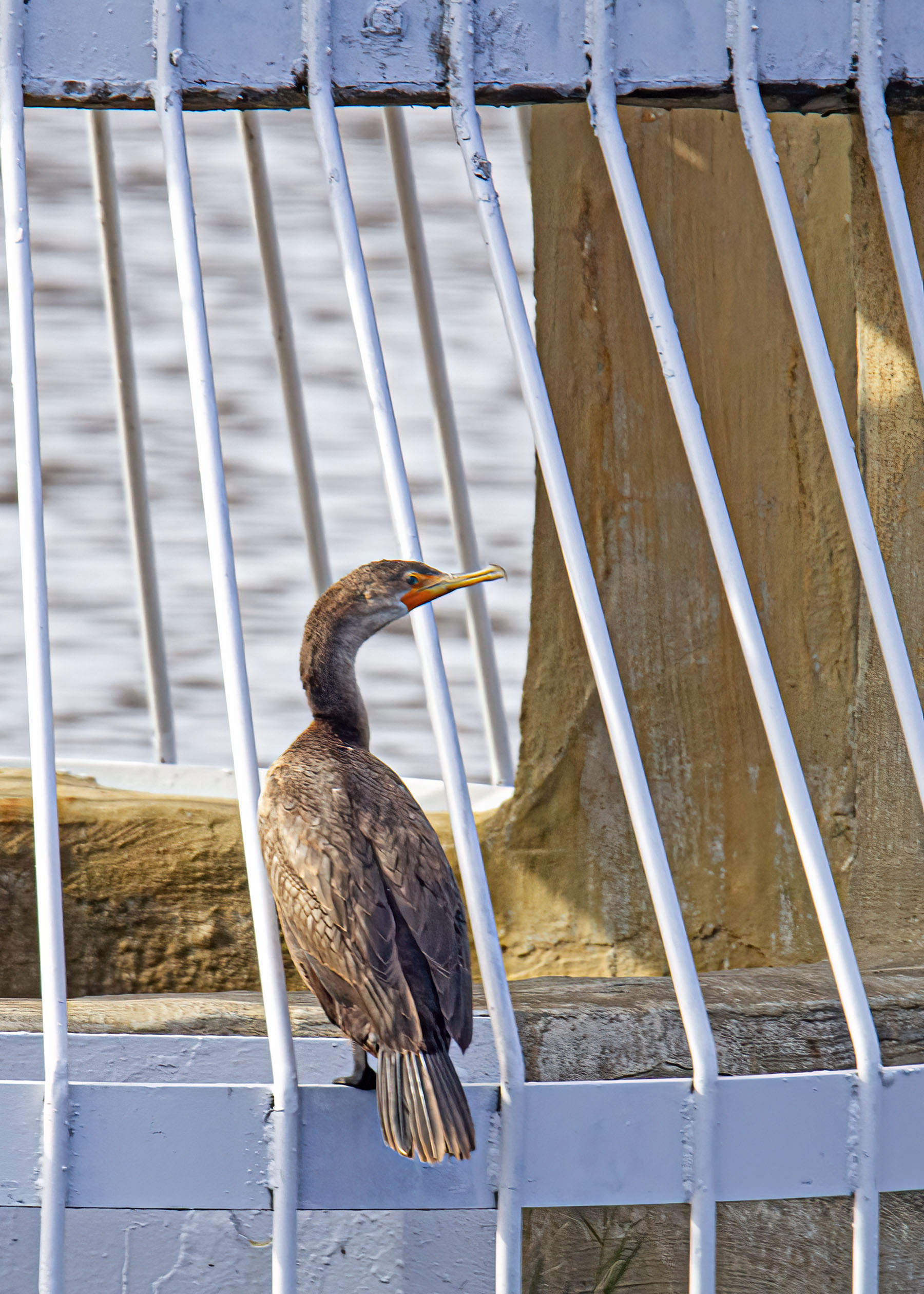
When I circled around the pond a second time the cormorant (or possibly a second cormorant) was hanging out on a man-made structure sticking out of the water in the pond that is probably part of the water filtration system. Often when I see cormorants out of the water, they have their wings spread wide to dry them out, but this cormorant had its wings closed and just seemed to be chilling out. Generally I avoid including man-made objects in my wildlife photos, but I like the juxtaposition of the curves and warm color of the cormorant with the straight lines and cooler cooler colors of the structure.

Double-crested Cormorant

Double-crested Cormorant

© Michael Q. Powell. All rights reserved.

Read Full Post »

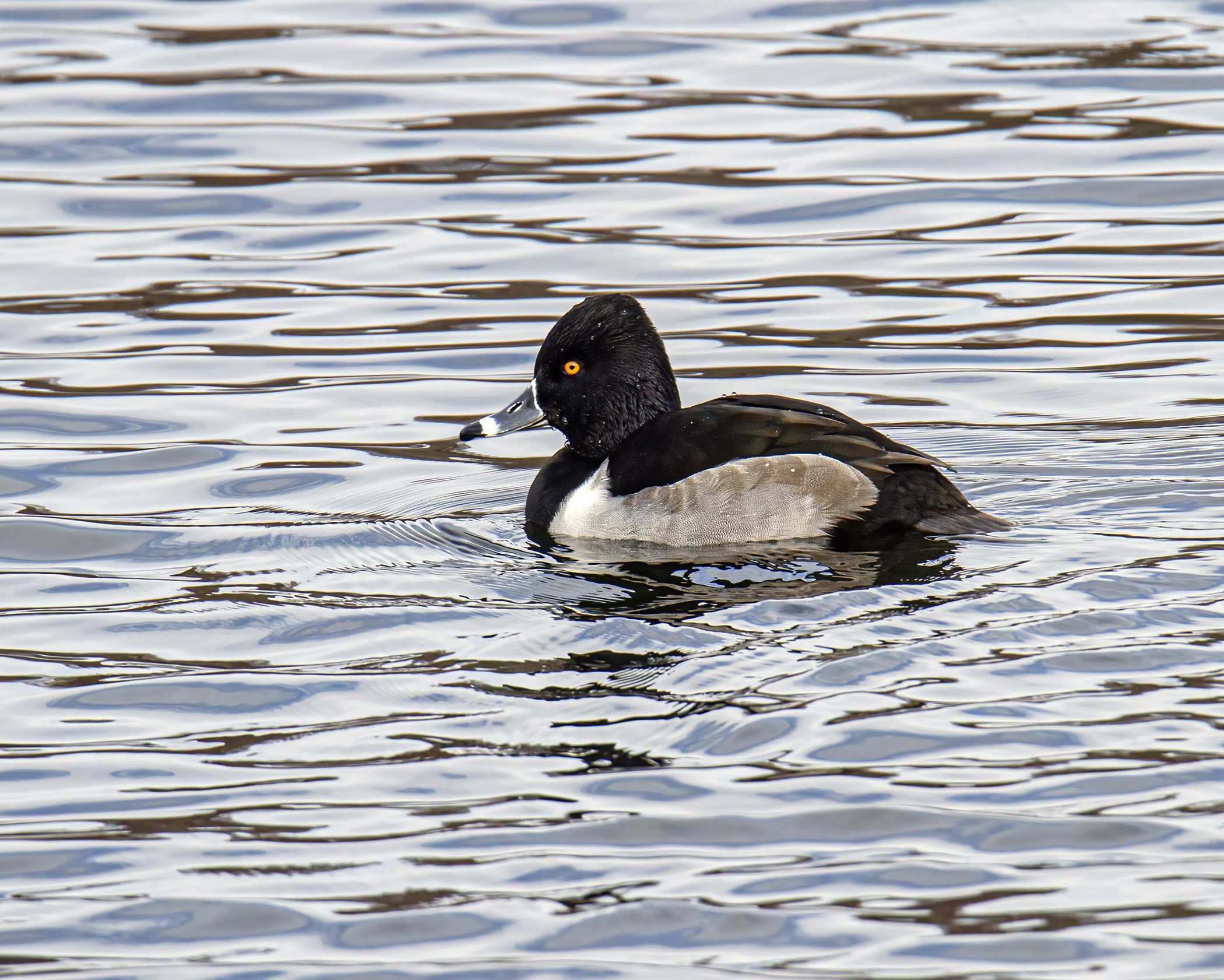
Yesterday I made a quick trip to a local suburban water retention pond, where several migratory bird species overwinter with us. I was shocked to see that no Canada Geese were there, but did spot two Double-Crested Cormorants, a few Ruddy Ducks, and several pairs of Ring-necked ducks (Aythya collaris). All of these are diving birds, so they mostly hung out near in the deeper waters at the center of the pond.

I spent a good amount of time watching one Ring-necked Duck repeatedly dive into the water and would try to guess when and where he would resurface. Male Ring-necked Ducks have a distinctive appearance, with yellow eyes, a striped bill, and a strangely pointed head.

Clouds would drift across the sun from time, causing patterns on the surface of the water to shift and change. I really got caught up in these reflections and these three photos give you a sense of the swirl of colors and patterns that provided an amazing backdrop for these cool-little ducks.

Ring-necked Duck

Ring-necked Duck

Ring-necked Duck

© Michael Q. Powell. All rights reserved.

Read Full Post »

While I was composing a shot of this turtle at a small pond in Kingstowne, a suburban area only a mile or so from where I live, another turtle popped its head out of the water to photobomb its friend. I am pretty sure that the basking turtle is a Red-eared Slider (Trachemys scripta elegans), though I must admit that turtles are definitely not my speciality when it comes to identifying species.

We are in a transitional time of the year—we have already had some days with frost, but some other days have been warm and sunny. Today, for example, we may be flirting with record high temperatures up to 76 degrees (24 degrees C). Tomorrow, on the other hand, the high temperature is forecasted to reach only 52 degrees (11 degrees C).

turtle

© Michael Q. Powell. All rights reserved.
 

Read Full Post »

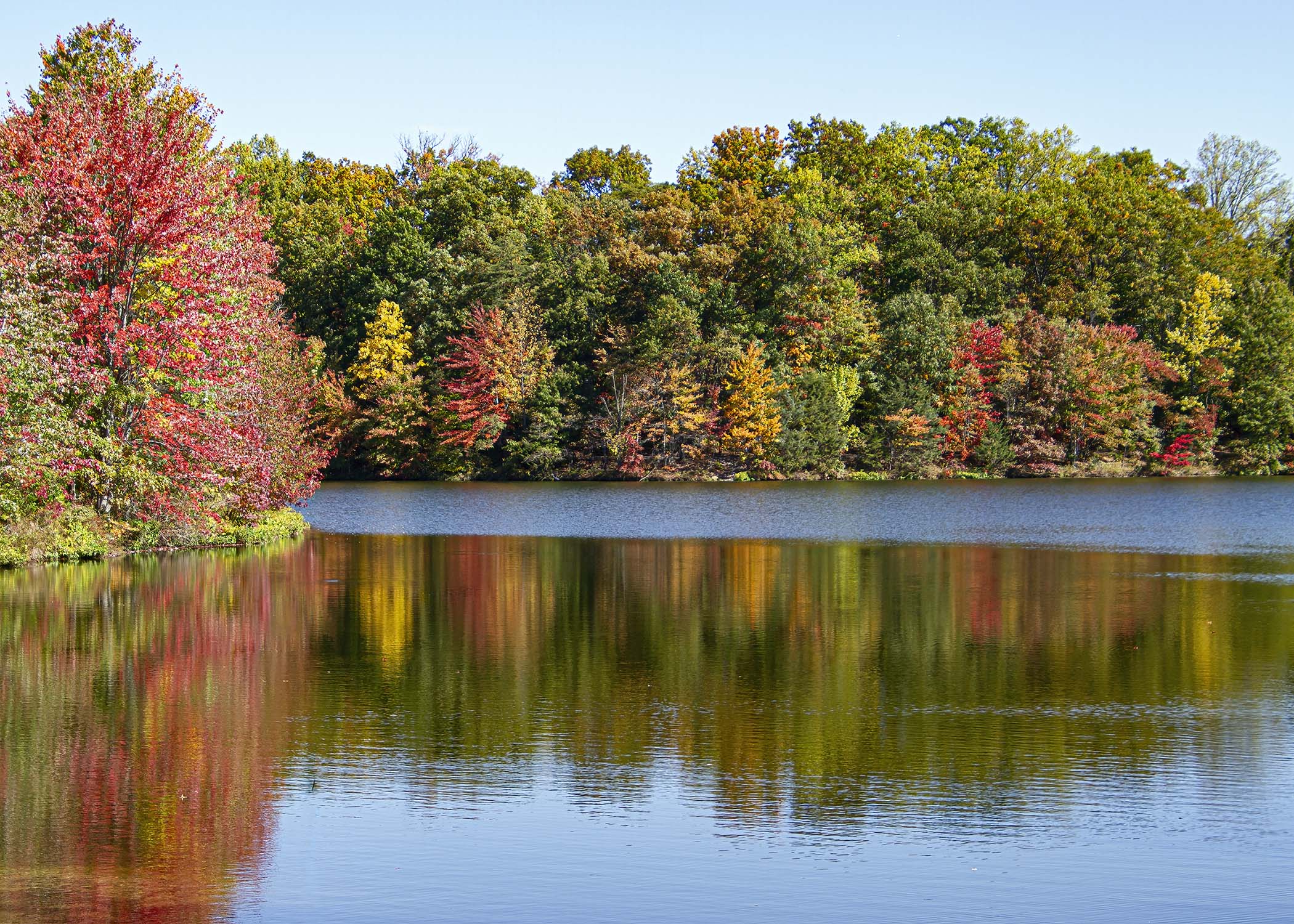
How do you capture the beauty of the fall foliage? I like to try a variety different approaches with my camera.  These three images of the water retention pond in Kingstowne, only a mile or so from my townhouse, convey some of my impressions of this colorful season.

The first image is perhaps my favorite of the three. By photography the reflections in the water I was able to remove the details of the foliage and focus on the colors and the light. It reminds me a little of some impressionist paintings by Monet and others.

For the second photo, I pointed my camera at a particularly colorful patch of leaves that were being backlit and zoomed in quite a bit. In addition to the brilliant colors, I really like the interplay of the light and the shadows.

The third image is the most “traditional” in its approach to the foliage—it is the kind of photo that you might see on a calendar. It provides the “big picture” that I sometimes forget to include in my normal photography, when I tend to concentrate on capturing the details of a subject with a macro or telephoto lens.

This season of autumn color will soon be coming to an end. When I left my house yesterday morning, I couldn’t help but notice that all of the streets and yards in my neighborhood were covered with fallen leaves. Life, it seems, is all about changes and celebrating each new moment.

autumn colors

autumn colors

autumn colors

© Michael Q. Powell. All rights reserved

Read Full Post »

Do you imagine a photo in your mind and then try to create it? Most of the time I am an opportunistic wildlife photographer—I react to the situations in which I find myself and try to make the best possible photo to capture the subject, the action, or the mood. Sometimes, though, I look at a spot and think, “Wouldn’t it be great if my subject moved into that light or onto that photogenic perch?”

On Wednesday I watched a lone Double-crested Cormorant (Phalacrocorax auritus) as it repeatedly dove into the water in a small suburban pond not far from my townhouse. Generally I encounter cormorants at larger bodies of water, but I know that this manmade pond is deep and is suited to birds that dive for food—some species of migratory diving ducks, for example, overwinter there.

The cormorant would spend quite a while underwater and I never knew where it would pop up next. I kept hoping it would surface in an area where the reflections of the fall foliage were especially colorful and eventually it did. The cormorant was quite far away, but I captured the kind of imagine that I had imagined, with colorful rippled patterns on the surface of the water as the cormorant swam into the frame. I encourage you to click on the imagine to see the details of the first image.

The second image was one of my earlier attempts. The cormorant surfaced closer to me than in the first shot, but the surface of the water was not as colorful as I wanted. However, the shot provides a really good look at the striking aquamarine eyes of this beautiful bird. Wow! Those eyes never fail to startle and delight me.

It is a fun challenge to try to incorporate the fall foliage into my photos and I have had an unusual amount of good luck in doing so this past week with a variety of subjects. I am starting to see more and more leaves on the ground, so I know that this period is transitory. Carpe diem!

Double-crested Cormorant

Double-crested Cormorant

© Michael Q. Powell. All rights reserved


Read Full Post »