Feeds:
Posts
Comments

Posts Tagged ‘Haliaeetus leucocephalus’

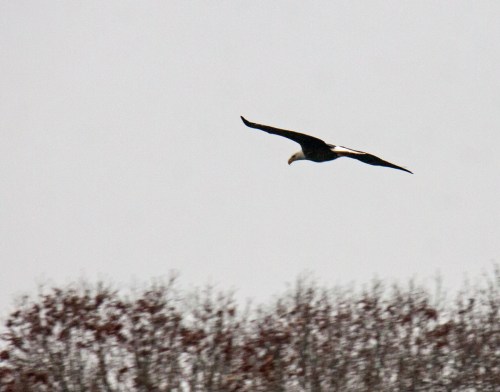
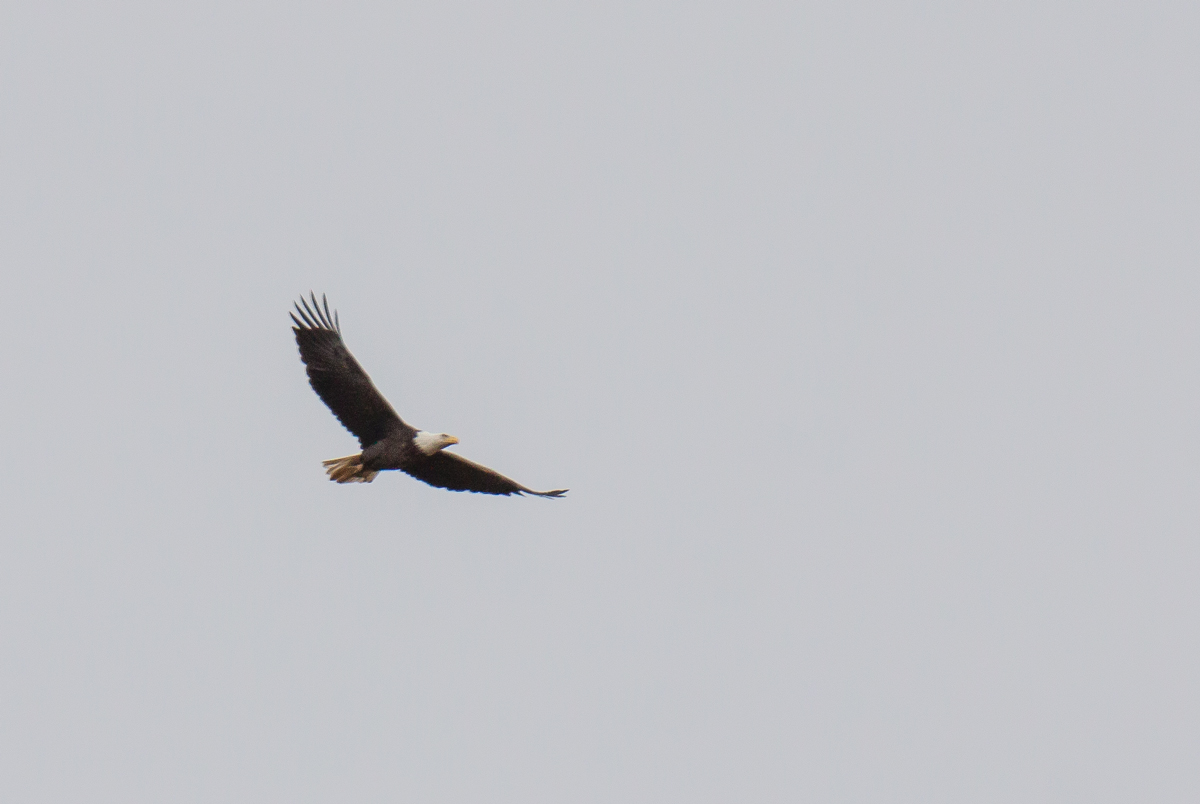
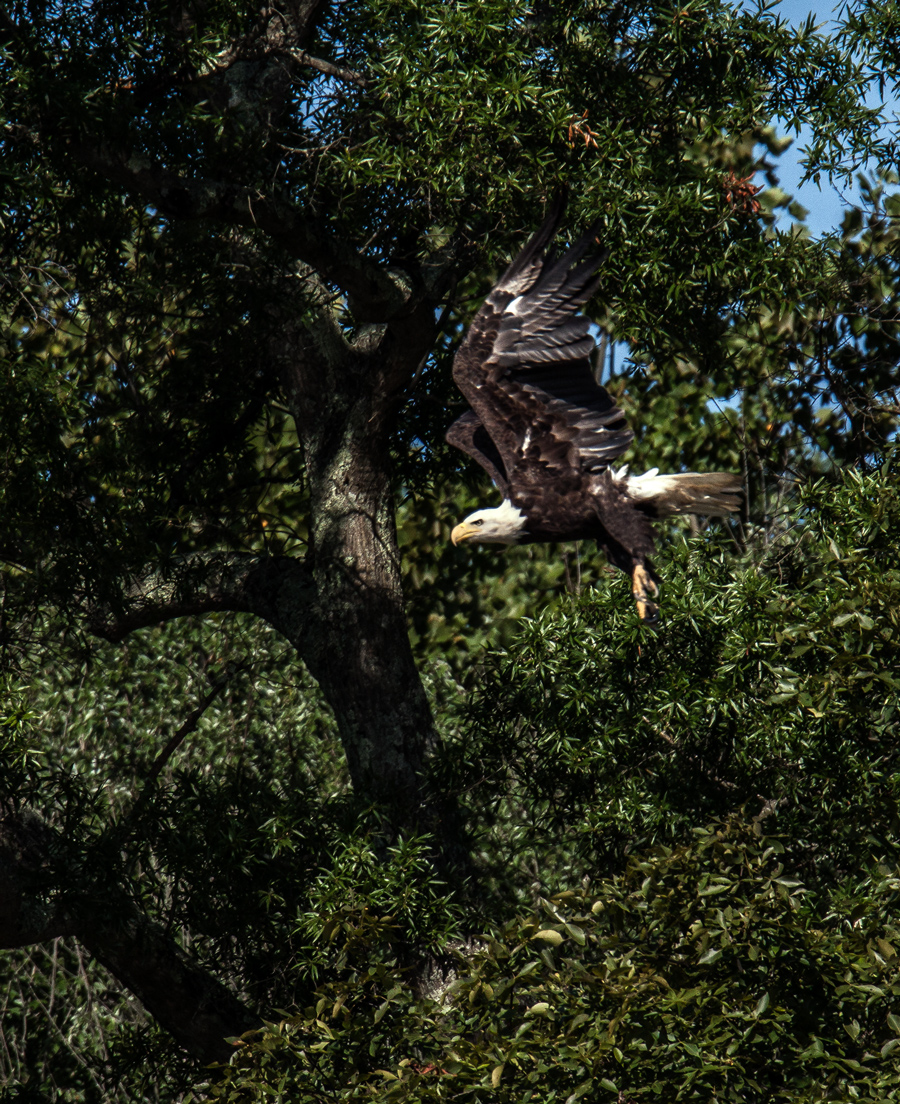
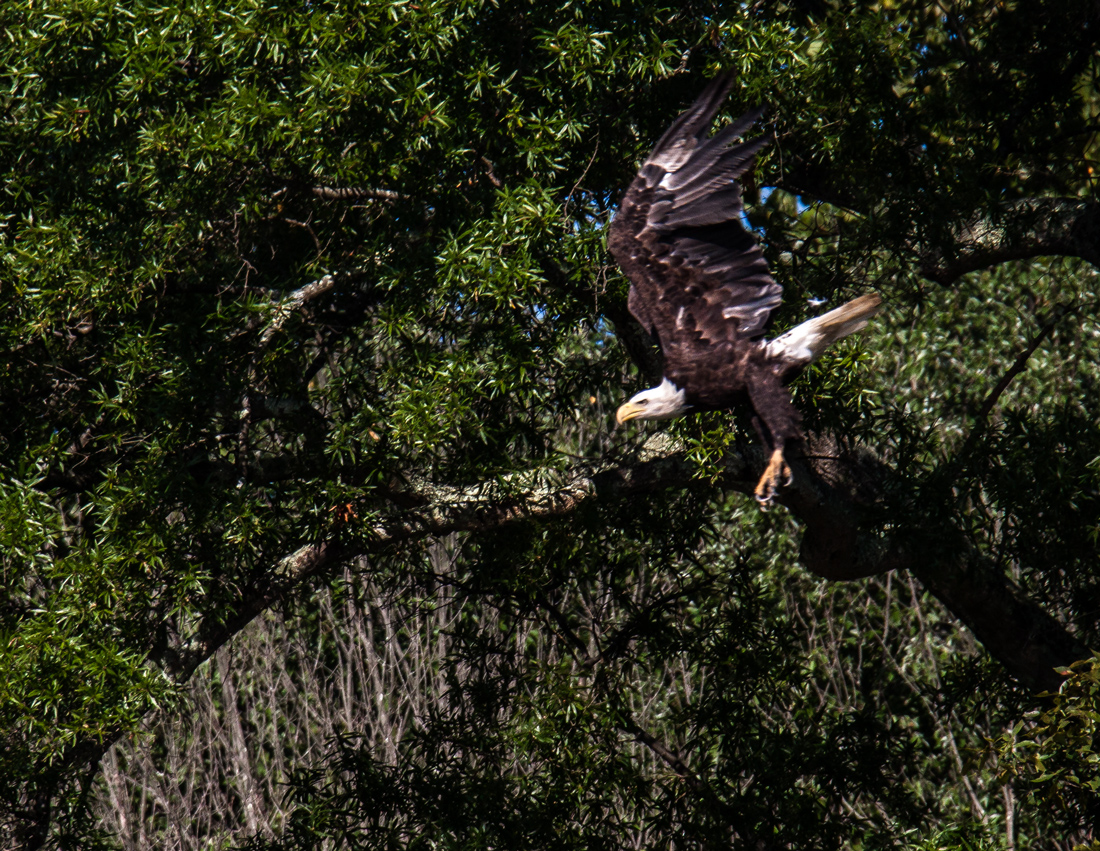
As I zoomed in on a bright white splotch of color in a distant tree at Occoquan Bay National Wildlife Refuge on Friday, I realized it was a Bald Eagle (Haliaeetus leucocephalus). almost hidden in the autumn foliage. The eagle reacted quickly to my presence and took to the air, but I was able to capture a few images of this majestic bird.

Photographing a bald eagle is always a challenge. One of the biggest issues is the contrast between its bright white head and dark body, making it tough to get a good exposure. In this case, if I had had a little more time to check my exposure, I might have been able to avoid blowing out the details in the eagle’s head. Time, though is something that I usually don’t have. The eagle’s vision and reaction time are so far superior to mine that I have to react immediately when I spot an eagle, usually with the settings that already dialed into the camera. On multiple occasions I have missed opportunities as I scrambled to make adjustments to my camera.

Finally, it is often hard to predict an eagle’s actions and the direction in which it will choose to fly. This was a somewhat unusual situation in that the eagle initially flew right at me. You have to have really steady hands and a lot of luck to maintain focus when a bird is coming at you that fast. I didn’t quite nail the focus on the eagle’s eyes in the final shot, but am happy at the way that I was able to capture its fully extended wings.

This situation reinforces in me the continuing applicability of the Boy Scout motto that was drilled into me as a youth—”Be Prepared.” You never know when you might stumble upon a Bald Eagle.


Bald Eagle

Bald Eagle

Bald Eagle

© Michael Q. Powell. All rights reserved.

Read Full Post »

As I turned the corner of a trail at Occoquan Bay National Wildlife Refuge on Monday, I spotted a large bird perched high in a tree. It didn’t immediately fly away, so I figured it wasn’t an eagle. Zooming in, I realized I was wrong—it was a Bald Eagle (Haliaeetus leucocephalus) facing in the opposite direction.

I got lots of photos of the back of the eagle’s head, but decided that I wouldn’t share any of them. I knew that eventually the eagle would turn its head and tried to get ready. I snapped off a few photos, including the first one below, when the eagle turned its head and surveyed the area.

I don’t know if it was the noise of the shutter or if it detected motion, but the eagle spotted me and I was able to capture the second shot as it was preparing to take flight. I was thrilled, because this was the closest encounter that I had had with a bald eagle in a long time.

I continued down the trail and a short while later made a turn onto another trail. As I glanced to my left, I saw a perched eagle. I don’t know if it was the same one that I had just observed, but I managed to snap off a few more shots, including the third shot below. I like the way that I was able to capture a bit of the feel of autumn with the red leaves.

Bald Eagle

Bald Eagle

Bald Eagle

© Michael Q. Powell. All rights reserved.

Read Full Post »

Recently at Occoquan Bay National Wildlife Refuge, the only views I have gotten of Bald Eagles (Haliaeetus leucocephalus) have been of them flying away from me. Yesterday I got lucky and caught a glimpse through the foliage of one sitting in a distant tree in what appears to be a nest. Earlier this year, several roads in the refuge were closed after two eaglets were born. I don’t know if this was the nesting site, but suspect it might have been.

I was a long way away, but had a small visual tunnel through the trees that gave me a mostly unobstructed view of the eagle. I tried to move slowly, although I figured that the eagle was unaware of my presence. Apparently I underestimated the sharpness of the eagle’s vision, because it took off from the nest not long after I began shooting.

As I have said in the past, however, any day that I am able to see and photograph a Bald Eagle is a wonderful day.

Bald Eagle

Bald Eagle

Bald Eagle

© Michael Q. Powell. All rights reserved.

Read Full Post »

I was looking high and in the distance and the Bald Eagle (Haliaeetus leucocephalus) came in low and was almost on top of me before I saw it yesterday morning at Huntley Meadows Park. I had to scramble and pull back on my zoom lens to capture this image, which barely fit into the frame of the viewfinder. (The EXIF data for the shot indicate that it was shot at 309mm of my 150-600mm Tamron telephoto zoom lens.)

I feel like I should have been able to take better advantage of the situation that presented itself, but I am not disappointed. As I have noted repeatedly, any day with a bald eagle is a great day.

Bald Eagle

© Michael Q. Powell. All rights reserved

Read Full Post »

For wildlife photographers, I would argue, a successful image is most often the result of some combination of luck, skill, and equipment. We inhabit a world of tremendous uncertainty and have to be hypervigilant, never knowing when “the moment” will arrive when we will be forced to make a series of split-second decisions.

One of those moments arrived for me yesterday as I was exploring Occoquan Bay National Wildlife Refuge in Woodbridge, Virginia. Although I was quite aware that there were bald eagles in the area, because some of the trails in the refuge near eagle nesting sites were closed, I was primarily chasing dragonflies and butterflies, so I had my 180mm macro lens mounted on my camera. I knew that I would be doing a lot of walking, so in order to minimize weight, I was not carrying my trusty (and heavy) 150-600mm zoom lens.

I was following a trail that ran parallel to the waters of Occoquan Bay and was a little frustrated that the view was frequently obstructed by heavy vegetation. When I reached an opening in the vegetation I looked out at the water and suddenly a Bald Eagle (Haliaeetus leucocephalus) burst into view out of nowhere. The eagle was almost at eye level and seemed to be struggling a little to gain altitude. As I later was able to ascertain, it had just caught a fish.

The logical part of my brain might have told me that a 180mm lens is not long enough to capture an image of an eagle in flight, but think I was acting on an instinctive level at that moment and I was able to snap off some shots before the eagle disappeared out of sight. It took a while for the adrenaline to wear off and I didn’t know for sure if I had been able to capture the moment. It was only when I reviewed the images on my computer that I realized that I had gotten my best eagle shots ever.

As is the case with most of my bird images, I cropped the first image to bring the subject in a bit closer. However, I am also including an uncropped version of the same image. It boggles my mind to think that I filled up that much of the frame with an eagle in flight with a 180mm lens.

Luck was hugely important; skill played a role, though it was my quick reaction time that was critical; and equipment turned out to be less important that I would have anticipated.
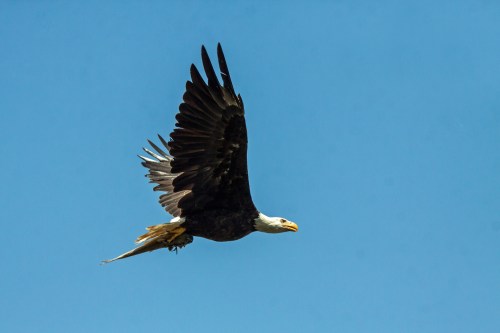
Bald Eagle

Bald Eagle

© Michael Q. Powell. All rights reserved


Read Full Post »

One of my fellow photographers keeps posting such awesome photos of the birds of Fort Washington Park, a historic fort on the Potomac River in Maryland, that I decided to make a visit there yesterday. Upon arrival, I quickly realized that I did not know exactly where in the park I would be most likely to find wildlife, so I wandered around somewhat aimlessly for most of my time there.

I had been at the park once before and had seen a bald eagle that time, so my eyes looked mostly upwards as I scanned the trees and the sky. Several times I focused my camera on a shape in the trees and was disappointed that it was only a misshapen branch or a clump of leaves. Finally, though, I spotted a Bald Eagle (Haliaeetus leucocephalus) high in the trees.

Sometimes bald eagles will perch on branches somewhat in the open, but this one was buried among the branches. This photo show my initial view of the eagle as I looked through my lens zoomed all the way out to 600mm.

Bald Eagle

Focusing on eagle was somewhat of a challenge because of all of the branches, but as this blow-up of a part of the image above shows, I was able to capture some pretty good detail.

Bald Eagle

I tried to be stealthy as I moved a bit closer, but the eagle detected my presence and immediately took off. Initially the eagle flew behind the trees, but I managed to acquire my target and capture a number of image before the eagle disappeared in the distance. The lighting was not the greatest and I had to crop the images a good deal, but I am really pleased that I managed to get some relatively sharp views of the eagle’s head.

I am pretty sure that eagles will show up in my blog again in the upcoming months, though not with quite the regularity with which they have appeared recently.

Bald Eagle

Bald Eagle


© Michael Q. Powell. All rights reserved.

Read Full Post »

Is it possible to post too many photos of Bald Eagles (Haliaeetus leucocephalus)? I don’t think so. Here’s a shot of one I saw yesterday flying in the distance at Huntley Meadows Park. It was a nice bonus that we had sunshine and blue skies after a series of dreary, overcast days, even though it was still pretty cold outside.

I see Bald Eagles, including juvenile ones, often enough at the park that I frequently wonder if there is a nest hidden somewhere the park. I have wandered through some pretty remote areas of the park, but so far have been unsuccessful in locating a nesting site.

Bald Eagle

Bald Eagle

© Michael Q. Powell. All rights reserved.

Read Full Post »

The sky was pretty overcast early Friday morning at Huntley Meadows Park and the light was limited, so I had to crank up my ISO to 1600. My long telephoto zoom lens works best when there is good light, so I was thrilled that I somehow managed to capture some identifiable shots of this Bald Eagle (Haliaeetus leucocephalus) as it circled around me before flying away.

Any day I see a bald eagle is a wonderful day.

Bald Eagle

Bald Eagle

Bald Eagle

© Michael Q. Powell. All rights reserved.

Read Full Post »

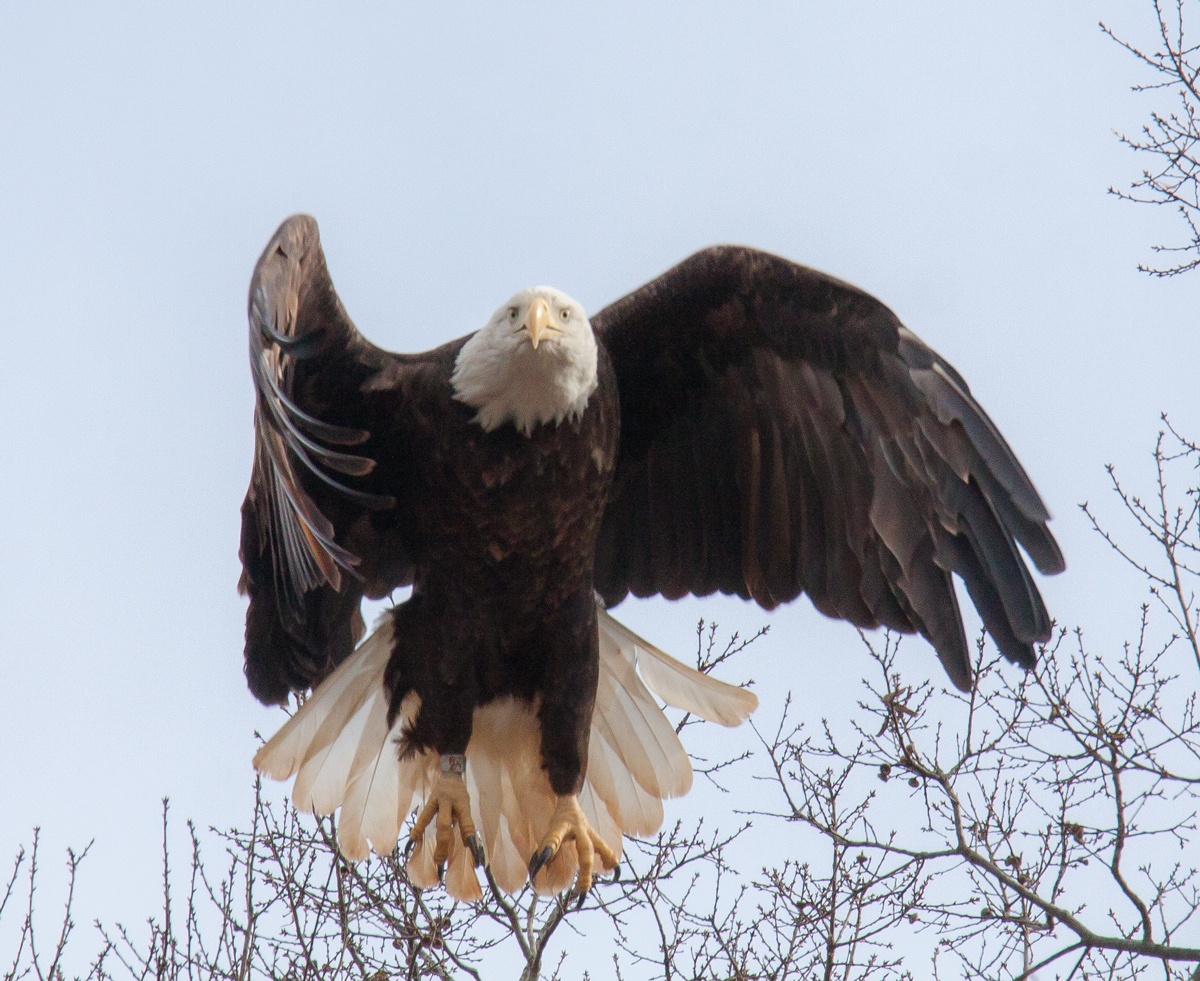
Recently I posted a photo of a Bald Eagle (Haliaeetus leucocephalus) arriving at a perch with talons extended. Here’s what the same eagle looked like when it eventually left the perch. I love sense of power that the eagle is able to convey when it extends its mighty wings. (The second photo, taken a split-second before the first one, shows the eagle as it was preparing to take off,)

Note that the eagle has a band around his left leg. I wonder how many of the eagles I see at Huntley Meadows Park are banded. I can recall only one other time when I could see a band, but must admit that most of my eagle shots do not have enough detail to be able to tell if a band is present.

Bald Eagle

eagle2_5Mar_blog

© Michael Q. Powell. All rights reserved.

Read Full Post »

A Bald Eagle (Haliaeetus leucocephalus) was preparing to land in a tree yesterday morning at Huntley Meadows Park and had its talons fully extended. With perfect form, the eagle was able to stick and hold the landing.

The judges all gave the eagle a perfect score of 10 for the routine.

Bald Eagle

© Michael Q. Powell. All rights reserved.

Read Full Post »

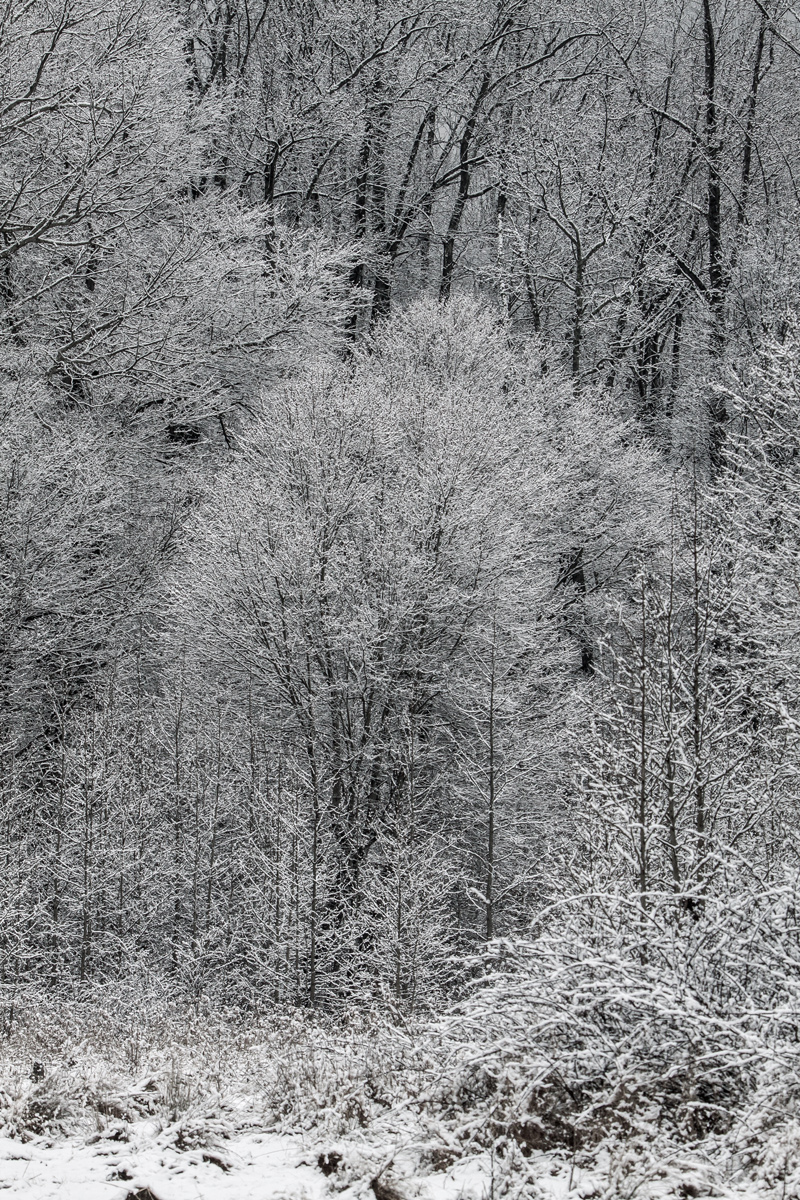
Coated in a layer of snow, the landscape yesterday morning at Huntley Meadows Park was devoid of color, transformed into a study of black and white.

snowscape

Partially hidden behind a branch, this Bald Eagle (Haliaeetus leucocephalus) was almost invisible in a distant snow-covered tree.

Bald Eagle

This was almost a perfect snowfall—the accumulation of an inch or two (2-5 cm) was just enough to create a beautiful snowscape without inhibiting travel on the roads.

© Michael Q. Powell. All rights reserved.

Read Full Post »

My heartbeat definitely accelerates when a Bald Eagle (Haliaeetus leucocephalus) flaps its wings and heads straight in my direction, as one did again this past Monday morning. I don’t know why the eagle chose to fly toward me, since I am pretty sure that it was aware of my presence and could have flown away. Perhaps the eagle was simply curious and wanted to check me out.

Eventually the eagle did pull up and fly past me, without getting as close as it might seem from the images. Some readers have asked me if I was near an eagle nest when I posted similar photos in the past. I have seen eagles multiple times in the same general location and suspect there might be a nest nearby, but so far have not located one.

Bald Eagle

Bald Eagle

Bald Eagle

© Michael Q. Powell. All rights reserved.


Read Full Post »

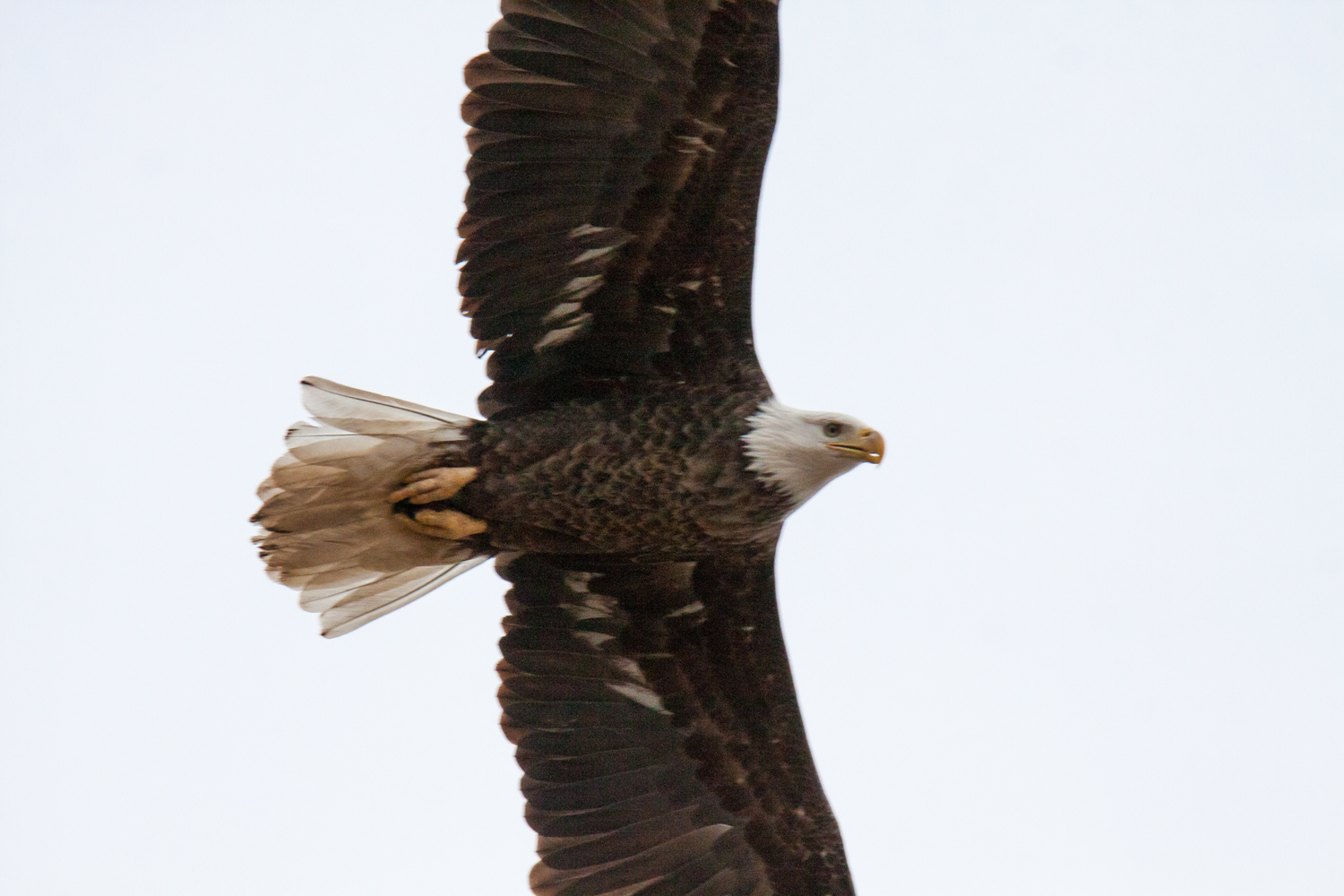
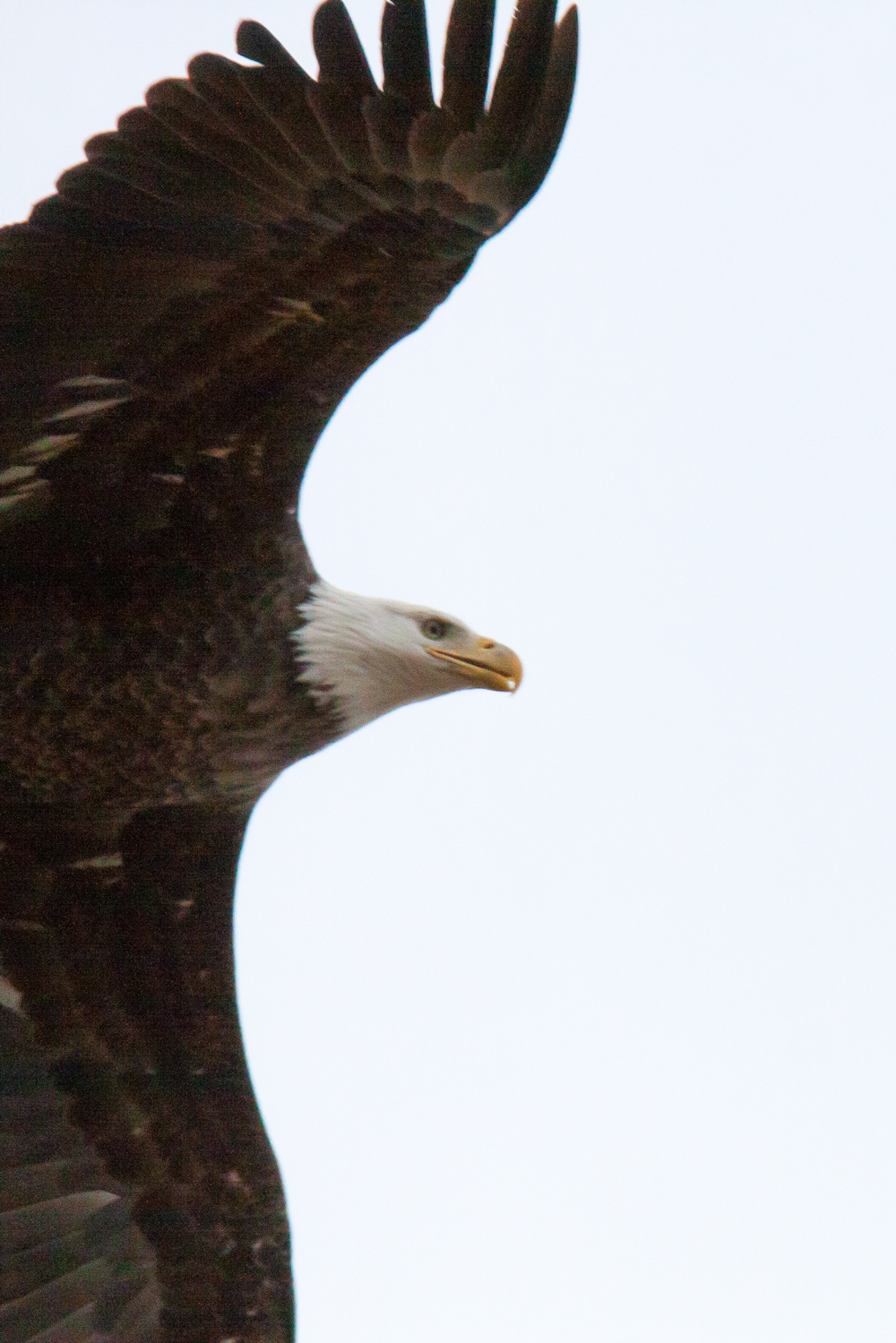
I didn’t see where this Bald Eagle (Haliaeetus leucocephalus) came from early yesterday morning at Huntley Meadows Park, but suddenly it was overhead at a relatively low altitude. I zoomed back a bit on my telephoto lens, but the eagle still more than filled the frame. At that close range, tracking was difficult and I had trouble keeping the eagle in the viewfinder (I think adrenaline might have been a factor too).

Incredibly, the first shot is an uncropped image. It was shot handheld at 483mm on my crop sensor Canon 50D camera with my trusty Tamron 150-600mm lens. The lighting was not that great, so I was shooting at ISO 1600, which resulted in a somewhat grainy image.

The second shot is one in which I got a bit ahead of the eagle in tracking it and chopped off its body. I liked the eagle’s expression so I cropped off the wide expanse of white sky to the right, turning the image from landscape mode to portrait mode, but otherwise left the framing untouched.

If someone had told me before yesterday that I could fill the frame of an image with a bald eagle in flight, I almost certainly would have laughed at them. Reality continues to amaze me.


Bald Eagle

Bald Eagle

© Michael Q. Powell. All rights reserved.

Read Full Post »

No matter how slowly and silently I move, a Bald Eagle (Haliaeetus leucocephalus) seems to sense my presence very quickly and immediately takes to the air. It’s really not that surprising, given the eagle’s amazingly keen eyesight that lets it spot prey from a long distance away.

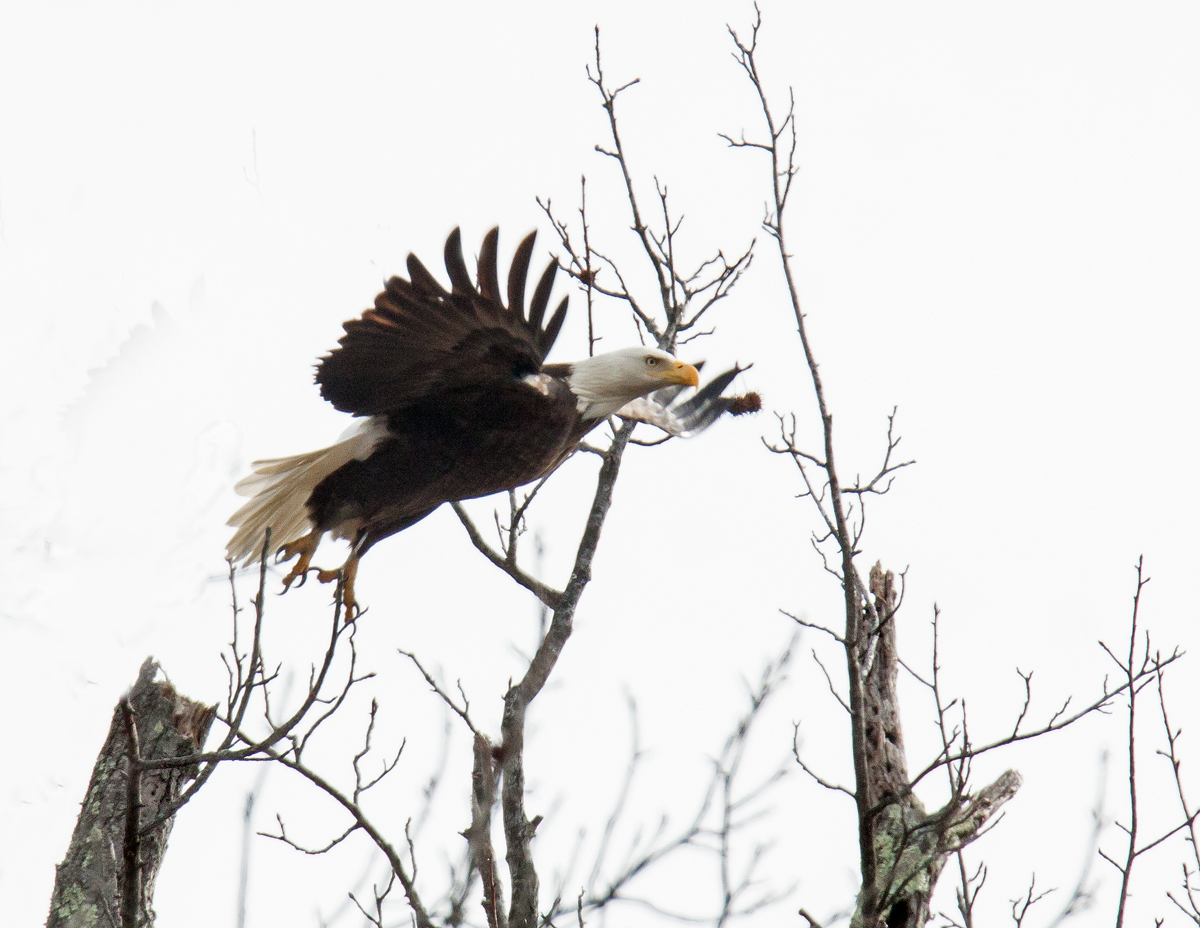
Last weekend I spotted this Bald Eagle when it was perched atop a broken-off tree. Most of the previous times the stationary eagles that I have seen have been sitting on branches. When they took off, they seemed to push off of the branch a bit to gain some forward momentum.

In this case, the eagle appeared to initially push in an upward direction to gain a little height before flapping its powerful wings. Here are a few shots that show some of the stages of the takeoff process.


Bald Eagle

Bald Eagle

Bald Eagle

© Michael Q. Powell. All rights reserved.

Read Full Post »

I usually miss the takeoff sequence of a Bald Eagle, because the eagle spots me before I see it, but this weekend I managed to capture a series of shots of one such takeoff.

My first indication of an eagle’s presence is often when I see it flying away. Several times this past weekend, however, I spotted a Bald Eagle (Haliaeetus leucocephalus) perched in the trees at Huntley Meadows Park and I was able to observe the eagle for at least a few minutes at a time.

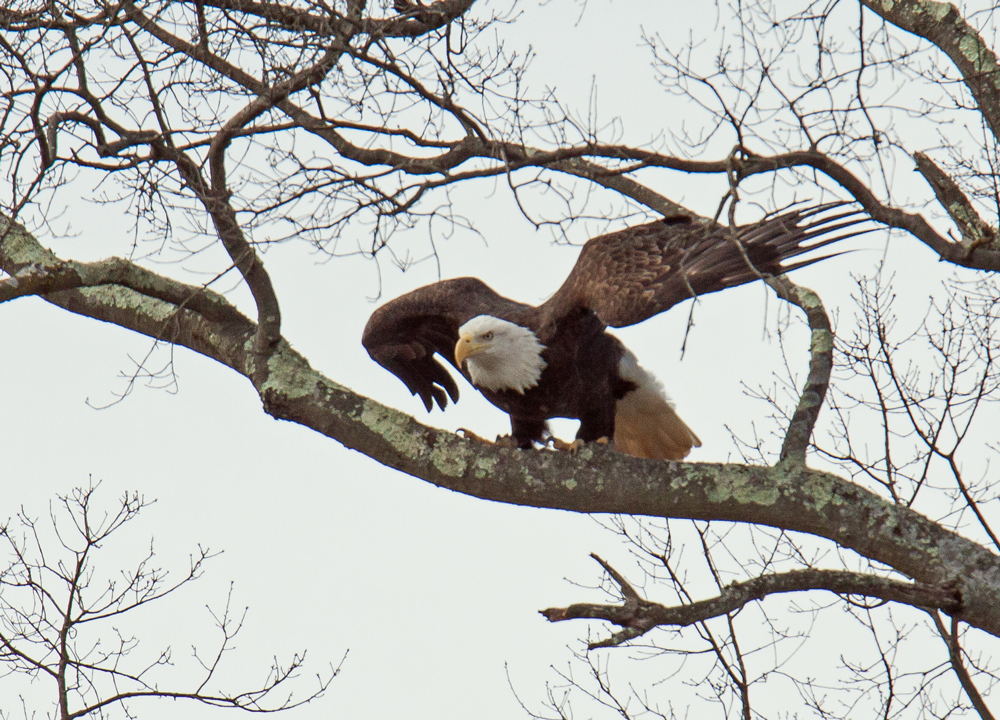
In the case of these images, I was looking across a beaver pond at the eagle as it perched in the trees. In the first couple of shots, the eagle seemed to getting a little agitated and is lifting its feet and flexing its wings. Then he assumed a position that reminds me of the start of a speed skating race or a sprint, with a flexed wing ready to propel the eagle forward. Finally the eagle pushed off from the tree and descended a little with talons extended before leveling off and flying away.

Some of the time it seems an eagle just springs into motion and ignores most of the items on its pre-flight checklist as it prepares for takeoff. Other times, like this one, it follows the established procedures and waited for flight clearance from the tower.

Bald Eagle

Bald Eagle

Bald Eagle

Bald Eagle

Bald Eagle

Michael Q. Powell. All rights reserved.

Read Full Post »

Yesterday was a great day for me photographing Bald Eagles (Haliaeetus leucocephalus) at Huntley Meadows Park. I took this photo later in the day than the more close-up shots that I posted earlier. I can’t tell if it is the same eagle, but it too appears to have a band on its right foot.

I really like the way that the dynamic position of the eagle’s wings conveys a sense of the power of this majestic creature. There is a kind of dramatic tension in the pose that captivates me.

Bald Eagle

Michael Q. Powell. All rights reserved.

Read Full Post »

Yesterday, for the second day in a row a Bald Eagle (Haliaeetus leucocephalus) flew close to me at Huntley Meadows Park. Unlike the previous day, when the eagle simply soared by overhead, this one looked like he thought I might be a potential prey.

With the snow almost totally gone, I decided yesterday to hike out to some of the more remote regions of the park. I was following a familiar stream when I noticed a dark shape near the top of a tall tree on the opposite bank of the stream. I extended my lens to its full length and was surprised to see that it was a bald eagle.

I had time to shoot shoot only a couple of images when suddenly the eagle took off, initially heading right toward me. I kept firing as the eagle grew larger and larger in my viewfinder. I think I might have startled the eagle when I moved to bring the camera up to my eye and his instinctive reaction was to check out the movement.

Eventually the eagle veered off and flew in the opposite direction and my heart rate started to return to normal.  I don’t think that I was actually at risk, but through a 600mm lens, it sure looked like the eagle was speeding toward me with talons extended.

I couldn’t help but notice that the eagle has a band on its right foot. Whenever I capture a shot of an eagle, I will have to check to see if I can see a band. I don’t know how many eagles hang out at our park, but eagle sightings have become much more common this last year than previously.

Bald Eagle

Bald Eagle

Bald Eagle

Bald Eagle

Michael Q. Powell. All rights reserved.

Read Full Post »

Another eagle? I know that I posted some eagle photos a few days ago, but normally when I see a Bald Eagle (Haliaeetus leucocephalus), it is flying in the distance. Yesterday at Huntley Meadows Park, however, one flew almost directly over me while I was on the boardwalk.

This different perspective allowed me to get some shots that are much more detailed than usual, showing, among other things, the eagle’s tail feathers and fully-extended wings. The wingspan of this magnificent bird is amazing.

Bald Eagle

Bald Eagle

Bald EagleMichael Q. Powell. All rights reserved.

Read Full Post »

This past weekend at Huntley Meadows Park, I accidentally spooked a Bald Eagle (Haliaeetus leucocephalus) perched on a distant tree. As the eagle flew away, I was able to capture a few images that highlight some of its beautiful details.

These images were shot from a long way off and I had to do a lot of cropping. I am really happy, though, with the performance of my lens, even when zoomed out all the way, especially when the light is nice.

I continue to hold fast to the view that any day that I spot one of these majestic creatures is a wonderful day. I hope that today is wonderful for you, however you choose to define “wonderful.”

Bald Eagle

Bald Eagle

Michael Q. Powell. All rights reserved.


Read Full Post »

Clouds can be a mixed blessing. Clouds can help diffuse the sunlight and eliminate harsh highlights. However, when the skies are as heavily overcast as they were for most of this past weekend, they can block so much light that details are hidden and contrast is really soft.

When I saw a bird with a large wingspan take flight in the distance, I readied myself. I wasn’t sure if it was a hawk, a vulture, or an eagle (or possibly even a heron), but I will generally try to get shots of any large bird I see in the sky. As I tracked the bird and took some shots, I still couldn’t positively identify the bird, but my hopes rose in anticipation that it might be a Bald Eagle (Haliaeetus leucocephalus).

Bald Eagles are one of the few species that I will try to photograph every single time that I manage to spot one. I did get some shots of what turned out in fact to be a Bald Eagle. They are recognizable, though the poor lighting conditions made it impossible to capture the details of its feathers. Usually I worry about blowing out the highlights of the eagle’s white head—that was not a problem this time.

I’ve had a pretty good year spotting eagles and suspect this might be the last one that I see in 2015, though I am heading out in a little while and am eternally hopeful that I will spot another one. As with many other photographic subjects, I hope in the coming year to get even better images of eagles, one of my favorite (and most challenging) subjects.

Bald Eagle

Bald Eagle

Bald Eagle

Bald Eagle

© Michael Q. Powell. All rights reserved.


Read Full Post »

As many of you know, I recently entered some photos in a local photo competition and was fortunate to be awarded second place for one of them. I was a little surprised by the one that was selected, because, quite frankly, it was not my favorite one of the group.

The more that I though about it, the more I realized how difficult it must be to be a judge, especially in an area like photography in which there is both a technical and an artistic component.

Why do we like what we like?

I’ve never used a poll in a posting before, but thought that in this case it might be interesting to learn which one of my four entries is your favorite. I am not really asking you to judge which one is “best,” but am looking more for a sense of which one you like most. You can use whatever criteria you like and I would be thrilled if you gave a few words about your choice.

As you can see, I chose a diverse set of subjects to appeal to a variety of tastes. There are two birds—a Bald Eagle (Haliaeetus leucocephalus) and an Eastern Bluebird (Sialia sialis); one insect—a Blue-faced Meadowhawk dragonfly (Sympetrum ambiguum); and one mammal—a Red Fox (Vulpes vulpes).

If I have set this up correctly, you can click on any image and scroll through each of them in full size. After viewing them all, select your favorite and register your vote. As I mentioned earlier, I’d be really happy if you left a few words about your choice. (I think the poll might let you vote multiple times if you have trouble choosing, but am not 100 percent certain, given that I am not familiar with the polling component.) NOTE: If you open the posting in Reader, you may need to click on the Title to get to the actual posting and to the poll.

Thanks. Merry Christmas in advance for those celebrating Christmas and best wishes as we move toward the start of a new year.

© Michael Q. Powell. All rights reserved.

Read Full Post »

The sky was overcast yesterday morning, the day of the Winter Solstice, but my spirits soared when I caught sight of a Bald Eagle (Haliaeetus leucocephalus) high in the air over Huntley Meadows Park.

I was thrilled to be able to capture a sequence of shots that shows the eagle initially coming right at me and then gradually circling to a position that gave me a side view.

bald eagle

Bald Eagle

Bald Eagle

Bald Eagle

Bald Eagle

Bald Eagle

© Michael Q. Powell. All rights reserved.


Read Full Post »

As I was wandering about yesterday in a remote area of my favorite park, the sharp eyes of a younger fellow photographer permitted him to spot a Bald Eagle (Haliaeetus leucocephalus) in a distant tree. The eagle’s even keener vision meant that it spotted us too and shortly thereafter departed.

In a shot of the eagle flying away, I noticed that the eagle seems to be carrying something. However, when I zoomed in on the next shot I took, in which I managed to cut off the eagle’s wings, it looks like the eagle’s left foot is dark and withered and is very different from the yellow right foot.

Am I seeing things? Is this an injury or merely an optical illusion?

Bald Eagle

Bald Eagle

© Michael Q. Powell. All rights reserved.

Read Full Post »

Can you spot perched birds at a distance or do you need them to move in order for you to see them? Generally I need some movement for me to pick them out and it has been sometimes frustrating in the past not to be able to see birds that are almost right in front of me.

Yesterday morning, however, I managed to spot a Juvenile Bald Eagle (Haliaeetus leucocephalus) that was perched in a distant tree. Actually, I didn’t know initially that it was a Bald Eagle and I wasn’t even sure that it was a bird. I was scanning the trees on the other side of a small pond with my telephoto zoom lens extended to 600mm when I noticed a dark shape among the branches. I took a quick shot and zoomed in on the screen on my camera and was thrilled to see that it was some kind of raptor. This shot gives you an idea of what I was seeing.

Bald Eagle

It was early morning and there were a lot of clouds, but periodically the sun would break through and illuminate the scene. I made a few adjustments to my camera and, of course, that is when the eagle took off. The eagle initially flew in the direction it is facing and my shots became a hopeless mess of branches that were in focus and an eagle that was not in focus.

Suddenly the eagle began to change directions and gradually started to head back in my direction, flying a bit closer to me. I was finally able to get some in-flight shots that are pretty much in focus, although they did require some cropping.

Bald Eagle

Bald Eagle

Bald Eagle

As the eagle flew away, I was able to get this final shot. The eagle’s face is mostly hidden, but there is something that I really like about the wing position and details and the way that some of the clouds are visible in the sky.

Bald Eagle

© Michael Q. Powell. All rights reserved.

Read Full Post »

A year ago today my heart was breaking as I informed readers that the injured Bald Eagle at my local marshland park had been euthanized. It was a really difficult posting for me to write, particularly because I had been so hopeful the previous day’s blog posting when I described the heroic rescue of the eagle.

The emotions are still pretty intense, despite the passage of time. I felt something really special when I was privileged to look into the eyes of the eagle at close range, a bird that somehow retained a sense of majesty despite the pain she was obviously feeling.

I don’t often re-blog my own postings, but today, I want to remember and treasure the moments that I chronicled. (If you want to know more details about the experience, there are links in the text below).

Text of my posting from 5 November 2014:

We all like to believe in happy endings, but unlike fairy tales, real life does not always turn out that way. I was saddened this afternoon to learn that the female Bald Eagle (Haliaeetus leucocephalus) that was rescued on Monday at Huntley Meadows Park had to be euthanized.

The dislocation of her elbow was chronic and so severe that eventual release was not a possibility.  The doctors at The Wildlife Center of Virginia determined that humane euthanasia was the best treatment.

I was happy that the work of the Fairfax County Animal Control Services officer that I chronicled in an earlier posting were featured today in the on-line editions of local media, including the Washington Post, WJLA (ABC television), WTOP radio, and Inside NOVA. The sad ending in no way diminishes my respect and thanks to Officer Kathy Prucnal for her extraordinary efforts to rescue the injured eagle.

This photo that I took during the rescue is how I want to remember the female Bald Eagle, appearing strong and alert.

RIP, beautiful eagle.

Bald Eagle

© Michael Q. Powell. All rights reserved.

Read Full Post »

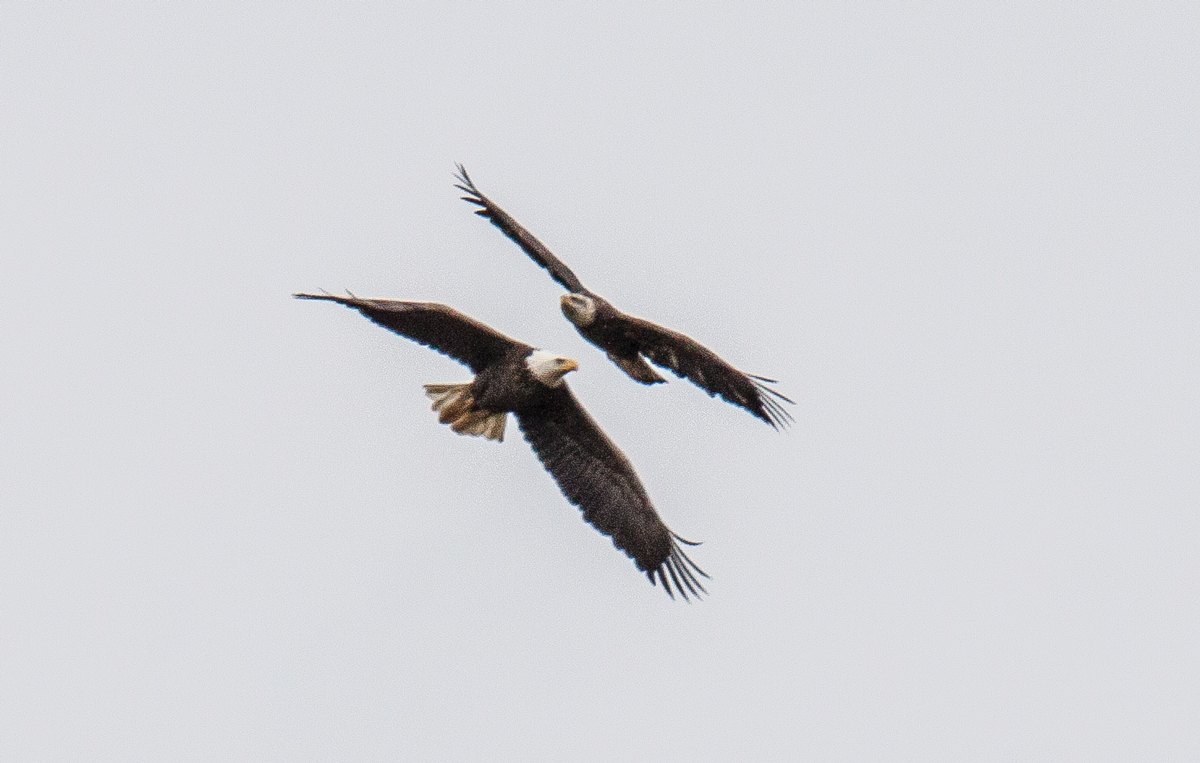
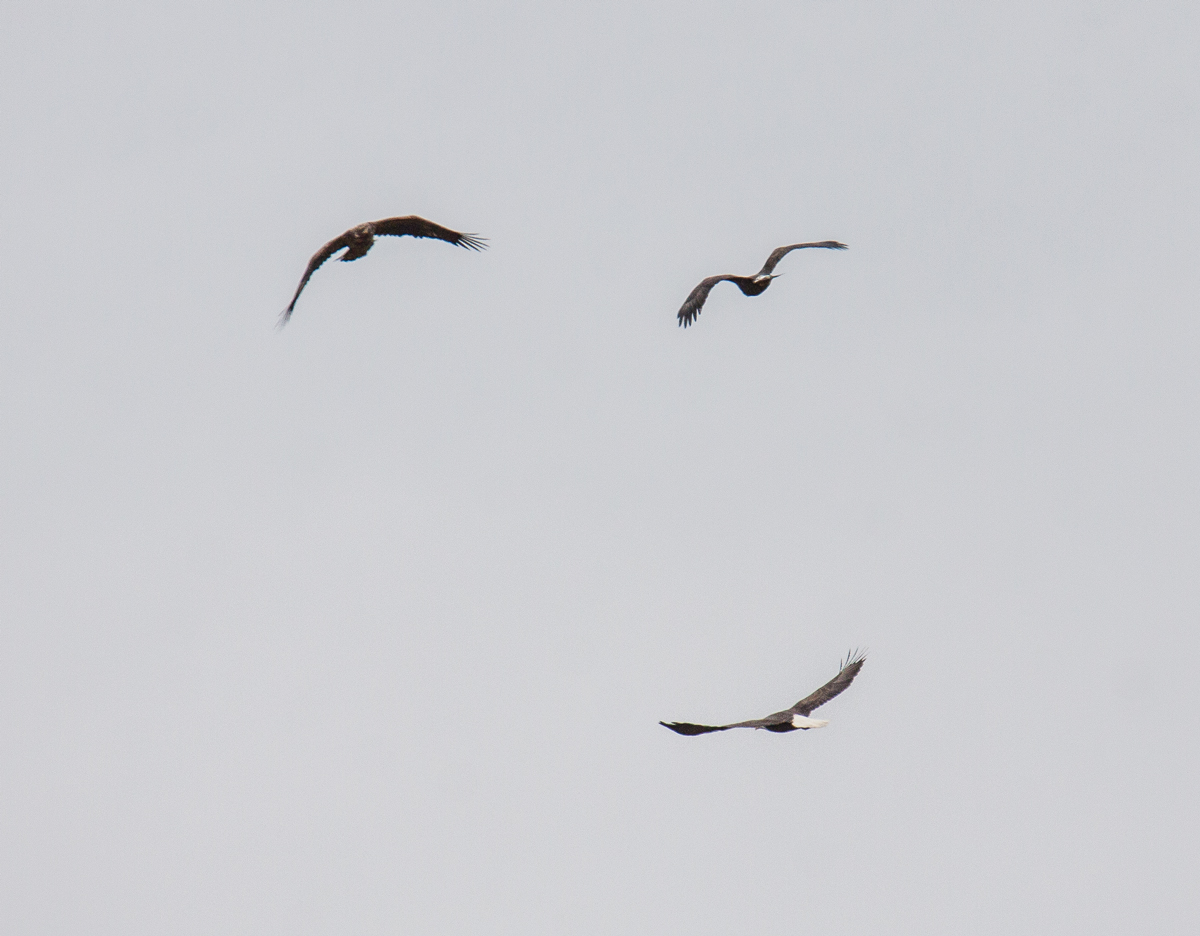
It was cool and cloudy yesterday at Huntley Meadows Park, but my spirits were brightened considerably when I saw three Bald Eagles (Haliaeetus leucocephalus) soaring briefly over the park. It looked to be two adults and one juvenile, perhaps a family on a Saturday outing.

The eagles were pretty far away and I had my telephoto zoom lens extended as far as it could go as I attempted to track the flying eagles. Occasionally two of them or even all three would come into the frame for a split second, but then they would be soaring off into different parts of the sky.

I’m including an assortment of shots to give you a sense of the experience. I consider any day that I spot a Bald Eagle and get recognizable shots of it to be a wonderful day.

Bald Eagle

Bald Eagle

Bald Eagle

Bald Eagle

Bald Eagle

© Michael Q. Powell. All rights reserved.

Read Full Post »

Walking down one of the informal trails at Huntley Meadows Park this past Friday, I spotted a dark shape in a distant tree. The moment that I got my camera focused on what turned out to be a bald eagle, it took off.

My camera settings were not optimal, but I somehow managed to capture some images of the eagle in flight as it flew away. The final shot in this posting shows my initial view of the eagle, just seconds before he took to the air.

As I have noted before, it’s a wonderful day for me whenever I see a Bald Eagle (Haliaeetus leucocephalus) and especially so when I am able to photograph this majestic bird.

Bald Eagle

Bald Eagle

Bald Eagle

© Michael Q. Powell. All rights reserved.

Read Full Post »

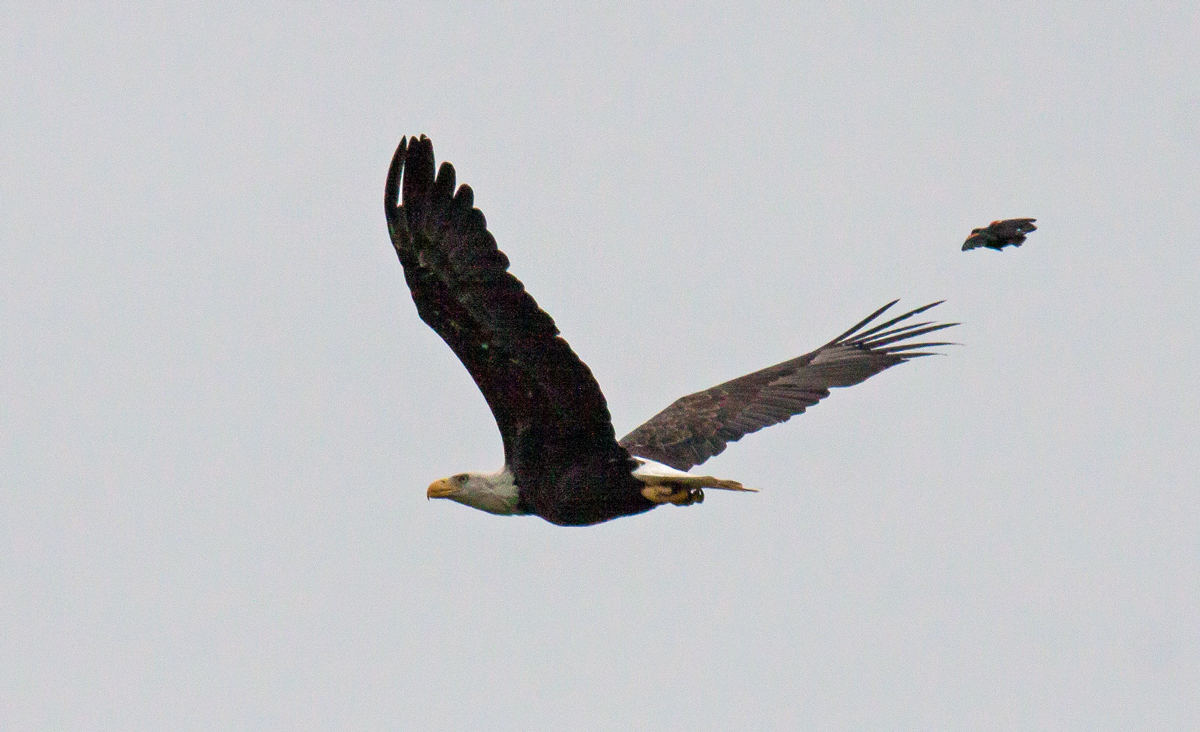
The Red-winged Blackbird (Agelaius phoeniceus) was either really brave or really foolish chasing a Bald Eagle (Haliaeetus leucocephalus) across the sky early yesterday morning at Huntley Meadows Park in Alexandria, Virginia.

Bald Eagle chase

I did manage to get a few other shots (below) in which the eagle’s wings are in more photogenic positions, but the blackbird is farther away from the eagle in each of them.

Bald Eagle chase

Bald Eagle chase

© Michael Q. Powell. All rights reserved

Read Full Post »

As an American, I feel a special affinity for the Bald Eagle (Haliaeetus leucocephalus), our national bird and one of our most visible national symbols. Eight months ago, I was privileged to witness the rescue of an injured bald eagle at my local marshland park and captured some of the best photos that I have ever taken.

This photo, which appeared originally on 4 November last year, seems particularly appropriate today, reminding that our liberty requires constant vigilance and that brave men and women across the globe are on duty today safeguarding that freedom.

If you would like to see additional photos or learn more of the eagle rescue, check out my earlier posting. That posting has been my most popular one ever, thanks in part to the fact that several media outlets used my photos in their on-line coverage and provided links to my blog. Unfortunately, this story ended tragically and the eagle’s injuries turned out to be so severe that this majestic bird was euthanized.

Bald Eagle

© Michael Q. Powell. All rights reserved.

Read Full Post »

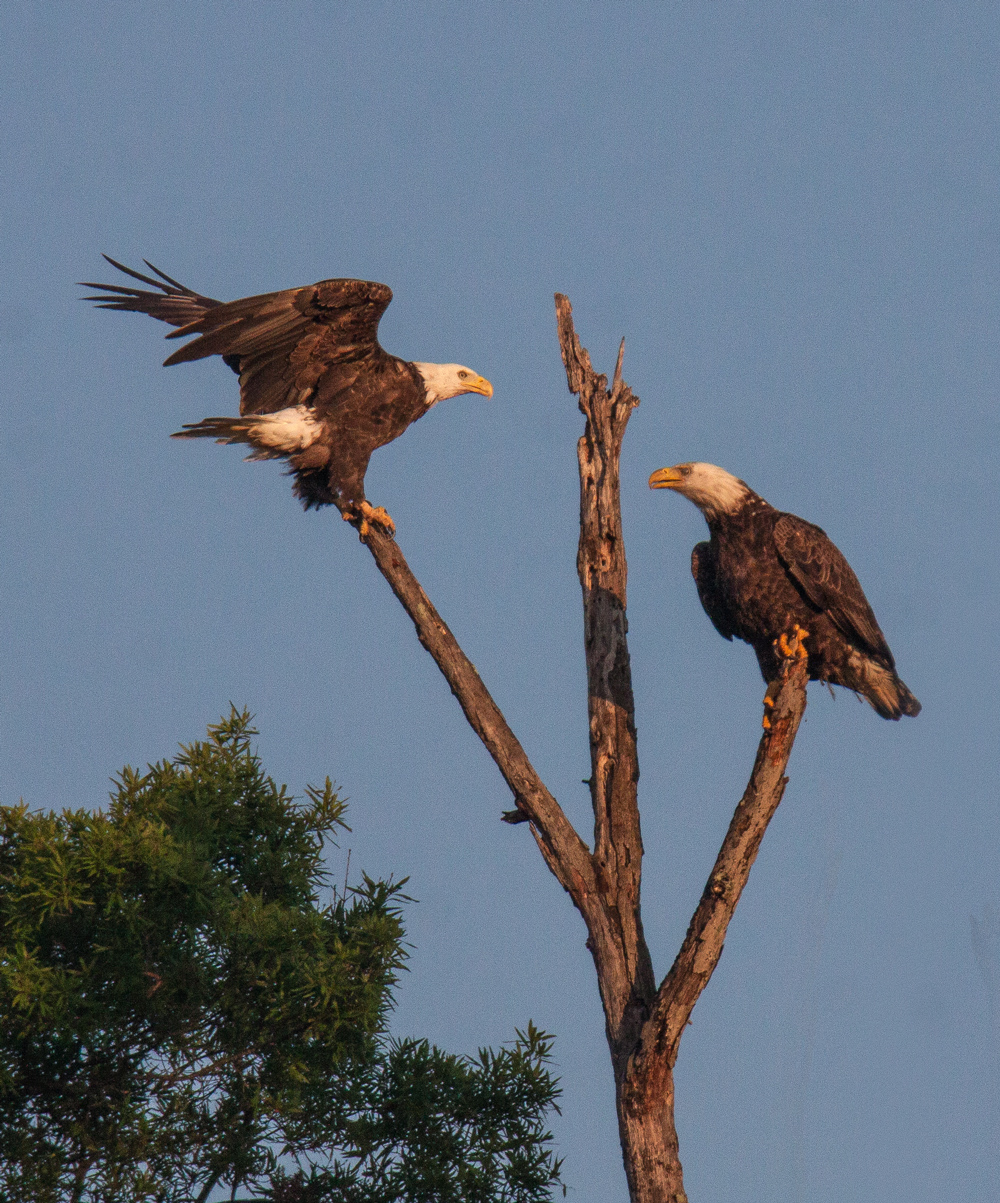
What could possibly be a better way to start a day than seeing a Bald Eagle (Haliaeetus leucocephalus)? Seeing two of them.

I spotted these eagles at Huntley Meadows Park at about 6:45 yesterday morning. Being an early bird helps me to capture the early birds like these.

Bald Eagle

Bald Eagle

Michael Q. Powell. All rights reserved.

Read Full Post »

In the early morning hours above Huntley Meadows Park, all kinds of birds are flying about, like this immature Bald Eagle (Haliaeetus leucocephalus) that I spotted yesterday.

A year ago, I probably would have guessed that this was a hawk, but my identification skills have improved somewhat and I can tell this is an eagle. Given that it takes about five years for a Bald Eagle to mature, I’d guess that this one is about two to three years old, though I defer to more expert birdwatchers on this point.

As you can probably tell, the eagle was moving from right to left as I tracked it over the treetops. I was shooting over a small pond at a pretty good distance in early morning light that was not yet bright, so my ISO was cranked up a bit. I especially like the shots that include the trees. Although I will try to photograph an eagle every time I see one, I think it is a nice extra when I manage to include part of the surroundings in the shot.

Bald EagleBald EagleBald Eagle

© Michael Q. Powell. All rights reserved.

Read Full Post »

« Newer Posts - Older Posts »