Feeds:
Posts
Comments

Posts Tagged ‘Great Egret’

Before long, the White Egrets (Ardea alba) will leave this area for more temperate locations, so I was happy to get a few shots this past weekend of one of them at Cameron Run, a tributary of the Potomac River.

The egrets like to roost in trees that overlook this stream and the first shot shows an egret relaxing in a tree after I inadvertently flushed him. I am deliberately underexposing the image in an effort to keep from totally blowing out the highlights of this very white bird, but it is still very hard to capture any details on the body.

The second shot shows the egret out of the water and its pose reminds me of a dancer, with its slim body and long elegant neck.

If things follow last year’s course, the blue herons will remain in my local area for most of the winter, but the egrets and green herons will soon depart. I’ll be looking for more photo opportunities with them before they leave.

egret_tree_blogegret_standing2_blog

© Michael Q. Powell. All rights reserved

Read Full Post »

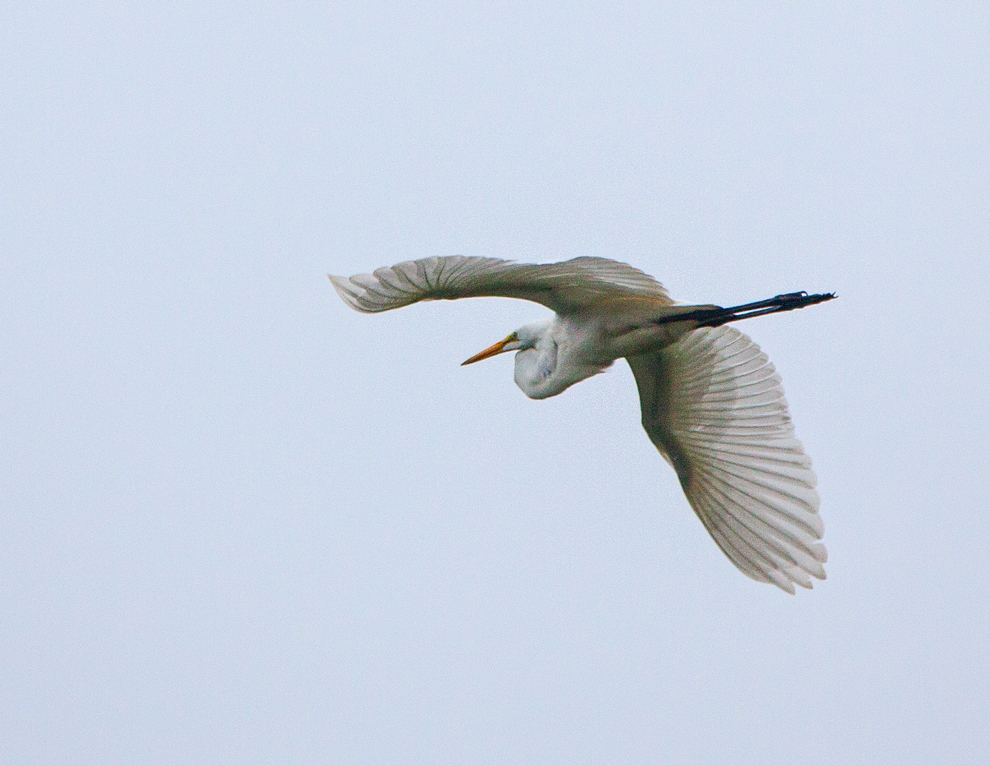
I am in awe of photographers who can capture amazing shots of birds in flight and I continue my quest to improve my own skills. So many things have to come together to get such shots including the timing, location, lighting, and focusing.

Here is one of my most recent efforts, a shot of a Great Egret (Ardea alba) in flight. The focus is a little soft, but I really like the position of the egret that I managed to capture, with a beautiful sweep of the wings.

flying_egret1_blog

© Michael Q. Powell. All rights reserved

Read Full Post »

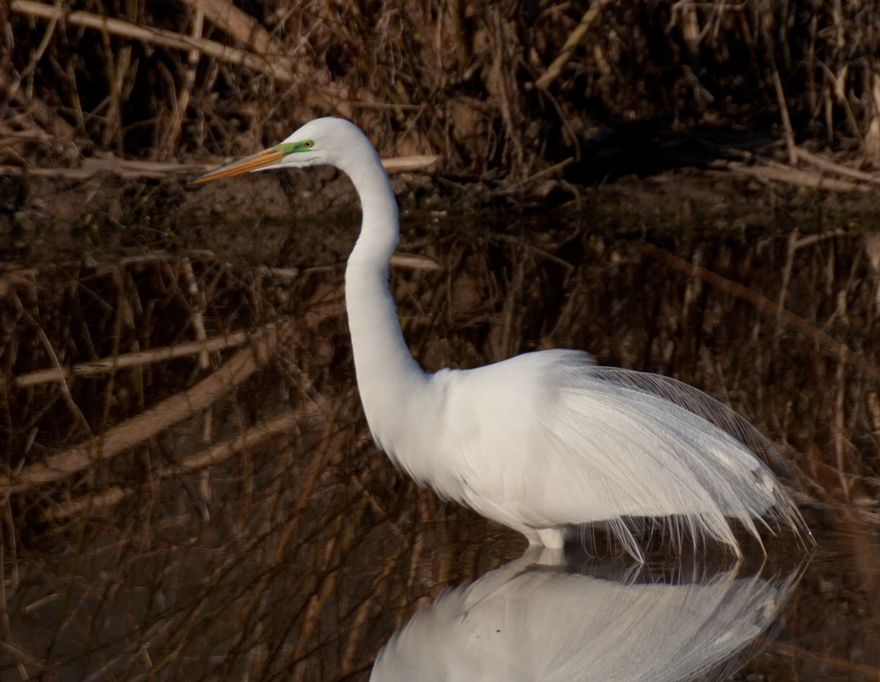
Arriving at the marsh really early in the morning, I was finally able to get a relatively well-exposed shot of a Great Egret (Ardea alba) in breeding plumage, with wispy plumes on its back and a bright green color between its eye and bill (an area known as the “lore”).

Generally I have trouble photographing this beautiful bird, because its brilliant white color gets blown out pretty easily when there is a lot of light and using exposure compensation is often not sufficient. One obvious solution to the problem of too much light is to come at a time of reduced light. I switched to manual mode and, after a bit of experimentation, found a setting that seemed to work pretty well. I also had my camera on a tripod, which is a good practice any time I can manage to use it, which permitted me to use a slower shutter speed.

morning_egret2_blog

Michael Q. Powell. All rights reserved

Read Full Post »

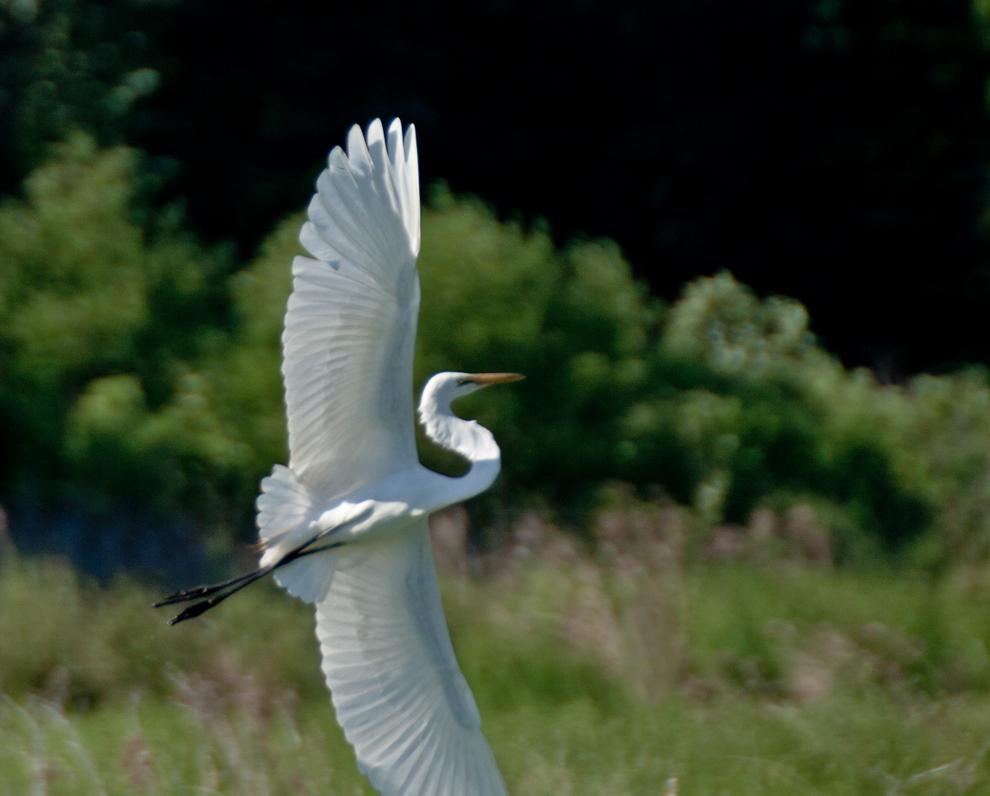
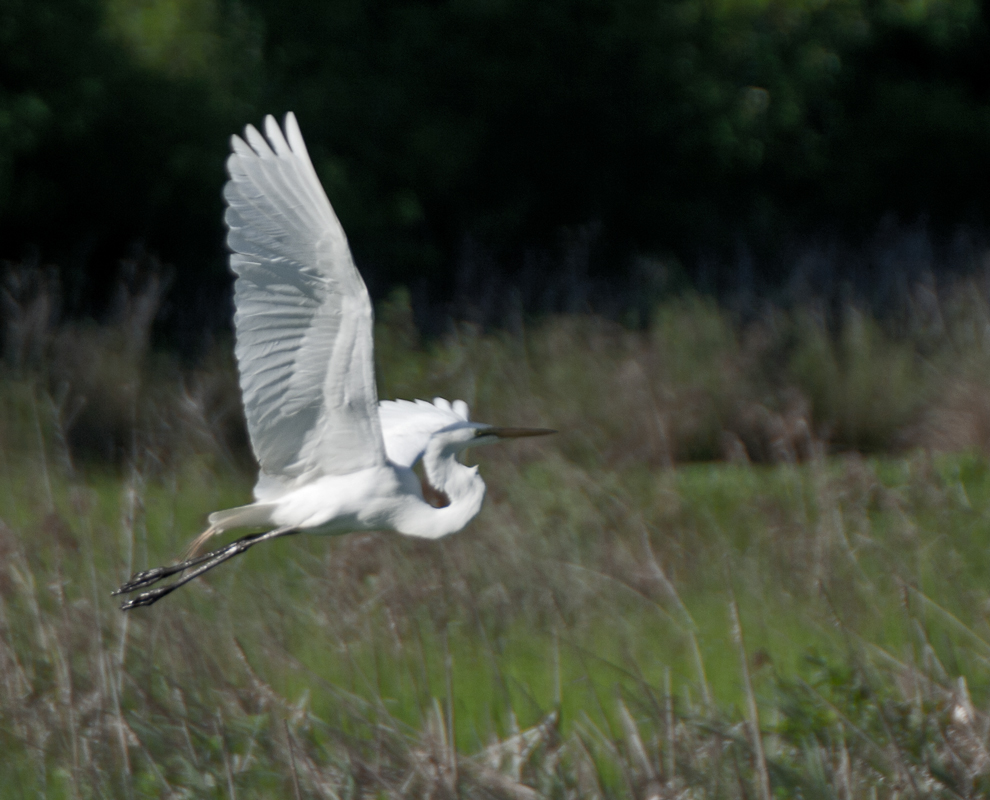
Although I observed as many as eight Great Egrets (Ardea alba) foraging at the same time in my local marshland park this weekend, they were mostly in the distance, but I came up one that was closer and got these shots as it was taking off.

The Cornell Lab of Ornithology notes that these birds have “impressive wingspans,” and I was really treated to a display of those wings. The wings were spread so wide, in fact, that I couldn’t fit them entirely in the frame in the first photo. The impressive set of wings in the second photo remind me of those were associated with Pegasus, the mythological winged horse.

egret_wings2_blogegret_wing1_blog

Michael Q. Powell. All rights reserved

Read Full Post »

Early yesterday morning when I arrived at my local marsh, two Great Egrets (Ardea alba), were already up and trying to find some breakfast. At this time of year, I suspect that they may be eating a lot of frogs at this location, though I didn’t actually see them catch anything. Eventually they wandered into the reeds and cattails, so I gradually lost sight of them.

In the past, I had a lot of trouble taking photos of these beautiful white birds and usually I ended up blowing out the highlights. Two things seemed to have helped me deal with these issues. I am paying a lot more attention to exposure compensation and I am underexposing by as much as two f-stops. Additionally, I am using a longer telephoto lens and filling more of the frame with the subject somehow helps me to get a better exposure.

egret1_blogegret2_blog

Michael Q. Powell. All rights reserved

Read Full Post »

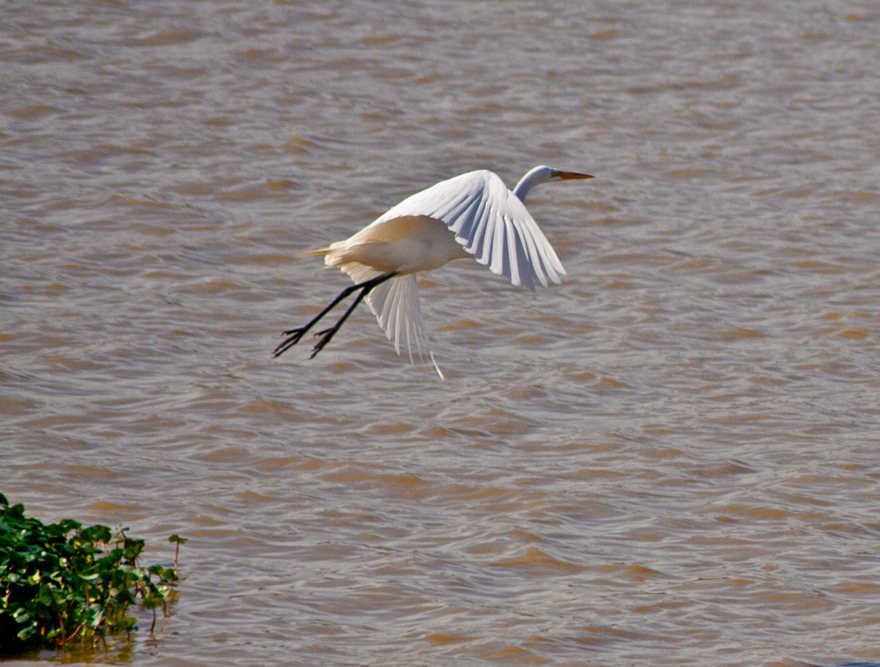
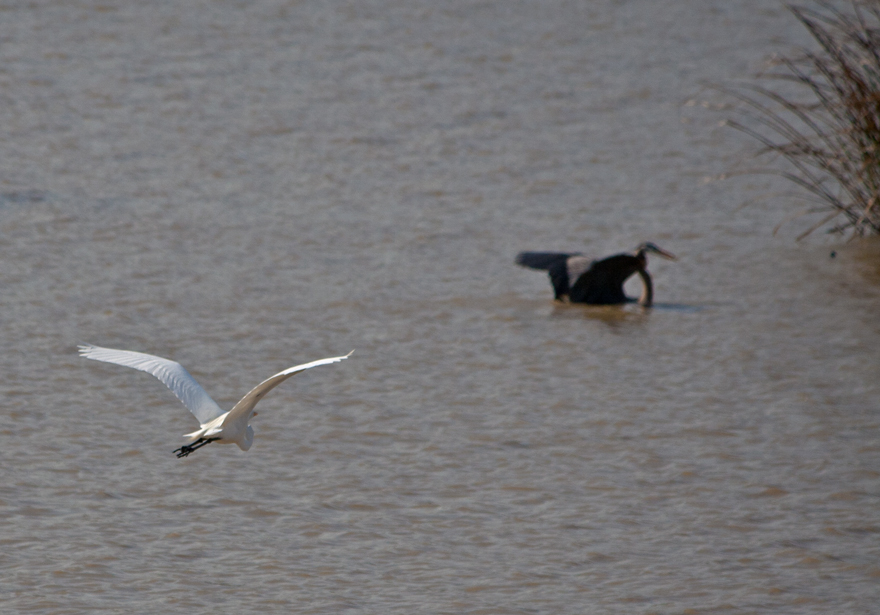
What was the mission that prompted this Great Egret to launch himself into the air?  His mission, it seems, was to continue to harass a Great Blue Heron that he had previous forced out of a prime fishing spot. As you can see from the second photo onward, the egret headed straight for the heron and only at the last minute did he veer off. (I may post some photos later of the initial encounter, but I especially like these in-flight photos.)

I took this series of photos a couple of weeks ago, when I was in Augusta, Georgia, at the Phinizy Swamp Nature Park.

takeoff_blogattack_blogattack2_blogattack3_blogattack4_blog

Michael Q. Powell. All rights reserved

Read Full Post »

I was thrilled yesterday to see a Great Egret (Ardea alba) at my local marshland park for the first time in months. Unlike the Great Blue Herons, which stayed with us all winter, the Great Egrets flew south when the weather grew cold.

This egret was standing and fishing in a small pool of water near the boardwalk that runs through the marsh, undeterred by the crowd of photographers busily snapping away. I was a late arrival to the encounter and missed seeing the egret catch a frog, but I was happy that I was managed to get some good shots.

Egrets are always beautiful, but the wispy plumes they have at this time of year are especially spectacular. Normally I have problems with blowing out the highlights when I try to photograph egrets, but I think that the closeness of the bird helped me to get a decent exposure.

I can’t wait to see what other surprises are in store for me as we move into spring.

egret2_blogegret1_blog

Michael Q. Powell. All rights reserved

Read Full Post »

As many of you know, periodically I try to take photographs of the Great Egrets (Ardea alba) that are often present in the waters or the trees of Cameron Run, a tributary stream of the Potomac River. Usually I am frustrated, because the bright white bodies of the egrets caused my images to be overexposed and the highlights are almost always blown out.

Today, the light was a little more forgiving and I was able to capture an image of an egret with the light coming from the side. There is a dramatic glow surrounding part of its body and a nice reflection in the water. It is certainly not a perfect photo, but I like the way that it turned out.

Egret with dramatic lighting

© Michael Q. Powell. All rights reserved.

Read Full Post »

This morning I went shooting at Cameron Run, a tributary stream of the Potomac River in Alexandria, VA. I frequently commute along a road that parallels this stream and have often seen large white wading birds as I drove by. Today I decided to investigate and see if I could get some photos and determine if they were herons or egrets or some other kind of bird.

I did manage to get some shots of the birds in the water and even in the trees, but learned how difficult it is to get a proper exposure with a pure white bird. I’m pretty confident that the birds are Great Egrets (Ardea alba), which are also known as Great White Egrets. A passerby with binoculars (who seemed to know what he was talking about) told me that the orange beak is one of the characteristics that distinguishes the egret from the heron. If you want to know more, there is lots of interesting information about the Great Egret in an article on the website of the Cornell Lab of Ornithology.

The Great Egret is a really impressive looking bird, so much so that it is the symbol of the National Audubon Society, according to Wikipedia.  The Cornell Lab article points out that Great Egrets were hunted nearly to extinction for their plumes in the late nineteenth century, sparking conservation movements and some of the first laws to protect birds.

I was struck by the fact that the Great Egret roosts in the trees and seems to enjoy doing so with other egrets. In one cluster of trees I saw three egrets that appeared to be grooming themselves—they definitely did not seem territorial. I was impressed too by the wingspan that I got to see when I startled one of them and he flew up to a nearby tree.

Now that I know what kind of birds these are and where they hang out, I’m sure I’ll be back to watch them and, hopefully, to photograph them.

Great Egret in a tree
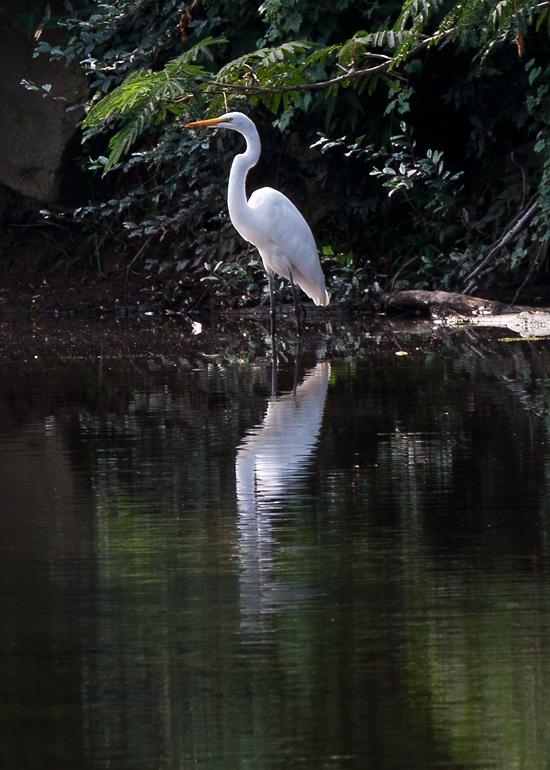
Great Egret in the shade

Great Egret fishing in the stream

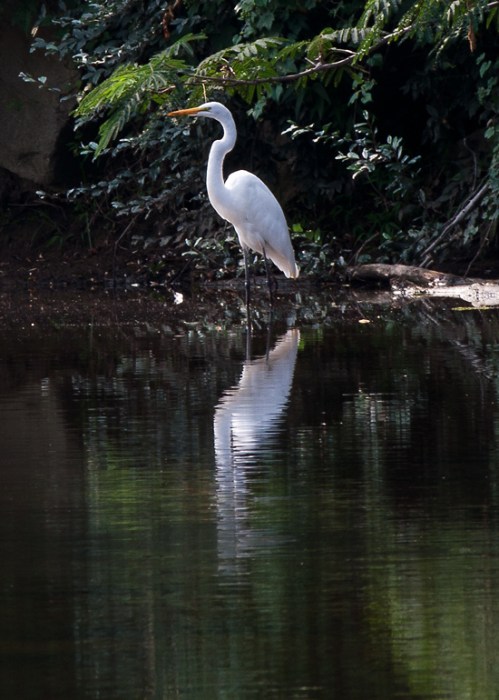
Reflections of a Great Egret

© Michael Q. Powell. All rights reserved.

Read Full Post »

« Newer Posts