Feeds:
Posts
Comments

Posts Tagged ‘Great Blue Heron’

On Monday I spotted this Great Blue Heron (Ardea herodias) on a stump in the middle of a pond at Huntley Meadows Park. The heron seemed to be fully attentive and somehow his pose struck me as regal, like that of a monarch surveying his kingdom. The wonderful reflections in the pond added additional visual interest to the image that I was able to capture.

Great Blue Heron

© Michael Q. Powell. All rights reserved.

Read Full Post »

When it is really hot outside, birds try to avoid direct sunlight, like this Great Blue Heron (Ardea herodias) that I spotted last week during a visit to Occoquan Bay National Wildlife Refuge. The heron was relaxing in the vegetation at the edge of a small pond and appearing to be standing on a single leg, with the other leg probably tucked under.

In the winter months, I often see herons using this position as a way of conserving body heat, which obviously was not needed on this hot, humid day, so I am wondering if the “missing” leg was simply hidden by the vegetation.

Great Blue Heron

© Michael Q. Powell. All rights reserved.

Read Full Post »

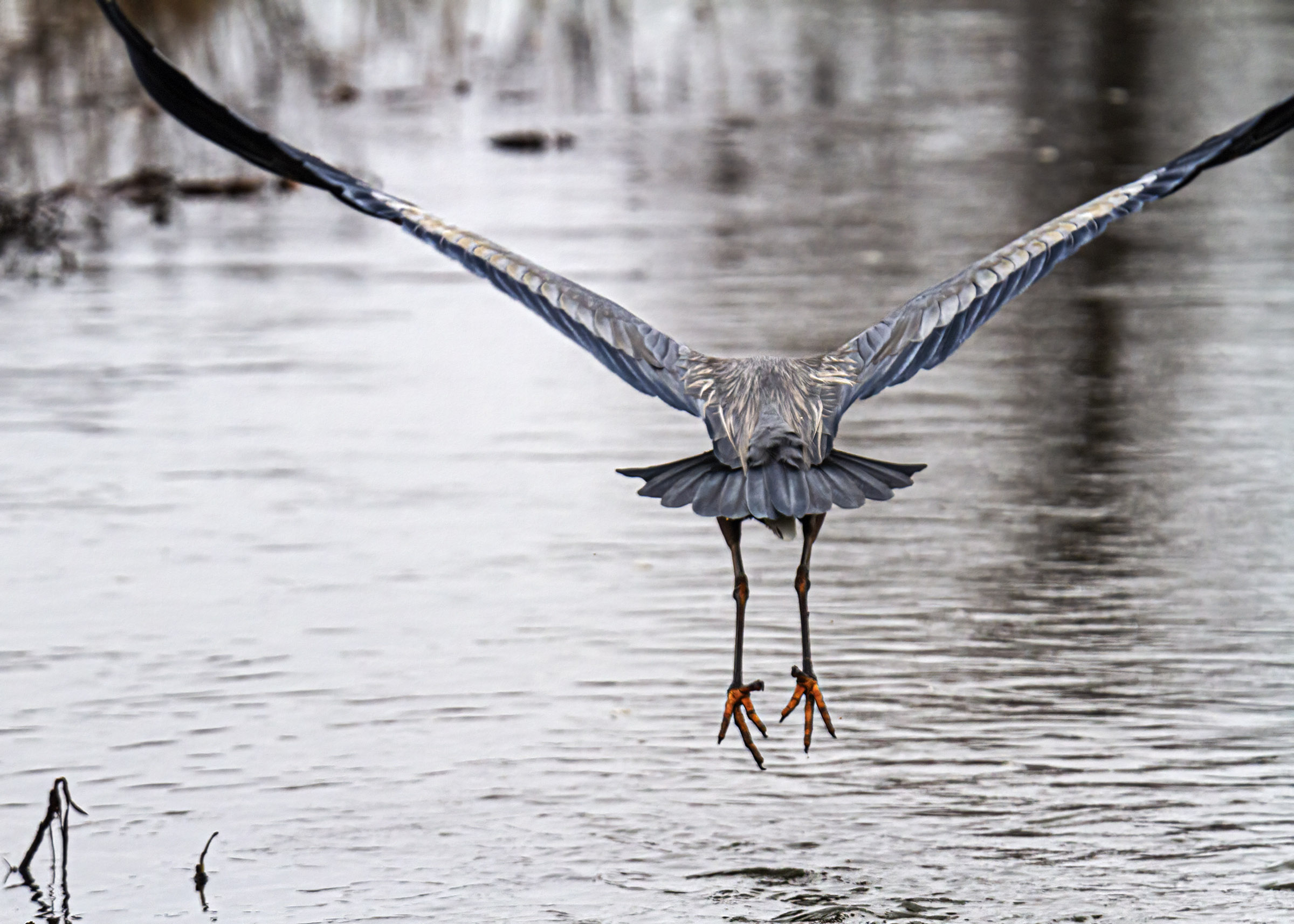
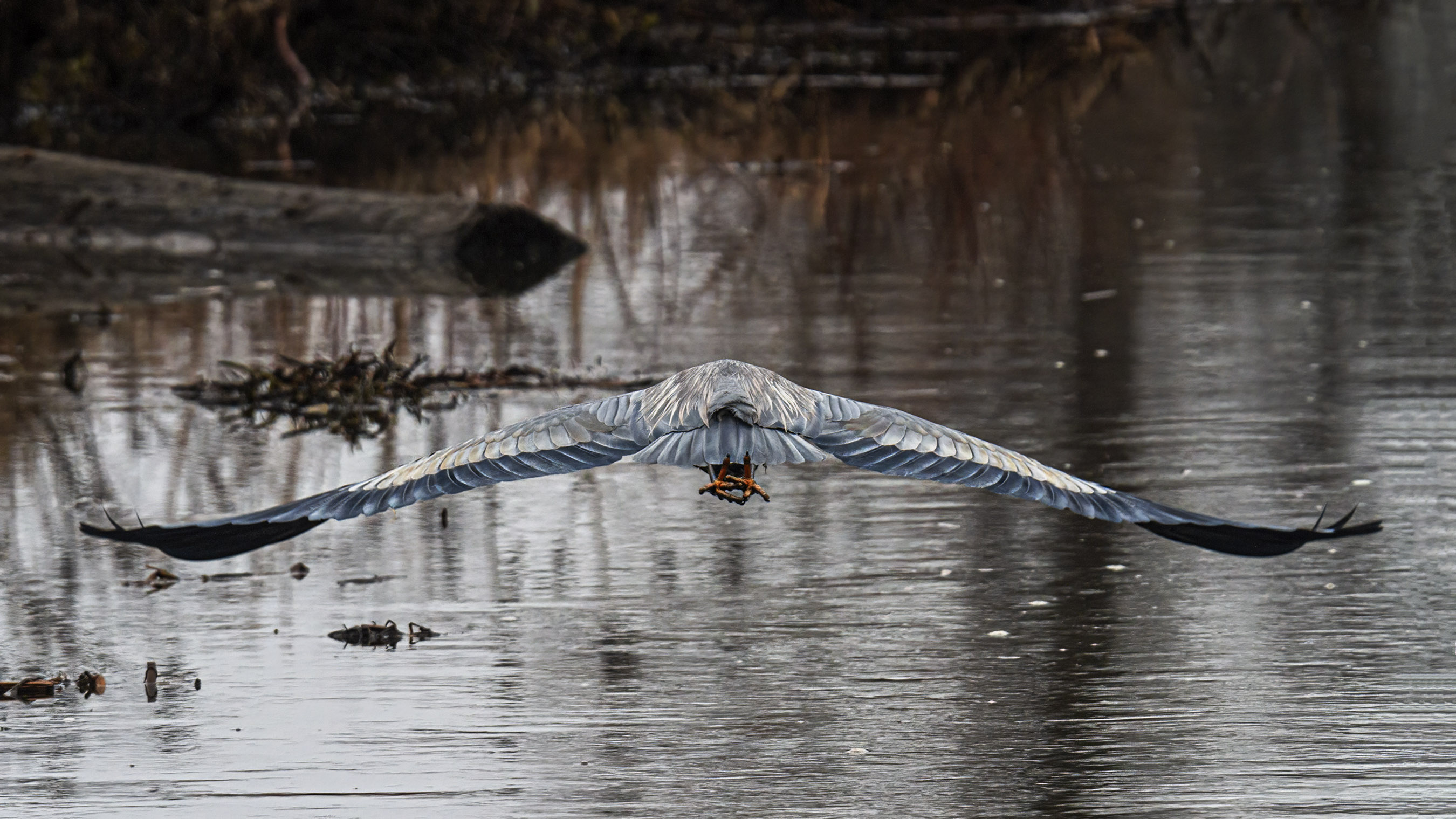
When Great Blue Herons (Ardea herodias) take off from the water, they really stretch out and usually I cut off part of their bodies when trying to photograph them in action. Last week, though, my timing was good and I captured this little sequence of images as a heron took to the air, flew for a short distance, and “stuck” its landing in the water.

I was really happy with the way that I was able to capture so many details, from the arc of the water droplets as the heron rose out of the water to the bird’s different-colored feathers. In the final photo, the spread wings, wind-blown “hair,” and the wonderful reflection combine to create a really cool mood in the image.

Great Blue Heron

Great Blue Heron

Great Blue Heron

© Michael Q. Powell. All rights reserved.

Read Full Post »

I do not pay too much attention to the statistics that WordPress provides about my blog, but I could not help but notice this morning that, according to the “official” statistics, I have now had over a half million views since July 2012 of 5,33p posts. Wow! It’s a bit of a mystery to me how exactly WordPress counts those views, so I am not sure if the stats are fully accurate, but those numbers indicate a lot of effort on my time.

More than that, though, those statistics reflect an incredible amount of support and encouragement from so many of you. Thanks to all of you, whether you have followed my photographic wanderings for a day for for years. The second image below is a screen shot of the overall statistics for the blog this morning.

As you may have noticed, I have slowed my pace of posting a bit over the last six months as more of my free time has been increasingly devoted to other interests and activities. I’ll be keeping up with the photography blog, though, at least a few times a week and quite possibly more frequently than that as the weather warms up.

During a recent visit to Occoquan Bay National Wildlife Refuge, I captured this shot of a Great Blue Heron (Ardea herodias) in action. Most of the time these herons thrust their bills violently in the water in attempting to catch fish, but this one was doing so much more gently that normally. The water level was low because it was lot tide and the heron may have been trying to pluck a small fish out of the water. On this attempt, though, he was not successful, but the heron’s open bill made for a nice photo.

I thought about posting one of my “best” images for today’s blog entry, but decided instead to continue my habit of posting recent images that appeal to me. As many of you know, I am generally content to post photos of everyday creatures to highlight the beauty that surrounds us all of the time if we slow down and take the time to observe it. Beauty is everywhere.

Great Blue Heron

© Michael Q. Powell. All rights reserved.


Read Full Post »

I see Great Blue Herons (Ardea herodias) quite often at Occoquan Bay National Wildlife Refuge, but generally they are far away from me. Last week, however, I was lucky to get close enough to a heron to be able to capture a portrait-like image of the big bird. How did I do it?

The heron was standing in the waters off of the shore of the refuge and was mostly hidden from view by the vegetation. I was walking along a trail parallel to the water and discovered a little break in vegetation that gave me a clear view of most of the heron. I twisted and turned my body, trying to make sure that no branches were blocking my view and zoomed in with my telephoto lens. I had to wait a little while and eventually the heron lifted its head and turned to the side, giving me a perfect profile pose.

Some wildlife photographers are always searching for new species to photograph, but most of the time I am content to photograph the same species over and over, capturing the changing seasons and environments in which I find these beautiful creatures.

Great Blue Heron

© Michael Q. Powell. All rights reserved.

Read Full Post »

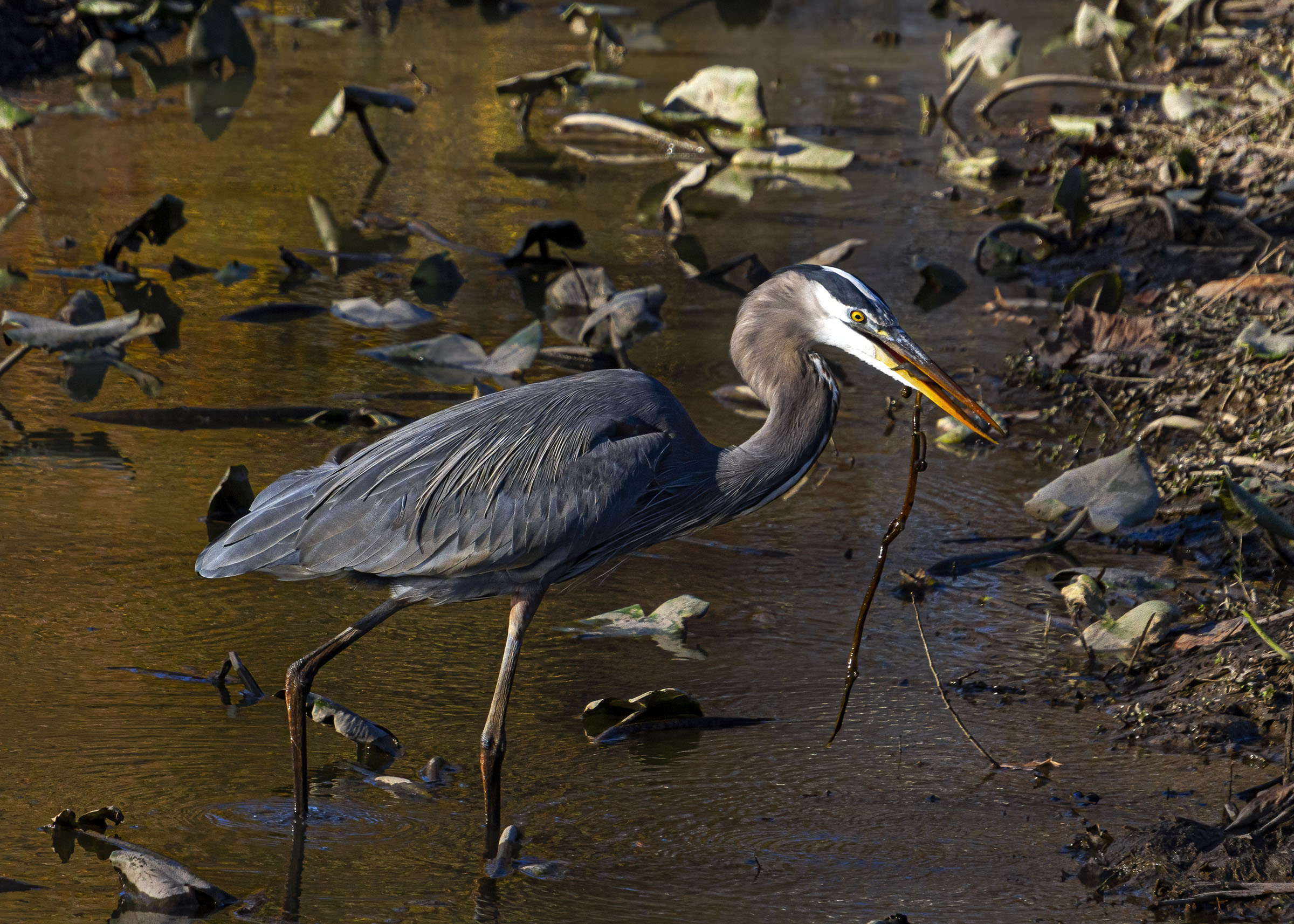
This past Friday I photographed this Great Blue Heron (Ardea herodias) at Occoquan Bay National Wildlife Refuge in stealth mode as it attempted to sneak up on some potential prey. At other times, the heron walked through the water with its head held high. It was a fun little photo session for me, though I suspect that the heron wished it were more successful in catching some fish.

Great Blue Heron

Great Blue Heron

Great Blue Heron

© Michael Q. Powell. All rights reserved.


Read Full Post »

Last Friday I was walking slowly along a trail that runs parallel to the water off of Occoquan Bay National Wildlife Refuge when I noticed a Great Blue Heron (Ardea herodias) doing the same thing. Most of the time when I see a heron, it is in the water, though occasionally I have spotted one perched in a tree. It is highly unusual for me to see one on dry land, but this heron seemed to strolling down the path, taking in the sights.

I slowed down a little to maintain my distance from the heron and managed to capture this shot as heron was lifting its long toes to take another step. Eventually the heron became aware of my presence and quickened his walking pace a bit until he reached an opening to the water and flew away. What a fun little encounter with the heron!

Great Blue Heron

© Michael Q. Powell. All rights reserved.

Read Full Post »

This Great Blue Heron (Ardea herodias) had its neck extended so much on Monday at Occoquan Bay National Wildlife Refuge that it reminded me of a giraffe. The mind can sometimes make weird associations.

We have finally made it to the end of January. What a crazy month it has been in so many different ways.

Great Blue Heron

© Michael Q. Powell. All rights reserved.


Read Full Post »

This Great Blue Heron (Ardea herodias) was having pretty good success in catching some small fish one morning last week at Occoquan Bay National Wildlife Refuge. I personally do not like to have fish for breakfast, but am aware that some people like lox, mackerels, or other kinds of fish with their morning meals. As the old Latin saying goes, “De gustibus non est disputandum” (“There is no accounting for taste.”)

Great Blue Heron

© Michael Q. Powell. All rights reserved.

Read Full Post »

This last week or so, I have had several opportunities to capture “artistic” shots of Great Blue Herons (Ardea herodias) at Occoquan Bay National Wildlife Refuge. In these cases the heron was not actively engaged in fishing and was standing in the vegetation a bit removed from the water.

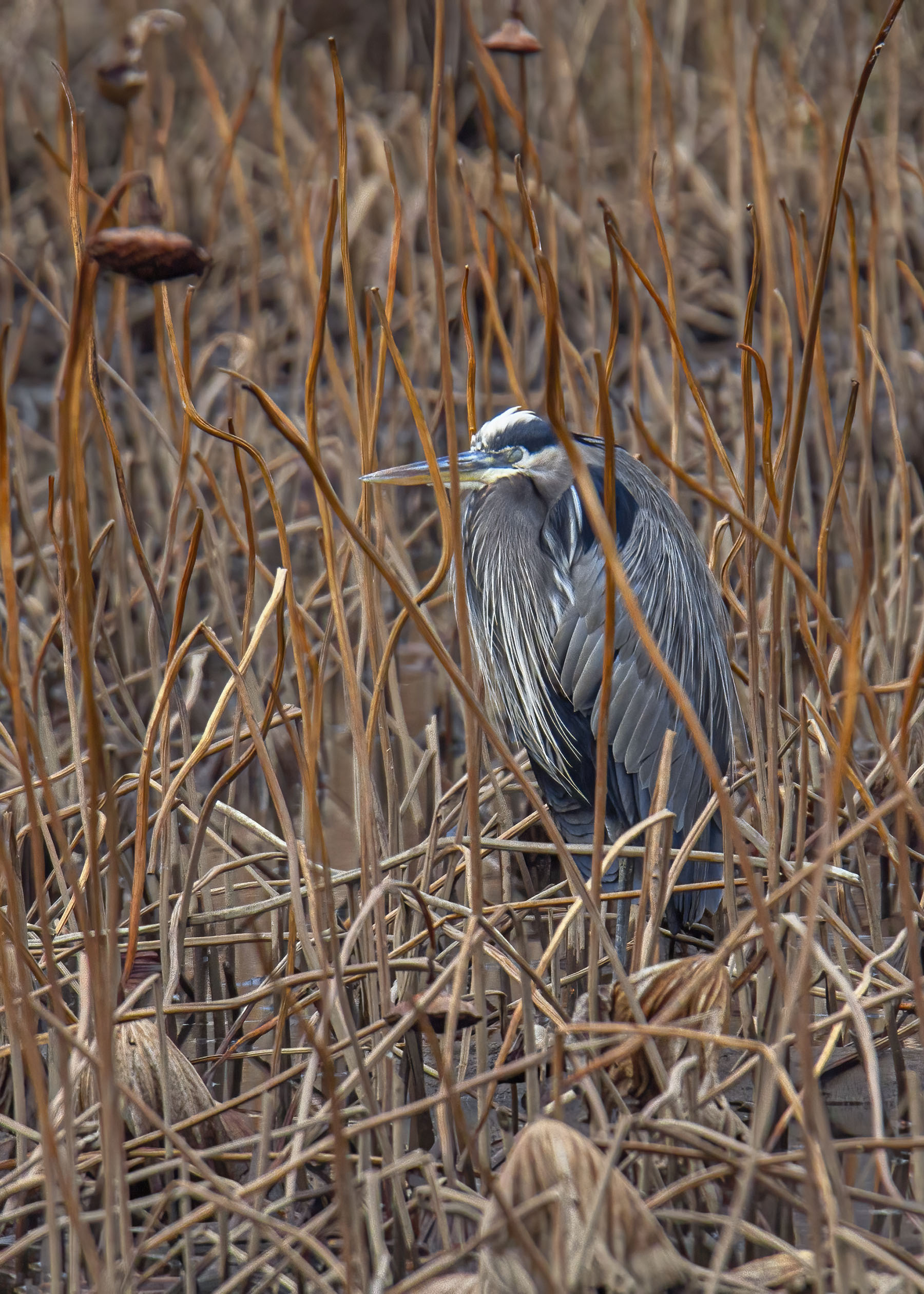
In the first two photos, I was struck by the beautiful light that was falling on the heron. I particularly like the heron’s pose in the first image in which the heron has his neck stretched out, giving him a very slim profile. In the final photo, the heron was partially hidden by the reeds and is much more hunched over in an effort, perhaps, to retain his body heat.

Great Blue Heron

Great Blue Heron

Great Blue Heron

© Michael Q. Powell. All rights reserved.

Read Full Post »

Yesterday I watched a Great Blue Heron (Ardea herodias) fishing at Occoquan Bay National Wildlife Refuge. After an extended period of cold and cloudy days, it was a treat for both of us to be out in the somewhat warmer weather. Although the the heron was really focused on its task, its results were modest—the fish that it caught may well be the tiniest fish that I have ever seen a heron catch.

I am hoping that the heron was eventually more successful later in the day—it would take a lot of those tiny fish to satisfy its appetite.

Great Blue Heron

© Michael Q. Powell. All rights reserved.

Read Full Post »

Some birds, like the ospreys and Great Egrets, leave our area and migrate to warmer climates as winter approaches. Others, like Great Blue Herons (Ardea herodias), remain with us and have to work harder to find food.

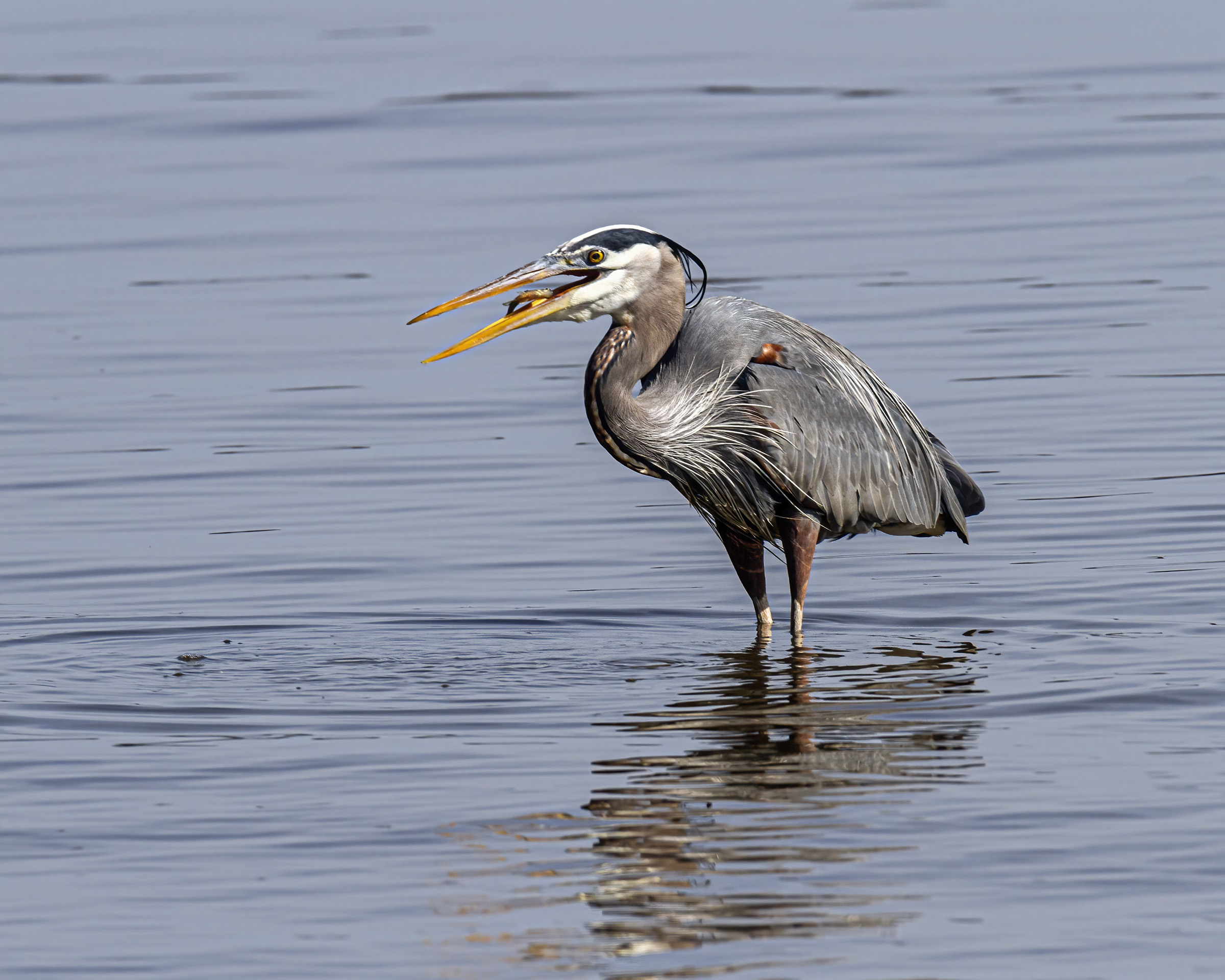
Last week I spotted a heron standing in the shallow water of one of the tidal ponds at Occoquan Bay National Wildlife Refuge. In the past I have often seen herons wait patiently for extended periods of time to catch large fish, but this heron was content to strike often and pluck small fish from the water—every few minutes he would catch another fish, swallow it in a single gulp, and return to fishing.

I encourage you to click on the image to get a better look at the small fish in the heron’s bill and the visible spray of water droplets. I also really like the dynamism of the  heron’s pose that suggests both the energy and the focus of the heron.

Great Blue Heron

© Michael Q. Powell. All rights reserved.

Read Full Post »

I can usually count on spotting at least one Great Blue Heron (Ardea herodias) during my visits to Occoquan Bay National Wildlife Refuge. Sometimes, when the tides are right, I will see them in the waters of the bay, but most often they are in the small ponds throughout the refuge.

Last Friday I caught sight of this heron in the shallow waters of one such pond. The heron was intently focused on the water and eventually plunged its head into the water. When the water is deep, the heron will thrust violently into the water, but in this case the movement was much smaller.

I watched and waited as the heron slowly lifted its head to see if it had been successful in catching a fish. As you can see in the final photo, the results were not clear. Obviously the “catch” included a lot of vegetation, but I can’t tell for sure if there was also a small fish. A few seconds later the heron seemed to swallow, dipped its bill into the water to rinse it, and resumed its fishing.

Great Blue Heron

Great Blue Heron

© Michael Q. Powell. All rights reserved.

Read Full Post »

The leaves are still on the trees, which makes it tough for me to spot perched birds, which is one the reasons why I focus on insects in the summer months. Nonetheless, I tend to scan the trees when I am out with my camera, hoping to spot a bird perched in the open.

On Monday at Occoquan Bay National Wildlife Refuge, I spotted an unfamiliar shape through the foliage as I was hiking along one of the trails. As I moved a bit to the side to get a better view, I realized that it was a Great Blue Heron (Ardea herodias). Now I know that herons will roost in the trees at night, but it is a little unusual for me to see on in a tree at midday. The bird appeared to be keeping an eye on something, almost like a sentinel, though I have no idea on what its attention was focused.

I moved slowly and stealthily to get a better shooting angle and eventually captured this image of the heron. As you can see in the photo, the heron was definitely alert and paying attention—it did not appear to be relaxing in the tree. Maybe the heron felt like the king of the world and was taking a moment to survey his realm.

Great Blue Heron

© Michael Q. Powell. All rights reserved.

Read Full Post »

Although it was sunny, the wind was kicking up quite a bit during my visit on Thursday to Occoquan Bay National Wildlife Refuge. Bird activity seemed lighter than usual. Perhaps the birds were all taking shelter from the wind,

At the far edge of a small pond, I spotted a Great Blue Heron (Ardea herodias) hunched over in a one-legged pose. The wind was whipping around the wispy feathers on the heron’s chest, head, and back. I encourage you to click on the photo to get a closer look at the heron’s “flyaway” feathers.

Have a wonderful weekend.

Great Blue Heron

© Michael Q. Powell. All rights reserved.

Read Full Post »

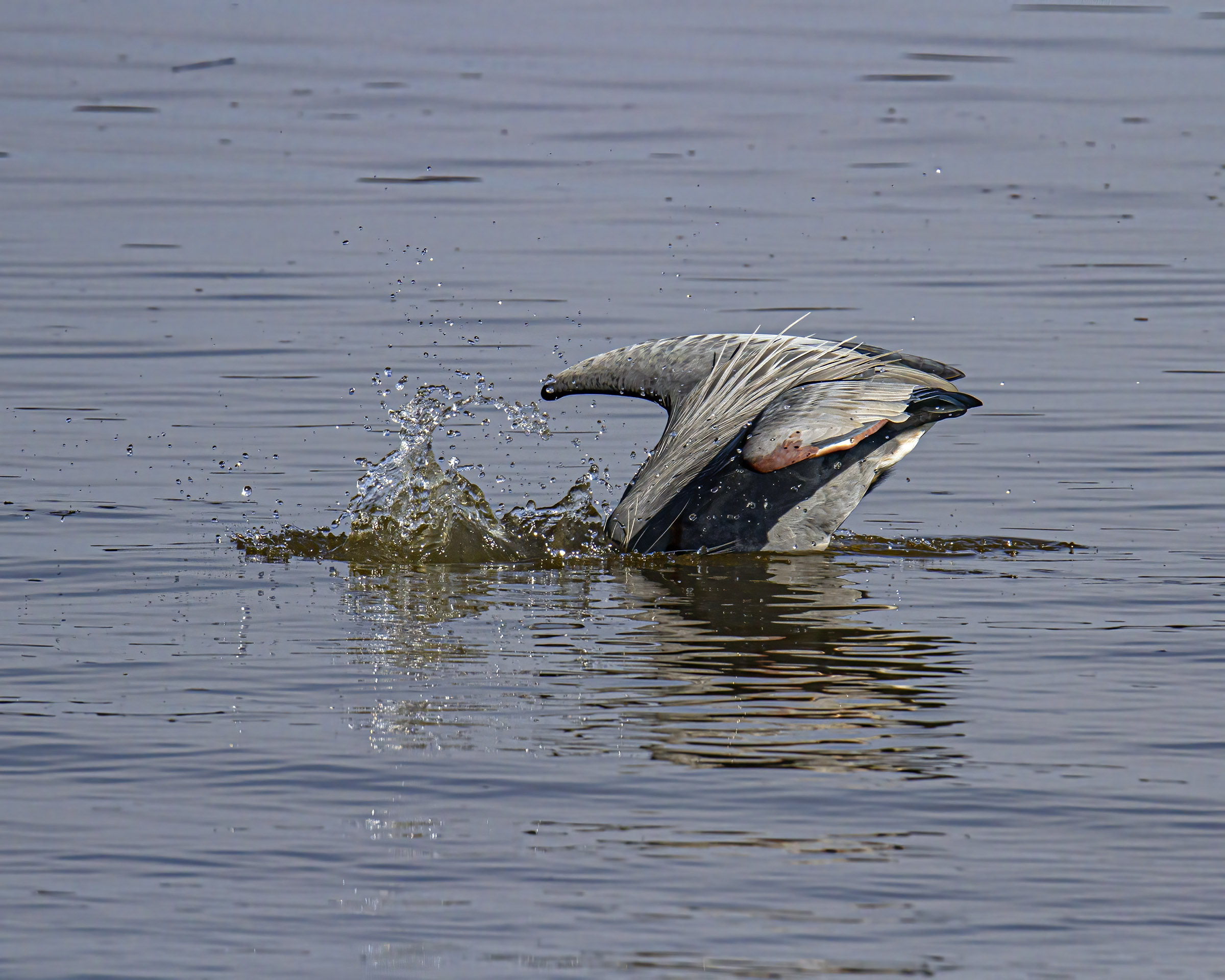
It is hard to anticipate when a Great Blue Heron (Ardea herodias) will strike. Herons have an amazing amount of patience and will often stand stationary for extended periods of time and then without much warning they will strike swiftly and violently.

Last week I was fortunate to be able to capture a sequence of shots of a heron in action at Occoquan Bay National Wildlife Refuge. I was amazed at how deeply the heron plunged its head, neck, and upper body into the water, creating quite a splash in doing so.

It seemed like the heron kept its head underwater for quite a while, but my sense of time is sometimes distorted in these kinds of situations. In any case, I impatiently waited for the heron to lift its head, anxious to see what it had caught. The heron slowly lifted its head and eventually it became clear that it had caught nothing but water. It may be my imagination, but I seem to see a mix of disbelief, dismay, and disgust in the heron’s expression in the final photo.

Undeterred, the heron returned to fishing and I moved on down the the trail, undoubtedly happier with my “catch” than the heron was with his.

Great Blue Heron

Great Blue Heron

Great Blue Heron

Great Blue Heron

Great Blue Heron

© Michael Q. Powell. All rights reserved.

Read Full Post »

The tide was going out on Monday when I spotted a Great Blue Heron (Ardea herodias) in the shallow waters off of Occoquan Bay National Wildlife Refuge. The heron was walking slowly, stopping periodically as it scanned the water, patiently searching for prey. I decided to stop, wait, and watch the heron.

I know from long experience that herons are very patient—it is hard to remain constantly alert for extended periods of time, hoping to anticipate the moment when the heron will strike.

On this occasion, I was able to capture some of the action when the heron plunged its head into the water. Time seemed to slow down as I waited to see what, if anything, the heron had caught. As you can see in the first photo, the heron’s catch was a modestly-sized fish. The heron flipped its head to the side to reposition the fish—herons swallow fish headfirst in a single gulp. The final photo shows the fish’s final repositioning in the heron’s long bill. A split second later the heron tilted it bill upward and the fish disappeared from sight.

As I looked a these three photos, I was struck by the way that the heron’s long head feathers moved around as it twisted and turned its head. That little detailo revived distant memories of the 1970’s when I had long hair—I remember flipping my head from time to time to keep the hair out of my eyes.

Great Blue Heron

Great Blue Heron

Great Blue Heron

© Michael Q. Powell. All rights reserved.


Read Full Post »

How good is your balance? This morning I was reading an article in AARP magazine about measuring your fitness level and one of the tests was a one-legged balance test. I tested myself and was able to hold the pose for only a few seconds. Yikes!

A Great Blue Heron (Ardea herodias) that I spotted on Monday at Occoquan Bay National Wildlife Refuge would have aced the test. The heron seemed to be perfectly stable as it relaxed in an open area adjacent to a small pond while standing on a single leg. It was a cold morning and I suspect that the heron’s other leg was tucked under its feathers to conserve body heat.

As I get older, I have become more conscious of the need for balance in all areas of my life. When I worked for the federal government a lot of lip service was given to the importance of “work-life balance,” but the sad reality was that few of my co-workers achieved that sense of balance—most of us, myself included, tended to be workaholics. Retirement has provided me a lot more freedom to use my time in a way that attempts to balance my physical, mental, spiritual, relational, and creative needs. It’s a constant juggling act, but I’m working on it.

In the meantime, I think I would do well to emulate the Great Blue Heron and practice my one-legged pose some more.

Great Blue Heron

© Michael Q. Powell. All rights reserved.


Read Full Post »

Great Blue Herons (Ardea herodias) often stand still for extended periods of time when fishing. I consider myself to be quite patient, but most of the time a heron’s patience exceeds my own and I will move on before he has made a strike to catch a fish.

Sometimes, though, herons will walk slowly through the water, carefully lifting their large feet to create minimum disturbance in the water. That was the case last week at Occoquan Bay National Wildlife Refuge, where I spotted a heron slowing making its way through the shallow water—the waters in the Potomac River area are influenced by the tides and it was near low tide when I was observing the heron.

I captured this fun little image just as the tips of the heron’s visible foot cleated the water. If you look closely, you will notice that he claws on the heron’s visible foot were just touching the water. (I love to play with words, so you could say that the heron was “just scratching the surface.” Sorry.)

The angle at which I took the shot caused the heron’s two legs to blend together, so that it looks almost like there are two legs coming out of a single knee. The reflections further confuse the viewer, because it is not clear where the legs end (especially the back leg) and where the reflections begin. The net result, I think, is a positive one, prompting the view to linger longer on the image in an effort to resolve the visual confusion—many viewers scroll through photos really quickly and it is a real plus when something about an image causes them to pause for a moment and examine it more closely.

Great Blue Heron

© Michael Q. Powell. All rights reserved.

Read Full Post »

Have the rules changed or have I simply changed? When I first starting getting into wildlife and nature photography, one of the basic “rules” that I learned was I should try to fill the frame with my primary subject. I acquired longer lenses and worked to become more stealthy so I could get closer and closer to my subjects. My “ideal” shot was a sharp “portrait” image with a soft creamy background.

I still like those kind of images, but I began to realize that I was removing the birds and bugs from their environments. I am now pushing myself to try to include more of the relationship between the subject and its surroundings and ideally the interaction between the two. What that means is that I am growing increasingly comfortable with images in which the primary subject takes up only a small portion of the frame.

In the first image, for example, I could have easily cropped this shot of Song Sparrow (Melospiza melodia) much more tightly to draw the viewers’ eyes to the bird’s feather details. Instead, I limited the cropping in order to show all of the dried vegetation hanging from the branch on which the sparrow was perched.

In the second image, the Great Blue Heron (Ardea herodias) was quite far away. In the past, I might not have taken the shot, because I knew I would not be able to capture a detailed view of the heron. In this case, I instantly knew that I wanted to capture the mood of the moment by showing the heron in its environment. I was happy to be able to convey a sense of the peacefulness of the moments that I shared with this beautiful heron, a time for reflection both literally and figuratively.

Rules and guidelines are undoubtedly helpful for beginners, because they establish a general framework for understanding what makes a “good” photograph. Over time and after spending countless hours with my camera and my computer, I have learned that “good” is a relative term and that “beauty” is often subjective. Most importantly, however, I have developed a greater sense of what types of photos I personally like and become more skilled in creating these kinds of images.

Nothing is static, though, and I know that my tastes and preferences and those of my readers are likely to change over time. Artists of all types are prone to introspection and are more likely than most other people to explore their inner landscape for inspiration and understanding. Whatever output those artists create is often the result of the interplay between their inner world and the outer world—the “environment” really matters in understanding the context of a work.

Song Sparrow

Great Blue Heron

© Michael Q. Powell. All rights reserved.


Read Full Post »
Birds have to work really hard to find even the smallest amount food during the winter, as this Great Blue Heron (Ardea herodias) demonstrated last week at Occoquan Bay National Wildlife Refuge. Alas, the fish that the heron pulled out of the water turned out to be a tiny one, nothing more than an appetizer. After gulping the fish down, the heron patiently returned to its fishing and I moved along.

As you can probably tell from the blurred foreground of the photo, I was crouched in some vegetation adjacent to a small pond and did not have an unobstructed view of the heron. I generally try not to disturb my wildlife subjects and am even more careful during the cold months, not wanting to cause the subject to expend excess energy in escaping me that it might need to find food.

Great Blue Heron

© Michael Q. Powell. All rights reserved.


Read Full Post »
Something caught the attention of this Great Blue Heron (Ardea herodias) yesterday at Occoquan Bay National Wildlife Refuge and caused it to momentarily look up towards the sky. The upward tilt of the heron’s head helped it to be better illuminated, allowing me to capture this little environmental portrait of one of the year-round inhabitants of the refuge.

Great Blue Heron

© Michael Q. Powell. All rights reserved.

Read Full Post »
When a Great Blue Heron (Ardea herodias) looked skyward on Friday at Occoquan Bay National Wildlife Refuge, it helped me create an unusual portrait of one of my most frequently photographed subjects.

This past Saturday I helped to decorate my church in preparation for the Christmas Eve candlelight service. One of the items that was set up was a manger scene that included the three wise men. They did not arrive at the stable at the moment of the birth of Jesus, but a bit later—we celebrate the visit of the Magi on 6 January.

According to the second chapter of Matthew, the wise men travelled from the East with their eyes turned skyward, like those of this heron, following a star in order to find and worship Jesus. It has become a bit of a cliché, but I firmly support the idea that “wise men still seek Him.”

Merry Christmas to all who are celebrating today and I pray that we all can join in the message of the angels in Luke 2:14, “Glory to God in the highest heaven, and on earth peace to those on whom his favor rests,” a peace that has seemed so elusive during 2023.

Great Blue Heron

© Michael Q. Powell. All rights reserved.

Read Full Post »
There are almost always a few Great Blue Herons (Ardea herodias) at Occoquan Bay National Wildlife Refuge. Most often I see them patiently fishing in the water, but sometimes I have to scan the tangled vegetation surrounding the ponds to find them, as was the case last Friday. Some herons are very skittish and fly away as soon as they sense my presence, but this heron remained in place while I carefully composed this image and continued silently along the trail.

Unlike the Great Egrets, Green Herons, and Ospreys that leave our area in the winter, Great Blue Herons are with us year round. Now that the weather is getting colder and we have already had our first snowfall (it was less than a half-inch (1 cm) or so), I suspect that it is getting harder for herons to find food. I am sure, though, that I will continue to see herons foraging for food, including in the frigid waters of the ponds and the bay—even when the surface of the water freezes, there is enough movement in the water that there are some open areas.

Great Blue Heron

© Michael Q. Powell. All rights reserved.


Read Full Post »
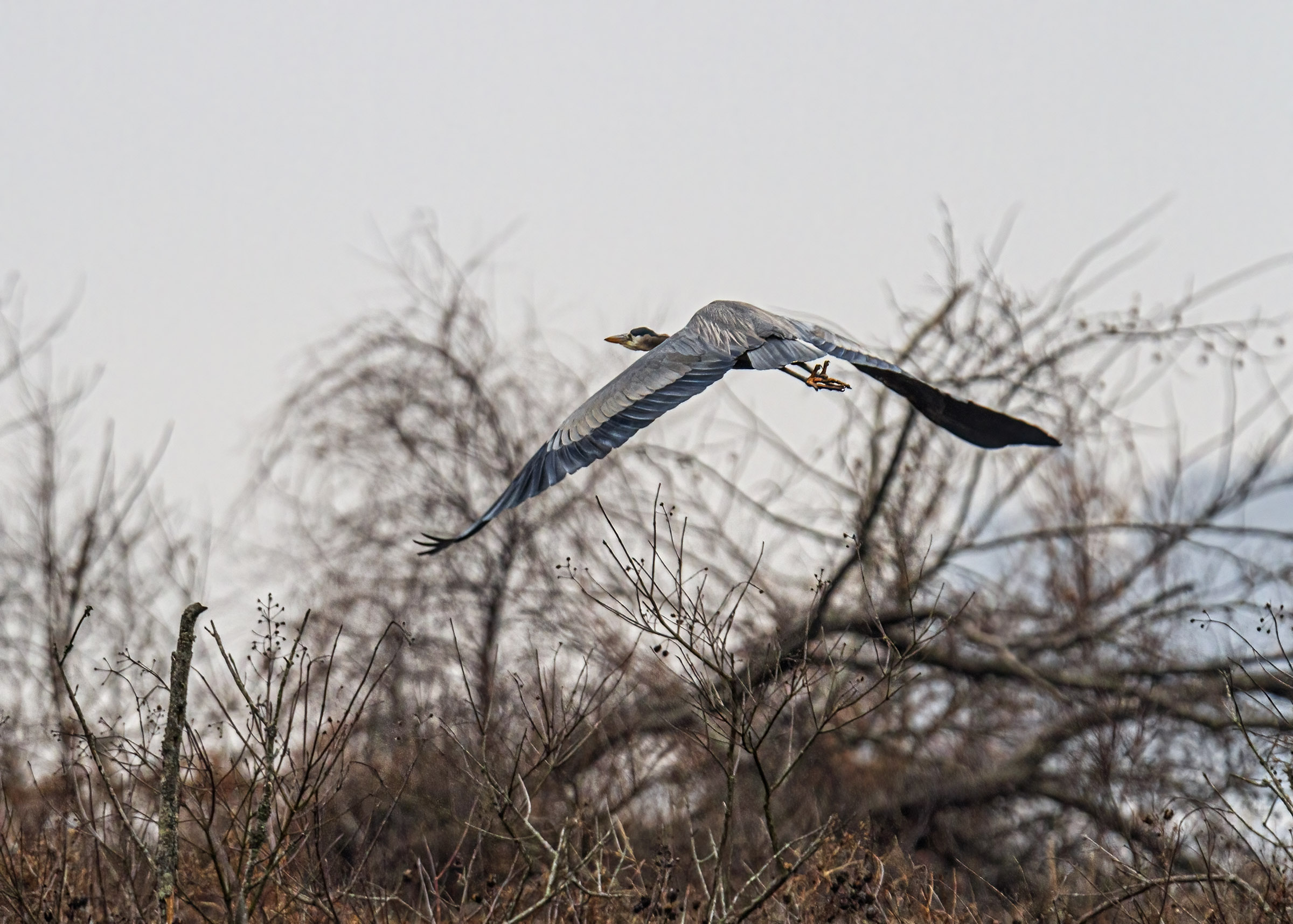
It was cold and gray and last Friday at Occoquan Bay National Wildlife Refuge. Most of the birds seemed to be inactive, like this sleeping Great Blue Heron (Ardea herodias) that was partially hidden by the vegetation in a field adjacent to a small pond.

I have often wondered if birds sleep with their eyes closed. I do not have a definitive answer, but if you click on this image to enlarge it and look closely at the heron’s eye, it sure looks like it is closed. I wonder too how birds can sleep in trees without falling over, but this heron was on solid ground, so I do not think that it was at risk of falling. As for me, I think that I have dozed off while standing, but don’t think that I have fallen into a deep sleep.

Great Blue Heron

© Michael Q. Powell. All rights reserved.


Read Full Post »
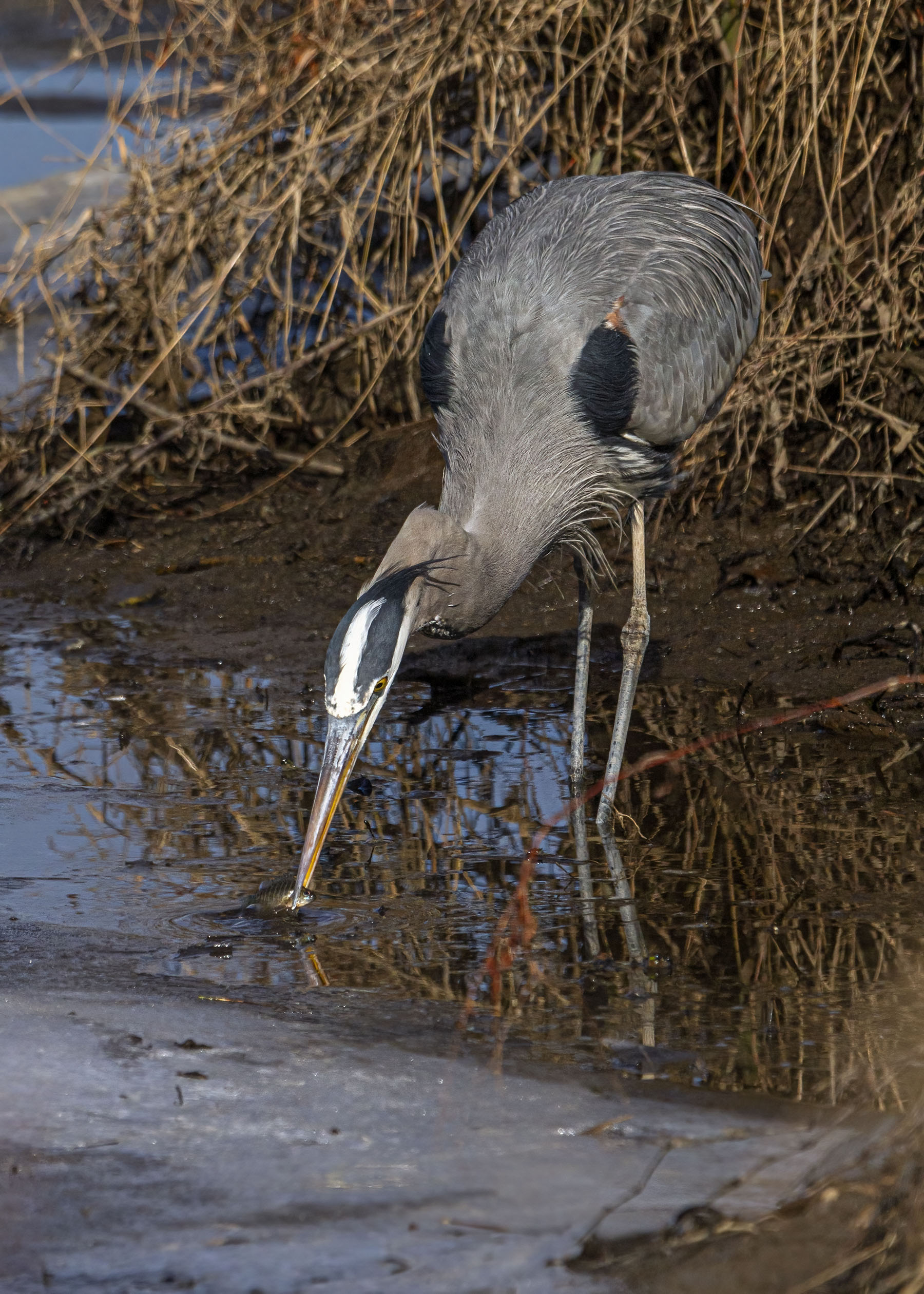
Sometimes when you have an itch, you just have to stop what you are doing and scratch it. I have certainly had that experience and that seemed to be the case with this Great Blue Heron (Ardea herodias) that I spotted last week at the edge of the water at Occoquan Bay National Wildlife Refuge.

If you zoom in on the photo, you can see that the heron has quite long claws on its toes that it was using along the length of its neck. I love the way that the feathers were all awry as the heron focused on scratching its itch.

Great Blue Heron

© Michael Q. Powell. All rights reserved


Read Full Post »

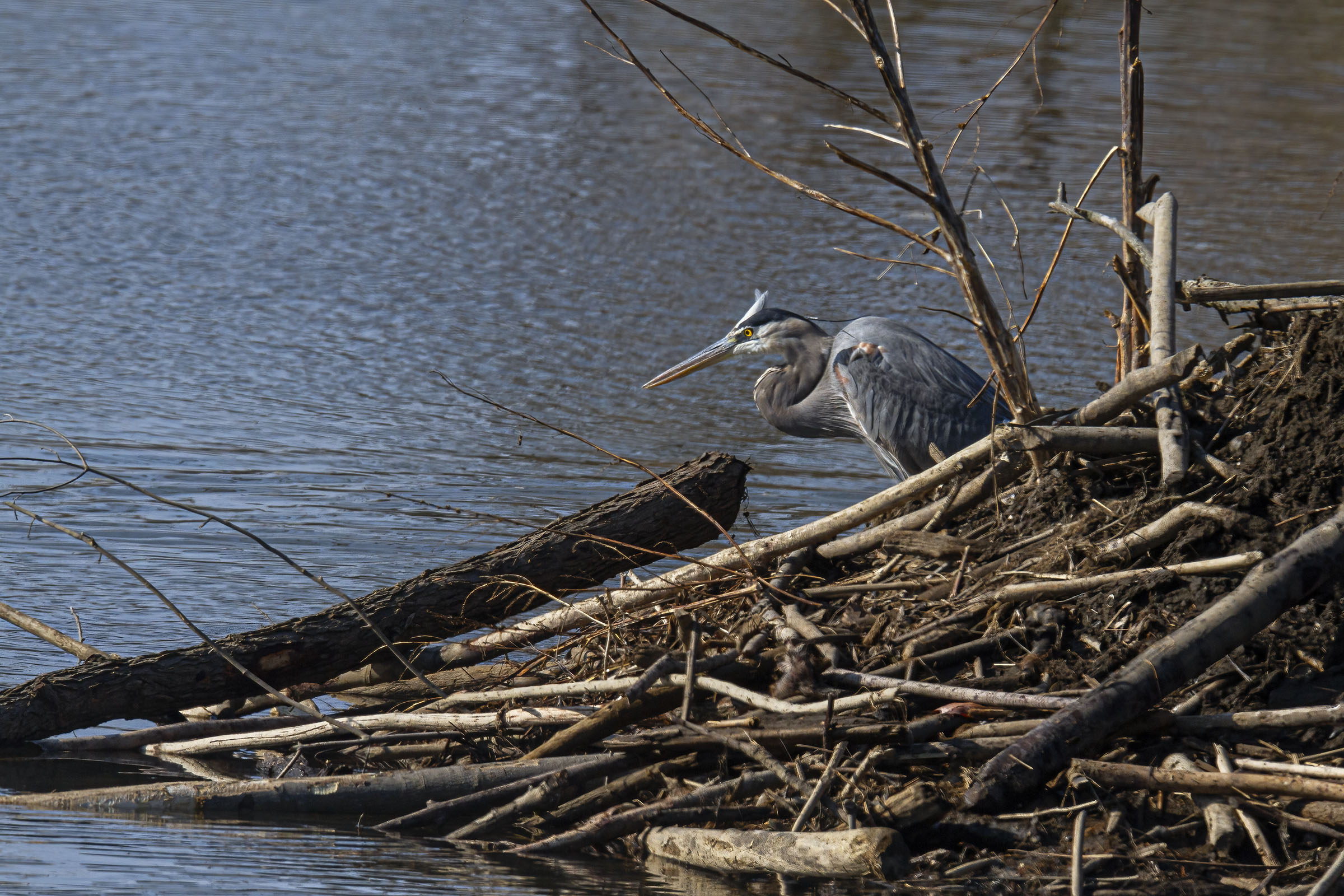
This Great Blue Heron (Ardea herodias) was so well hidden that I could not tell if it was perched on a small raised portion of the ground or in a tree when I caught a glimpse of it during a recent visit to Occoquan Bay National Wildlife Refuge. My view of the heron initially was mostly obscured by the thick vegetation, but I managed to get a somewhat clear shot of it by climbing on top of a conveniently placed park bench.

Great Blue Heron

© Michael Q. Powell. All rights reserved.


Read Full Post »

On Thursday at Occoquan Bay National Wildlife Refuge I captured this image of a Great Blue Heron (Ardea herodias) at water’s edge. Heron’s are quite large and normally are easy to spot.

However, as I was approaching this area, this Great Blue Heron was initially hidden from view by the metal posts sticking out of the water, as you can see in the second photo. Fortunately the heron’s head was turned to the side and it was the bird’s large bill that gave away its presence. I had to walk farther down the trail and look back to get the viewing angle for the first photo in which the heron is somewhat separated from the posts and is more visible.

Great Blue Heron

Great Blue Heron

© Michael Q. Powell. All rights reserved.


Read Full Post »

I inadvertently spooked a Great Blue Heron (Aredea herodias) on Wednesday at Occoquan Regional Park and captured this first image as it flew up to a perch high in a nearby tree. It was really cool to see the heron’s impressive wingspan as it came in for a landing in the tree. The second image shows the Great Blue Heron as it surveyed its surroundings from its new perch.

When I was just starting out in wildlife photography, I remember being shocked the first time that I saw a Great Blue Heron in a tree. I somehow had assumed that they spent all of their time in the shallow water or at the edge of ponds. Little did I know at that time that Great Blue Herons build their nests in the trees and often spend their nights roosting in trees to protect themselves from potential predators.

Great Blue Heron

Great Blue Heron

© Michael Q. Powell. All rights reserved.


Read Full Post »

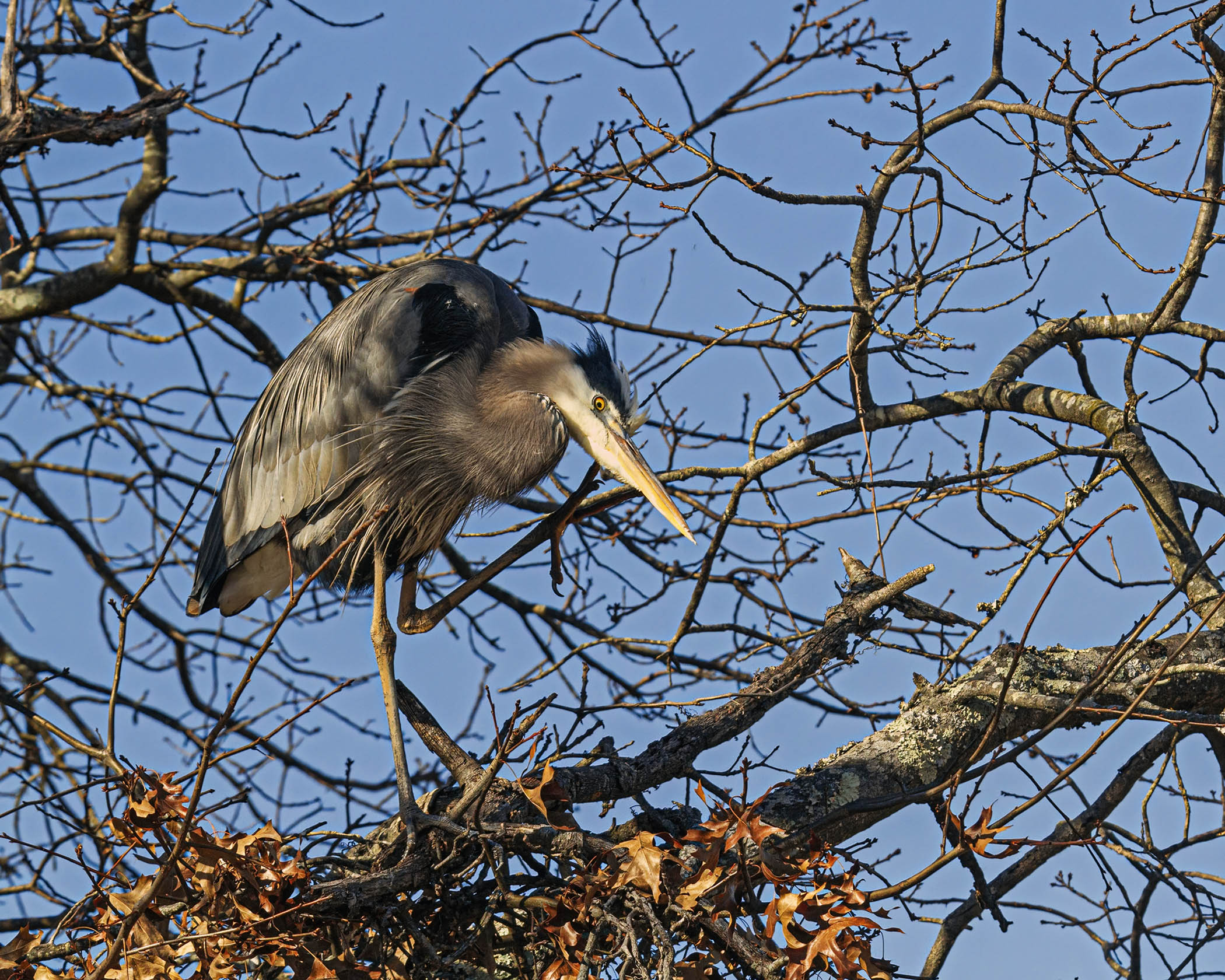
As I was scanning the trees for small birds last Thursday at Occoquan Bay National Wildlife Refuge, I spotted this Great Blue Heron (Ardea herodias) surveying its surroundings from its high perch. I have occasionally seen herons roosting in the trees in the past, but it has usually been earlier in the day—this heron might have decided that it wanted a mid-afternoon nap or at least a few peaceful moments.

Now that I am retired, I have rediscovered the pleasure of naps and a Sunday afternoon nap has become part of my weekly routine.

Great Blue Heron

© Michael Q. Powell. All rights reserved.

Read Full Post »

Last Tuesday I spotted a Great Blue Heron (Ardea herodias) at Occoquan Bay National Wildlife Refuge with its wings spread forward in the so-called “flasher pose.” There are several theories about why herons assume this posture. Some speculate that it is for the purpose of temperature regulation (either to warm up or to cool off) or to dry out their feathers. Others believe that it is part of the preening process and that the increased heat makes parasites more active and easier to remove.

Great Blue Heron

© Michael Q. Powell. All rights reserved.

Read Full Post »

Older Posts »