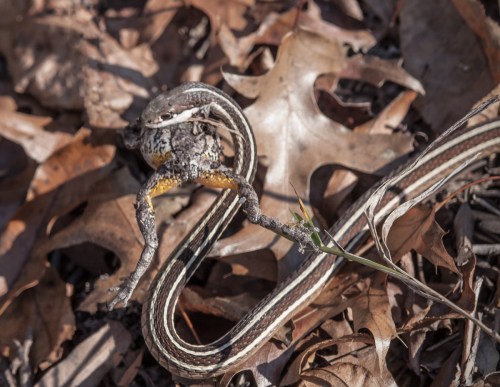
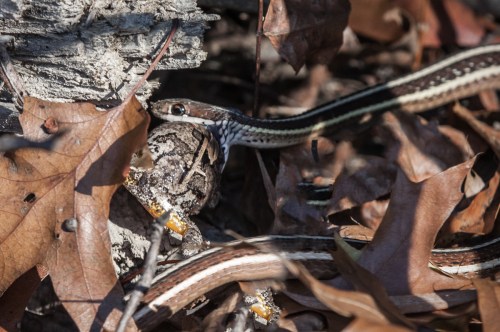
How is it possible to sneak up on a frog and grab it with such force that it is unable to escape as you slowly swallow it headfirst while it is still alive? With a mixture of horror and fascination, I witnessed part of the process yesterday when I spotted an Eastern Ribbon Snake (Thamnophis sauritus sauritus) that had captured a Gray Treefrog (Hyla versicolor).
I was walking through the vegetation at the edge of a field when I spotted a part of the body of the ribbon snake. I moved closer as my eyes traced the body of the snake as I searched for its head. When I spotted the head from a distance, I was confused—it was enlarged like that of a hooded cobra and it was swaying back and forth. What was going on?
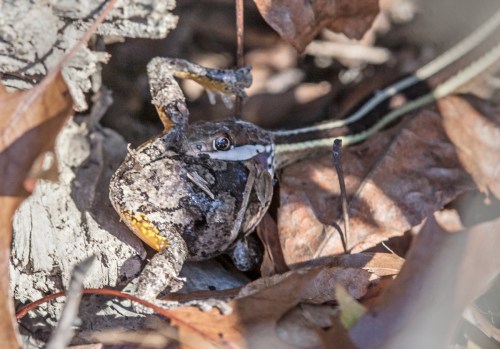
I slowed down and gradually came to realize that the snake had a struggling frog in its mouth and was holding it in the air so that the flailing legs had nothing to grab onto for leverage. The frog seemed so much bigger than the snake’s head that it seemed almost impossible that the snake could swallow it.
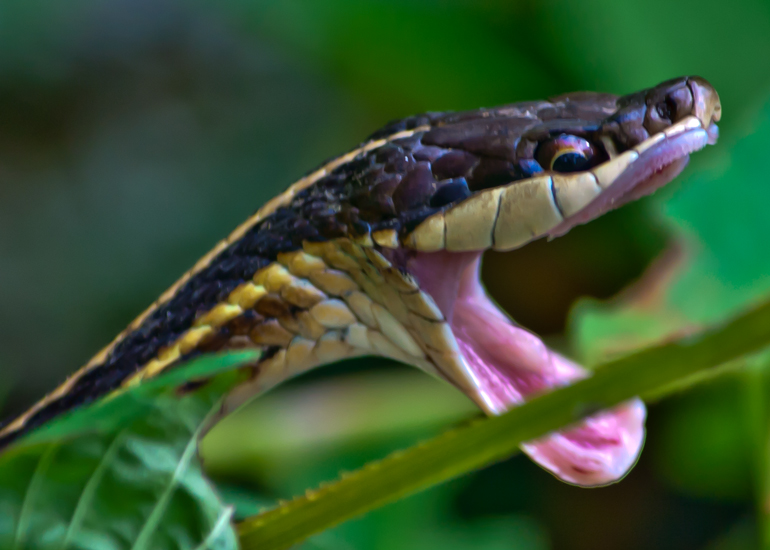
The snake slithered a short distance away with its partially swallowed prey and continued the process. I managed to get a glimpse of the astonishing extent to which the snake can open its mouth before the disappeared disappeared under a pile of wood to enjoy its meal in peace.
Initially I couldn’t identify the frog, but my good friend Walter Sanford made an initial identification and pointed me to the website of the Virginia Herpetological Society. I carefully read the information there and have concluded that the frog is probably a Gray Treefrog (Hyla versicolor), although it is possible it could be a Cope’s Tree Frog (Hyla chrysoscelis). “Our two native gray treefrogs are identical in appearance. In the field the only two ways to distinguish H. chrysoscelis from H. versicolor is by their call and in some cases geographic location.”
I was particularly struck by the bright orange color on the hind legs of the frog. Wikepedia notes that both of the potential species have bright-yellow patches on their hind legs, which distinguishes them from other tree frogs and that “the bright patches are normally only visible while the frog is jumping.” Obviously the situation I witnessed is not “normal,” so I was able to see the colors, even though the frog was obviously not jumping.
I’ve included a small series of shots to give you a sense of the situation. They were all shot handheld with my Tamron 180mm macro lens.


© Michael Q. Powell. All rights reserved.

 Mike Powell