Feeds:
Posts
Comments

Posts Tagged ‘death’

These images are disturbing, especially the first one. They show the harsh reality of the struggle for survival for wild creatures, even in the relatively comfortable confines of a suburban marshland park.

For the second time this winter, I stumbled upon a dead deer in a remote area of my the marsh when I take many of my wildlife photos. (I documented the earlier sighting in a posting that I titled “The Buck Was Stopped Here.”) This time, the skeleton was relatively intact and I was surprised to see that it was another buck. I am still baffled about the cause of his death. Predators? Starvation?

As a photographer and as a human, I struggled in deciding how to present this subject in photographs. I knew that I was not going to remove the body far from where I found it, so I had to settle for a relatively cluttered backdrop. Was it better to show the whole body, as I did in the third photo and keep death at a distance? Should I photograph it to look like the deer had fallen asleep and died peacefully, as the second shot suggests, the way we treat death at a funeral home?

I decided that my best shot was the one in which I forced the viewer essentially to look death in the face directly, by focusing directly on the deer’s now empty eye socket. Death is a reality that can’t be avoided. The photo is a bit macabre, I know, but it speaks to me of life and of death, of the passing of one of God’s creatures.

buck_small2_blogbuck_small1_blogbuck_small3_blog

© Michael Q. Powell. All rights reserved

Read Full Post »

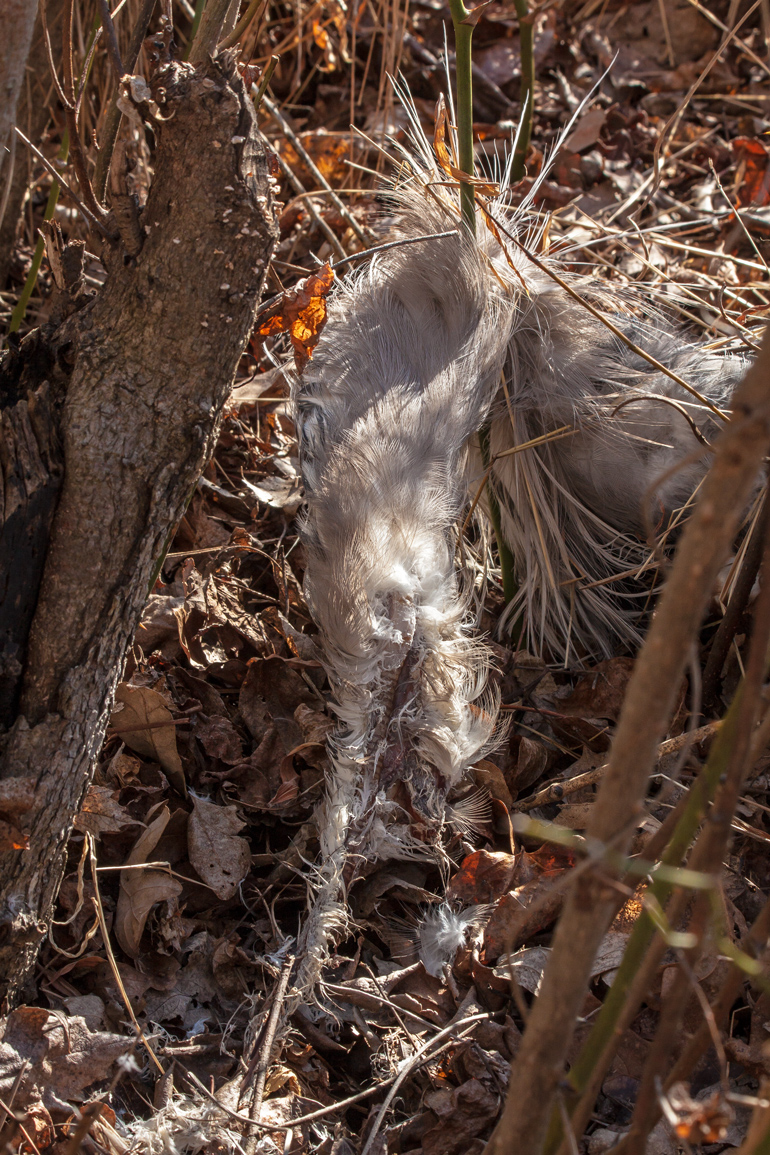
As I was walking about in a remote area of my local marsh, I came across a dead Great Blue Heron (Ardea herodias), with its body partially hidden in the undergrowth and its large feet prominently displayed. I couldn’t help but wonder about the cause of its death, though my sense of reverence for this beautiful bird kept me from poking about its body and examining it more closely.

According to a University of Michigan website , the average lifespan for a blue heron in the wild is 15 years, although 69 percent of those born in a given year die before they are a year old. Was this heron a young one who was unable to survive in our recent cold weather?  Was it perhaps an older one which had lived a long life and died of natural causes? Was it killed by a predator? Known predators of young (and sometimes adult) blue herons include eagles, raccoons, turkey vultures, and red-tailed hawks, all of which I have seen in this marsh.

I struggled a bit in determining how to present these photos to avoid offending those who might find the subject too morbid or gruesome. In the end, I decided to lead with the photo of the large, weathered feet with the small talons. The next two shots pull out progressively to give a sense of the surroundings in which I found the heron. I took the final shot from the side, looking directly at the area where the head should be and quite frankly I am not sure what I am seeing in that image.

Life is a constant struggle for animals and birds in the wild and this little encounter reminded me of that sometimes harsh reality.

heron_dead1_blogheron_dead2_blogheron_dead4_blogheron_dead3_blog

© Michael Q. Powell. All rights reserved

Read Full Post »