Feeds:
Posts
Comments

Posts Tagged ‘Cyrano Darner dragonfly’

Yesterday I visited Jackson Miles Abbott Wetland Refuge and spent a lot of my time there trying to get shots of dragonflies in flight. The dragonflies were not very cooperative and kept their distance most of the time, but eventually I managed to get a few decent shots. What was especially cool was that I captured images of dragonflies from three different families—Skimmer, Darner, and Emerald.

The first photo shows a Banded Pennant (Celithemis fasciata), a Skimmer, as he was flying toward me. Banded Pennants are pretty small at about 1.3 inches (33 mm) in length, so I was pretty thrilled to capture this shot as he was flying toward me. This was actually the first time that I had seen a Banded Skimmer this season.

The second photo shows a Cyrano Darner (Nasiaeschna pentacantha). Despite the fact that I took the shot from a long distance away, you can still see the prominent “nose” that is supposedly reminiscent of the long nose of literary character Cyrano de Bergerac.

The last two photos show Prince Baskettails (Epitheca cynosura) that are members of the Emerald family. Prince Baskettails, which are about 2.9 inches (74 mm) are quite easy to identify, because they are the only large dragonfly in our area with patterned wings. I had more opportunities with this species that with the others, because several Prince Baskettails were flying repetitive patrols only various parts of the pond and passed by me multiple times. Although it is a little easier to focus on a dragonfly in flight when the background is clear, I think it is even cooler when I manage to include reflections in the water in a photo, as was the case with the reflections of the branches in the final photo.

Banded Pennant

Cyrano Darner

Prince Baskettail

Prince Baskettail

© Michael Q. Powell. All rights reserved.


Read Full Post »

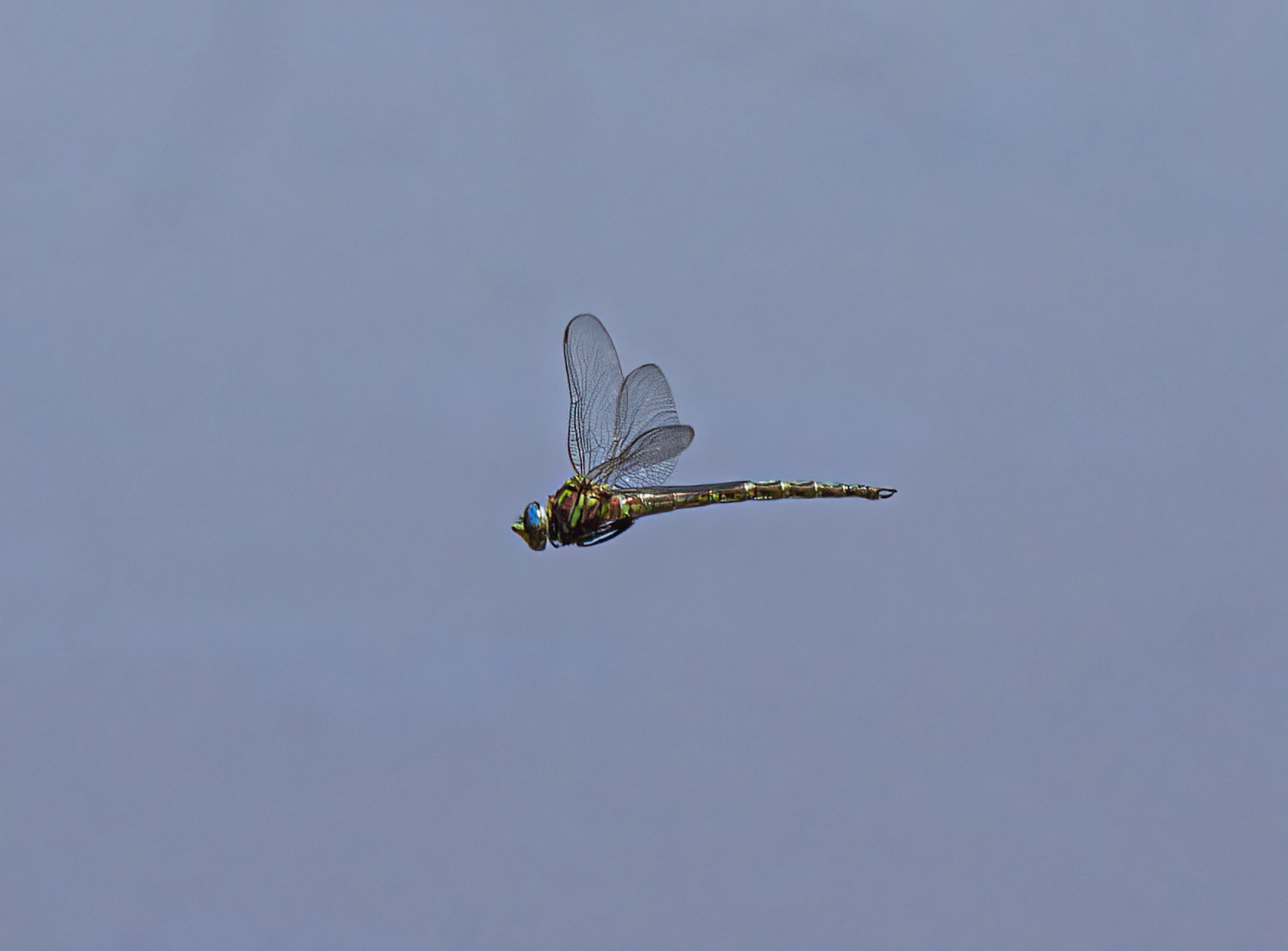
It is fairly uncommon for me to see a Cyrano Darner dragonfly (Nasiaeschna pentacantha), so when I do, I try my best to get a shot of it. The problem, though, is that they always seem to be patrolling over the water far from the shore and rarely seem to perch.

Last Wednesday I spotted this Cyrano Darner flying around a heavily vegetated area, which made it even tougher to focus on the dragonfly. I was thrilled to be able to get a recognizable shot of the dragonfly, though the background is so cluttered that you may have to look hard to see it in the first image. The second image is a little less sharp, but gives you a clearer view of the dragonfly.

In case you are curious, the species is named for its long, protruding, greenish forehead that is somewhat reminiscent of the long nose of literary character Cyrano de Bergerac. This is the only species that I have encountered where the “nose” helps me to identify it—most of the time I focus on other parts of a dragonfly’s anatomy.

Cyrano Darner

Cyrano Darner

© Michael Q. Powell. All rights reserved.


Read Full Post »

As I stood at the edge of an open marshy area yesterday at Jackson Miles Abbott Wetland Refuge, I was excited to spot a large patrolling dragonfly. The dragonfly was flying low over the water in repetitive patterns and I suspected that it was a Cyrano Darner dragonfly (Nasiaeschna pentacantha), a species that I do not see very often.

When the dragonfly flew into the light I got a good enough look at it to confirm that it in fact was a Cyrano Darner. In case you are curious, the species is named for its long, protruding, greenish forehead that is somewhat reminiscent of the long nose of literary character Cyrano de Bergerac.

I kept hoping that the dragonfly would fly closer, but it kept its distance and the only shots I could get were at relatively long range. I am happy that I managed to capture some images that are more or less in focus and show some of the beautiful details of this dragonfly.

The second shot is a bit sharper and you can see the dragonfly’s colors and patterns better.  However, I have a slight preference for the first image, because the reflections of the vegetation in the water in the first shot give you a sense of environment that is lacking in the more clinical view of the second one.

Cyrano Darner

Cyrano Darner

© Michael Q. Powell. All rights reserved.


Read Full Post »

Do dragonflies have noses? That sounds like a crazy question, but it is the first one that came to mind when I looked at the image that I had captured of a dragonfly in flight this past week at Jackson Miles Abbott Wetland Refuge. I could not immediately identify it, so I consulted with experts in a Facebook group and learned that it is a Cyrano Darner (Nasiaeschna pentacantha). This species has a protruding forehead—it’s not a nose— that is reminiscent of the long nose of literary character Cyrano de Bergerac.

The species in the second shot is a Prince Baskettail (Epitheca cynosura), a species that I have featured multiple times in this blog. During much of the summer, I can usually spot one or two Prince Baskettail dragonflies patrolling over the pond at the same wetland refuge and I love trying to capture shots of them in flight. What makes this image distinctive, though, is not so much the dragonfly, but the background. There were ripples in the pond and the way that I shot and processed the image turned them into a wonderfully abstract background.

When I post photos like these, I often get questions about how I am able to capture images of flying dragonflies. Luck and persistence are the keys to getting shots like these. I use my 180mm macro lens and focus manually as the dragonflies zoom by, because the dragonflies don’t fill enough of the frame for my auto-focus to engage quickly and accurately. I have found that is almost impossible for me to use a zoom lens in this task—I get overwhelmed when I try to zoom, track, and focus simultaneously.

Cyrano Darner

Prince Baskettail

© Michael Q. Powell. All rights reserved.
 

Read Full Post »