Feeds:
Posts
Comments

Posts Tagged ‘Catharus guttatus’

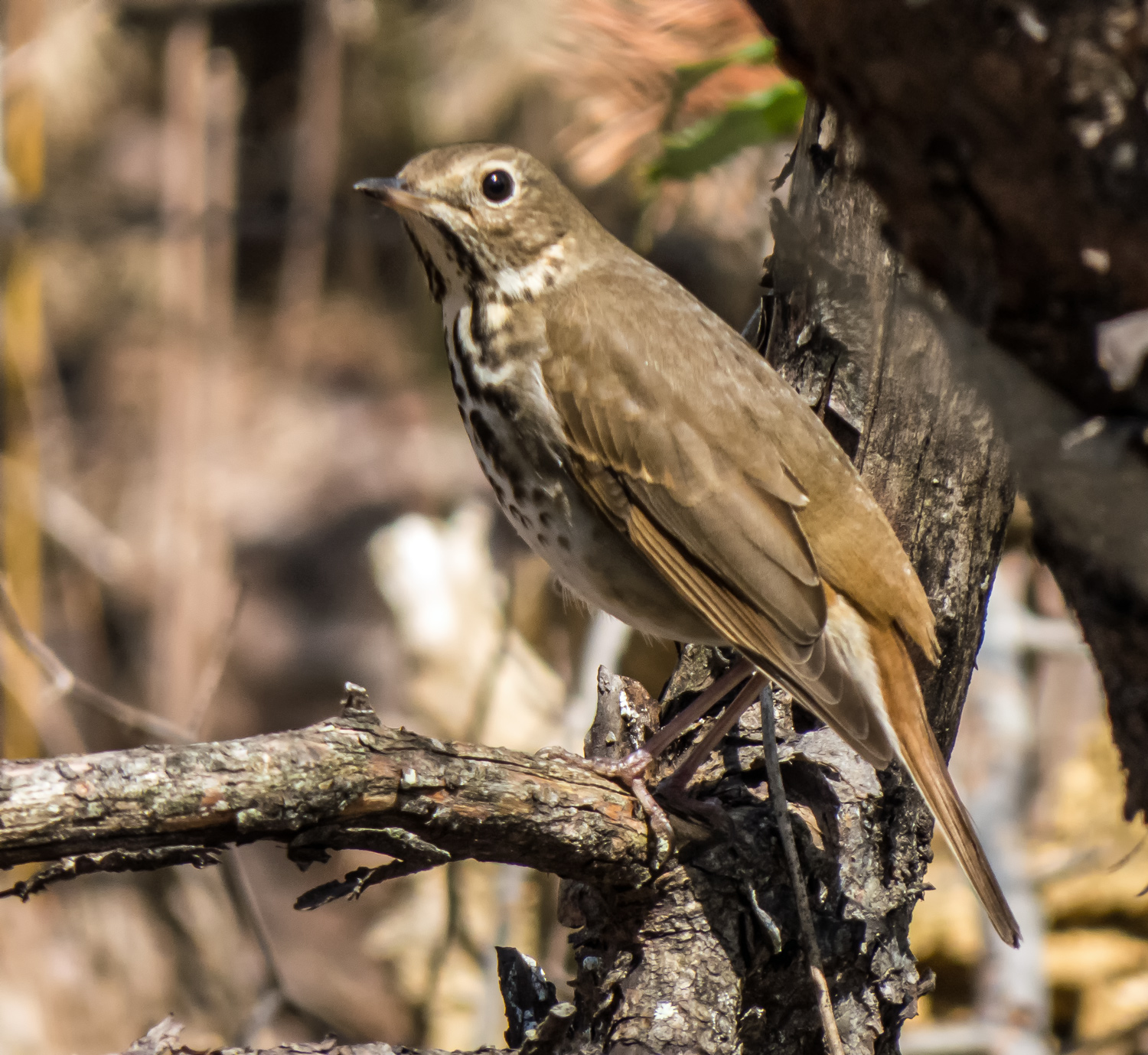
This handsome Hermit Thrush (Catharus guttatus) posed momentarily for me during my visit earlier this week to Occoquan Bay National Wildlife Refuge. It was unusual for me to be able to get such an unobstructed shot of a bird. Although the leaves are gone from the trees, most of the birds at this time of the year seem to forage within the vegetation where my view is often partially blocked by branches.

I am reasonably sure that this is a Hermit Thrush, though I do not see this species very often, so it is possible that I am mistaken in my identification. Let me know if you think that I have misidentified this bird.

Hermit Thrush

© Michael Q. Powell. All rights reserved.


Read Full Post »

As the weather cools off and the insects disappear, my attention has gradually been shifting to birds. This was a real challenge for me a month ago when the leaves were still covering the trees and hid the birds from my view. Now, however, most of the leaves have fallen and I feel like I have a fighting chance of spotting a bird when I see or hear one.

On Tuesday I visited Occoquan Bay National Wildlife Refuge and managed to capture shots of some of the resident birds. The bird in the first photo is a Downy Woodpecker (Picoides pubescens), the smallest woodpecker in our area. You can see a touch of red on the back of his head, indicating that he is a male.

Carolina Chickadees (Poecile carolinensis), like the one in the second photo, are quite common, but they are small and elusive and therefore difficult to photograph. During most of the time that I was observing this bird, its head was hidden by branches, but I watched and waited and finally was able to get an unobstructed shot of it.

I am not certain of the identification of the bird in the final photo. On the basis of its markings and color, I think that it may be a Hermit Thrush (Catharus guttatus), but that is really not much more than an educated guess. I would welcome a confirmation or correction from a more experienced birder.

Downy Woodpecker

Carolina Chickadee

Hermit Thrush

© Michael Q. Powell. All rights reserved.

Read Full Post »

When I first spotted this little bird on Monday as it perched high in a tree at Occoquan Bay National Wildlife Refuge, its shape caused me to think that it was an American Robin. As I got a little closer, though, I could see that the bird’s breast was spotted and did not have the distinctive orange color of “our” robin.

I remembered that the American Robin is a member of the thrush family, so I assumed that this bird was another kind of thrush. (The European Robin, by contrast, belongs to the chat subfamily of the Old World Flycatcher family—check out this November 2019 blog posting to see a photo of a European Robin that I photographed in Paris.) When I returned home and checked by bird identification guide, I was able to determine that this is probably a Hermit Thrush (Catharus guttatus), a species that I have encountered only a few times.

As I was looking up information on the Hermit Thrush, I discovered that this bird played a an important role in “When Lilacs Last In The Dooryard Bloom’d,” an elegy on the death of Abraham Lincoln by noted American poet Walt Whitman. The thrush, along with lilacs and a star, is one of the recurring elements in the poem and seems to represent a kind of reconciliation with death and its song is described as “Death’s outlet song of life.” I am providing a link to the entire poem in case you are interested in reading the beautiful poem in its entirety. As a foretaste, I will leave you with one small section of the poem in which Whitman first introduced his readers to the Hermit Thrush:

“In the swamp in secluded recesses,

A shy and hidden bird is warbling a song.
Solitary the thrush,
The hermit withdrawn to himself, avoiding the settlements,
Sings by himself a song.
Song of the bleeding throat,
Death’s outlet song of life, (for well dear brother I know,
If thou wast not granted to sing thou would’st surely die.)”

Hermit Thrush

© Michael Q. Powell. All rights reserved.

Read Full Post »

Hermit Thrushes (Catharus guttatus) migrate to my area for the winter, but I rarely see one, probably because they spend most of their time foraging out of sight in the underbrush. When I first spotted this one last week at Occoquan Bay National Wildlife Refuge, it was in the shadows and its shape made me think it was an American Robin, another member of the thrush family. However, when it hopped onto this branch and was better illuminated, the spotted breast and lighter coloration made it really obvious that this was not a robin.

I was a little disappointed that I did not hear this little bird sing. According to the Cornell Lab of Ornithology, “the Hermit Thrush’s beautiful, haunting song begins with a sustained whistle and ends with softer, echo-like tones.”

Hermit Thrush

© Michael Q. Powell. All rights reserved.


Read Full Post »

I was thrilled on Monday at Occoquan Bay National Wildlife Refuge to see this handsome Hermit Thrush (Catharus guttatus), another one of our winter visitors. The Cornell Lab of Ornithology describes the Hermit Thrush in these words—”An unassuming bird with a lovely, melancholy song, the Hermit Thrush lurks in the understories of far northern forests in summer and is a frequent winter companion across much of the country.” Wikipedia notes that “the hermit thrush’s song has been described as “the finest sound in nature” and is ethereal and flute-like, consisting of a beginning note, then several descending musical phrases in a minor key, repeated at different pitches.”

When I first spotted the bird, I thought it might be an American Robin, because of the shape of its body and bill. The American Robin is also in the greater thrush family, but close examination showed that “my” bird lacked the reddish-orange breast color of the robin and had instead a distinctive pattern similar to that of some sparrows.

Hermit Thrush

© Michael Q. Powell. All rights reserved.


Read Full Post »

Last week I took a break from exploring Occoquan Bay National Wildlife Refuge and hiked about in Prince William Forest Park in Triangle, Virginia. According to Wikipedia, this park is the largest protected natural area in the Washington D.C. metropolitan region at over 16,000 acres.  I went lighter than usual with my camera gear, carrying only my Canon SX50 superzoom camera, because I knew that I would be doing a lot of walking on hilly forest trails, which fortunately were well-marked with signs and colored blazes on the trees.

I did not see much wildlife, but was quite happy to capture these shots of a Hermit Thrush (Catharus guttatus) that was poking about in the underbrush. The shape of the Hermit Thrush reminds me of that of the American Robin, another bird in the greater thrush family, though, of course, the breast of the Hermit Thrush lacks the distinctive reddish-orange color of the robin.

Hermit Thrush

Hermit Thrush

© Michael Q. Powell. All rights reserved.

Read Full Post »
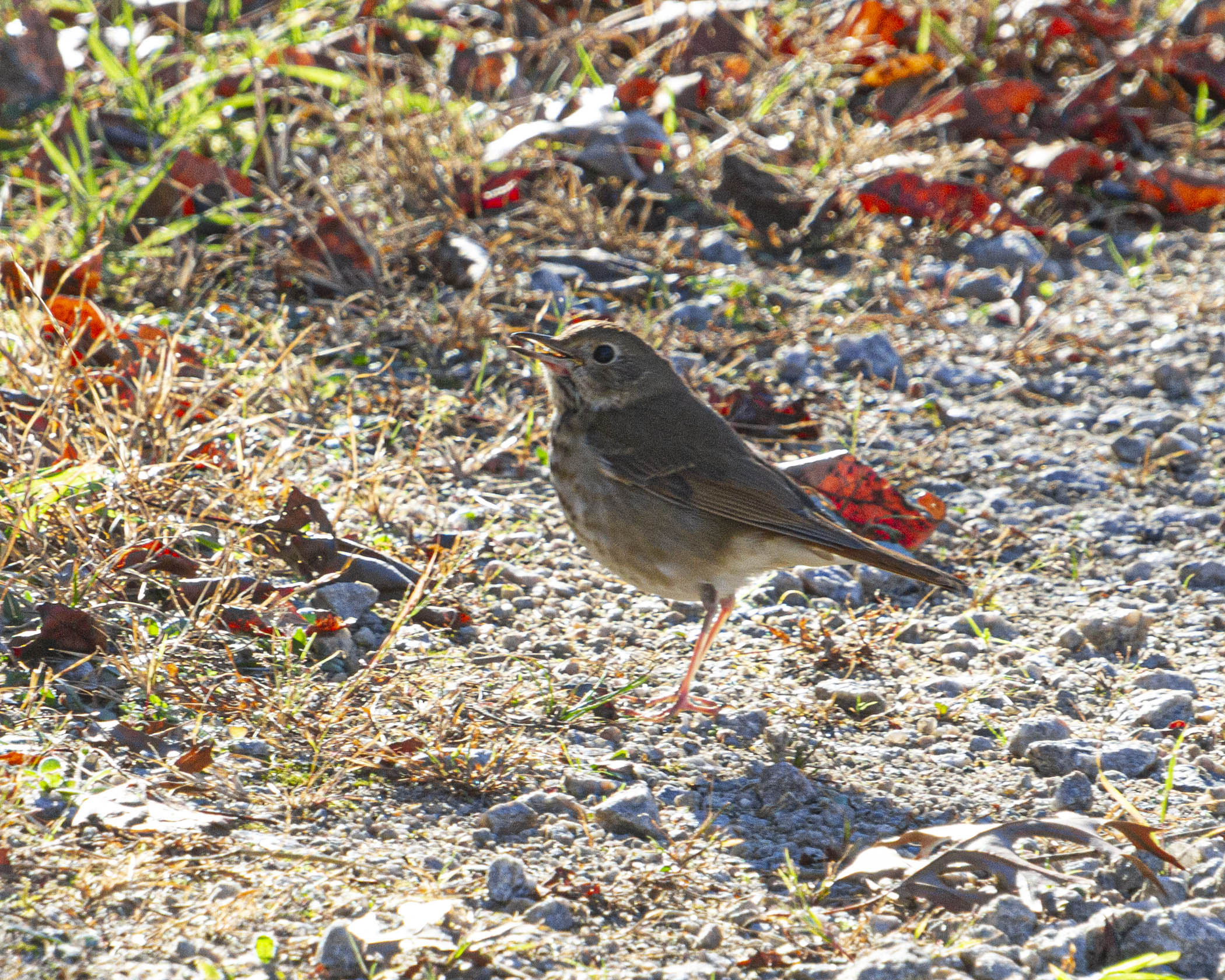
I spotted this fluffy Hermit Thrush (Catharus guttatus)on New Year’s Day at Occoquan Bay National Wildlife Refuge. In this frigid weather, all of the birds seem unusually round as they try to retain their body heat.

I don’t recall ever seeing a Hermit Thrush before, but when I did a search in my blog, I was surprised to discover that I had photographed one in December 2016 eating berries—here is a link to that posting. At that time I could not identify the species and asked for assistance. I guess I did not internalize the identification very well, for I ended up asking for help in a Facebook forum again.

It is funny how we associate certain words with memories from out childhoods. When I hear the word “Thrush,” I immediately think of the “enemy” organization in the television series “The Man From U.N.C.L.E.” According to a page on the IMDb website, “In the series, the organization was merely called Thrush. Ace paperbacks, which published a series of paperback novels based on the show, had one installment in which Thrush stood for The Technological Hierarchy for the Removal of Undesirables and the Subjugation of Humanity.”

This winter I am spending more time outdoors and it is exciting to discover how many birds and other little creatures are active, even in the most inclement, inhospitable weather. The challenge for me is to stay motivated and dressed warmly enough to be able to spot and photograph these little beauties, like this Hermit Thrush, that may have traveled south to winter with us.

Hermit Thrush

© Michael Q. Powell. All rights reserved.

Read Full Post »
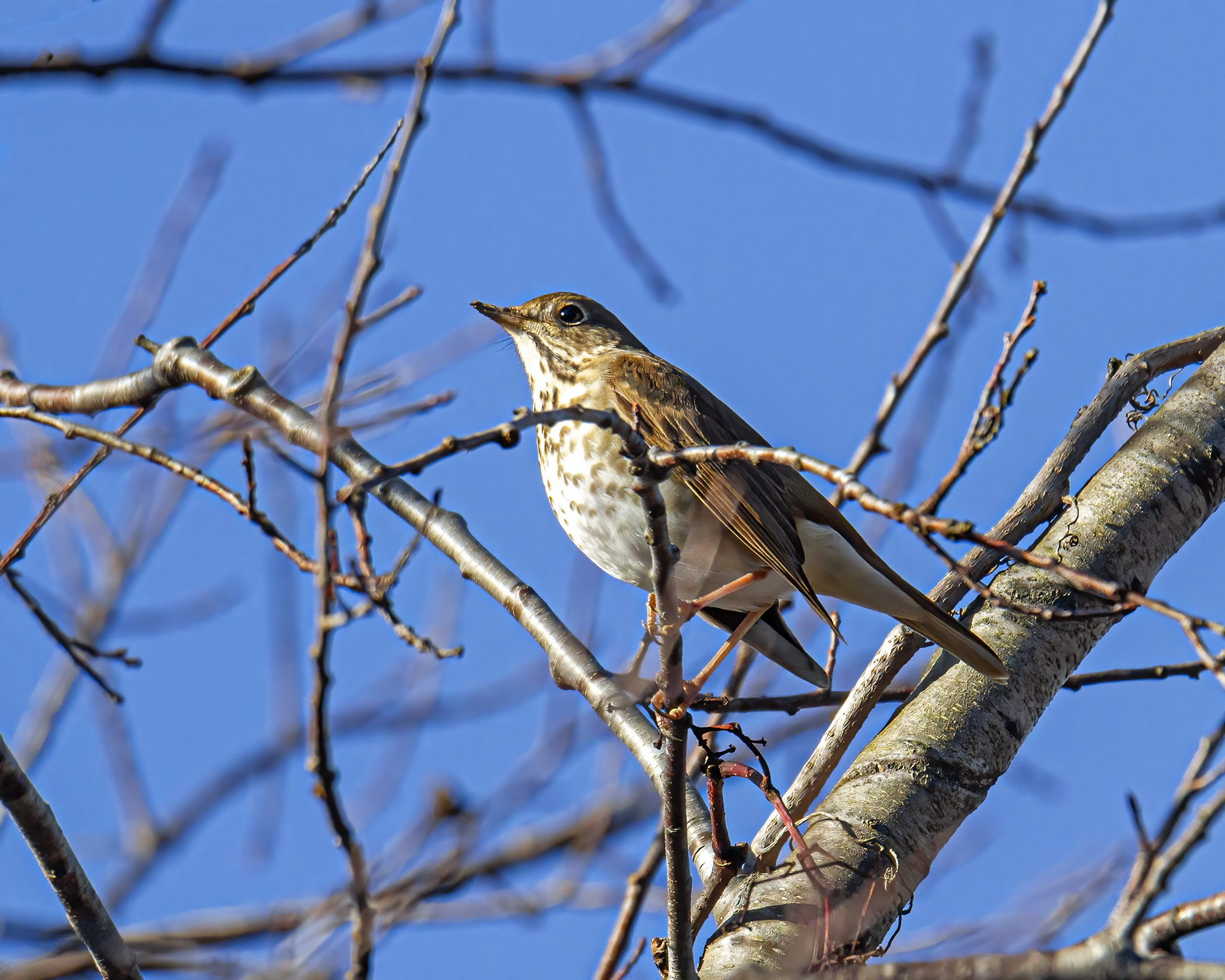
It was unusually cold when I set out this morning to go shooting, about 18 degrees F (minus 8 C). I always worry about birds in the wild being able to survive when it gets this cold, but somehow they manage.

As I was walking along the boardwalk at Huntley Meadows Park, I spotted a bird in the distance bobbing up in a tree. I couldn’t figure out what was going on until I got closer and could see that the bird was reaching up to grab some red berries that were just above its head.

At first I thought that this was an immature American Robin, but the more I look at the photos, the more I think that it is probably a different bird species. I would welcome assistance in identifying this mystery bird that obviously was berry hungry.

UPDATE:  Thanks to several knowledgeable folks on Facebook, I have learned that the bird is a Hermit Thrush (Catharus guttatus) and the plant with the berries is an American Bittersweet vine (Celastrus scandens).

berry hungry

berry hungry

© Michael Q. Powell. All rights reserved.

Read Full Post »