Feeds:
Posts
Comments

Posts Tagged ‘Cameron Run’

Great Blue Herons (Ardea herodias) look graceful when they are flying or when they are wading, but they sure look awkward and gawky when on dry land. This heron seemed to be taking a break in the shade on a sunny, fall day. I took this photograph yesterday at Cameron Run, a tributary stream of the Potomac River, where I often see both egrets and heron. I do not know if they will remain here through the winter, but I hope that they do.

Great Blue Heron in the underbrush

© Michael Q. Powell. All rights reserved.

Read Full Post »

We continue to fade to brown, with only muted color changes as the leaves begin to fall from the tree. As if to compensate for the lack of spectacular foliage, brightly colored flowers are still blooming. I managed to get some shots of equally colorful insects interacting with yellow flowers. When I see Monarch butterflies (Danaus plexxipus), they are usually in the midst of blooming flowers, but I was surprised to also see a shiny red ladybug near the center of a yellow flower.

Monarch butterfly on yellow flower

Ladybug on yellow flower

© Michael Q. Powell. All rights reserved.

Read Full Post »

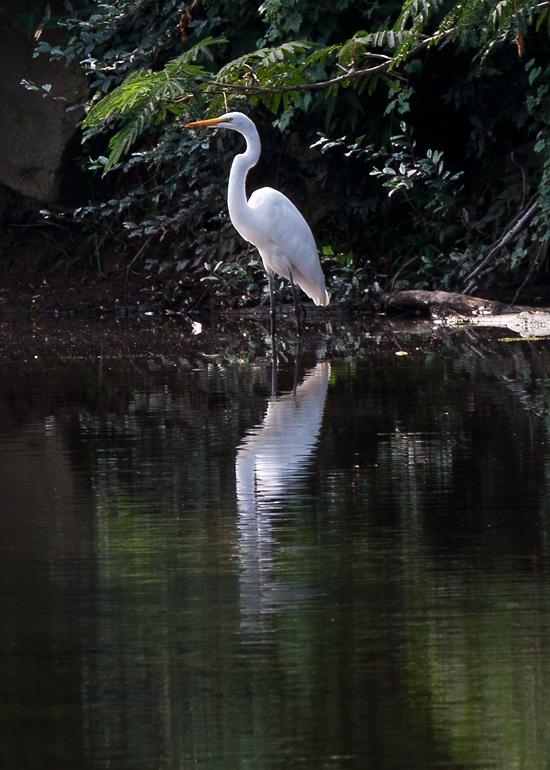
As many of you know, periodically I try to take photographs of the Great Egrets (Ardea alba) that are often present in the waters or the trees of Cameron Run, a tributary stream of the Potomac River. Usually I am frustrated, because the bright white bodies of the egrets caused my images to be overexposed and the highlights are almost always blown out.

Today, the light was a little more forgiving and I was able to capture an image of an egret with the light coming from the side. There is a dramatic glow surrounding part of its body and a nice reflection in the water. It is certainly not a perfect photo, but I like the way that it turned out.

Egret with dramatic lighting

© Michael Q. Powell. All rights reserved.

Read Full Post »

This shot has some great elements—a Great White Egret and a Great Blue Heron,  practicing together in the trees for their audition for “Dancing With the Stars.” They look to be almost perfectly synchronized, though the heron may need to work on his neck position. From a technical perspective, alas, the shot is far from great, but it was interesting enough that I decided to share it.

I frequently see egrets roosting in the trees along Cameron Run, a stream in Alexandria, Virginia that feeds into the Potomac River, but this is the first time that I had seen a blue heron fly into the trees. I was shooting from a running path that parallels one side of the stream.  Shooting across a considerable amount of growth as well as the stream itself, I find it difficult to get a close-up shot. In this photo, I had startled the heron and he took off into the trees, startling the egret, who was already perched there.

Dancing in the trees

I continue to have difficulties getting good shost of the egret, because there is often glare and it is hard to keep the highlights from blowing out. Here is a shot of an egret in partial shade that has some detail, but I can’t seem to keep the detail without imparting a grayish tinge to what is a really white bird. I will definitely keep trying, though, because I find the egrets and herons to be fascinating to watch in their almost geeky gawkiness.

Egret in a tree along Cameron Run

© Michael Q. Powell. All rights reserved.

Read Full Post »

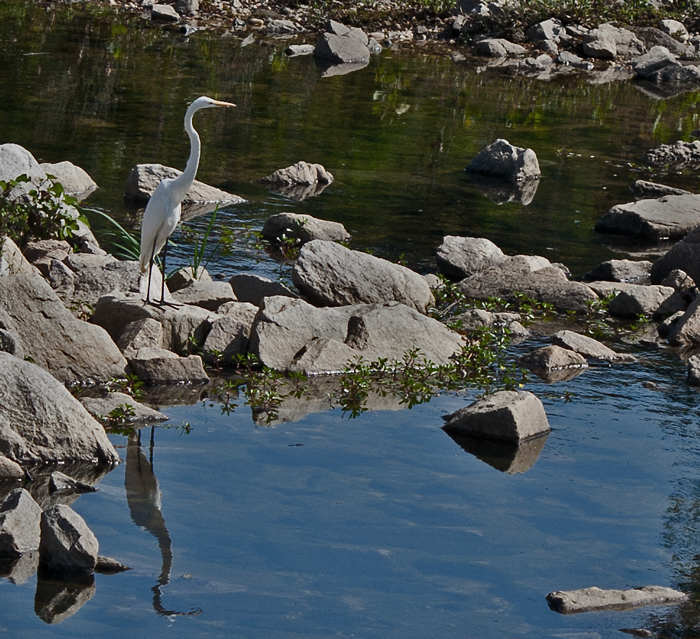
It’s been at least a few weeks since I last photographed the Great White Egrets that inhabit the Cameron Run area of Alexandria, VA.  It was immediately obvious to me this past weekend that the dry summer has affected this tributary of the Potomac River and the water was really low in many places.

I was happy to stumble upon an egret standing out of the water on some rocks. The sky was a brilliant blue and it was reflected beautifully into the water, as was the egret itself. Behind the egret, the water was in the shadows and was a deep shade of green, contrasting nicely with the blue and white of the sky and the clouds. The rocks reflected the light and their highlights were a little blown out, but not outrageously so.

As we move into the fall, I am not sure if the Great Blue Herons and Great White Egrets will remain in the area. I hope that I will have the chance to photographs these wonderful birds later in the year.

Great White Egret in Cameron Run, Alexandria VA

© Michael Q. Powell. All rights reserved.

Read Full Post »

The length and small size of damselflies make then a challenge for me to photograph clearly. Moreover, it is my experience that they rarely choose to land in places where I can isolate them against an uncluttered background. Yesterday I was fortunate when this Bluet damselfly perched near the end of an interesting budded branch overhanging the water and I managed to get a shot that I like.

Bluets are a whole group of damselflies of the genus Enallagma that often are very difficult to identify down to the species level, so I don’t feel back that I can’t decide whether or not this is an Atlantic bluet or an American bluet or some other kind. Apparently the only way to tell them apart is to capture them and examine them with a magnifying glass. In my case, I am not sure a magnifying glass would help.

I am thinking of buying a guide to dragonflies and damselflies that I can study during the winter so that I’ll be better prepared next year to identify more correctly some of the subjects that I shoot (and I love to photograph dragonflies and damselflies, challenges notwithstanding.

Bluet damselfly in mid-September

© Michael Q. Powell. All rights reserved.

Read Full Post »

During the last few months I have tried to get more serious about expressing myself in photos. I started out by photographing small things like insects and flowers and eventually got a macro lens. More recently I have been taking photos of larger things, like turtles, frogs, and wading birds. Yesterday I decided to try a landscape picture, without really knowing how to do it.

I’ve read enough to know that I wanted maximum depth of field and saturated colors. So I set my camera up on my tripod with these settings, f22, 1/50 sec, ISO 100, and 21mm on my 18-55mm zoom lens. I also used exposure compensation to underexpose by one f stop, figuring that reflections off the water might cause the image to be overexposed.

My subject was Cameron Run, a stream that runs into the Potomac River. There are concrete slabs at intervals that run across the stream, presumably to help the water flow as it moves downstream. I was standing on one of them with my camera on my tripod when I took this shot, looking east toward Old Town Alexandria, VA.

I’m pretty happy with the result. What you see if pretty much what came out of the camera—I am not sure what adjustments I should do in Photoshop. Perhaps I’ll try more like this, especially if I travel outside of the suburban area where I do most of my shooting.

Cameron Run looking east toward Old Town Alexandria, VA

© Michael Q. Powell. All rights reserved.

Read Full Post »

This is a shot of a green heron in the third different location where I have seen a green heron within the past month or so, all within a five mile radius of where I live in suburban Northern Virginia, outside of Washington DC. I came upon this little guy while I was walking down a stream bed and he flew into a tree when he became aware of my presence. Luckily he was still very visible in the foliage and, in fact, the green leaves serve as a nice backdrop to highlight the beauty of this green heron.

Green Heron in a tree

© Michael Q. Powell. All rights reserved.

Read Full Post »

This morning I went shooting at Cameron Run, a tributary stream of the Potomac River in Alexandria, VA. I frequently commute along a road that parallels this stream and have often seen large white wading birds as I drove by. Today I decided to investigate and see if I could get some photos and determine if they were herons or egrets or some other kind of bird.

I did manage to get some shots of the birds in the water and even in the trees, but learned how difficult it is to get a proper exposure with a pure white bird. I’m pretty confident that the birds are Great Egrets (Ardea alba), which are also known as Great White Egrets. A passerby with binoculars (who seemed to know what he was talking about) told me that the orange beak is one of the characteristics that distinguishes the egret from the heron. If you want to know more, there is lots of interesting information about the Great Egret in an article on the website of the Cornell Lab of Ornithology.

The Great Egret is a really impressive looking bird, so much so that it is the symbol of the National Audubon Society, according to Wikipedia.  The Cornell Lab article points out that Great Egrets were hunted nearly to extinction for their plumes in the late nineteenth century, sparking conservation movements and some of the first laws to protect birds.

I was struck by the fact that the Great Egret roosts in the trees and seems to enjoy doing so with other egrets. In one cluster of trees I saw three egrets that appeared to be grooming themselves—they definitely did not seem territorial. I was impressed too by the wingspan that I got to see when I startled one of them and he flew up to a nearby tree.

Now that I know what kind of birds these are and where they hang out, I’m sure I’ll be back to watch them and, hopefully, to photograph them.

Great Egret in a tree
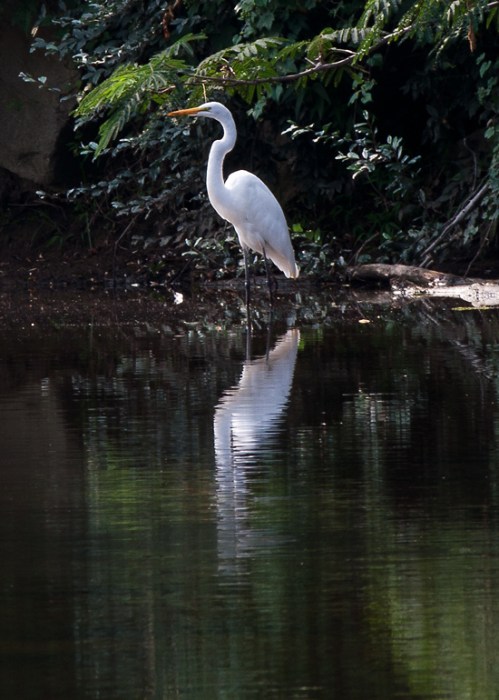
Great Egret in the shade

Great Egret fishing in the stream

Reflections of a Great Egret

© Michael Q. Powell. All rights reserved.

Read Full Post »

« Newer Posts