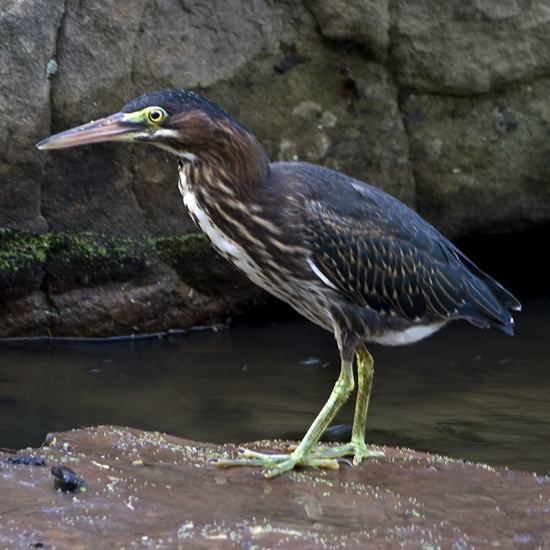
Feeds:
Posts
Comments

Posts Tagged ‘Butorides virescens’

Recently I had the chance to observe a Green Heron (Butorides virescens), one of my favorite birds, as it waded into the water at the edge of a small pond and focused its attention on catching a meal.

It was fascinating to watch the heron’s movements—it moved so with such care and stealth that it almost seemed to be moving in slow motion. At times, the heron would lean forward, as in the first photo, perhaps when a potential prey caught its attention.

The water in the pond was very still and I was happy to capture some nice reflections of the heron. They presented a minor dilemma for me in deciding how to crop the shot. Was it better to crop tighter and emphasize the main subject, as I did in the first shot, or to show the entire reflection, as in the third shot, which is the same image cropped differently? What do you think?

In many ways, the second shot is my favorite one. The heron had started to slowly move away and then turned its head back and opened its mouth a little. That little gesture seemed to give the heron more personality and it looks almost like it is smiling.

green_heron_close2a_bloggreen_heron_close1_bloggreen_heron_close2_blog

Read Full Post »

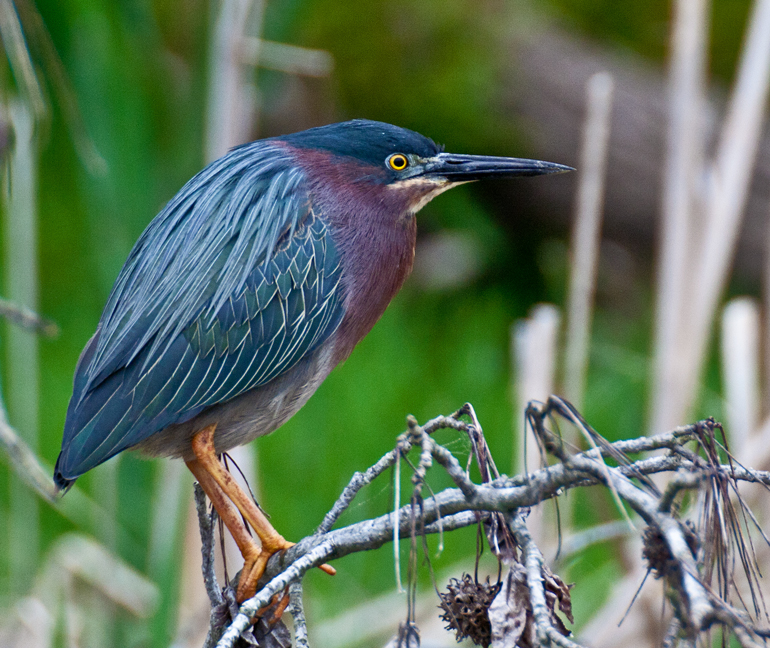
The water has gone down in some parts of my local marsh and I encountered this Green Heron (Butorides virescens) in a little tree that overlooked one of the dried out areas.

I am not sure if the heron was hunting or resting, although it looked more like the former than the latter, because he seemed to be looking from side to side. Perhaps he was searching for frogs or some other terrestrial prey.

I did not have my longest telephoto lens on my camera, but I was happy that to get some several decent shot of the little heron in a number of different poses.

limb1_bloglimb3_bloglimb2_blog

© Michael Q. Powell. All rights reserved

Read Full Post »

Can you spot the heron in this photo?

I think that you probably can pick out the Green Heron (Butorides virescens), which blends in pretty well with the vegetation, a little easier than I was able to do, when I visited my local marshland yesterday. The heron, which I think might be a young one, was foraging about in the marsh plants, unlike other Green Herons that I have seen in the past, which tended to stand near the edge of the water awaiting prey. If the heron had not moved, I might not have seen him, because it was so close to the ground.

I really like the colors of the Green Heron and its distinctive yellow eyes. The Green Heron may not be as big in size as a Great Blue Heron, but it has its own beauty—maybe I should begin a campaign to change its name to Great Green Heron.

heron_grass1_blog

© Michael Q. Powell. All rights reserved

Read Full Post »

It seems like I have been seeing Green Herons (Butorides virescens) everywhere recently. Of course, that is an exaggeration, but within the last month I have encountered Green Herons in three separate locations.

Out of the three locations, this is the most suburban—a little pond at a local garden, surrounded by grass on most sides. The other locations are in marshy, wooded areas.

I observed this Green Heron this past weekend and think it is a juvenile. Normally I have trouble identifying juvenile birds, but adult Green Herons have yellow legs, while juveniles have greenish legs.

I happened to have my 100mm macro lens on my camera, so I had to try to inch my way toward the heron to get this shot. I like the heron’s pose with its head tilted up. Ideally I would have liked to blur out the background more, but I don’t find the green grass to be too distracting.

juvenile_green1_blog

© Michael Q. Powell. All rights reserved

Read Full Post »

As the summer temperatures have soared, I have been seeing fewer birds and therefore I was surprised when a Green Heron (Butorides virescens) flew in and perched on a log in the middle of a small pond where I was photographing dragonflies.

I saw his arrival from a distance and at first thought it was a duck, but as I crept closer, it became clear that it was a Green Heron. Most of the times when I have observed Green Herons, they have been intently focused on catching prey. This heron, however, seemed to be content to check out the area and apparently didn’t like what he saw, because he did not stay very long.

I really like the contemplative look of the heron in both of the images here. Something must have caught its attention in the second shot that caused the heron to extend its neck and look upward—Green Herons almost always look down toward the water. I like the way that the heron has cocked its head.

heron_log2heron_log1_blog

© Michael Q. Powell. All rights reserved

Read Full Post »

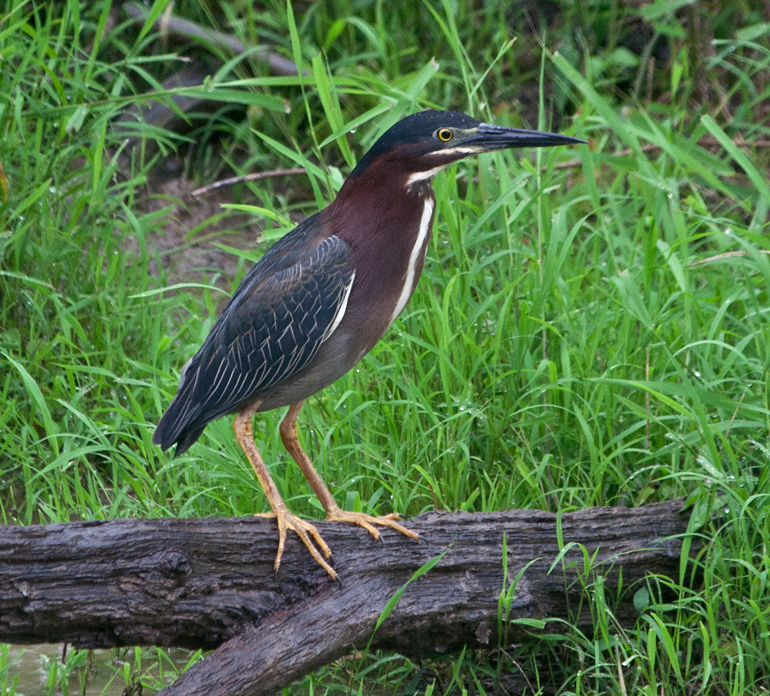
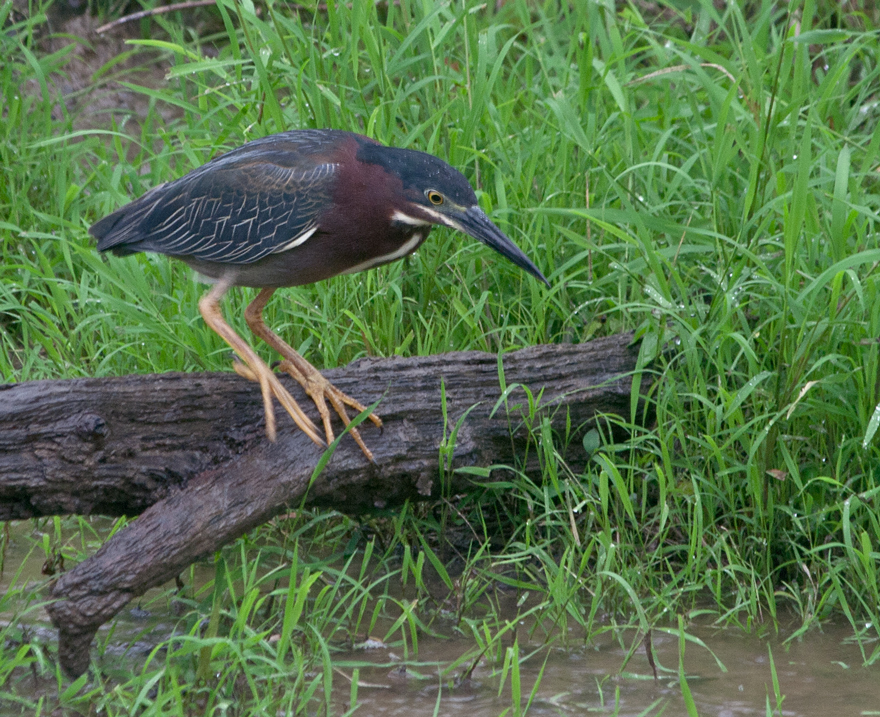
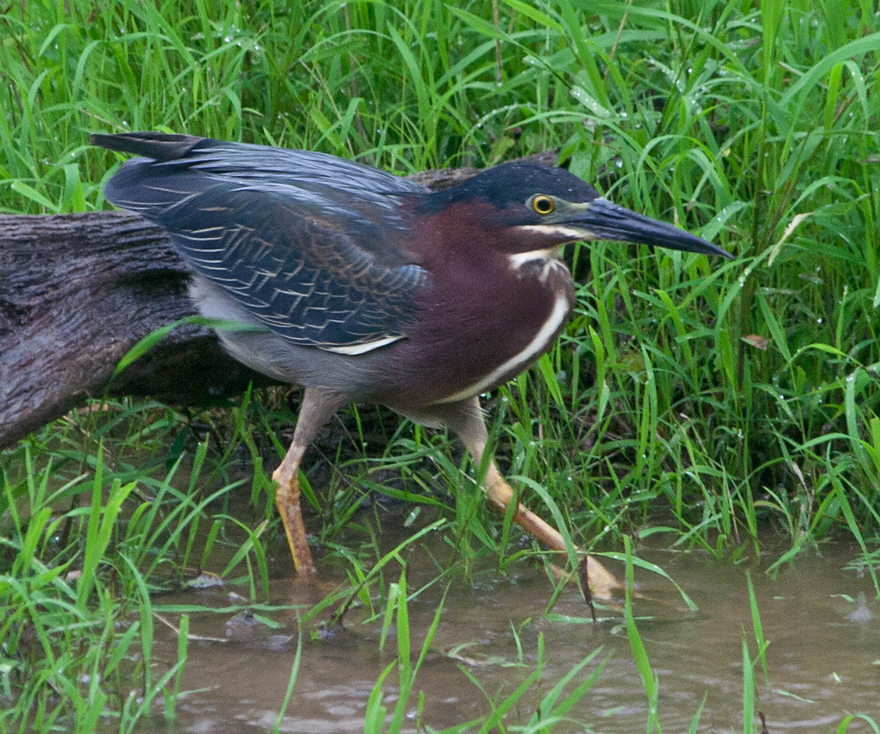
One of the advantages to taking photos in the rain is that the birds and animals seem a little less sensitive to my presence and there are fewer other people around to spook them. This past weekend I came across this Green Heron (Butorides virescens) at relatively close range while it was raining.

The heron was perched on a log, just about the level of the water and I had an unobstructed view of him.  Despite the sound on my shutter as I snapped off some shots, the heron seemed oblivious to the fact that I was there.

Initially, the little Green Heron stood on the log, surveying the situation. Eventually, he bent over a bit to look more attentively at the water for potential prey. After a little while, he hopped off the log and I lost sight of him in the plant-filled water.

This is one of the few times that a Green Heron has not taken off immediately when I saw it or,  as is often the case, before I even saw it. As a result I was able to get my clearest shots of a Green Heron to date, though, of course, I’ll continue to be on the lookout for even better shots.

heron_log1_blogheron_log2_blogheron_log3_blogMichael Q. Powell. All rights reserved

Read Full Post »

I stopped dead in my tracks on Monday when I spotted this Green Heron (Butorides virescens) as I was walking along the boardwalk at my local marshland park.

Only rarely have I had such an unobstructed view of this beautiful bird. My camera was already affixed to my tripod and I slowly opened its legs and set it down, all the while keeping my eyes on the Green Heron. I didn’t dare to make any sudden movements and felt like I was moving in slow motion as I inched my way forward to the edge of the boardwalk.

I don’t know if the heron was actively hunting for prey, but he seemed really focused and unaware of my presence (or was willing to ignore me). Initially upright, the heron gradually leaned more and more forward and appeared to be focusing even more intently.

My breathing seemed loud in my ears and my shutter sounded like a machine gun to me, but the heron hung around long enough for me to get some pretty good photos. Eventually, though, he got spooked and flew away, but I think I have an idea of the general area in which he hangs out, so I hope to encounter him again.

greenheron1_bloggreenheron2_bloggreenheron3_blog

Michael Q. Powell. All rights reserved

Read Full Post »

On Monday as it was raining,  I encountered a Green Heron (Butorides virescens), one of my favorite birds. Initially he was perched atop an abandoned beaver lodge, but he took to the air as I approached. He flew to the edge of a cattail patch, where new shoots have started to appear during the last couple of weeks. The cattail shoots help contribute to the green backdrop for this Green Heron.

I was happy that I was able to get an unobstructed path to this little heron—normally Green Herons are at the edge of the water or are in trees, where it’s almost impossible to get a clear shot.

greenheron_rain_blog

Michael Q. Powell. All rights reserved

Read Full Post »

I was thrilled this past Saturday when I caught sight of this Green Heron (Butorides virescens), because green herons have only recently returned to the area after spending their winter in warmer locations.

The lighting situation, however, was really problematic. There was beautiful dappled sunlight in the background, but the heron was mostly in heavy shade and his back was illuminated with harsh sunlight. I played around with a number of different settings and this was one of the better images.  I still had to make some adjustments in post-processing to pull some of the details out of the shadows, which made the final image a bit grainy.

I really like the Green Heron’s pose, as he looks off into the distance. I don’t think that he was actively fishing, but was merely relaxing in the shade of the tree.

greenheron1_blog

Michael Q. Powell. All rights reserved

Read Full Post »

Stereotypes of a heron’s  appearance

This past weekend I visited a pond at a local garden and encountered this interesting bird. He looked a little like a heron but had a totally different body type—he was shorter and squatter than the herons I was used to seeing. I have photographed blue herons and white herons and have a mental picture of what a heron looks like. They are tall and slender and posses a fashion model’s elegance. Could this really be a heron?

Surveying the situation

Playing and posing like a child

I was alone with the bird for quite some time for the gardens were deserted after a thunderstorm. The beautiful bird, later identified as a juvenile green heron, seemed to be unusually willing to remain as I attempted to photograph him. At times he even seemed to be posing for me. Like a child he was enjoying himself, running around and playing in the water. He definitely was not intent on adult-type tasks such as catching food.
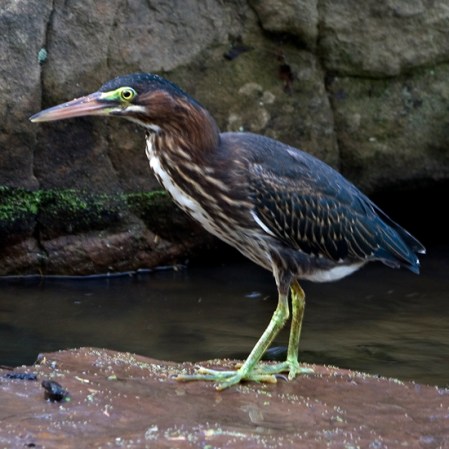
Full body shot. Don’t I have great legs?

Is this enough of a smile for you?

It’s a green heron

I am pretty confident that this bird is a green heron (Butorides virescens). Wikipedia helped me determine that he is a juvenile because of the brown-and-white streaked feathers on his breast and the greenish-yellow webbed feet. (The adult green heron has a darker bill and a more pronounced  chestnut-colored neck and breast.) NatureWorks has some summary information if you want to quickly learn about green herons.

This grass feels really good on my bare feet.

A tool-using bird

My favorite website for information on the green heron, however, belongs to the Cornell Lab of Ornithology, which includes range maps and audio files. It also noted the following truly amazing fact about green herons, “The Green Heron is one of the few tool-using birds. It commonly drops bait onto the surface of the water and grabs the small fish that are attracted. It uses a variety of baits and lures, including crusts of bread, insects, earthworms, twigs, or feathers.”

Ready for my close-up

Maybe the green heron should have its own reality television show, “Fishing With a Green Heron-Choosing the Right Bait. You Don’t Even Need a Hook”

© Michael Q. Powell. All rights reserved.

Read Full Post »

« Newer Posts