As I strolled through my suburban neighborhood on a sunny Sunday afternoon, I expected to see cardinals, chickadees, sparrows, and goldfinches in the trees—I had no idea that I would also encounter a brightly colored tropical bird.
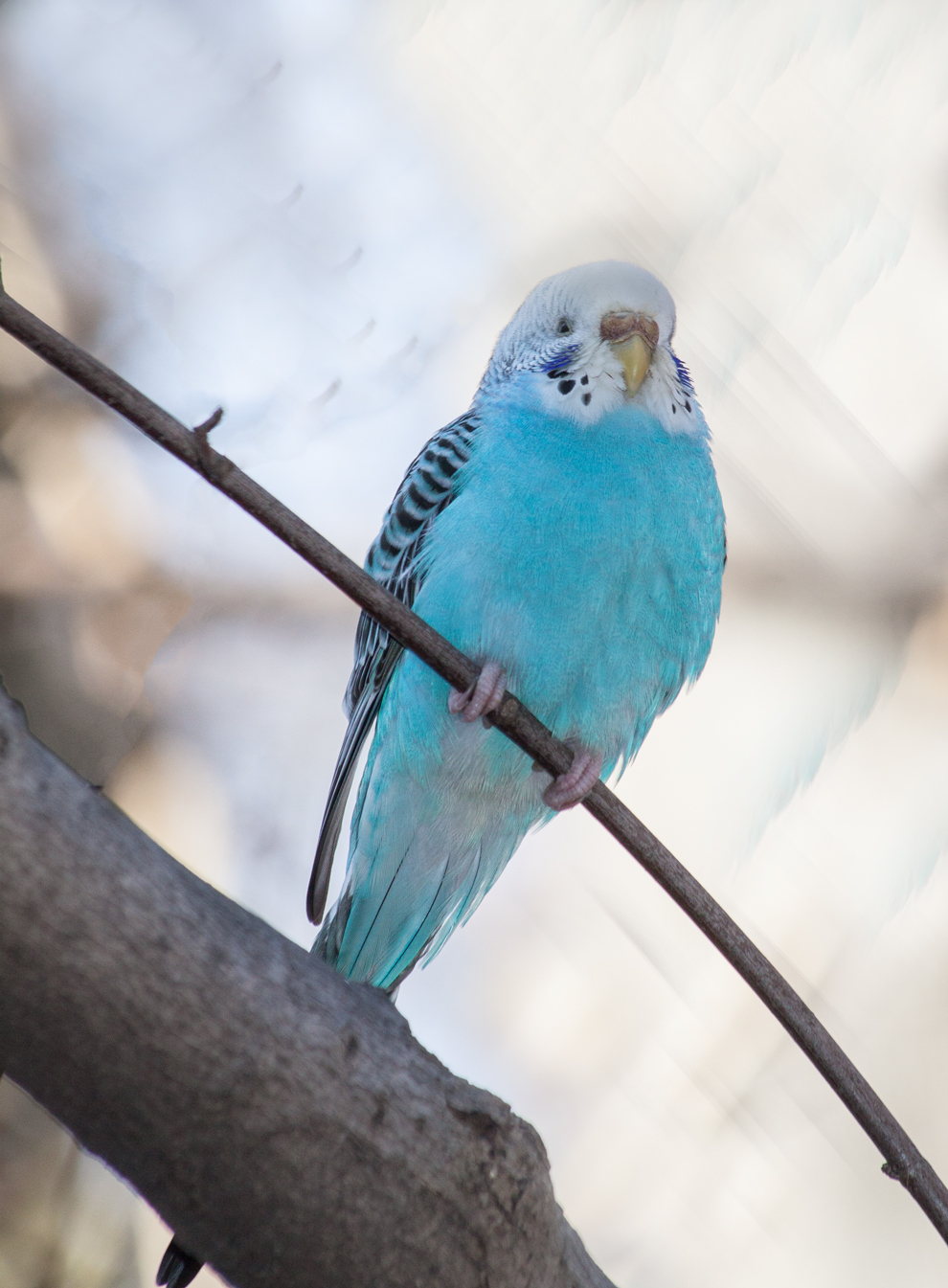
I first saw the bird as a flash of brilliant blue, when it flew from a bird feeder on a back porch to a nearby tree. I love the blue colors of the Eastern Bluebirds, but this was an entirely different shade of blue. Initially the bird was in the shade and I tried to figure out what it was from its shadowy shape, but I was stumped, because it didn’t seem to have a bill.
When I circled around and got a better look, I could see that it was a blue parakeet. What was a parakeet doing outdoors in Northern Virginia? Had it recently escaped from one of the nearby townhouses? Can it survive for long outside?
I did a little research on the internet and learned that the birds we know as parakeets are more technically known as Budgerigars (Melopsittacus undulatus). In the wild, they live in parts of Australia and are naturally green and yellow. In captivity, they have been bred to have different colors, like the electric blue of this one. Judging from the brown color of the cere (the waxy structure that covers the base of the bill), this appears to be a female.
I’ll keep my eyes open to see if I can spot this beautiful bird again. Meanwhile, I will post the photos in the Facebook group of my homeowners’ association and see if I can learn from others how long this bird has been living in the wild.


© Michael Q. Powell. All rights reserved
Read Full Post »


 Mike Powell