Feeds:
Posts
Comments

Posts Tagged ‘birds in flight’

I never get tired of photographing Bald Eagles (Haliaeetus leucocephalus), like this one that soared by me last week at Occoquan Bay National Wildlife Refuge. The eagle made minor adjustments to its wings and tail to maintain its speed and direction, but it mostly seemed to be enjoying itself without exerting much effort. I couldn’t help but think of the Steve Miller Band and its well-known song “Fly Like an Eagle” from the 1970’s.

“I want to fly like an eagleTo the seaFly like an eagleLet my spirit carry meI want to fly like an eagle‘Til I’m freeOh, Lord, through the revolution…”


Bald Eagle

Bald Eagle

Bald Eagle

Bald Eagle

© Michael Q. Powell. All rights reserved.

Read Full Post »

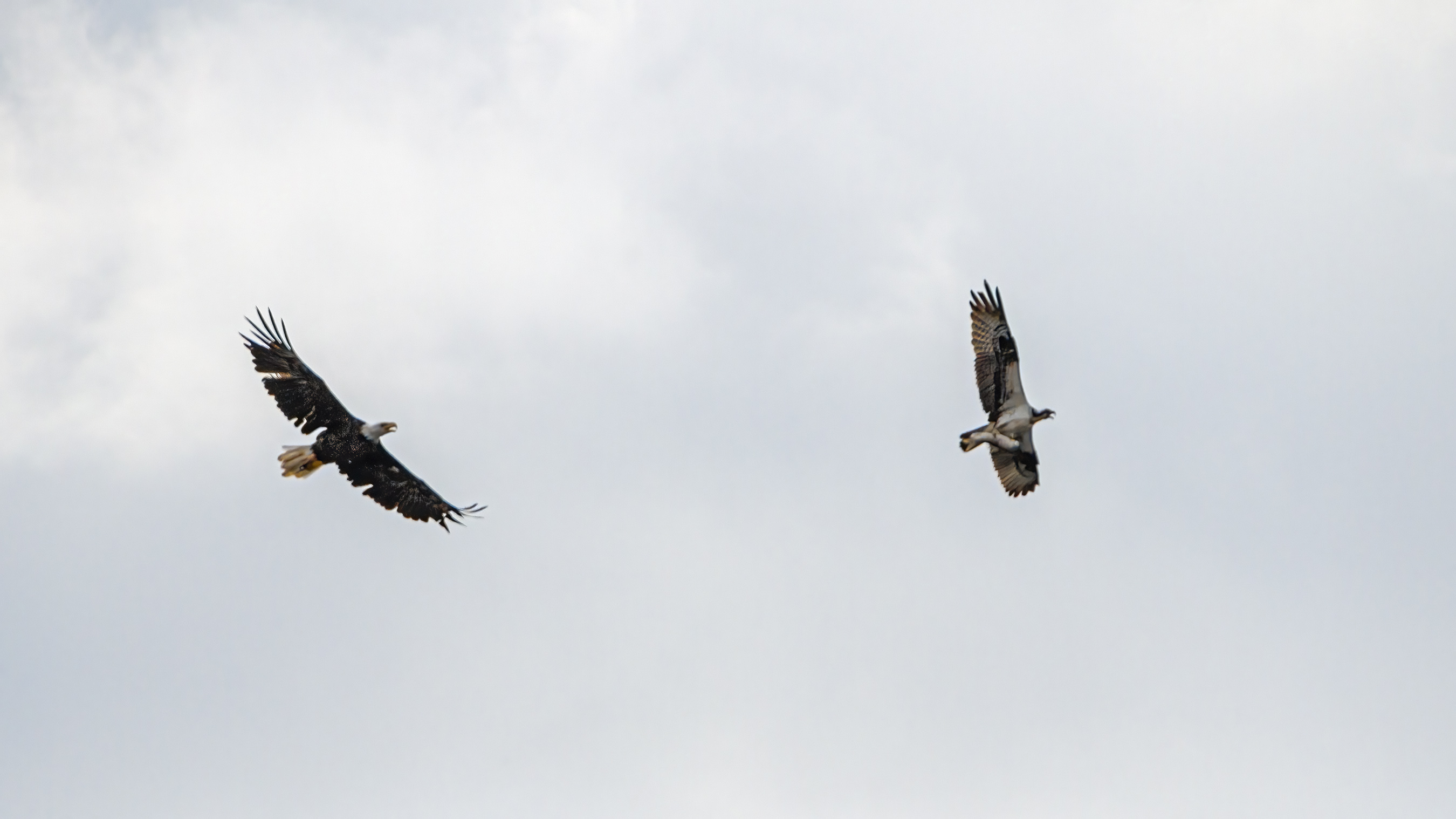
On Wednesday I watched as a Bald Eagle (Haliaeetus leucocephalus) chased an Osprey (Pandion haliaetus) high in the sky above the waters off of Occoquan Bay National Wildlife Refuge in a vain attempt to steal its freshly caught fish. I captured the second shot when the eagle flew past me after giving up on its chase.
It has been several months since I last photographed a Bald Eagle, so I was thrilled to capture these images. As most of you know, I concentrate most of my photographic attention on dragonflies and other insects during the warmer months. However, I am always alert to the possibility of photographing birds when I manage to spot them.
During the winter months I generally use a 150-600mm telephoto zoom lens that gives me a long reach, but in the summer I tend to rely on a 180mm macro lens or the 18-400mm zoom lens that I used for these shots. This lens gives me a good deal of versatility, allowing me to capture my close-in tiny subjects and some longer distance ones like these raptors in flight.
Eagle and Osprey
Bald Eagle
© Michael Q. Powell. All rights reserved.

Read Full Post »

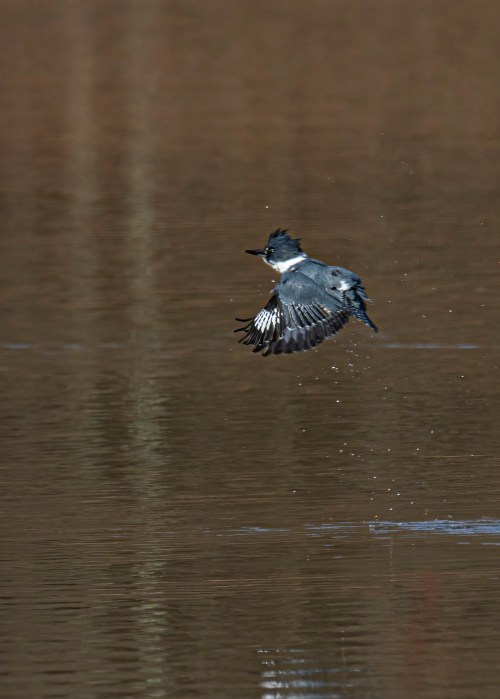
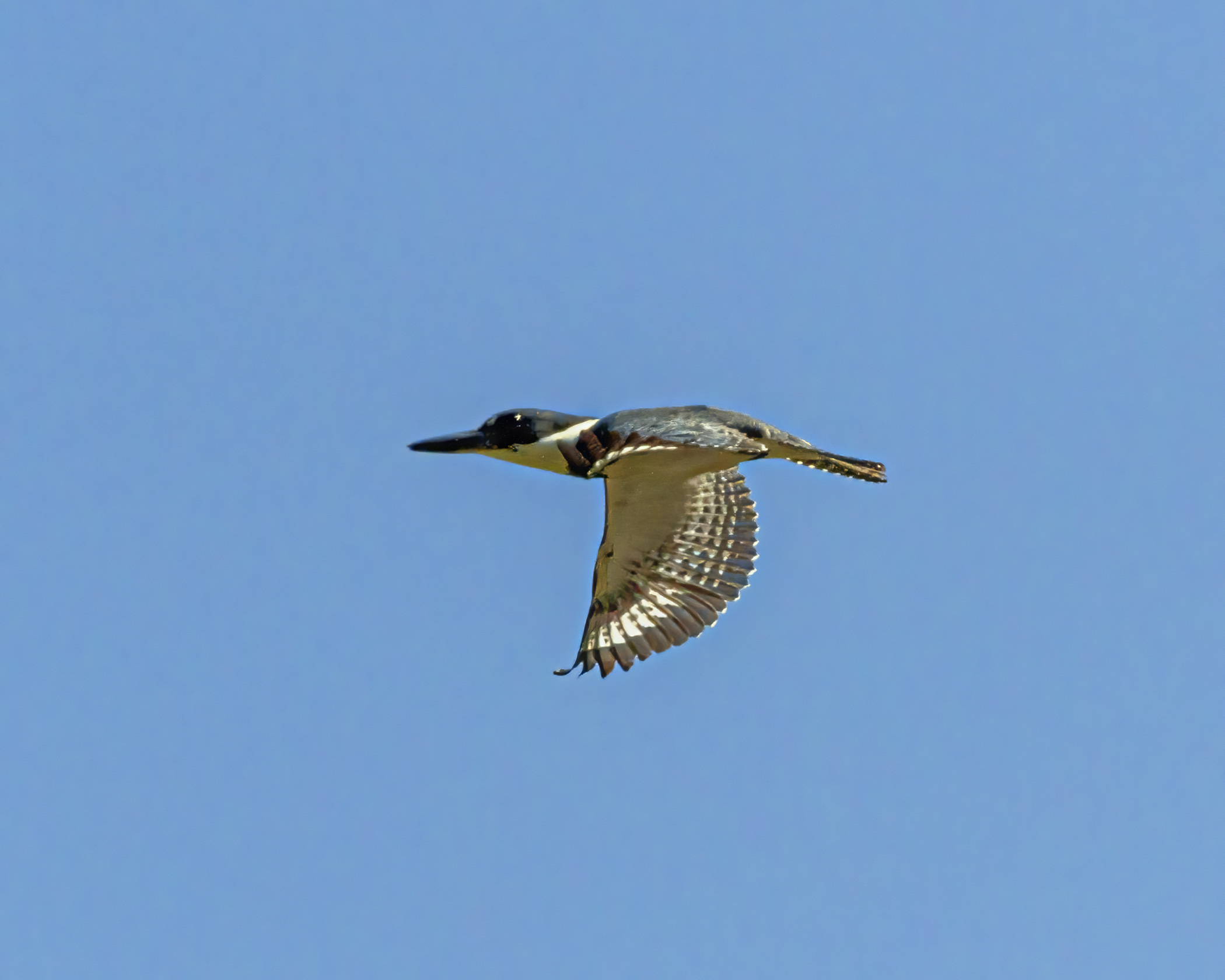
On Monday at Occoquan Regional Park, I was thrilled to capture some shots of this male Belted Kingfisher (Megaceryle alcyon) as he flew by me overhead. Kingfishers are really skittish and quite often I am aware of their presence of these speedy little birds when I hear their rattling call as they fly away from me. This kingfisher, however, flew across my field of view, which allowed me to track it and focus on it as it passed.

How do I know this is a male kingfisher? Normally male birds are more colorful than their female counterparts, but that is not true for Belted Kingfishers—females have a chestnut-colored band across their chests that the males do not have.

Belted Kingfisher

Belted Kingfisher

© Michael Q. Powell. All rights reserved.

Read Full Post »

An Osprey (Pandion haliaetus) raised a wing as it flew by me on Monday at Occoquan Bay National Wildlife Refuge, displaying the fish that it had just caught. There are quite a few osprey at the refuge at this time of the year and it is not uncommon for me to see one clutching an osprey in its talons. However, it is rare that I am able to get a good look at the prey, because it is often hidden by the osprey’s wing movements.

Normally I attempt to capture shots of birds in flight with my longest lens, a Tamron 150-600mm. At this time of the year, though, I am just as likely to want to photograph butterflies and dragonflies as birds, so most of the time I keep my Tamron 18-400mm lens on my camera that lets me focus on a much closer subject. I sacrifice a bit of reach by using this lens, but, as you can see in the image of the osprey captured with this lens, it can produce good results even when fully extended. I encourage you to click on the image to see the feather details of the osprey and the details of the hapless fish too.

osprey

© Michael Q. Powell. All rights reserved.

Read Full Post »

I raised my camera to my eye when I spotted a Carolina Chickadee (Poecile carolinensis) extracting seeds from spiky Sweet Gum balls on Monday at Occoquan Bay National Wildlife Refuge. As I pressed the shutter release, the chickadee took off and I captured this fun photo of the departing little bird.

I really like the way the head is tilted upward and how the tiny claws are still extended. Most of all, though, I love the way that I was able to capture the feather details in the extended wing.

Sometimes it is better to be lucky than good—this was definitely not the shot that I thought I was taking.

Carolina Chickadee

© Michael Q. Powell. All rights reserved.


Read Full Post »

Belted Kingfishers (Megaceryle alcyon) are one of my nemesis birds. They are small and fast and incredibly skittish. I see (or hear) them quite often, but I am rarely able to get a decent shot of one.

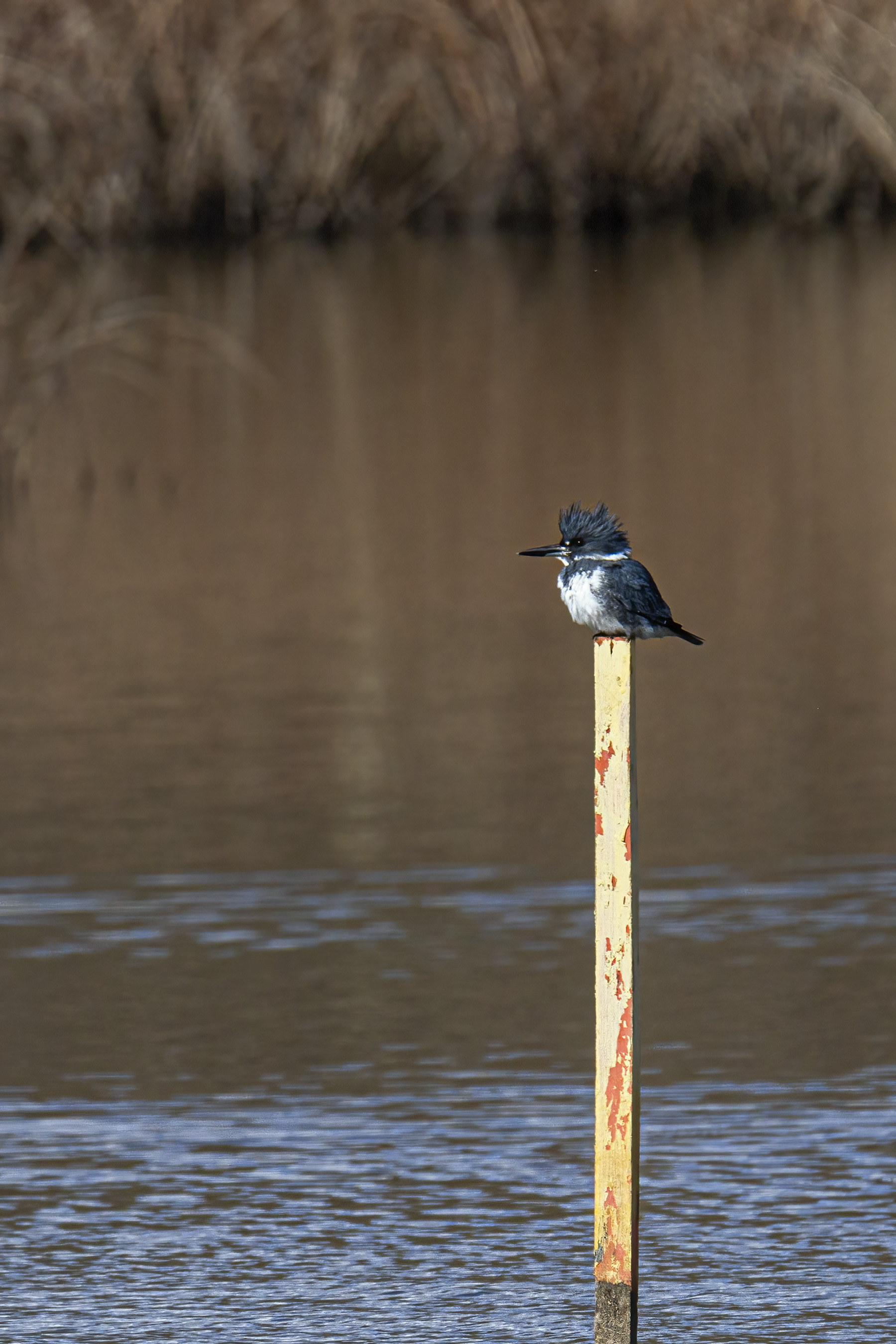
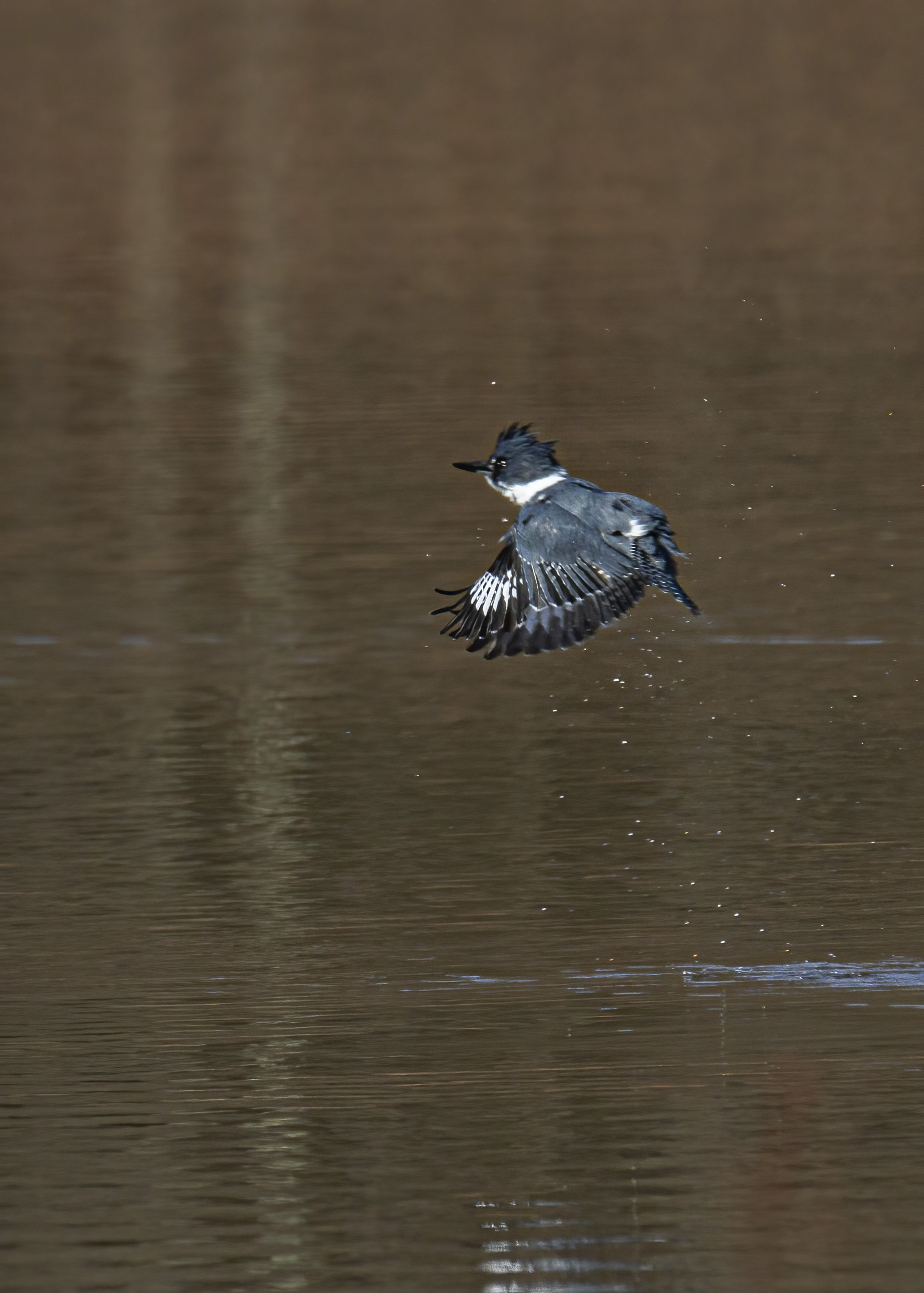
I spent a good amount of time last Friday at Huntley Meadows Park observing a male Belted Kingfisher trying to catch a fish. He was perched on some kind of board sticking out of the water and repeatedly dove into the water and returned to the same post. Eventually he caught a fish, but, alas, flew away with it before I could get a shot of him with his catch.

Unlike an eagle that grabs a fish with its talons without submerging itself, a kingfisher dives headfirst into the water, creating a big splash. According to the Cornell Lab of Ornithology, “When it spots a fish or crayfish near the surface, it takes flight, dives with closed eyes, and grabs the prey in its bill with a pincer motion. Returning with its prize, it pounds the prey against the perch before swallowing it head first.”

I was perched on am observation platform some distance away, but had a clear line of sight to the kingfisher. Over time I was able to capture some relatively sharp shots of the kingfisher in action. The first shot is my favorite—the kingfisher was rising up out of the water, surrounded by water droplets, after what appeared to have been an unsuccessful attempt.

The second photo shows the kingfisher on its perch. I am not sure why this board was sticking out of the water, but noted several similar boards nearby. The subsequent images show the kingfisher in various stages of action. I was fortunate that the kingfisher made several attempts, sometimes diving to the left and sometimes to the right, so I had multiple chances to get shots. Actions shots are a tough, but fun challenge. The kingfisher would take off without warning and after it dove into the water, I was never sure exactly when and where he would reemerge.

Belted Kingfisher

Belted Kingfisher

Belted Kingfisher

Belted Kingfisher

Belted Kingfisher

Belted Kingfisher

© Michael Q. Powell. All rights reserved.


Read Full Post »

Most of the time my photos have a well-defined subject. Some of the time, though, I am so interested in trying to capture the mood of the moment that the “subject” occupies only a small part of the frame.

Last Friday, I spotted a large bird perched on a skeletal tree at Occoquan Bay National Wildlife Refuge. I thought at first that it might be a Bald Eagle, but when I zoomed in a bit I could see that it was a Turkey Vulture. I really like the starkness of the bare trees and the way that they give an abstract feel to the landscape. As I was preparing to take a shot, a small flock of Canada Geese flew into the frame and I captured several of them in the photo below.

The resulting image is mostly monochromatic, though you can see occasional glimpses of a warmish brown on some of the broken edges of the trees. If you look really closely at the vulture’s head, you can see a touch of red.

I do not know if this image “works” in conveying the mood of that monochromatic moment, but I thought it might be interesting to share with you my thought process as I experimented in capturing an image that is quite different from my normal wildlife shots.

monochromatic

© Michael Q. Powell. All rights reserved.

Read Full Post »

As I was focusing in on a Tree Swallow (Tachycineta bicolor) that was happily singing from a perch sticking out of a small pond, another swallow came screeching in in an attempt to take over the perch. The attack was successful and the first bird was forced to leave.

Happy with his effort to become “king of the hill,” the new swallow began to sing with all of his might as he surveyed his new kingdom. How long will his reign last? Undoubtedly the swallow knows that others may soon seek his place, but seems determined to enjoy his moment in the spotlight.

Tree Swallow

Tree Swallow

Tree Swallow

© Michael Q. Powell. All rights reserved.

Read Full Post »

Bald Eagles (Haliaeetus leucocephalus) have impressive wing spans, approximately 80.3 inches (204 cm), according to the Cornell Lab of Ornithology. I was thrilled last week to capture some images of an eagle with its wings fully extended as it flew over me at Occoquan Bay National Wildlife Refuge.

The afternoon sunlight was pretty strong, which caused a shadow on the side of the eagle’s face, but I was happy that I was able to keep the visible eye in pretty sharp focus—you may want to click on the images to get a better look at the eagle’s eyes.

bald eagle

bald eagle

© Michael Q. Powell. All rights reserved.

Read Full Post »

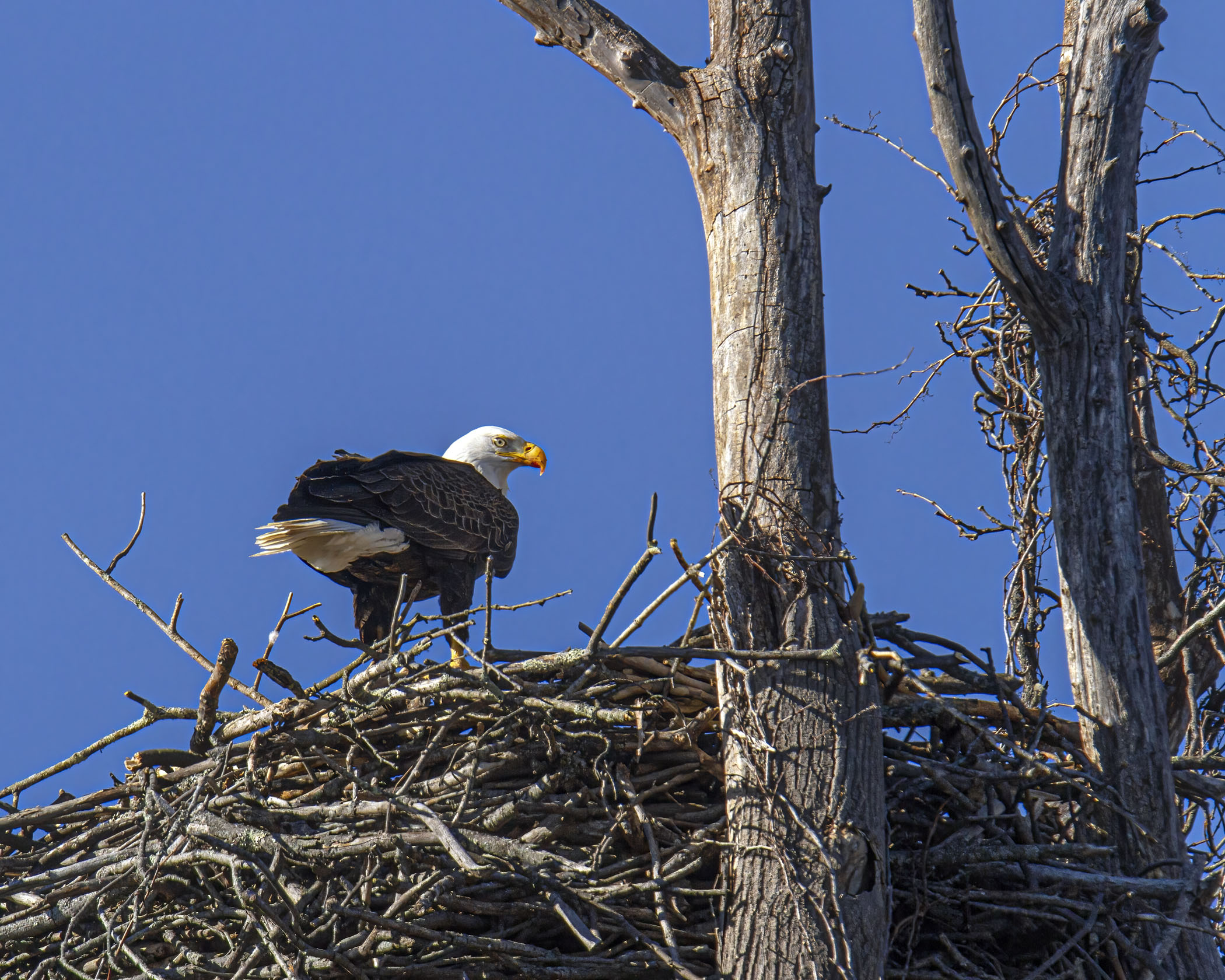
Last Wednesday I watched as this Bald Eagle (Haliaeetus leucocephalus) approached its nest to take the place of its mate, who had flown away a moment earlier. It would have been cooler if the eagle had been coming towards me when it landed, but I like the way that I was able to capture the wing, tail, and talon positions in the first two photos. In the final photo, the eagle had successfully landed at the large nest—the eagle’s head was initially in the shadows, so I was happy when it glanced over its shoulder in my direction and the sunlight hit its eye.

Bald Eagle

Bald Eagle

Bald Eagle

© Michael Q. Powell. All rights reserved.


Read Full Post »
I was tracking a Carolina Chickadee (Poecile carolinensis) foraging high in a tree at Occoquan Bay National Wildlife Refuge on Wednesday and instinctively pressed the camera shutter when it took off, allowing me to capture this cool image of the tiny bird. I love the fully outstretched wings, which appear to be translucent, and the long skinny legs that were just being released from the branch when I took the shot.

Carolina Chickadee

© Michael Q. Powell. All rights reserved.


Read Full Post »

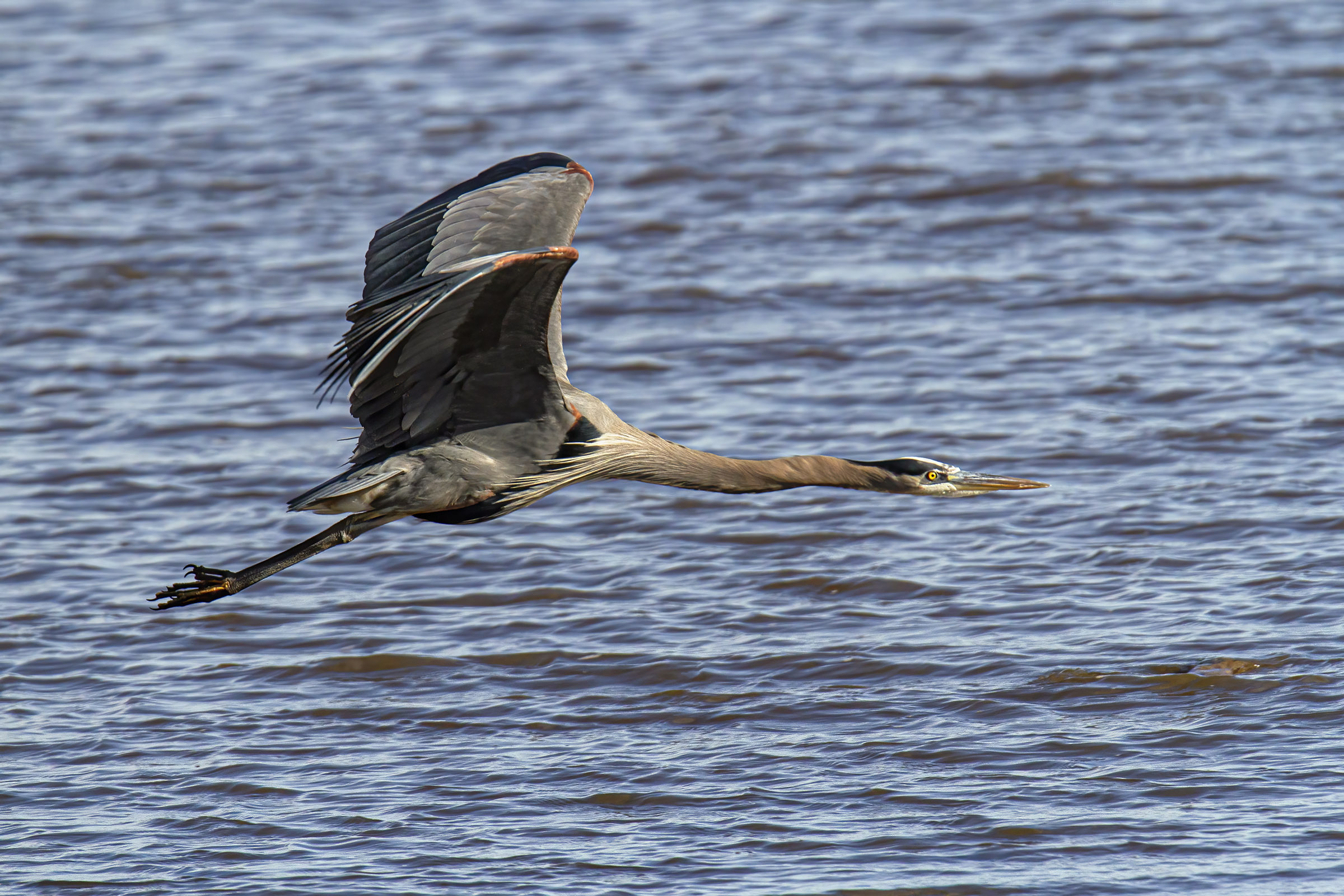
I was thrilled on Tuesday to capture this image of a Great Blue Heron (Ardea herodias) as it flew by me, low over the waters off of Occoquan Bay National Wildlife Refuge. I love the way that the heron was stretched out, almost as straight as an arrow in flight.

Great Blue Heron

© Michael Q. Powell. All rights reserved.

Read Full Post »

Great Blue Herons (Ardea herodias) can be quite cranky when they are disturbed and they will often make a loud squawking sound to signal their displeasure. Last week at Occoquan Bay National Wildlife Refuge, I inadvertently spooked this heron and he made sure to indicate vocally that he was not happy to relocate as he flew past me.

Great Blue Heron

© Michael Q. Powell. All rights reserved.

Read Full Post »
Normally I see only a few Double-crested Cormorants (Phalacrocorax auritus) at a time, but last Thursday I spotted several dozen of them in the waters off of Occoquan Bay National Wildlife Refuge. I see cormorants throughout most of the year, but this group may have been migrating through our area and were heading for destinations further south.

I was delighted to be able to capture some in-flight shots of one of the cormorants as it zoomed by, flying low over the water. I was particularly happy to capture enough detail that you can see the bird’s striking aquamarine eyes. I highly recommend that you click on the images to get a better look at the amazing colors of the eyes. Wow! It was a nice bonus to be able to capture the reflection of the cormorant in the water.

As the winter progresses, I hope to be able to hone my skills in tracking birds like this with my long telephoto zoom lens. During the warm months, I use a macro lens a lot and my tracking abilities may have atrophied a bit. It takes some practice for me to be able to be able to find a bird in the camera’s viewfinder when my telephoto lens is fully extended.

Double-crested Cormorant

Double-crested Cormorant

© Michael Q. Powell. All rights reserved.

Read Full Post »

I wish that I could say that I planned this cool image of an Eastern Bluebird (Sialia sialis) in flight, but the truth is that I did not even know that I had taken a shot like this until I was reviewing my shots this morning from yesterday’s visit to Occoquan Bay National Wildlife Refuge.

Most of the time when I am photographing birds, even those that are perched, I shoot in short bursts to try to capture different head and wing positions. In this case, the bluebird must have taken off as I was depressing the shutter button. In most situations like this, the resulting image is out of focus or shows only the back side of the departing bird.

Yesterday, however, I was very lucky and the bluebird flew to the side and remained more or less in focus. In wildlife photography, luck almost always plays some role in getting good images—yesterday it played a major role.

Eastern Bluebird

© Michael Q. Powell. All rights reserved.


Read Full Post »

I usually try to zoom in on my subjects as much as I can, but it is also great to show their environment (sometimes by choice and sometimes out of necessity). I captured these long distance in-flight shots of a Tundra Swan (Cygnus columbianus) and a Bald Eagle (Haliaeetus leucocephalus) during recent visits to Occoquan Bay National Wildlife Refuge. The eagle was a bit closer to me than the swan, which is why the background was so much more blurry in the second shot than in the first one.

Tundra Swan

Bald Eagle

© Michael Q. Powell. All rights reserved.

Read Full Post »

As I was observing a Bald Eagle (Haliaeetus leucocephalus) last Thursday (8 December) at Occoquan Bay National Wildlife Refuge, it suddenly swooped down to the water and snagged what I assumed was a fish. When I looked at my photos, however, the prey looked like it might be a duck or some kind of grebe. Yikes!

I have read that eagles will sometimes grab a waterfowl for meal, but I thought that was only as a last resort, for example, when the waters at a location are mostly iced over during the winter. At this time of the year, the waters are completely ice-free, so I am not sure what prompted the eagle to hunt for another bird rather than a fish. Perhaps the eagle was feeling lazy or was really hungry and did not want to go to the trouble of tracking and catching a fish.

Some birders on Facebook have suggested that the prey might be a small grebe, possibly a Horned Grebe, or perhaps a small duck, like a female Hooded Merganser.

Bald Eagle

© Michael Q. Powell. All rights reserved.

Read Full Post »
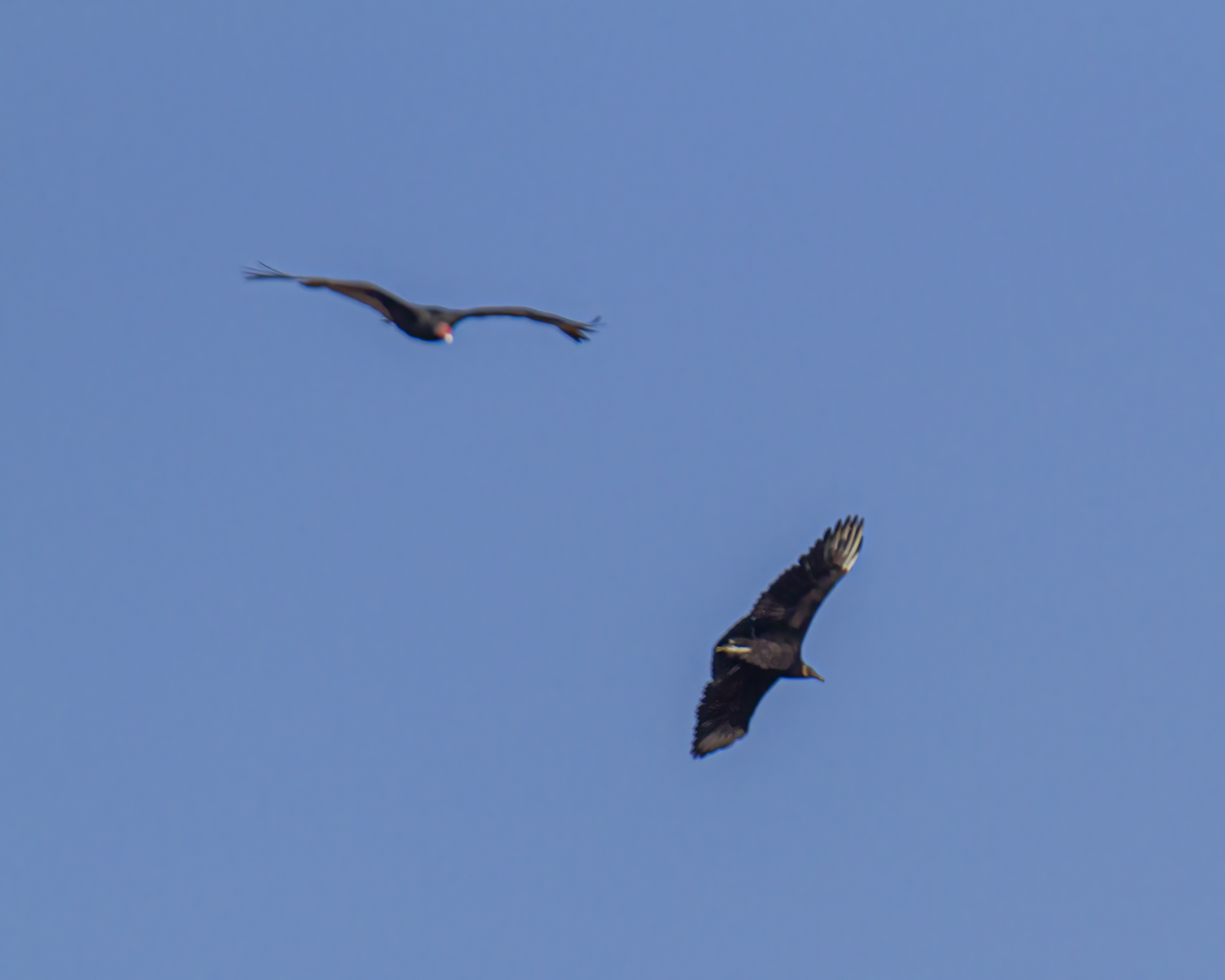
I often see vultures circling overhead when I am walking along the trails at Occoquan Bay National Wildlife Refuge. Although I have gotten used to their presence, I find them to be slightly spooky and I try to make sure I don’t stand still for too long a period, lest the vultures think that I am carrion.

Most of the vultures that I see are Turkey Vultures (Cathartes aura), like the one in the first photo. Occasionally, though, I also see Black Vultures (Coragyps atratus). How do I tell them apart? As you can see in the second photos, Turkey Vultures have red heads, while Black Vultures have black heads. In addition, the pattern of the light feathers on the underside of the wings of the two vultures is different. Black Vulture have patches of light feathers near the tips of the wings and Turkey Vultures have light feathers along almost the entire length of the trailing edges of the underside of their wings.

Turkey Vulture

vultures

© Michael Q. Powell. All rights reserved.

Read Full Post »

I first became aware of the presence of this Great Blue Heron (Ardea herodias) last week when I caught sight of it lifting off into the air from a small stream at Occoquan Bay National Wildlife Refuge. I swung my camera around quickly and captured a few in-flight shots of the large bird.

Normally I would not post photos of a bird flying away from me, which are derisively referred to as “butt shots” by many photographers. In this case, however, I was quite taken by the way that the dangling feet of the heron stand out in the photos. The heron was flying only a short distance and did not bother to lift its legs. In the second photo, the heron was preparing to land on the large branch that was protruding from the vegetation.

Great Blue Heron

Great Blue Heron

© Michael Q. Powell. All rights reserved.

Read Full Post »

Red-tailed Hawks (Buteo jamaicensis) are the most common hawks in North America, but I rarely see one. Most of the hawks that I photograph in my home area of Northern Virginia are Red-shouldered Hawks.

I was delighted on Monday when I spotted a perched hawk through the vegetation at Occoquan Bay National Wildlife Refuge. The hawk was perched in a small tree just above eye level. I had to work to find a visual tunnel that let me get a relatively unobstructed view of the beautiful hawk, as you can see in the first photo.

Before long, the hawk detected my presence and took to the air. I reacted quickly and was able to capture some shots of the bird as it flew away. I really like the way that the second and third shots show the markings on the underside of the hawk that I think is a juvenile.

Red-tailed Hawk

Red-tailed Hawk

Red-tailed Hawk

© Michael Q. Powell. All rights reserved.


Read Full Post »
I thought that the ospreys (Pandion haliaetus) in our area had already headed south, so I was pleasantly surprised to spot one last Friday at Occoquan Bay National Wildlife Refuge and was thrilled to be able to capture this image as it zoomed by me. During the summer there are multiple pairs of mating ospreys throughout the refuge and the ospreys are vocal and visible, but it had been at least a month since I had last seen an osprey.

Osprey

© Michael Q. Powell. All rights reserved.


Read Full Post »
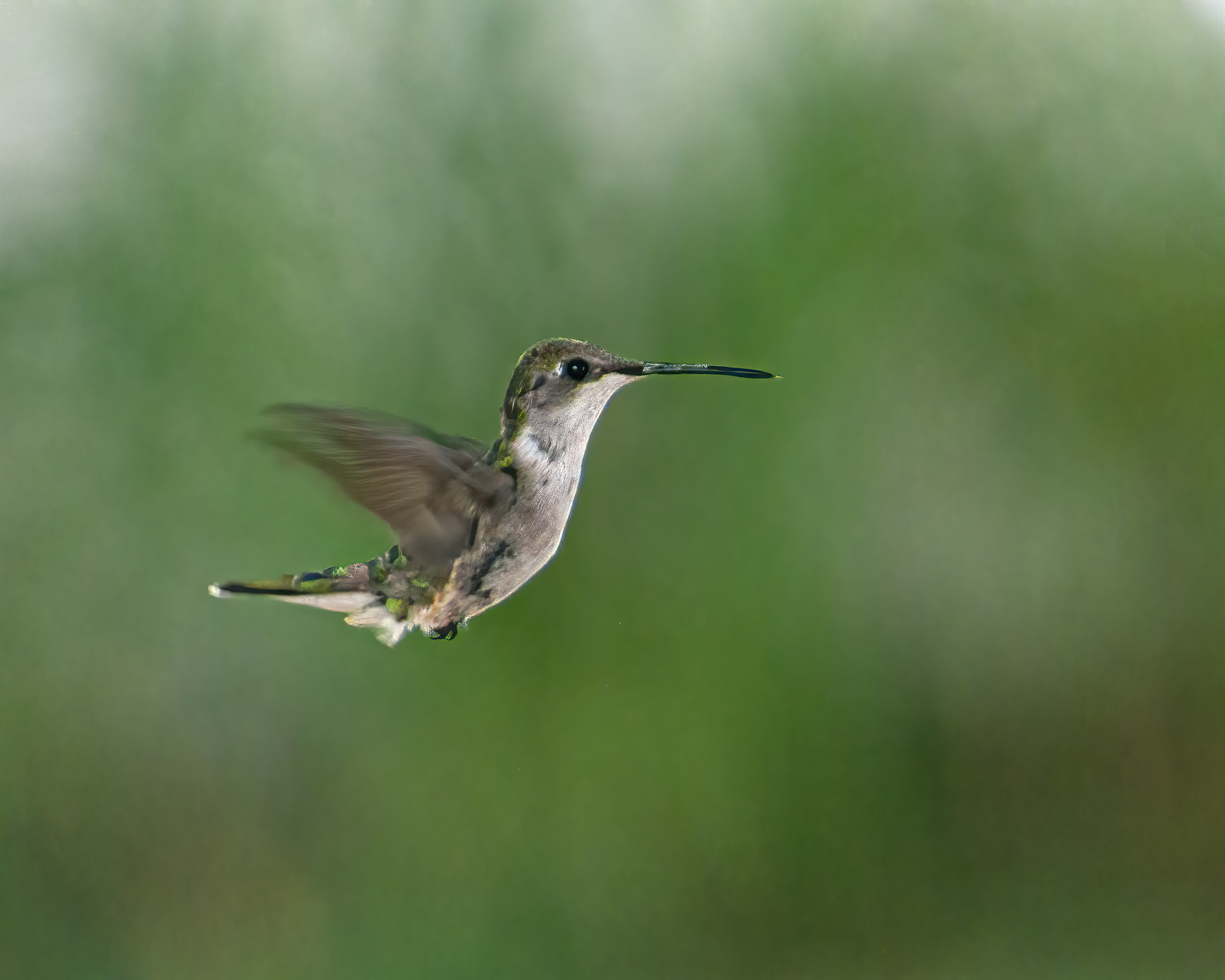
Yesterday I visited some family members who live on a farm. They have hummingbird feeders set up at various spots around the farmhouse and I was delighted to see Ruby-throated Hummingbirds (Archilochus colubris) zipping about throughout the time of my visit. I would have liked to have gotten shots of the hummingbirds feeding on some beautiful flowers, but they seemed content to use the feeders.

Ruby-throated Hummingbirds, the only hummingbirds where I live, are small at about 2.8-3.5 inches in length (7-9 cm), so it is not easy to capture shots of them in flight. Most of my shots include the feeders, but I generally prefer a more natural-looking backdrop whenever possible, so I used these shots. It was a hot, humid day and I quickly wore myself out chasing after these energetic little birds.

In case you are curious, I was once again using my new Tamron 18-400mm lens. I would have liked to have had a bit more reach to get closer shots—these shots are significantly cropped—but I think that is the constant complaint of most wildlife photographers, even those with super telephoto lens. I’m pretty happy with the shots that I was able to get of these hummingbirds that look to be either females or juvenile males—I did see some adult males with their brilliant ruby throats, but, alas, was unable to get any shots of them.

Ruby-throated Hummingbird


Ruby-throated Hummingbird

Ruby-throated Hummingbird

© Michael Q. Powell. All rights reserved.


Read Full Post »

A speedy little Barn Swallow (Hirundo rustica) was perched on a paved path at Meadowlark Botanical Gardens last Saturday and I captured this first image as it was taking off. The shot is a little blurry, but I love the the really cool shadow that the swallow was casting onto the ground. The second image shows the same swallow just before it took off and give you a better view of the coloration and markings of a Barn Swallow.

When I first spotted the birds in the final photo, I thought they might also be Barn Swallows, but when I took a closer look and did a little research, I determined that the bird on the outside of the nest was a male Purple Martin (Progne subis) and the one with her head poking out was a female Purple Martin. As far as I can recall, this is the first time that I have photographed this bird species, which is the largest swallow in our area.

Barn Swallow

Barn Swallow

Purple Martin

© Michael Q. Powell. All rights reserved.


Read Full Post »

I love seeing the differences between juvenile and adult Bald Eagles—the coloration and markings of the eagles change dramatically over time. Earlier this week I did a posting called Two eagles that showed two juvenile eagles perched in a tree. One of them was quite young and the other was almost an adult. It was really easy to see the differences between the two stages of development, with only the older one showing the distinctive white head feathers.

Today I am featuring in-flight photos of two eagles that I spotted last Monday while exploring Occoquan Bay National Wildlife Refuge. The first photo shows a juvenile Bald Eagle that looks to be about two to three years old. The head appears to be dark and the there is a mottled mixture of white and brown feathers. The second image shows a mature Bald Eagle with a white head and uniformly dark feathers.

It is an awesome experience for me when eagles fly almost directly over me and I love trying to get shots of them. I never fail to be impressed by their amazing wingspans, which can reach more than seven feet (213 cm).

Bald Eagle

Bald Eagle

© Michael Q. Powell. All rights reserved.

Read Full Post »

When it comes to aerial skills, Tree Swallows (Tachycineta bicolor) are some of the most agile fliers that I have ever observed. On Monday I watched in awe and amazement as a small group of tree swallows swooped and zoomed over the waters off of Occoquan Bay National Wildlife Refuge. The flight of these tiny birds was graceful and mesmerizing, full of acrobatic twists and turns.

It was a real challenge, though, to take photos of birds that are so small and so fast. I was especially happy when I managed to capture the first image that shows a pair of swallows with their wings fully extended. The second shot shows a swallow gliding low over the water—the shape of the bird reminds me of a stealth aircraft skimming low over the earth to avoid being detected by radar.

I did not realize that Tree Swallows had returned to our area. There are several nesting boxes at this wildlife refuge that Tree Swallows regularly use, so I will have to check them out soon.  Sometimes there is a competition between Tree Swallows and Eastern Bluebirds for the nesting boxes. I am not sure how they decide who will get to use the boxes, but somehow they figure it out. Tree Swallows

tree swallow

© Michael Q. Powell. All rights reserved.


Read Full Post »

Quite a few ospreys (Pandion haliaetus) have returned to Occoquan Bay National Wildlife Refuge and I spent a lot of time last Thursday trying to photograph them. Most of my efforts were focused on trying to capture images of them in flight.

Ospreys will fly in circles over the water and occasionally will hover and glide a little as they search for prey, which makes it somewhat easier to focus on them than on many other birds. However, it’s still a pretty formidable challenge to get shots in which the eyes are visible and in focus and in which the wing positions are good.

For the first image, I did not react quickly enough to zoom out when the osprey flew overhead, so I clipped its wings in the photo. I think that it is nonetheless a cool shot that provides a good look at the feather details of the osprey and at its eye and beak.

In the second shot, I captured the osprey at a moment when it had its wings fully extended. I like the way that the osprey’s yellow eye really stands out in the image.

I am sure that I will get lots of chances to photograph ospreys in the upcoming months, but it is always exciting me to them again for the first time each year—another sign that the seasons are changing.

osprey

osprey

© Michael Q. Powell. All rights reserved.

Read Full Post »

I was blessed to see multiple Bald Eagles (Haliaeetus leucocephalus) last Friday during a visit to Occoquan Bay National Wildlife Refuge. I am used to seeing two eagle couples that occupy the nests plus a few other from time to time. On this day, though, there seemed to be a whole lot more eagles than normal.

Seeing eagles is great, of course, but getting photos of them is not always easy. In the first photo, the eagle was flying almost directly over me and it is challenging to hold a long telephoto lens upright and track a moving subject. I am pretty happy with the way that this one turned out. If you click on the photo you can see the wonderful details of the eagle more closely, including what looks to a band on at least one leg and possibly on both of them—to me it looks like the eagle is flying with leg shackles.

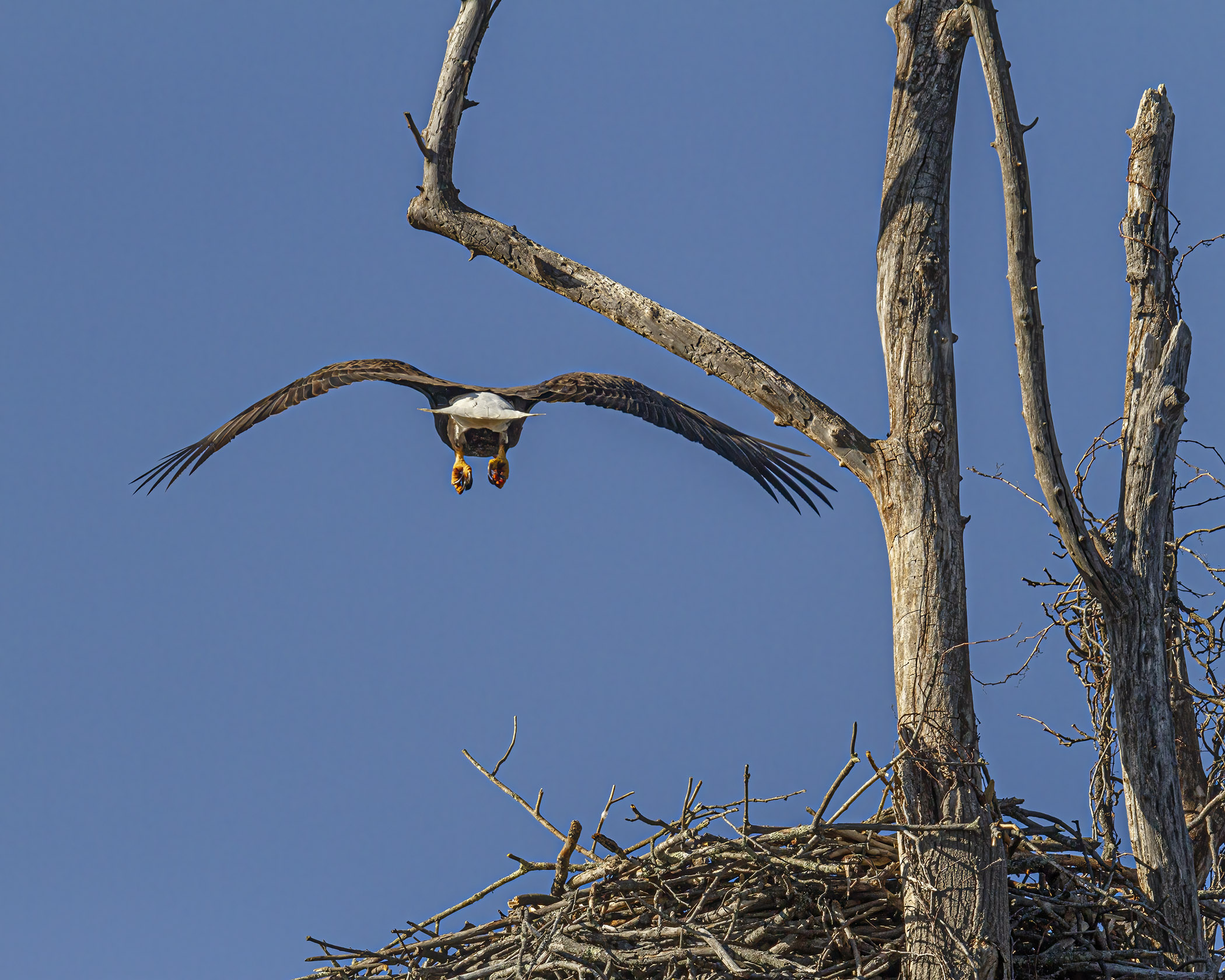
In the second image, I captured an eagle as it was preparing to land on its nest. There was a lot of activity at that nest on that day, with both eagles flying in and out of that nest. It seems a bit early, but I wonder if there is a change that the eaglets have already hatched. The only way that I will know for sure that there are eaglets is if they pop their heads up. However, the nest is so deep that it will probably be a while before the eaglets are big and strong enough to be seen.

Bald Eagle

Bald Eagle

© Michael Q. Powell. All rights reserved.

Read Full Post »

I was looking into the sun when I spotted this Bald Eagle (Haliaeetus leucocephalus) in a tree during a recent visit to Occoquan Bay National Wildlife Refuge. The eagle took off before I could get into a better shooting position, but I was able to capture some of the sunlight shining through its tail feathers.

I wish I had been able to frame the photo a bit better, but it is always tricky when focusing on a perched eagle to figure out how much to zoom out in order to capture its entire wingspan. In this case, I was worried more about adjusting for the backlight, so that I would not have a silhouetted shot, and was not worrying about framing the photo.

It is amazing to realize how many different considerations were coursing through my brain as I tried to analyze the situation, predict the possibilities, and react to changes. I remember how overwhelmed and paralyzed I felt in this kind of a situation when I was just starting to get serious about my photography some ten years ago. Now I am much  more comfortable with my gear and have a certain amount of muscle memory, so I am able to react more calmly and instinctively, without having to think consciously about all of the variables.

Every situation is different, though, and no matter how much I practice, there is still a spurt of adrenaline when a moment like this arrives and I realize I have to react instantaneously to take advantage of the situation. Things rarely works perfectly, but I am more than happy when they work as well as they did when I captured this image of the eagle’s takeoff.

bald eagle

© Michael Q. Powell. All rights reserved.

Read Full Post »
Have you ever noticed the different ways that birds take to the air? Some of them flap their wings and seem able to almost levitate themselves as they rise vertically. Others make a running start in order to gain additional momentum before they lift off. No matter how they do it, the birds have to coordinate a complex series of small actions by their various body parts for a takeoff to be successful.

On Tuesday I was observing this Northern Flicker (Colaptes auratus) in a tree at Occoquan Bay National Wildlife Refuge, when it decided to depart without warning. Instinctively I pressed the shutter and was able to capture this fun little photo. It looks like the first step in the takeoff process for this flicker was to leap from the branch and then perhaps glide a bit before engaging its wings.

Northern Flickers always fascinate me. I cannot help but marvel at the amazing combination of colors and patterns on the bodies of these woodpeckers whenever I see one.

Have a wonderful weekend.

Northern Flicker

© Michael Q. Powell. All rights reserved.

Read Full Post »

I spotted Bald Eagle couples (Haliaeetus leucocephalus) near each of the two bald eagle nests at Occoquan Bay National Wildlife Refuge this past week, but I have not yet seen them in the nest itself quite yet. I believe that it is now mating season and it probably will not be long before the eagles start nesting.

This past Wednesday I spotted one of the eagle couples perched on an osprey nesting platform that is not far from one of the eagle nests. This seems to be one of the favorite spots for the eagles to hang out together and I have seen them at this spot multiple times in the past. I was a good distance away from the eagles, but was monitoring them through my telephoto zoom lens.

I sensed that they were getting prepared to take off, so I got ready prepared in case they happened to fly in my direction. I was delighted when they zoomed past me and was even more thrilled when I managed to capture this image with both of the eagles in flight.

It is pretty hard to photograph a bird in flight under the best of circumstance and really difficult when there is more than one bird. I would consider this one to be a successful shot.

Have a wonderful weekend.

Bald Eagles

© Michael Q. Powell. All rights reserved.

Read Full Post »
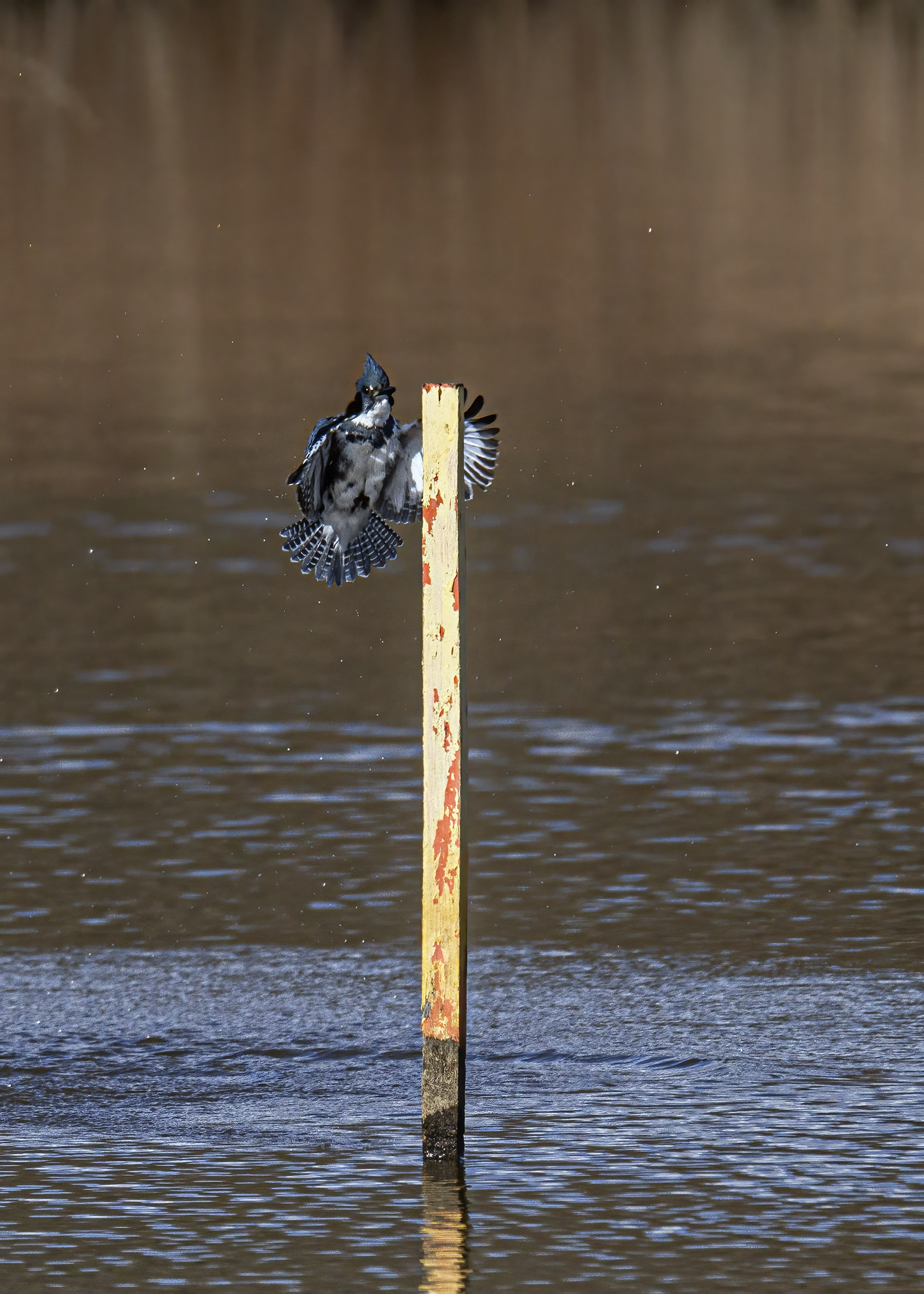
The female Belted Kingfisher (Megaceryle alcyon) that I spotted last Friday at Huntley Meadows Park was too quick and too far away for me to photograph in flight when she took off several times to try to catch a fish. I did manage, though, to capture a short sequence of shots when she was returning to her perch after an unsuccessful attempt. Unlike many birds that would have approached the perch horizontally, the kingfisher came up out of the water vertically, appearing almost to levitate as she rose to her perch.

Normally I lead a blog post with my favorite or my best image, but this time I decided to leave the shots in the correct time sequence. The middle image in which the kingfisher was fully spread her wings is my clear favorite of the three, though I like the way that each shot shows the different body and wing positions as she stuck her landing–I would give her a perfect score of 10.


Belted Kingfisher

Belted Kingfisher

Belted Kingfisher

© Michael Q. Powell. All rights reserved.

Read Full Post »

Older Posts »