Feeds:
Posts
Comments

Posts Tagged ‘Big Bluet damselfly’

Many of the trails at Occoquan Bay National Wildlife Refuge are now littered with fallen leaves as we move deeper into autumn. In my area the colors are not as bright and intense as in New England, where I grew up, but the muted colors here are a sign nonetheless that the seasons are changing.

Every year I try to get shots of dragonflies and damselflies perched on the colorful foliage. It is tough, though, to get these beautiful little creatures to cooperate, even though I try to communicate my desires to them telepathically. I doubt it was because of my weak attempts at communication, but on Monday a Big Bluet damselfly (Enallagma durum) perched momentarily on one of the brown, crunchy leaves on the ground and I managed to capture this shot.

I really like the way that the bright blue of the damselfly make it really “pop” in an environment of mostly muted colors. In a simple, uncomplicated way, this modest photo is a symbol to me of the arrival of autumn. For the record, there is no damselflies species called “Autumn bluet,” but I thought the title was a little more punchy as “Autumn bluet,” rather than “Bluet in autumn.” I apologize if I caused anyone to search frantically in their identification guides for a new species.

Big Bluet

© Michael Q. Powell. All rights reserved.

Read Full Post »

During my visit to Occoquan Bay National Wildlife Refuge last week I noted that some species of damselflies were still active, notably Big Bluet damselflies (Enallagma durum). Several couples were busily engaged in activities to ensure the perpetuation of their species.

The damselflies in the photo below were in the “tandem” position in which the male continues to clasp the head of the female. Often this position is assumed after the pair has mated and the male holds on while the female deposits the fertilized eggs. I think that may be what was going on when I captured the image, although it is possible that the pair was simply resting before flying to the actual spot where the eggs will be deposited.

Big Bluet

© Michael Q. Powell. All rights reserved.

Read Full Post »

When I spotted these damselflies last week I was not sure what species they were. Most of the damselflies that I had seen near this location at Occoquan Bay National Wildlife Refuge in the past were Big Bluet damselflies (Enallagma durum), but the coloration of this one was different enough that I was not confident in identifying it. I posted a photo in a Facebook group that specializes in dragonflies and damselflies and one of the experts there confirmed that this is in fact a Big Bluet.

I am happy to identify this species, but I must confess that I am even more happy with the images that I was able to capture. For all three images, I believe, I had to focus manually as I tried to compose the images, which can be a real challenge with a digital camera. When I first started taking photos back in the pre-digital age, I remember that my single-lens reflex film camera had a split prism area that you had to adjust and you knew that the subject was in focus when the two halves of the image aligned.

My telephoto lens was extended fully to 400mm, so I was a pretty good distance from the damselflies when I composed these shots. I particularly like the first image, in which the branch at the top third of the shot gradually falls out of focus, allowing the viewer to focus on the damselfly clinging to the leaf.

Big Bluet

Big Bluet

Big Bluet

© Michael Q. Powell. All rights reserved.

Read Full Post »

During a visit on Monday to Occoquan Bay National Wildlife Refuge, I noted that many of the summer dragonfly and damselflies are starting to appear. I was particularly delighted to spot several Big Bluet damselflies (Enallagma durum). As their name suggests, Big Bluets are relatively large damselflies, with an overall length of about 1.7 inches (43 mm).

Big Bluets tend to active and a bit skittish, so it’s a bit tough to get a decent shot of one, especially when I am shooting with a zoom lens. The auto-focus of my Tamron 18-400mm zoom often has trouble focusing on a damselfly, because their bodies are so thin and they clasp their wings together over their bodies. Consequently, I frequently end up focusing manually and it is an advantage with this lens that the minimum focusing distance is 17.7 inches (45 cm), so I can get pretty close to my subject.

I was delighted to be able to capture this beautiful image of a female Big Bluet. My focusing was spot on and the background blurred out nicely. If you look closely, you may notice that the depth of field, i.e. what was in focus, was so shallow that much of the stalk of vegetation on which the damselfly was perched was out of focus. In case you are curious, I tried to position myself so that I was on a parallel plane with the damselfly’s body to get as much of it in sharp focus as possible.

One interesting factual tidbits about Female Big Bluets is that, like several other damselfly species, they come in two different color variants. This one is the blue form and there is also an olive form. What that means is that I cannot rely exclusively on the color of the damselfly to determine its species and must also look at other features like the shapes of the eyespots and markings on the terminal appendages.

Big Bluet

© Michael Q. Powell. All rights reserved.

Read Full Post »

Last week I spotted this female Big Bluet damselfly (Enallagma durum) at Occoquan Bay National Wildlife Refuge, one of the few damselflies still around this late in the season. Big Bluets are primarily a coastal species in our area, which helped me to narrow down the possibilities when trying to identify the damselfly species. Generally female damselflies are tougher to identify than males, but I pretty confident that this one is a Big Bluet.

UPDATE: A sharp-eyed viewer pointed out to me that this is probably an immature male Big Bluet, not a female, based on a number of specific physical features. I think he’s right! It is not the first time that I have misidentified a damselfly and it almost certainly will not be the last time.

I love the way that the light green in the background matches the color of the damselfly’s body and makes for a really pleasing image.

Big Bluet

© Michael Q. Powell. All rights reserved.


Read Full Post »

As we move deeper into September I have been seeing more and more Black and Yellow Garden Orbweaver spiders (Argiope aurantia). These spiders are impressively large and have prominent webs with a distinctive zigzag pattern near the center.

During recent visits to Occoquan Bay National Wildlife Refuge, I have seen multiple Big Bluet damselflies (Enallagma durum) that have gotten caught up in the webs of the Argiope spiders. In the first photo the spider is moving in on two damselflies. After immobilizing the prey, the spider will often wrap it in web material, as you can see in the second image.

The final shot shows a hapless damselfly entangled at the edge of a web. I observed the damselfly for a few moments to see if I could detect any signs of movement, with thoughts that I might be able to free it. However, I did not see any movement and suspect that I had arrived too late to rescue this damsel in distress.

Some viewers may object to these kind of graphic images, but for me it is part of the “circle of life” in nature—all creatures have to eat to survive. As I have observed numerous times, today’s predator may well become tomorrow’s prey.

damselfly

damselfly

damselfly

© Michael Q. Powell. All rights reserved.


Read Full Post »

Yesterday it was hot and humid and there was an air quality alert because of smoke from the Canadian wildfires. I was therefore not too surprised when I pulled into the parking lot at Occoquan Bay National Wildlife Refuge to see that I was the only car there. As I have mentioned previously, I prefer to enjoy nature alone whenever possible, so I was quite pleased that I had the refuge to myself.

It was about midday, so I knew that the birds would not be very active—they tend to be more active in the early morning and later afternoon—but I knew that many insects prefer the warmest periods of the day. I saw quite a few Big Bluet damselflies (Enallagma durum) in the vegetation near the water. As its name suggests, this damselfly is quite large—up to 1.7 inches (43 mm)—and is primarily a coastal species.

This was my favorite shot of the day of a Big Bluet. I like the overall cool tones of the image and the way that the vegetation fades into background, allowing the viewer to focus on the wonderful details of this beautiful Big Bluet.

Big Bluet

© Michael Q. Powell. All rights reserved.


Read Full Post »

I try to pay a lot of attention to the background when I am composing a photo. If it is too cluttered, the background can draw attention from the primary subject, but if it is too plain, it can remove all sense of the environment in which the shot was taken. Ideally, the background adds visual interest to an image without being distracting.

For most of my wildlife shots, I have only a very limited control over my physical environment. Birds and insects will choose their perches or their flight paths and I am the one who has to adapt. It is amazing, though, how a slight change in the angle of view can improve an image. Sometimes I am able to improve my shot by moving a little to one side or the other or by shooting a little higher or a little lower.

Camera settings can help a bit too—by making the depth of field more shallow, for example, I can blur out the background. I have to be careful, however, in using this technique, because important parts of my subject to be blurred as well if I do not pay attention to my relationship to my subject. There are a lot of creative choices to make in choosing camera settings. I remember feeling overwhelmed by the number of choices when I first started becoming more intentional in my photography—it is now second nature and I make my choices instinctively, knowing pretty well what the effect will be of changing a setting.

In the first photo, I tried to be sure that the plane of my camera sensor was parallel to the body of the male Slaty Skimmer dragonfly (Libellula incesta), which meant that most of the dragonfly was in focus, while the background was blurry. You can certainly tell that there were branches all around, but the blurry branches, I think, make this image a whole lot more interesting than the traditional “dragonfly on a stick” shot.

The second image shows a Big Bluet damselfly (Enallagma durum) perched on some vegetation. I really like this shot because of the way that the background gradually fades away, unlike in the first image in which there was a sharp distinction between the foreground and the background. I also like the linear nature of the stalks of vegetation and their varying angles.

I took both of these shots using my Tamron 18-400mm lens during a visit to Occoquan Bay National Wildlife Refuge last week. As I mentioned in some other recent posts, I am experimenting with this lens to see if it can serve as an all-in-one lens for those times when I want to travel light, while retaining the capability to photograph a variety of subjects. These two shots proved to me that with this lens I can capture images of some small creatures with a good amount of detail. So far I am quite happy with its performance and I will continue playing around with it to learn about its capabilities and limitations.

Slaty Skimmer

Big Bluet

© Michael Q. Powell. All rights reserved.


Read Full Post »

I am finally starting to see many of the common species of dragonflies and damselflies that will keep me company through the long hot days of the summer. On Monday at Occoquan Bay National Wildlife Refuge I spotted my first Big Bluet damselflies (Enallagma durum) of the season, including the mating pair shown in the first photo below. This sidewards heart position, sometimes referred to as the “wheel position,” is quite distinctive and reminds me of something you might see in a Cirque du Soleil production.

American bluets are the largest genus of damselflies in North America and are often the most familiar and numerous damselflies that people see. As the genus name Bluet suggests, most members of this genus have bright blue coloration in various patterns, although I have also photographed Orange Bluets, which sounds like a contradiction in terms.

During the summer, I often see Big Bluets along the trails adjacent to the water at this wildlife refuge. As damselflies go, Big Bluets are comparatively large at 1.3- 1.7 inches (34 – 44 mm) in length. Big Bluets have elongated, arrow-shaped black markings on their abdomens, as  you can see in the second photo below, and this helps in distinguishing them from other bluets.

Damselfly identification is challenging under the best of all circumstances and even in this case, when I was fairly confident about my identification, I sought confirmation in a Facebook dragonfly group.


Big Bluet

Big Bluet

© Michael Q. Powell. All rights reserved.


Read Full Post »

Autumn has officially arrived, but I continue to see damselflies at Occoquan Bay National Wildlife Refuge, albeit in ever-decreasing numbers. The damselfly in the first photo is a female Familiar Bluet (Enallagma civile) and the one in the second image is a male Big Bluet (Enallagma durum).

I like the way that I was able to capture hints of the changing season in the images, with the reddish autumn tones in the first shot and the gnawed leaf in the second one.

Familiar Bluet

Big Bluet

© Michael Q. Powell. All rights reserved.

Read Full Post »

Life can be a risky proposition when you are relatively low on the food chain, like a damselfly. Some larger insects may hunt you down while you are flying—see my recent post called Predator that shows an Eastern Pondhawk dragonfly consuming a damselfly. Other creatures may try to trap you and then immobilize you.

Several times this past week during visits to Occoquan Bay National Wildlife Refuge I have encountered Black and Yellow Garden Orbweaver spiders (Argiope aurantia) that had captured a damselfly. I did not see the actual capture, but the spider in the first photo was in the process of wrapping up the damselfly when I spotted.

Spiders can produce variety of types of silk. In cases like this, the silk (known as aciniform silk) comes out in sheets that look like a gauze bandage and the spider spins around the prey as it wraps it up. If you want to get a better look at how the spider emits these sheets of silk, check out a 2014 posting called Wrapping up a meal. If you have every wrapped presents at Christmas time, you know how difficult it is to wrap an irregularly shaped object. The spider has done an amazing job in making a compact package of the long skinny body and wings of the hapless damselfly—I encourage you to click on the image to see the details of the trapped damselfly.

In the case of the second photo, the spider was content to do a looser wrap, which lets us see the damselfly a little better. I think this damselfly and the one in the first photo are Big Bluets (Enallagma durum), though it is difficult to be certain of the identification.

spider

Big Bluet damselfly

© Michael Q. Powell. All rights reserved.


Read Full Post »

Dragonflies are really fierce predators and will eat almost any insect that they can catch. Some dragonfly species will consume mosquitoes or other small insects while in flight, while others will hunt larger larger insect prey and, if successful, will perch at ground-level in order to enjoy a more leisurely meal.

Although they are not all that big in size, Eastern Pondhawks (Erythemis simplicicollis) are the species that I most often encounter with a large victim, often another dragonfly or a damselfly. I spotted this female Eastern Pondhawk last Wednesday at Occoquan Bay National Wildlife Refuge as she was feasting on a hapless Big Bluet damselfly (Enallagma durum).

I apologize if the image is too gruesome for some viewers, but I have grown accustomed to the “circle of life” in nature and recognize that all creatures have to eat. As for today’s predator, the Eastern Pondhawk, she could easily become tomorrow’s prey and be captured by a bird or a larger dragonfly.

Eastern Pondhawk

© Michael Q. Powell. All rights reserved.

Read Full Post »

It is hard to get privacy for some summer loving and rivals may try to interfere when you are a damselfly. That appeared to be the case on Monday at Occoquan Bay National Wildlife Refuge for this couple of Big Bluet damselflies (Enallagma durum) that I spotted in flagrante delicto.

Feeling a little bit like a voyeur, I was focusing on the couple when I was unexpectedly photobombed by a second male Big Bluet. As I noted yesterday, it is challenging to capture images of a flying dragonfly and it is even harder to get an in-flight shot of a damselfly. In this case it was a matter of luck and quick reactions, rather than skill, that allowed me to get the photo of the incoming damselfly.

The couple changed their position a bit, but were undeterred by the intruder.  I was happy to capture the sidewards-heart shape that is typical of mating damselflies and even more thrilled with the way that the colorful background turned out in a preview of fall colors.

big bluet

big bluet

© Michael Q. Powell. All rights reserved.


Read Full Post »
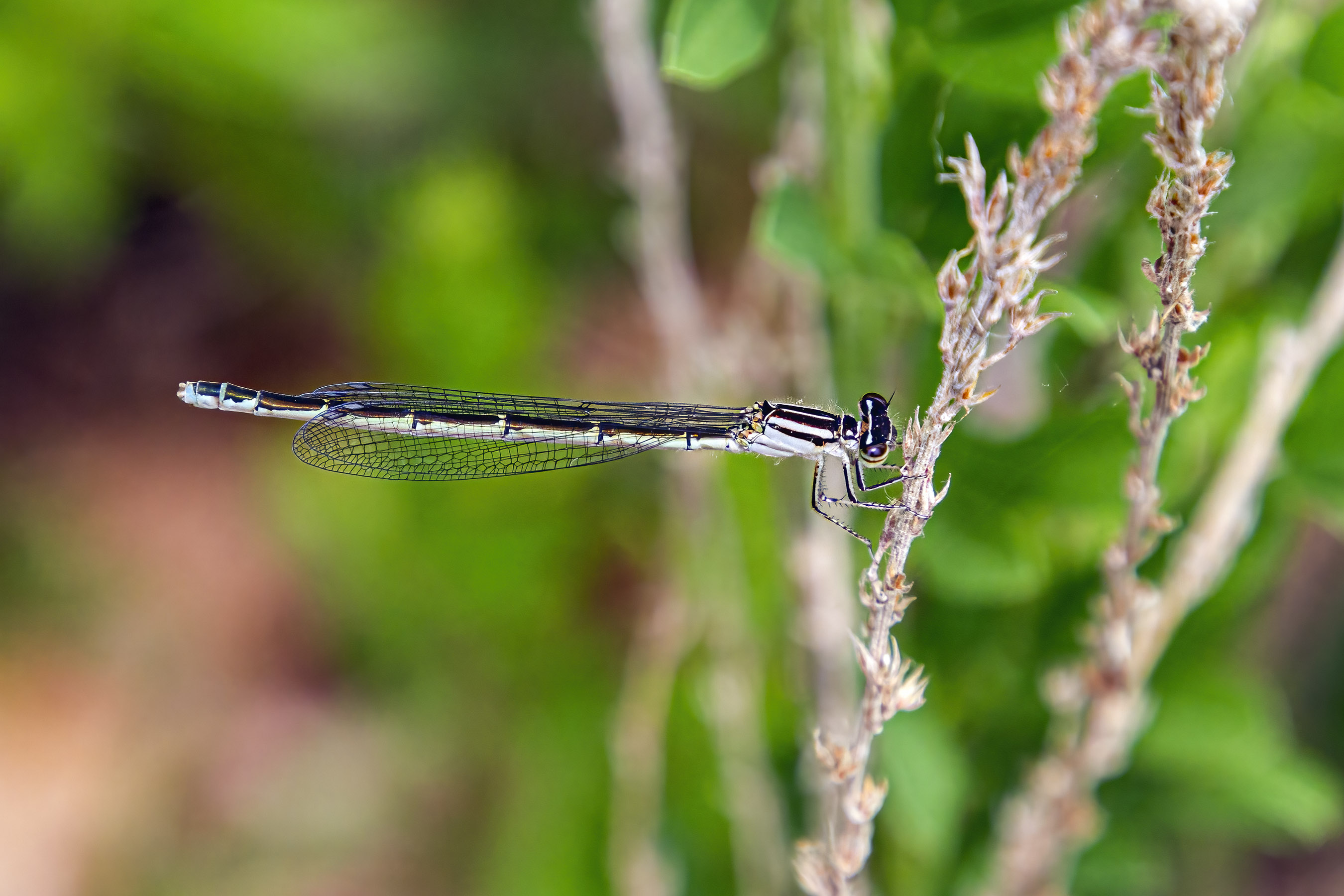
The number of dragonflies of certain species seems to be dropping as we approach autumn, but there seem to be plenty of Big Bluet damselflies (Enallagma durum) still around at Occoquan Bay National Wildlife Refuge. Their bright blue coloration and relatively large size—about 1.3 – 1.7 inches (34 to 44 mm) in length—makes the Big Bluets easy to spot in the vegetation along a trail that runs parallel to the waters of the bay.

One of the big challenges when photographing dragonflies and damselflies is getting the entire subject in focus—their bodies are long and narrow and are often pointing in a direction that makes it impossible to get sufficient depth of field. This male Big Bluet cooperated by perching in a way that allowed me to photograph him from the side. The damselfly is nicely in focus, while the leafy background is mostly out of focus and does not distract the viewer’s eyes from the primary subject.

Yes, the dragonflies and damselflies are still hanging on in my area. I think I will continue to see and photograph them for at least another month or two before I gradually begin to shift my focus towards birds, which will again become my main focus during the colder months of the year.

Big Bluet

© Michael Q. Powell. All rights reserved.

Read Full Post »

I am fond of challenging myself by photographing difficult subjects like tiny spiders and dragonflies in flight. However, I find equal joy in capturing the beauty of more common subjects in simple portraits, like this image of a male Big Bluet damselfly (Enallagma durum) that I spotted on a recent trip to Occoquan Bay National Wildlife Refuge.

Beauty is everywhere.

Big Bluet

© Michael Q. Powell. All rights reserved.


Read Full Post »

I spotted this Big Bluet damselfly (Enallagma durum) couple in flagrante delicto on Monday at Occoquan Bay National Wildlife Refuge. Although I could not help but notice the sidewards heart that their bodies form when they are mating, it was the other elements of the scene that really caught my eye. The shapes and shadows of the leaf and its gnawed-away holes all add visual interest and make a perfect backdrop for this little vignette of an intimate moment in the lives of these damselflies.

Big Bluet

© Michael Q. Powell. All rights reserved.

Read Full Post »

I spotted this damselfly on 2 September at Occoquan Bay National Wildlife Refuge. Initially I thought it was a male Big Bluet damselfly (Enallagma durum), based on its size and markings, but the colors seemed wrong—all of male Big Bluets that I had previously seen were blue.

In situations like this when my identification is uncertain, I normally post an image on one of several Facebook forums devoted to dragonflies and damselflies. Several experts on one of those  forums determined that this is in fact a Big Bluet, but it is an immature one—as it matures it will turn blue.

I am always learning new things as I take photos. Sometimes it is about camera settings and techniques, but more often it is about the subjects that I photograph, like this immature Big Bluet damselfly.


Big Bluet

© Michael Q. Powell. All rights reserved.

Read Full Post »

I will often shoot the same subjects over and over again. Each photo opportunity offers the possibility of a difference setting, a different pose, and different lighting conditions. I guess that is why I like the excitement and unpredictability of nature photography versus the more controlled environment of studio photography.

Last week I captured this image of a female Big Bluet damselfly (Enallagma durum) at Occoquan Bay National Wildlife Refuge. The single leaf on which the damselfly is perched makes for a simple composition that helps the subject to stand out, which is really important when the subject is so small. The sunlight helped to create a cool elongated shadow on the leaf that add additional visual interest to the shot. The minimal color palette works well too, I think.

Sometimes it is nice to have a little extra drama in our lives, even if it is only a dramatic damselfly.


Big Bluet

© Michael Q. Powell. All rights reserved.

Read Full Post »

With a name that includes the word “bluet,” you might expect that this female Big Bluet damselfly (Enallagma durum) would be blue, but obviously that is not the case here. There is a blue female variant in this species, but this one appears to be the olive variant.  Damselfly identification is difficult under the best of circumstances, because so many of them share the same colors—only the patterns help you distinguish among them. In this case, size helps a bit too, because Big Bluets are in fact larger than many other damselflies.

As I was exploring Occoquan Bay National Wildlife Refuge a few days, I was fortunate that this damselfly chose to perch at almost eye level on a stalk of Eastern Gamagrass, which let me get a clear shot with the sky in the background.  Most of the time damselflies like this perch lower to the ground in areas with denser vegetation.

Big Bluet

© Michael Q. Powell. All rights reserved.


Read Full Post »

Liaison dangereuse? Living life on the edge? That’s how I would characterize these mating Big Bluet damselflies (Enallagma durum) that I spotted on Monday at Occoquan Bay National Wildlife Refuge. Neither of them was harmed during their “activity,” though those thorns look really menacing.

It is definitely not what I would call “safe sex.”

Big Bluet

© Michael Q. Powell. All rights reserved.

Read Full Post »

Recently there seems to have been an explosion of Big Bluet damselflies (Enallagma durum) at Occoquan Bay National Wildlife Refuge. This damselfly species is a coastal species and usually likes brackish water. Not surprisingly I saw them repeatedly yesterday as I walked along a trail near the water’s edge.

I like the first shot a lot, because of the repeated angled lines that provide a nice contrast with the damselfly. The second image shows a mating Big Bluet couple in a position known as the “wheel” that is viewed by many as a sidewards heart. As is usually the case with insects and with birds, the male Big Bluet is the more brightly-colored than his female counterpart.


Big Bluet

Big Bluet

© Michael Q. Powell. All rights reserved.


Read Full Post »

It was cool and wet on Monday and clouds covered the entire sky, but I felt an irresistible need to return to the wild after a week in the urban confines of Brussels, Belgium. Many of the trails at Occoquan Bay National Wildlife Refuge, my recent favorite shooting location, were blocked by standing water and there was not a great abundance of wildlife to be seen.

Most dragonflies prefer warm, sunny weather, so I was not surprised when I did not see many of them. I was happy, though, to see that damselflies were active and I spent quite a bit of time trying to capture images of them. They seemed more skittish than normal and the poor lighting made it tough to keep my shutter speed high enough to keep my images from being blurry.

This is one of my favorite damselfly shots of the day. I was able to isolate the subject, which I believe is a male Big Bluet (Enallagma durum) damselfly, while still including enough of the vegetation to give you a sense of the environment in which I found him.

Big Bluet

© Michael Q. Powell. All rights reserved

Read Full Post »

When recently at Occoquan Bay National Wildlife Refuge I spotted these two damselflies, which an expert identified as probable Big Bluets (Enallagma durum), I initially thought they were mating. Then I realized that the positions were all wrong and the nibbling on the neck was probably indicative of a literal hunger. Yikes.

As Tina Turner once sang, “What’s love got to do with it?”

damselflies

daamselflies

© Michael Q. Powell. All rights reserved

Read Full Post »

At first I thought it was love, but looking closer I realized that Tina Turner was right—what’s love got to do with it. Both the predator and the prey in what appears to be an act of cannibalism look to be Big Bluet damselflies (Enallagma durum), which I spotted this past Sunday at Occoquan Bay National Wildlife Refuge.

The pale coloration of the victim suggests to me that it is newly-emerged, a phase referred to as “teneral.” At this stage of development, dragonflies and damselflies are relatively immobile as their bodies and wings are transforming and are particularly vulnerable.

damselfly cannibalism

© Michael Q. Powell. All rights reserved.

Read Full Post »