Feeds:
Posts
Comments

Posts Tagged ‘Bald Eagle’

It is fascinating to compare the size and construction of these three Bald Eagle (Haliaeetus leucocephalus) nests that I photographed last Thursday at Occoquan Bay National Wildlife Refuge. The first nest is by far the largest and is one that I feature quite regularly in my blog, including in yesterday’s posting. The second nest is new this year and, according to some fellow photographers, may be a converted osprey nest.

In recent months I have not seen any eagle activity at the nest in the sycamore tree in the third photo, so was not sure if it was being used this year. I was therefore delighted when I spotted a bald eagle in the nest last week and watched as its mate also flew in and they both perched on one of the branches of the tree. Although this nest was used in previous years, I believe that there were no eaglets born in it last year. It appears that one of the supporting branches for the nest broke off a year or so ago, dumping part of the nest, which was never very large, onto the ground.

Bald Eagle nest

Bald Eagle nest

Bald Eagle nest

© Michael Q. Powell. All rights reserved.

Read Full Post »

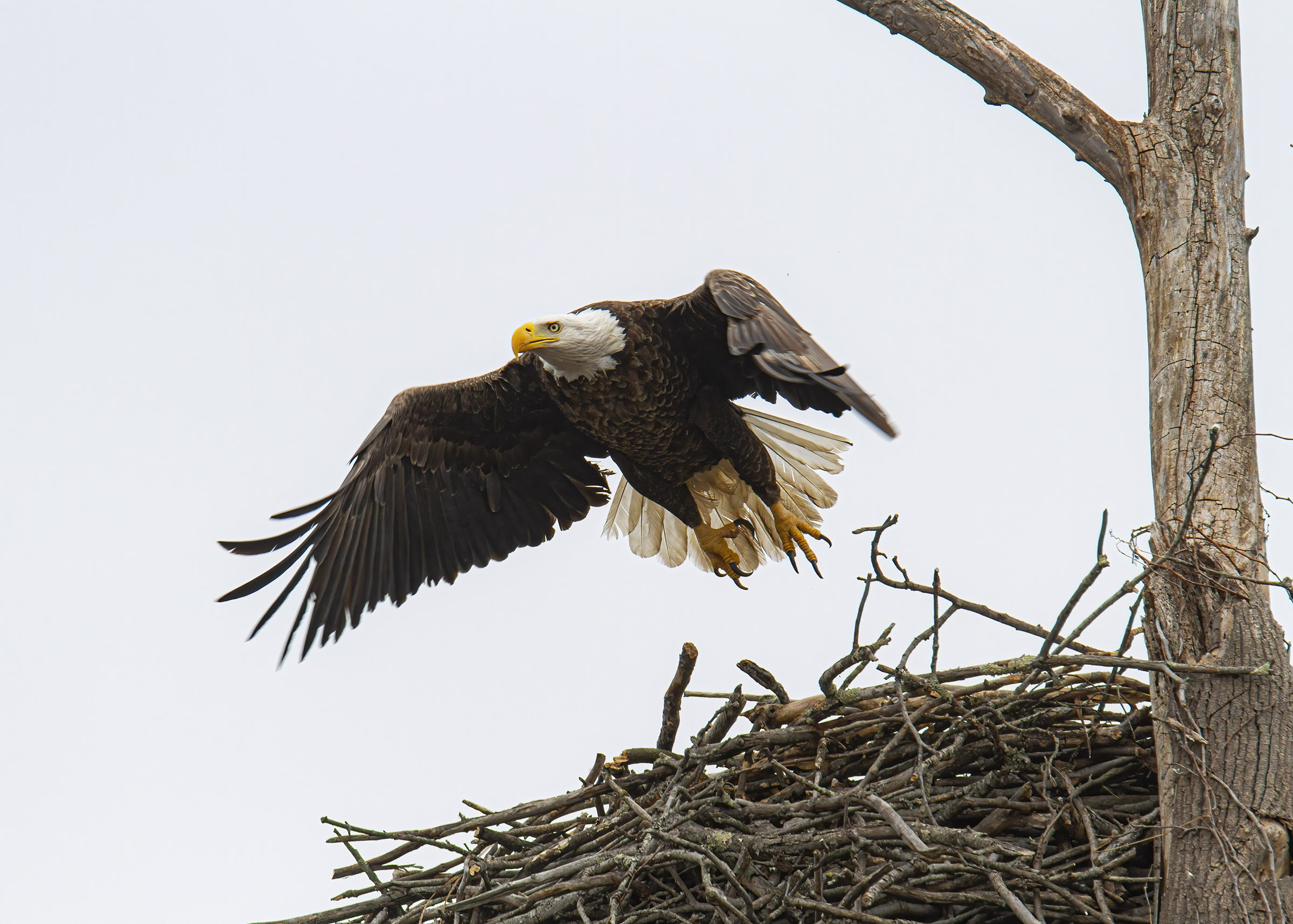
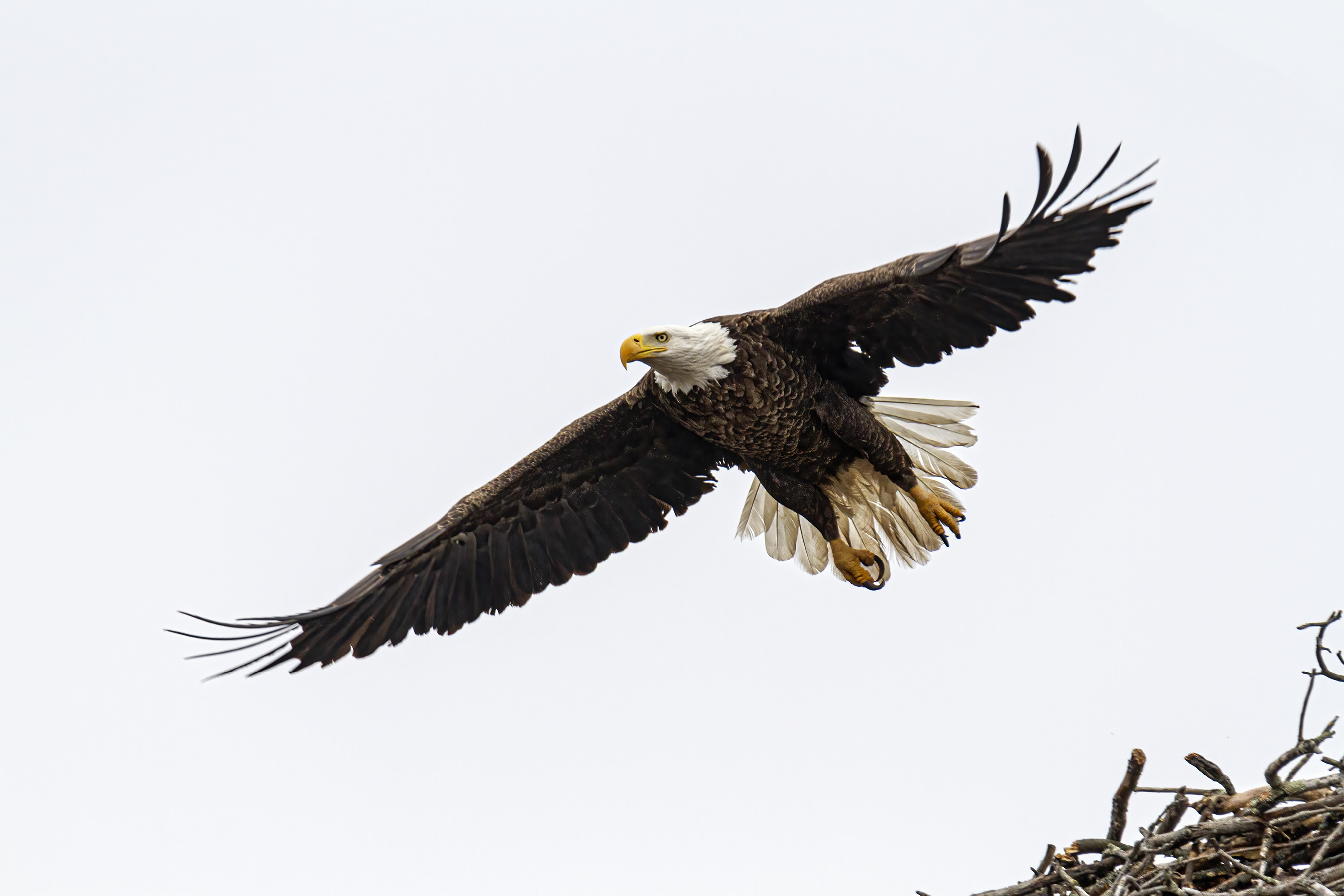
The sky was almost completely overcast last Thursday morning at Occoquan Bay National Wildlife Refuge and looked almost white in my photos, making some of my shots look like they were taken in a studio. Still, the uncluttered backdrop helps to draw the viewers attention to these cool images of a Bald Eagle (Haliaeetus leucocephalus) as it took off from the very large eagle nest at the refuge. The final photo, taken with my iPhone a few days earlier, gives you an idea of the setting in which the nest is located—the photos make it look like I was a lot closer to the nest than I actually was.

I spotted eagles perched on or in three separate nests that day, a clear sign that nesting season is almost here. The fact that the eagles did not remain continuously in the nest suggests to me that they are not yet sitting on eggs. I will continue to monitor the nests and with a little luck I may be able to see some eaglets in the upcoming months.

Bald Eagle

Bald Eagle

eagle nest

© Michael Q. Powell. All rights reserved.

Read Full Post »

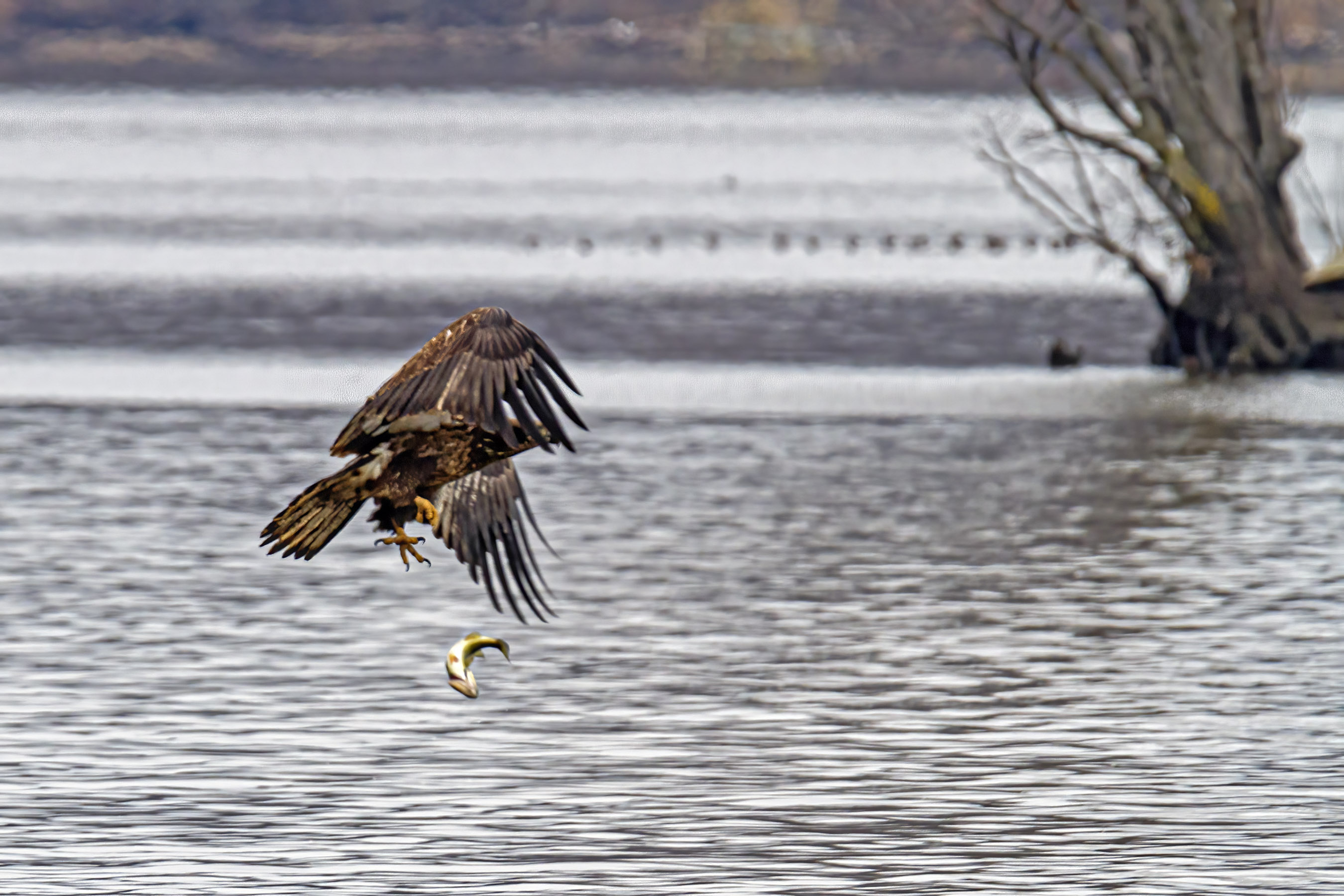
Last Thursday I spent some time observing a juvenile Bald Eagle (Haliaeetus leucocephalus) at Occoquan Bay National Wildlife Refuge that, judging from the coloration of its plumage, I guessed was about a year old. The eagle unexpectedly dropped to water level and I saw a small splash, suggesting to me that it had caught a fish. I snapped off a couple of quick shots as the eagle took to the air, hoping to capture an image of the eagle and the fish. I was so far away, though, that I doubted that I had captured an in-focus shot of the action.

When I later reviewed my photos on my computer, I was shocked to discover that the eagle had dropped the fish and that a couple of my photos actually showed the fish in mid-air. Perhaps the eagle was inexperienced at fishing or was distracted by some of the other eagles in the area. Whatever the case, the eagle did not yet seem aware that it had lost the fish when I captured the first image. A split second later, the eagle looked down and saw the falling fish that, alas, it was unable to recover.

Like most other fishermen, this eagle now has a story to share with his friends of “the one that got away.”

Bald Eagle

Bald Eagle

© Michael Q. Powell. All rights reserved.

Read Full Post »

Whenever I am walking on the trails at Occoquan Bay National Wildlife Refuge, I am always on the lookout for Bald Eagles (Haliaeetus leucocephalus). At this time of the year especially I keep my eyes for signs of new eagle nests. At the moment, I am aware of three nesting sites on the refuge, although I am not sure if all three are being used this year.

On Monday I spotted the bright white head of a mature Bald Eagle in a distant tree. As I trained my long telephoto lens on the eagle, I noticed that it was perched just above what looked to be a nest. I moved a bit further down the trail to get a somewhat less obstructed view of the nest and looked carefully to see if I could spot an eagle sitting in the nest.

Although I was standing quite still and was partially hidden from view by heavy vegetation, the eagle seemed to sense my presence and took off. I was happy to be able to capture a couple of shots of the eagle as it was flying away.

This may be another new nesting site or it may be a view of one of the newest nest from a different angle than I usually see it. Several roads at the refuge are not closed to protect the nesting eagles, so there is really only one nest that I can monitor closely—the very large nest that I have repeatedly featured in blog postings.

Bald Eagle

Bald Eagle

Bald Eagle

© Michael Q. Powell. All rights reserved.

Read Full Post »

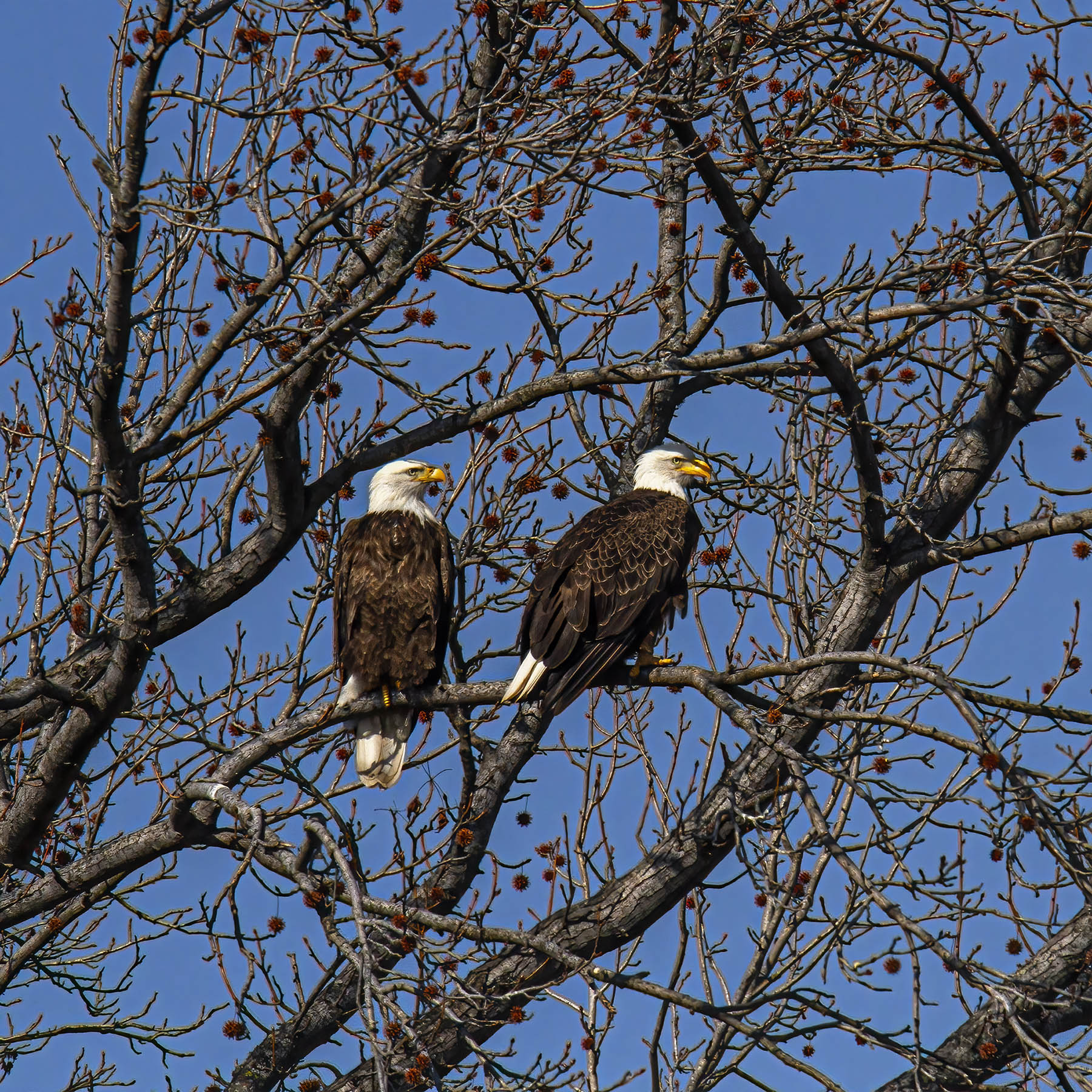
Most of the times when I see a Bald Eagle (Haliaeetus leucocephalus) couple, one or more of the eagles is partially hidden from view. I spotted these two eagles in a sweetgum tree during a recent visit to Occoquan Bay National Wildlife Refuge and was delighted to see that I had an unobstructed view of both of them. Equally important for me was the fact that they were both at approximately the same distance from me, which meant that I could get them both in focus.

The eagles were alert and appeared to be surveying the landscape. I do not know for sure, but I suspect that the eagle on the right is the female, which tend to be larger in size than the male counterparts.

Bald Eagle couple

© Michael Q. Powell. All rights reserved.

Read Full Post »

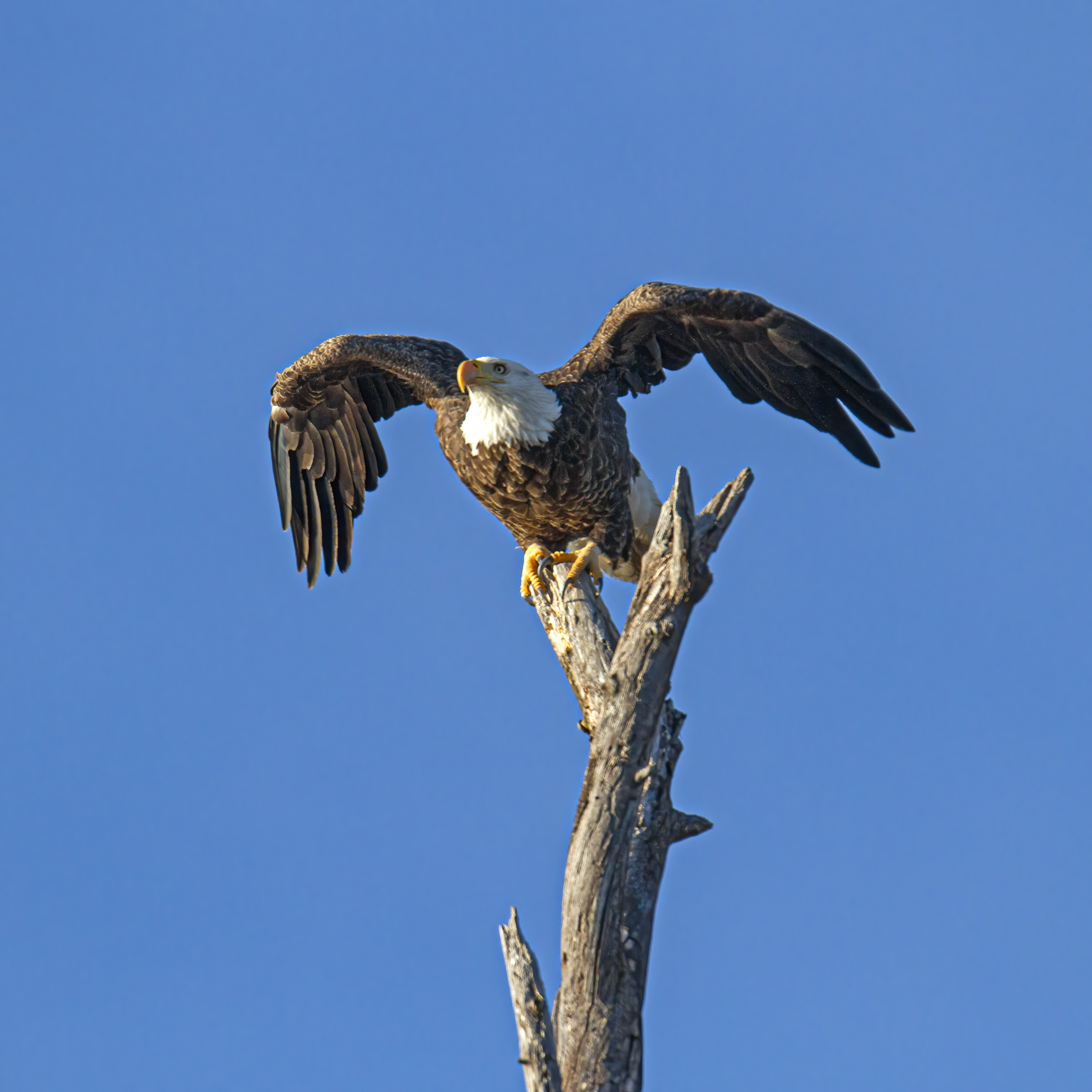
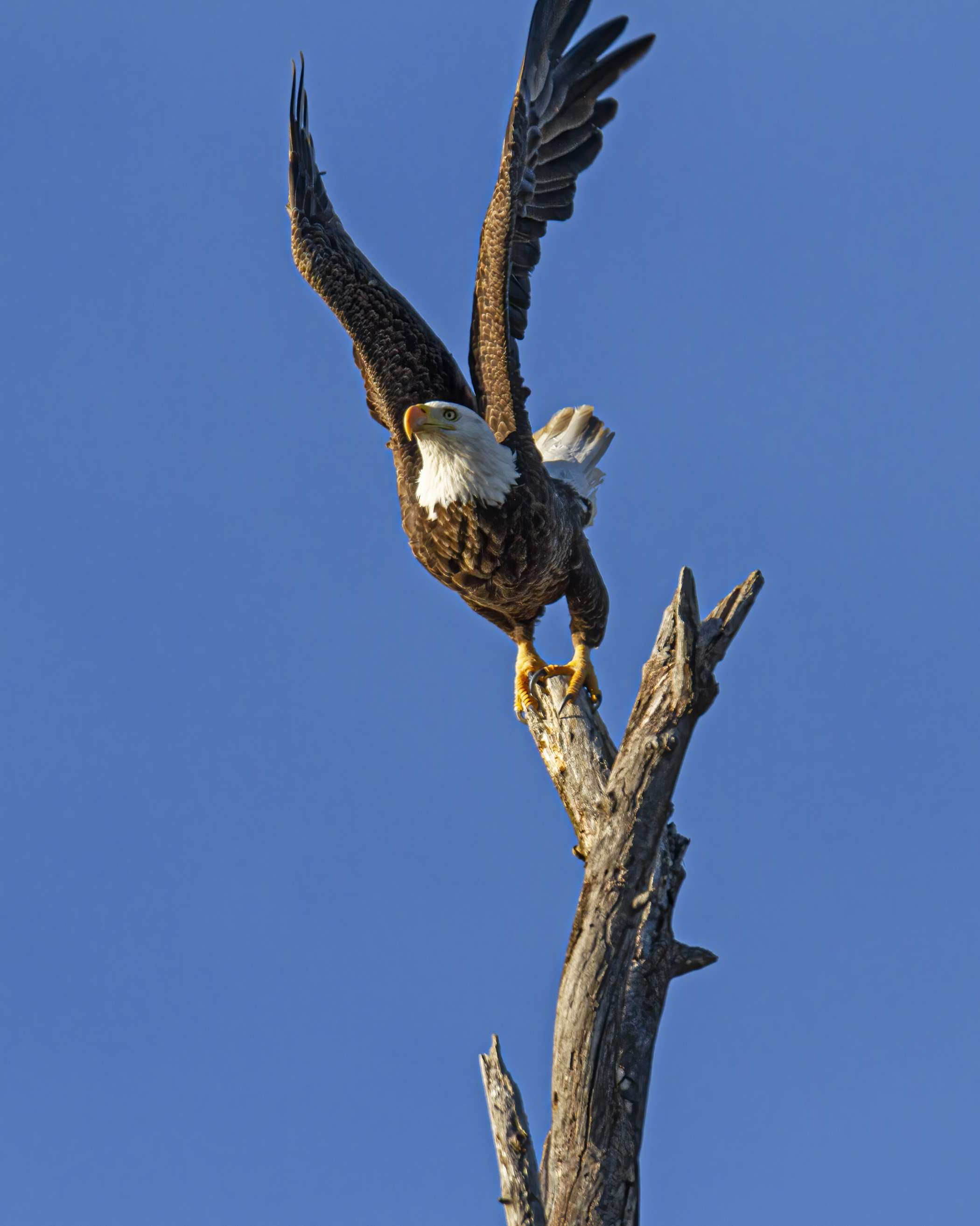
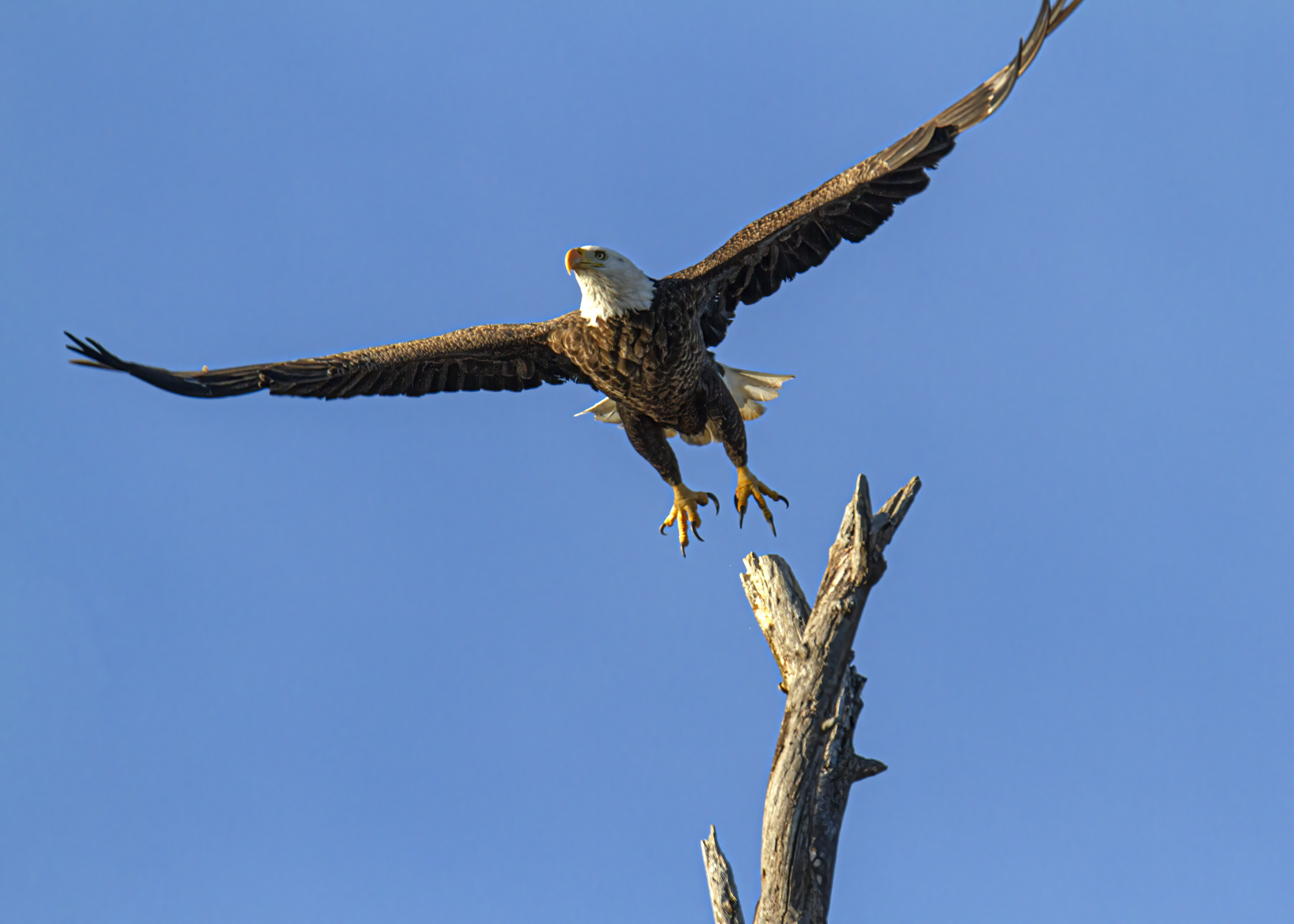
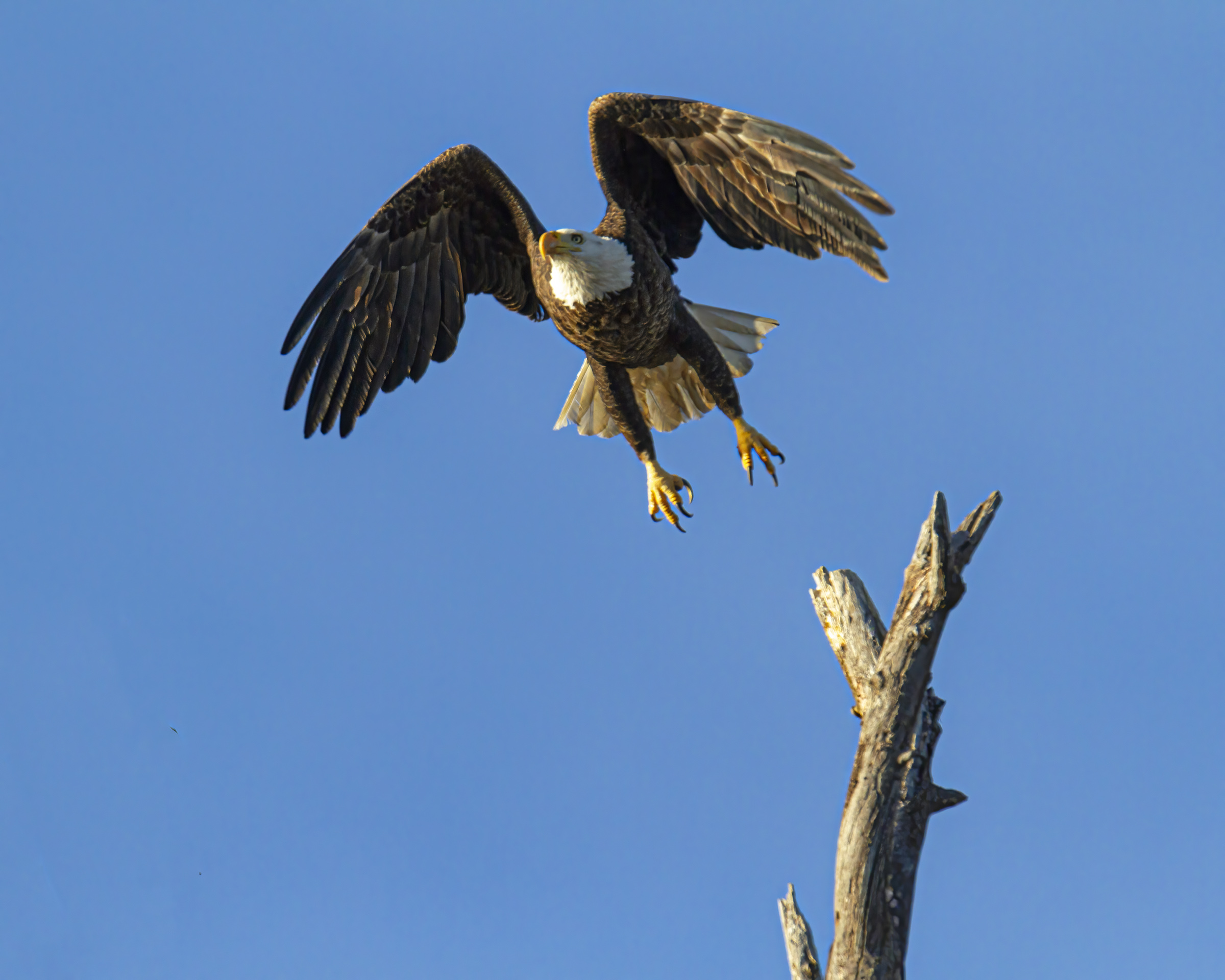
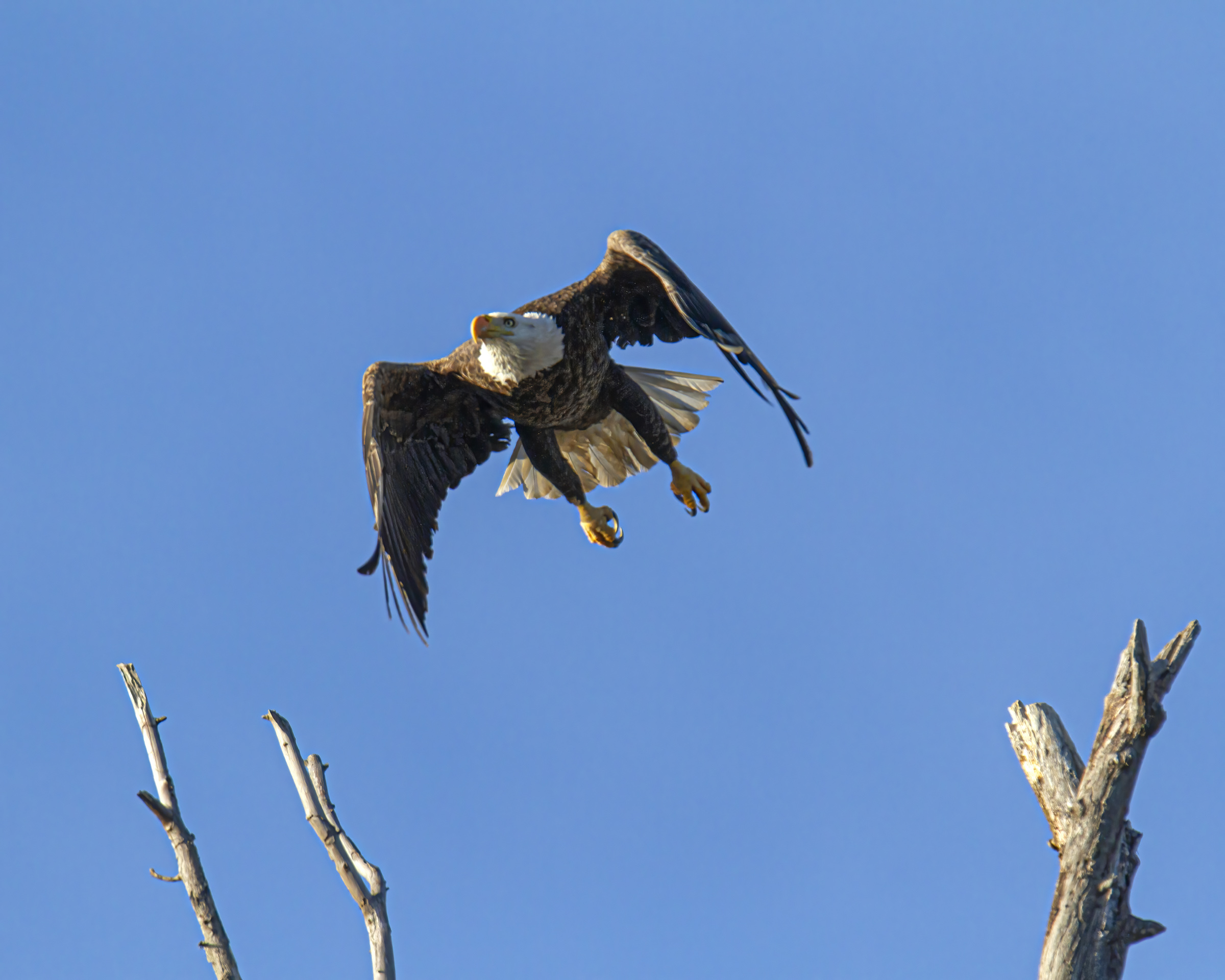
This Bald Eagle (Haliaeetus leucocephalus) was perched just above the large nest last Tuesday at Occoquan Bay National Wildlife Refuge. I was ready when the eagle started to extend its wings, as you can see in the first photo, and managed to capture a series of shots during its takeoff. The images show a variety of the wing positions used by the eagle to lift off and fly forward.

The wings of the eagle were so long that when it extended them upwards, the tips were out of the frame—note that the eagle’s feet were still on the perch in the second photo. When the eagle extended its wings fully to the side and moved upwards into the air, I once again was not quick enough to zoom out and clipped the tips of one wing in the third shot. The final two photos show some additional positions of the wings as the eagle continued to move away from its perch.

The day when I captured these images was an unusually fruitful one for me. I had multiple encounters with eagles and came away with some pretty good shots. As most wildlife photographers are well aware, those kind of day are quite rare, so I was happy to take advantage of my good fortune when the opportunities arose.


Bald Eagle

Bald Eagle

Bald Eagle

Bald Eagle

Bald Eagle

© Michael Q. Powell. All rights reserved.

Read Full Post »

I initially hesitated to post another sequence of shots of a Bald Eagle (Haliaeetus leucocephalus) takeoff, given that I posted a similar set of photos in yesterday’s blog posting. However, I never tire of seeing eagles and I hope that you agree with me. Unlike yesterday’s eagle that flew downward and away from me, the eagle in these shots had a more level flight path and I was able to capture a couple of images as it zoomed past me.

Eagles are a tough subject to photograph because of the extreme contrast between the white feathers on their heads and the dark feathers on their bodies. If the exposure is too far off from what it should be, it is easy to blow out the highlights on the head or to have super deep shadows on the body, both of which lead to a loss of details. When I took these shots, the light was pretty bright, creating shadows that further complicated my efforts.

None of these images is quite as sharp as I would like them to have been, but I am pretty happy with the overall results. Eagles are special and I consider any day when I spot one to be a good day. Capturing shots of one is a bonus.

Bald Eagle

Bald Eagle

Bald Eagle

© Michael Q. Powell. All rights reserved.

Read Full Post »

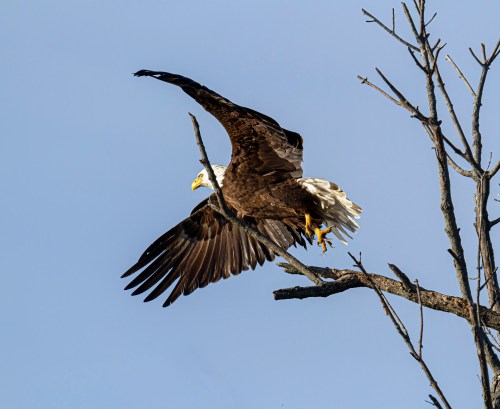
Whenever I am observing a perched Bald Eagle (Haliaeetus leucocephalus), I look for signs that it is preparing to take off. Sometimes there are little clues, like a flex of the wings or a slight movement of the feet, but quite often there is no warning. Usually I have my camera on a monopod, so my arms do not get fatigued as I try to stay ready and focused.

When the eagle actually takes to the air I have to track the movement and anticipate the direction in which the eagle will fly so that I can keep my subject within the frame. In the second image, for example, the eagle could have flown up into the air, but instead, as you can see in the third image, the eagle flew downwards. I was a little slow in following the bird and in the next frame, which I did not post, only half of the eagle was visible.

During a typical visit to the wildlife refuge, I am fortunate if I have one or two encounters of this sort, so I feel a little pressure to take advantage of each opportunity. There are so many variables over which I have no control that success is far from being guaranteed. No matter how good my shots may be, I am always convinced that I can get better ones, which helps to motivate me to go out again and again with my camera.

Technology is always advancing and some of the newer cameras have amazing capabilities to track moving subjects and stay focused on their eyes. Recently I watched a video on YouTube entitled “What is the SKILL and TALENT of a Wildlife Photographer” in which Scott Keys, a wildlife photographer, discussed the relative importance of personality traits, skill, talent, and gear in getting good photos. I highly recommend that you watch this video if you have ever thought about this issue.

Scott and I both agree that the most important of these four is the personality—you need to be patient and persistent, observant and aware in order to maximize the number of opportunities to get “the shot.” Knowledge and practice, which is how I would define skill, would be next in priority order for me. Gear would be in third or even fourth place and talent, i.e. God-given ability, occupying the remaining slot.

 

Bald Eagle

Bald Eagle

Bald Eagle

© Michael Q. Powell. All rights reserved.

Read Full Post »

It is hard to read body language in humans and almost impossible to do so with other species. It is still fun, though, to engage in a bit of anthropomorphism and imagine what was going on between the two Bald Eagles (Haliaeetus leucocephalus) that I spotted last Wednesday at Occoquan Bay National Wildlife Refuge.

The two eagles were sitting closely together on a single branch of a sweetgum tree and are almost certainly a couple. Despite their physical closeness, there seems to be a psychological distance between the two and the eagle on the right has its back turned to its partner. I can’t tell if the eagle on the right is angry or disappointed, but it appears to me to be pouting a bit. What ever the case, I sense a certain amount of tension between the two.

What do you think is going on in this image? I’d love to hear your creative thoughts about the eagle interaction.

Bald Eagle

© Michael Q. Powell. All rights reserved.

Read Full Post »

For several years I have keeping an eye on two Bald Eagle (Haliaeetus leucocephalus) nests at Occoquan Bay National Wildlife Refuge. One of them is adjacent to several trails, so each year the authorities close portions of those trails to keep the nesting eagles from being disturbed. This year, an additional area was closed and a sign was posted indicating eagle nesting activity.

I knew more or less where the new nest was located, but I had trouble spotting it from the trails that are still open. On Wednesday, I was delighted to spot an eagle in the nest, as you can see in the first photo below. A second eagle was keeping watch over the nest from a nearby tree and I managed to get the second shot by zooming out with my Tamron 150-600mm telephoto lens.

There was quite a bit of vegetation between me and the tree where the new nest is located, so I had to move about a lot to get a relatively unobstructed view of the nest. I suspect that the nest will be completely hidden when leaves reappear in a few months. Until then, I will continue to observe the new nest with a hope of seeing some eaglets. The incubation period is about 36 days for bald eagle eggs, but I do not think that any eggs have yet been laid.

Bald Eagle

Bald Eagle

© Michael Q. Powell. All rights reserved.

Read Full Post »

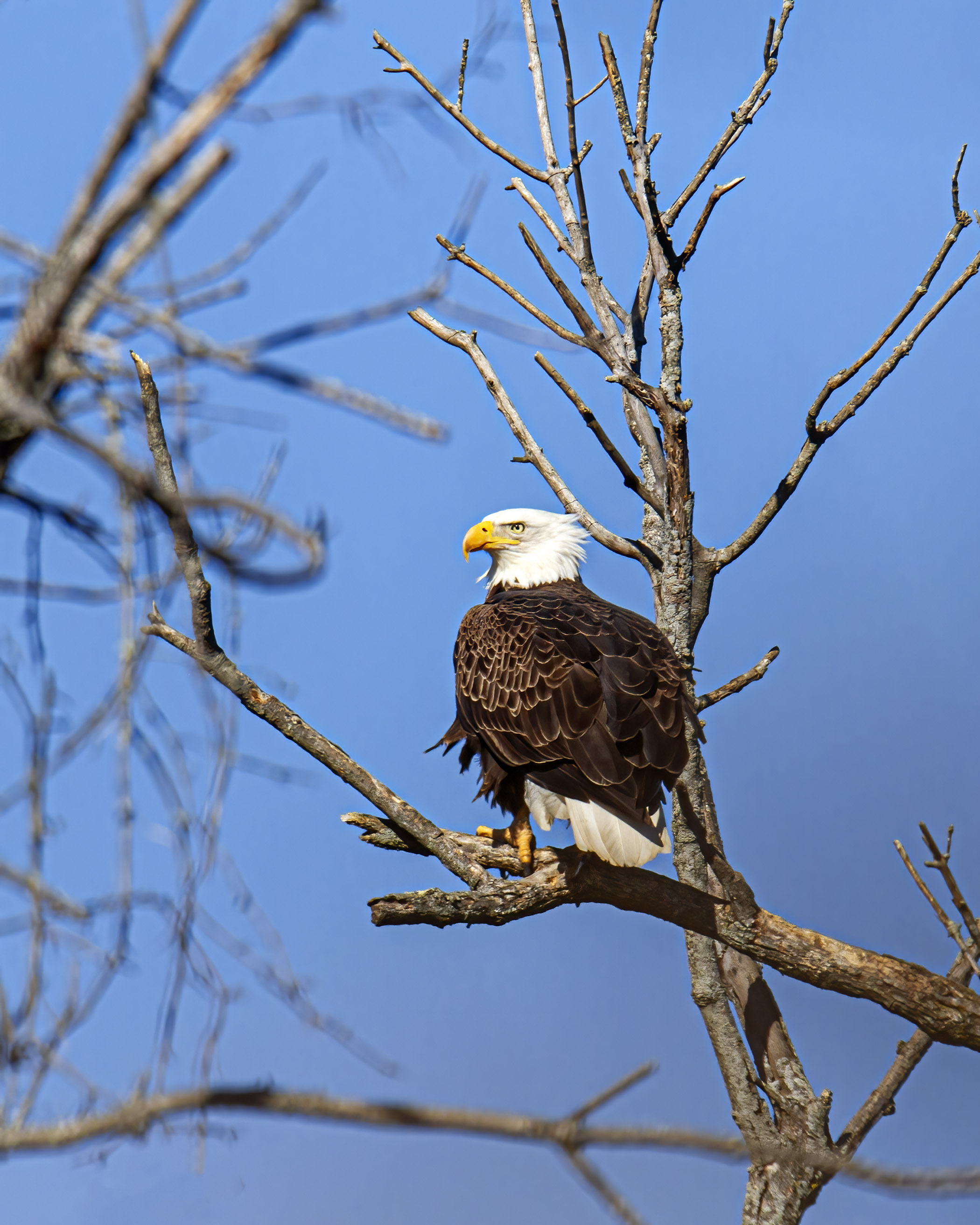
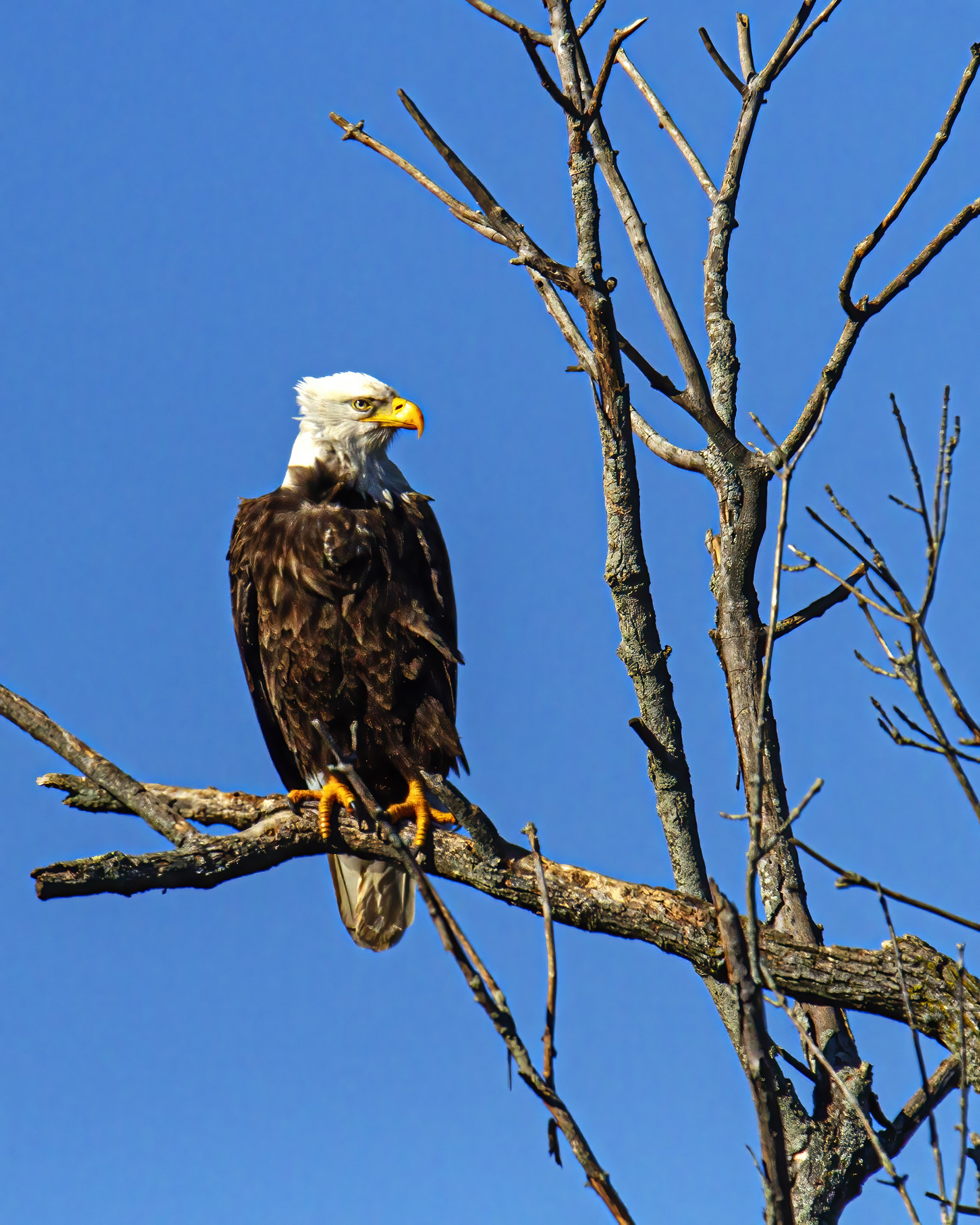
It is wonderful to capture images of Bald Eagles (Haliaeetus leucocephalus) in action, but most of the time when I spot one, the eagle is merely perching in a tree. Although the eagle is immobile, it is clearly keeping an eye on what is going on and is ready to spring into the air without warning.

Here are a couple of shots of perched eagle from a couple of recent visits to Occoquan Bay National Wildlife Refuge in Northern Virginia, about 15 miles (24 km) from where I live. The images are not spectacular or prize-worthy, but I nonetheless feel a special thrill whenever I see a Bald Eagle and doubly so when I manage to take a photo of it.

Have a wonderful weekend.

Bald Eagle

Bald Eagle

© Michael Q. Powell. All rights reserved.

Read Full Post »

Monday, I spotted a Bald Eagle (Haliaeetus leucocephalus) sitting in the large nest at Occoquan Bay National Wildlife Refuge and my first thought was that the eagle couple had already begun to sit on eggs in the nest. When I thought about it for a moment, though, I realized that was probably not the case—when one of the eagles is incubating an egg, it tends to sit really low in the nest and is hidden from view. This eagle seemed to be perched rather high in the nest and flew away from it a few moments after I spotted it.

I was pretty happy to be able to compose this shot so that the eagle is clearly visible and you can get a sense of the massive size of the nest. I worry sometimes that the weight of the nest will cause it to collapse during a rain or wind storm, but it has held up remarkably well during the five or so years that I have been watching it.

It shouldn’t be too long before actual incubation begins. According to the journeynorth.org website, the incubation period is 24-36 days. “Adults share incubation duties. Nest exchanges may occur after only an hour but usually take several hours between exchanges. Frequently the incoming adult brings a new branch or fresh vegetation for the nest, then the incubating adult carefully stands and takes off while the other settles over the eggs and rakes nesting material up against its body.”

Additionally the adult eagles have to also need to turn the eggs about once an hour to ensure that the eggs are evenly heated and that the embryos don’t stick to the insides of the shells. Be sure to check out the linked website for more fascinating facts about the process of bald eagle incubation.

Bald Eagle nest

© Michael Q. Powell. All rights reserved.


Read Full Post »

Quite often I will spot a perched Bald Eagle (Haliaeetus leucocephalus) perched in the distance when I am on certain trails at Occoquan Bay National Wildlife Refuge. The trail runs parallel to the waters of the bay and eagles like to perch in the high trees overlooking the water. My challenge is to get close enough to the eagle to get a decent shot without spooking the eagle.

Normally I will creep forward slowly, stopping periodically to get a shot. As I am moving forward, I am very conscious of the fact that the eagle may take off at any moment, but it is not easy to predict the direction of the takeoff. Sometimes eagles will fly upwards when they take off and other times they will drop from the branches like a rock. I feel a bit like a goalie in soccer match when an opposing player is taking a penalty shot as I look for clues that will allow me to predict the eagle’s timing and direction of its takeoff.

Last Thursday, I spotted an eagle perched at the top of a tree. As I approached the eagle, it grew larger in my camera’s viewfinder, though it still filled only a relatively small part of it. Suddenly the eagle took off. As it flapped its mighty wings, the eagle increased in size and rose into the air. As you can see, I clipped one of its wings when I captured the first image below. I had only a split second to react and I did ok, but there was definitely room for improvement.

Later in the day, I spotted another bald eagle high in a tree overhanging the trail. I had quite a bit of trouble getting a shot of it, because the sun was directly in my eyes. I tried to walk underneath the eagle to get the sun to my back, but the eagle spotted me and I snapped off the second shot below as it was taking off. Technically speaking it is not a very good shot, but I really like the way that I captured the underside of the eagle that was almost directly overhead and the light shining through the tail feathers is pretty cool.

When it comes to reaction time and eyesight, a bald eagle clearly has me beat, but that does not discourage me. Some of the time, the eagles are distracted or inattentive and I manage to capture action shots of them. I am blessed to live in an area with a good number of eagles and I never tire of photographing them.  Hopefully you enjoy seeing photos like these ones, especially if you don’t see eagles very often.

Bald Eagle

Bald Eagle

© Michael Q. Powell. All rights reserved.

Read Full Post »

I was thrilled last week at Occoquan Bay National Wildlife Refuge to spot two Bald Eagles (Haliaeetus leucocephalus) in the large nest at the refuge. They have been hanging around the area for a while, appearing to be keeping an eye on the nest, but this was the first time that I have spotted them inside of it. The eagle on the left was visible for an extended period of time, while the one on the right popped up only occasionally and appeared to working on renovating the interior of the nest.

The nest is quite large and deep, so it is often hard to tell when the eagles are in it, especially when they begin to sit on their eggs. I was not able to get many clear shots, but was happy with the two images below that show slightly different poses of the eagle couple.

UPDATE: I decided to add a third photo to give you an idea of the massive size of the eagle nest. Every year it seems like they add a new layer of sticks that increases its size.

Bald Eagles

Bald Eagles

eagle nest

© Michael Q. Powell. All rights reserved.

Read Full Post »
When I spotted the Bald Eagle couple (Haliaeetus leucocephalus) on Tuesday at Occoquan Bay National Wildlife Refuge, they were perched closely together on a branch of a distant tree. My view of them was partially obscured by branches of vegetation, so I had to maneuver around to get a mostly clear shot of them.

I thought that the vegetation would mask my movement and the eagles would not detect my presence. I was wrong. As I was observing them through my long telephoto lens, one of the eagles, the larger of the two, took to the air without warning and I was fortunate to capture its departure from the branch. If you look closely at the perched eagle in the second image, it appears to be giving me a stern look of disapproval. A short time later, the second eagle also flew away.

Bald Eagles

Bald Eagles

© Michael Q. Powell. All rights reserved.

Read Full Post »
I usually try to zoom in on my subjects as much as I can, but it is also great to show their environment (sometimes by choice and sometimes out of necessity). I captured these long distance in-flight shots of a Tundra Swan (Cygnus columbianus) and a Bald Eagle (Haliaeetus leucocephalus) during recent visits to Occoquan Bay National Wildlife Refuge. The eagle was a bit closer to me than the swan, which is why the background was so much more blurry in the second shot than in the first one.

Tundra Swan

Bald Eagle

© Michael Q. Powell. All rights reserved.

Read Full Post »

I was surprised and delighted to spot this pair of Bald Eagles (Haliaeetus leucocephalus) perched on a floating log in the waters off of Occoquan Bay National Wildlife Refuge last Thursday. As I draw closer to nesting season, I have been seeing more eagles in couples. Normally, of course, I see them in the trees, but I have gotten used to scanning the water as well—I never know where I might see a perched eagle.

Bald Eagles

 Michael Q. Powell. All rights reserved.


Read Full Post »
As I was observing a Bald Eagle (Haliaeetus leucocephalus) last Thursday (8 December) at Occoquan Bay National Wildlife Refuge, it suddenly swooped down to the water and snagged what I assumed was a fish. When I looked at my photos, however, the prey looked like it might be a duck or some kind of grebe. Yikes!

I have read that eagles will sometimes grab a waterfowl for meal, but I thought that was only as a last resort, for example, when the waters at a location are mostly iced over during the winter. At this time of the year, the waters are completely ice-free, so I am not sure what prompted the eagle to hunt for another bird rather than a fish. Perhaps the eagle was feeling lazy or was really hungry and did not want to go to the trouble of tracking and catching a fish.

Some birders on Facebook have suggested that the prey might be a small grebe, possibly a Horned Grebe, or perhaps a small duck, like a female Hooded Merganser.

Bald Eagle

© Michael Q. Powell. All rights reserved.

Read Full Post »

It had been over a week since I last went out with my camera, so I was thrilled yesterday to walk the trails at Occoquan Bay National Wildlife Refuge. One of the first places where I usually look for activity is the large eagle nest shown in the second photo. It may be a little early for the eagles to begin nesting, but an eagle couple is often in the surrounding area at this time of the year.

I scanned the trees in the immediate area, but came up empty-handed. As I continued down the trail, however, I spotted the bright white head of a Bald Eagle (Haliaeetus leucocephalus). As I maneuvered about, trying to get a clear shot, I suddenly realized that there were two eagles partially hidden in the trees. I don’t know for sure if the eagles were a couple, for they seemed to be perched far apart for a couple—maybe the pandemic has caused the eagles to practice social distancing.

I was happy to be able to capture an image that shows both of the eagles pretty well. As I have said many times before, any day when I am able to photograph eagles is a good day.

Bald Eagles


eagle nest

© Michael Q. Powell. All rights reserved.

Read Full Post »

It was really cool on Monday to see a Bald Eagle (Haliaeetus leucocephalus) working on a new nest at Occoquan Bay National Wildlife Refuge while the other member of the couple kept watch from a nearby tree. I suspect that this is the same nest that another frequent visitor to the refuge recently photographed. It is not yet clear if this will be a replacement for one of the nests used in the past or will be an additional one.

In the past I have seen active eagle nests in only two locations in the past. One of them is very large, but seems to be getting a bit precarious. The other is quite small and prior to last year’s nesting season seemed to have partially collapsed. Eagles were successful in the large nest this past season with at least one eaglet, but I don’t know for sure of there was an eaglet in the smaller nest.

In case you are curious, the new nesting site is almost equidistant from the two existing sites. It is a long way from any of the trails from which I can take photos and I suspect it will be tough to monitor when the leaves return to the trees in the spring.

eagle nest

© Michael Q. Powell. All rights reserved.

Read Full Post »

What a difference a month makes. When I last visited Occoquan Bay National Wildlife Refuge, it was still relatively warm and many of the leaves were still on the trees. Butterflies were relatively abundant and there were lots of other insects, including dragonflies.

Yesterday, it was cold and breezy, with temperatures in the mid 40’s (7 degrees C). Virtually all of the leaves were stripped from the trees and there were very few insects. Already I have pulled out my thermal underwear and insulated boots. It feels like winter is almost here.

One of the advantages of the naked trees was that I was able to spot some larger birds from a greater distance, like these Bald Eagles (Haliaeetus leucocephalus) that I photographed at different locations in the refuge. The eagle in the first photo was part of a pair that I had spotted. As I moved closer, one of them who had been looking at me flew away. The other one had its back to me and I tried to creep closer to it to get a better shot. Somehow the eagle detected my presence and looked back at me over its shoulder and I managed to capture its look of disapproval.

In the second shot, the eagle was pretty far away, but it was perched in the open, so I was able to frame my shot reasonably well. As you can see, the sun was shining brightly, though it did not provide much warmth, and the skies were blue.

The eagle in the final photo was perched in a sweetgum tree and I like the way that the spiky balls of the tree provice some color and texture to the image. Like the eagle in the first photo, this eagle was also looking over its shoulder at me. This eagle’s look appeared to be more coy and curious than annoyed.

Later in the day I spotted an eagle working on what appears to be a new nest. As we move closer to nesting season, I will try to keep track of the activity at the nesting sites that appear to be in use. In the past, eagle couples have used two different sites and I am not sure if this new nest will be a replacement for the older ones or will be a new addition.

Bald Eagle

Bald Eagle

Bald Eagle

© Michael Q. Powell. All rights reserved.

Read Full Post »

I was concentrating so intently on photographing the large eagle nest at Occoquan Bay National Wildlife Refuge last Wednesday that I almost missed the Bald Eagle (Haliaeetus leucocephalus) that was sitting in the nest. This nest is really deep and during nesting season it is hard to tell if one or more of the eagles are inside of it. The nesting season ended quite some time ago, so I definitely did not expect to see the nest occupied at this time of the year.

The second shot is the one that I was intending to capture. I liked the way that the red leaves were creeping up the side of the trees holding the nest and that was what I was I was photographing. If you look really carefully, you can just see a bit of the yellow beak of the eagle stick out from behind the leftmost tree, but I did not notice it at the time I took the shot.

After I had taken a few shots, I continued on the trail a half dozen steps, seeking to photograph the nest from a different angle. It was only then that I spotted a bit of bright white that turned out to be the eagle’s head. The eagle was hidden really well, but appeared have positioned itself so as to be able to keep an eye on what was happening around it.

I captured a series of images, but the eagle’s head was blocked by the nest and/or the leaves in most of them. Fortunately, the eagle was moving its head from side to side and eventually I managed to capture a shot in which we can see the eagle’s eye pretty clearly.

Quite often in my wildlife photography, I detect the subject only because of its movement, but in this case, the subject was stationary and it was the difference in color of the eagle’s head that allowed me to spot it. As you can probably guess, my eyes are moving constantly when I am out with my camera, searching high and low, near and far, and left to right for potential subjects to photograph.

eagle nest

eagle nest

© Michael Q. Powell. All rights reserved.


Read Full Post »

Yesterday I visited Occoquan Bay National Wildlife Refuge, my favorite local venue for wildlife photography, for the first time in almost a month. It was a beautiful summer day for a walk in nature, with temperatures and humidity lower than usual for this area. I was thrilled to be able to capture a few modest images of birds, which is a bit unusual for me during the summer, when most of the time I am more likely to hear birds hidden in the foliage than actually see them.

The first image shows a rather fluffy-looking Gray Catbird (Dumetella carolinensis). This is probably my favorite shot of the day, because the pose is more dynamic than most perched bird images. The little catbird seems to have a lot of personality and energy.

I was delighted to photograph a Bald Eagle (Haliaeetus leucocephalus) perched above the large eagle nest at the refuge. I composed the second shot to include some of the clouds that, in my view, add some visual interest to otherwise solid blue sky background. No matter how many times I see a Bald Eagle, it is always special for me.

The final image is a long distance shot of a Ruby-throated Hummingbird (Archilochus colubris). When I first spotted the hummingbird, I thought it was a butterfly as it flitted about among the flowers. When it finally registered on my brain that it was a hummingbird, I clicked off a series of shots, without much hope of getting a usable image. I was pleasantly surprised when several of the shots had the hummingbird relatively in focus. I selected this particular image because it shows the hummingbird hovering and because its wing positions reminded me of a butterfly.

It was exciting this month to be on the road, seeing different parts of the country and photographing some different subjects, but it was comforting to return to the familiar confines of a location that is a refuge for me in all senses of the word—it felt like I had returned home.

Gray Catbird

Bald Eagle

Ruby-throated Hummingbird

© Michael Q. Powell. All rights reserved.

Read Full Post »
Here is a look at what might be one or more of the parents of the young eaglet at Occoquan Bay National Wildlife Refuge that I featured in a recent post. Last Friday, the larger Bald Eagle (Haliaeetus leucocephalus) at the top was perched for an extended period of time in a tree overlooking the large nest when the second eagle flew in. They remained in place for several minutes before flying away.

Are these two eagles a couple? The one on the left is probably three to four years old and may not be mature enough to be a parent—it can take about five years for the head feathers to turn completely white and for an eagle to fully mature. On the other hand, if only the older one is a parent, it seems a little strange that it was so comfortable with an interloper zooming in and perching that close if they are not a couple.

Several Facebook readers commented that the eagles that were hanging around the nest earlier in the year both had completely white heads. What happened? We may need a paternity test to determine if this precocious young eagle is indeed the father.

So what do we have here? Is this a much older sibling of the eaglet in the nest? If so, where is the other parent? Female eagles tend to be larger than males, so it is quite possible that the eagle perched higher is a female. Maybe she is disappointed that there is only a single eaglet and is trying out a possible new mate. It is a bit of a mystery.

bald eagles

© Michael Q. Powell. All rights reserved.

Read Full Post »
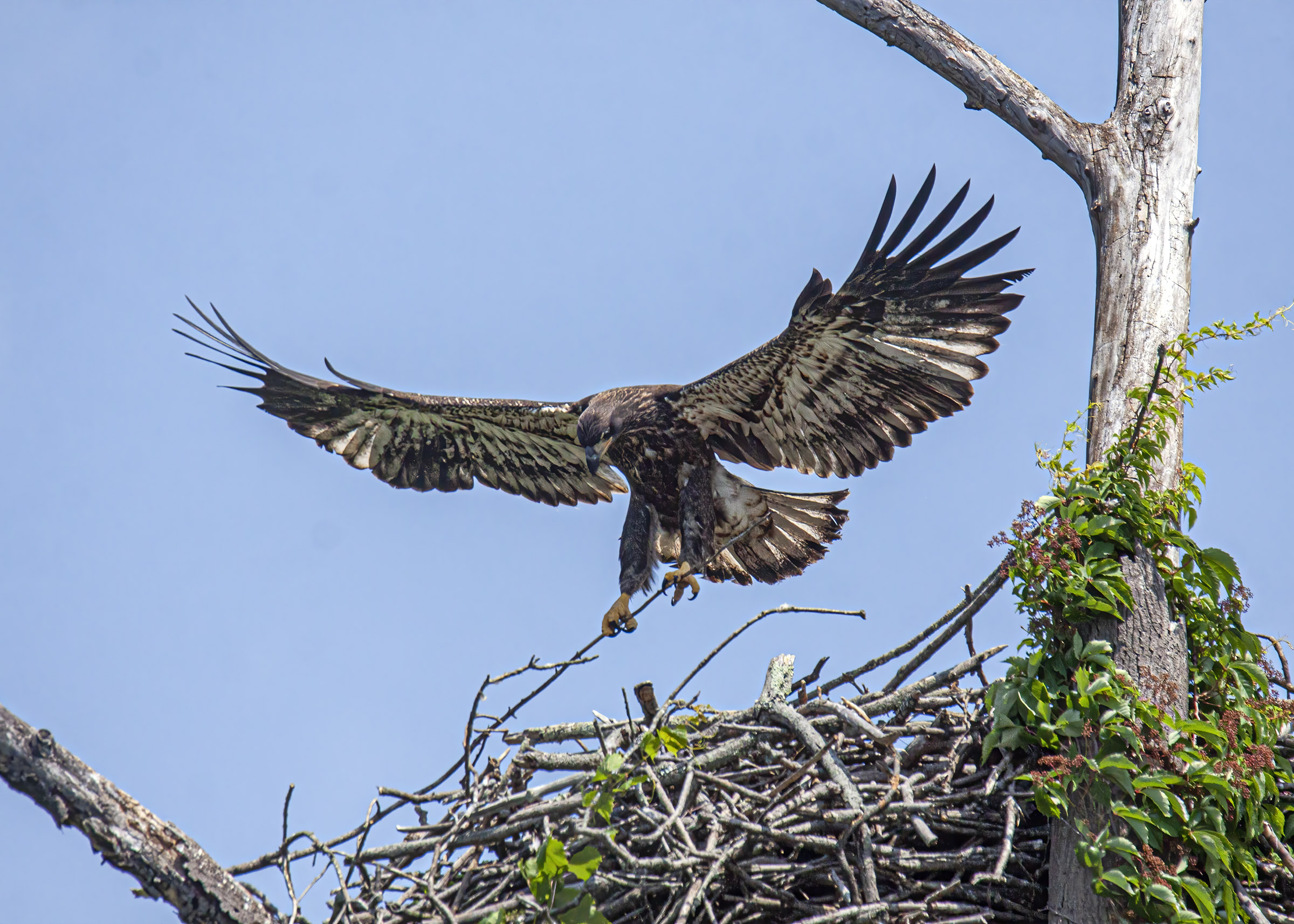
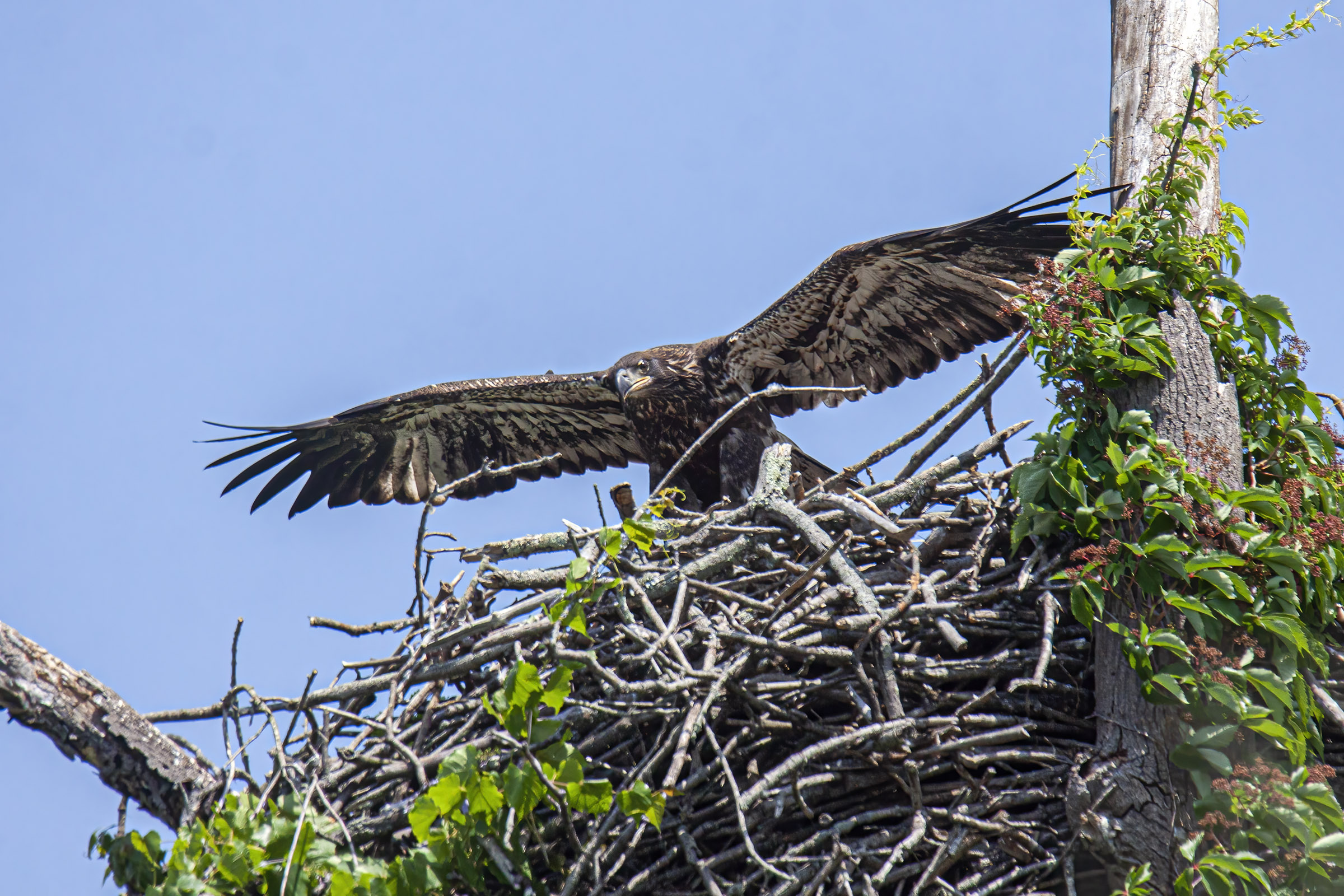
Earlier this month I did a posting called  Looking out of the nest that featured a young Bald Eagle (Haliaeetus leucocephalus) sitting up in a large nest at Occoquan Bay National Wildlife Refuge and wondered when it would be able to fly. Last Friday I returned to the refuge and was delighted to see the eaglet flapping its wings and testing them out—I think it is almost ready to fly..

The eaglet repeatedly extended its wings, but seemed a bit uncoordinated, like a gawky teenager who has experienced a growth spurt. Several times it was able to rise up into the air, but looked uncertain about what to do next. The photos below show some of the action, which lasted only for a few minutes. The eaglet then disappeared into the deep nest, possibly to rest after its exertion.

I watched for a while longer and eventually the eaglet reappeared, but it simply sat up, looking out of the nest. A fellow photographer told me that he spotted the eaglet the following day perched in the tree that you can see in the right side of the image. I suspect, though, that the eaglet will need some quite a bit more practice before it will be capable of venturing out on its own and, of course, it will have to learn how to fish.

I will probably make a trip to the refuge this week to check on the eaglet. So many of the nearby trees are covered with leaves that I may have trouble spotting the eagle, particularly because its dark, and mottled plumage help it to blend in well with the foliage. Adult Bald Eagles tend to stick out a bit more because of the bright white feathers on their heads.

Bald Eagle

Bald Eagle

Bald Eagle

© Michael Q. Powell. All rights reserved.

Read Full Post »
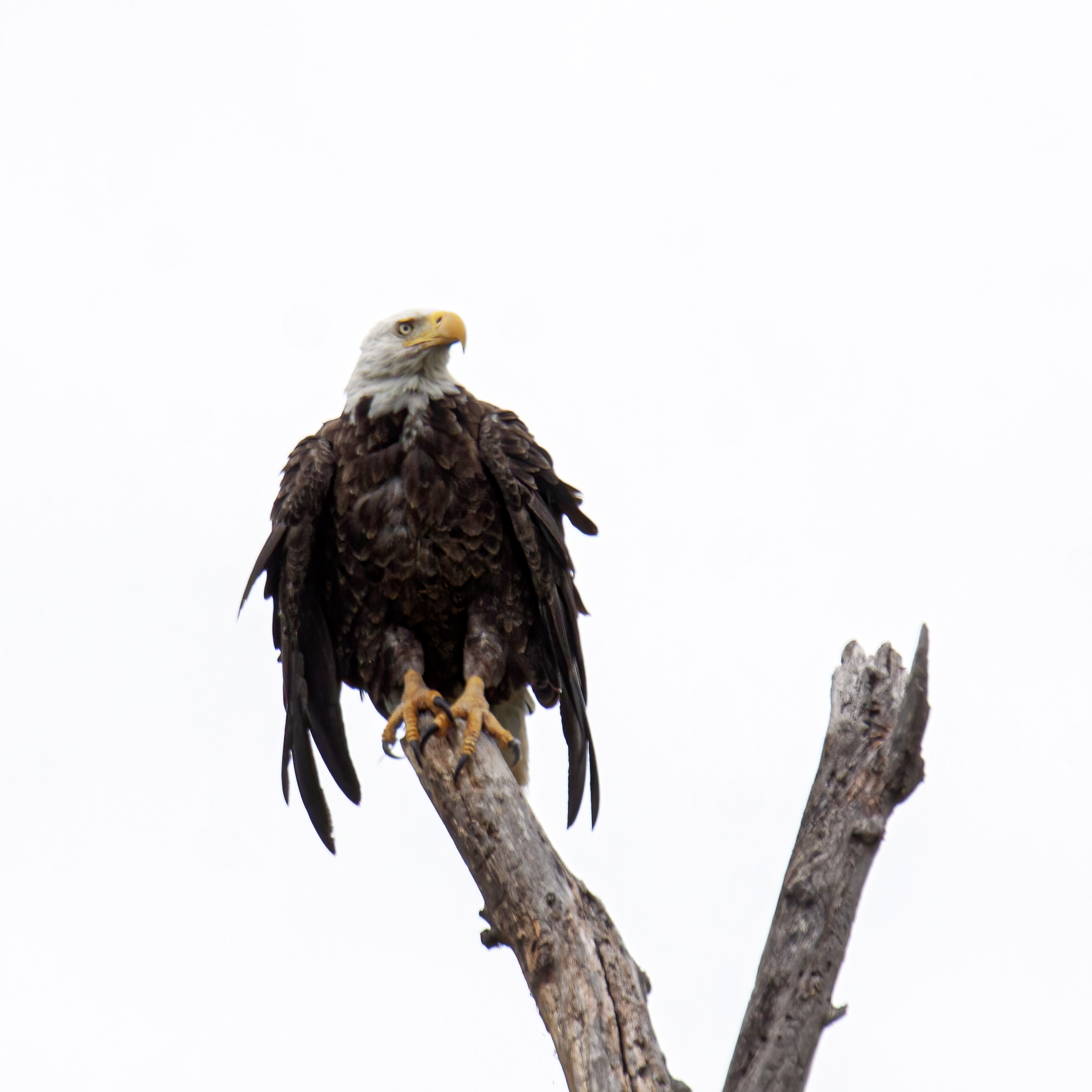
This Bald Eagle (Haliaeetus leucocephalus) looked a bit bedraggled when I spotted it on Tuesday at Occoquan Bay National Wildlife Refuge, where it was perched just above the large eagle nest in which a young eagle was visible. Harried parent? Check out yesterday’s posting “Looking out of the nest” if you missed the photos of the inquisitive juvenile eagle.

The sky was totally overcast on the day when I took these photos and the sky was almost pure white. The resulting effect makes these shots look almost like high key portraits taken in a studio setting, although personally I would have liked a little more directed light to make the photos look less flat. Still, any day is a good day when I get to see a bald eagle.

bald eagle

Bald Eagle

Bald Eagle

© Michael Q. Powell. All rights reserved.

Read Full Post »
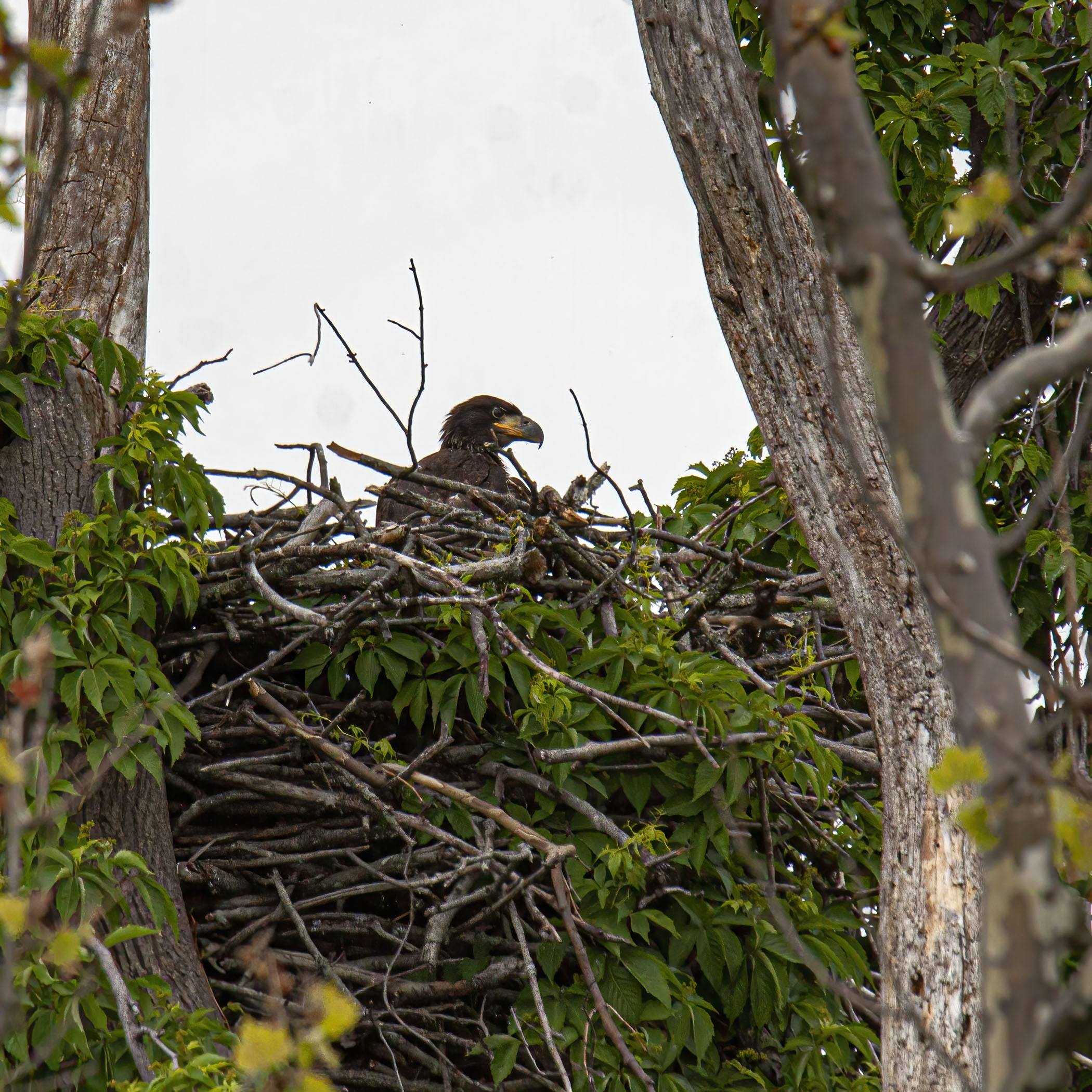
It was really cool on Tuesday to be able to capture these images of a young Bald Eagle (Haliaeetus leucocephalus) looking out from the large eagle nest at Occoquan Bay National Wildlife Refuge. The growing eaglet appeared to be quite alert and was sitting up quite high near the edge of the nest. I love how you can see the mottled plumage, dark eyes, and multi-colored beak of this eaglet in these photos.

The nest is high in the trees and there is now a lot of vegetation growing, so it was quite a challenge to get a clear angle of view. I am pretty happy with the results that I was able to achieve. The eaglet looks to be big enough to be flying, but I am not sure if that is the case. One of its parents was perched on some branches just above the nest, so I am pretty sure that it is not yet ready to go out on its own—eagles normally take about 12 weeks to fledge and then may hang around with their parents for another month or two.

Bald Eagle

Bald Eagle

© Michael Q. Powell. All rights reserved.

Read Full Post »
I was excited to spot this juvenile Bald Eagle (Haliaeetus leucocephalus) sitting up in the big nest at Occoquan Bay National Wildlife Refuge on Monday. I assume that this eaglet was born this spring, based on its coloration and markings.

Earlier this spring I had noted eagle activity around this nest and thought that the nesting process had already begun long ago. However, this nest is very large and so high up that it is impossible to tell when the eagles began to sit on the egg or eggs. I checked my blog postings from the past and saw that I posted a shot of eaglets at this same nest on 19 May last year (see the posting Eagle nest update in May), so things seem to be following the same approximate schedule.

I saw only a single eaglet this time, but will continue to monitor the nest for more eaglet activity, including indications that there is more than one eaglet. Earlier on the same day I spotted an adult eagle perched in a tulip tree—you can actually see some of the “tulips”— adjacent to the nest and suspect that this is one of the parents keeping an eye on the eaglet(s). I included a shot below of the presumed proud parent as a final photo.

Bald Eagle

Bald Eagle

© Michael Q. Powell. All rights reserved.


Read Full Post »

I love seeing the differences between juvenile and adult Bald Eagles—the coloration and markings of the eagles change dramatically over time. Earlier this week I did a posting called Two eagles that showed two juvenile eagles perched in a tree. One of them was quite young and the other was almost an adult. It was really easy to see the differences between the two stages of development, with only the older one showing the distinctive white head feathers.

Today I am featuring in-flight photos of two eagles that I spotted last Monday while exploring Occoquan Bay National Wildlife Refuge. The first photo shows a juvenile Bald Eagle that looks to be about two to three years old. The head appears to be dark and the there is a mottled mixture of white and brown feathers. The second image shows a mature Bald Eagle with a white head and uniformly dark feathers.

It is an awesome experience for me when eagles fly almost directly over me and I love trying to get shots of them. I never fail to be impressed by their amazing wingspans, which can reach more than seven feet (213 cm).

Bald Eagle

Bald Eagle

© Michael Q. Powell. All rights reserved.

Read Full Post »

I was excited to spot quite a few Bald Eagles (Haliaeetus leucocephalus) on Monday at Occoquan Bay National Wildlife Refuge. It was especially cool because the eagles that I observed were at different stages of development. Bald Eagles are mostly brown in color when they are born and it takes almost five years for them to mature and develop the white feathers on their head that we associate with Bald Eagles.

The eagle on the left in both of the photos is a really young one. I initially thought it might be a fledging that was born this year, but it seems too early for one to have already reached this stage of development. Perhaps this eagle is a year old, judging from its coloration and markings.

I thought that the other eagle was the same one in both photos, but the markings in the first photo show some dark feather on the head and some mottled coloration on the body that seems to me missing on the adult bald eagle in the second photo. I would guess that the “other” eagle in the first photo is about four years old.


Bald Eagles

Bald Eagles

© Michael Q. Powell. All rights reserved.

Read Full Post »

Sometimes I feel compelled to throw back my head and sing at the top of my lungs, as this Bald Eagle (Haliaeetus leucocephalus) was doing when I spotted it last week at Occoquan Bay National Wildlife Refuge. It might be somewhat of an exaggeration to call it “singing”—the eagle was calling out to its mate, I believe, in a somewhat unmelodious way, but it was a cool experience nonetheless.

The Cornell Lab of Ornithology had the following description of a bald eagle’s calls, “For such a powerful bird, the Bald Eagle emits surprisingly weak-sounding calls—usually a series of high-pitched whistling or piping notes.” Check out this link to a Cornell Lab webpage that has several sound samples of an eagle’s call. According to a National Public Radio report, Hollywood movies often dub over an eagle’s call with a Red-tailed Hawk’s cry, which is much more majestic, so you may be surprised to hear what a bald eagle actually sounds like.

bald eagle

bald eagle

bald eagle

© Michael Q. Powell. All rights reserved.

Read Full Post »

« Newer Posts - Older Posts »