Feeds:
Posts
Comments

Posts Tagged ‘Argia moesta’

Most of the time that I see damselflies, they are perched in the vegetation. Powdered Dancer damselflies (Argia moesta), like this one that I spotted last week at Occoquan Bay National Wildlife Refuge, however, like to perch on bare ground, emergent stones, and along trails. Immature male Powdered Dancers are tan to dark brown, turn darker with age, and becoming almost completely whitish at maturity.

The “powdered” color of this damselfly helped in to blend in almost perfectly with the sand and gravel on this trail at the wildlife refuge. If I had not seen it land, I suspect that I would have had real trouble spotting this Powdered Dancer damselfly.

Powdered Dancer

© Michael Q. Powell. All rights reserved.

Read Full Post »

I was happy to spot these male Powdered Dancer damselflies (Argia moesta) on Monday at a creek in Prince William County, Virginia. Most of the damselflies that I see regularly are found at small ponds and marshy areas, but this species prefers rocky streams and rivers. Sometimes Powdered Dancers will perch in the streamside vegetation, but often they will perch flat on rocks in the water, as you can see in several of these shots.

The thoraxes of Male Powdered Dancers are mostly white due to pruinosity, i.e. they are covered by minute waxy dust particles that makes them look frosted or powdered. This phenomenon is present in some dragonflies too, most notably the male Common Whitetail dragonflies.

Powdered Dancer

Powdered Dancer

Powdered Dancer

© Michael Q. Powell. All rights reserved.


Read Full Post »

Most of the damselflies that I photograph are found at ponds. However, there are other damselflies that are found primarily at streams and creeks. I spotted two such species this past Tuesday when I was exploring a creek in Prince William County, Virginia.

The damselfly in the first photo is a Powdered Dancer (Argia moesta) that I spotted on a rocky ledge of the creek. Male Powdered Dancers are the only mostly white damselflies that I have seen and they get increasingly white as they mature. I love the way the angle of the shot makes it look like the damselfly was perched on the side of a massive mountain that it was attempting to climb.

The damselfly in the second photo is a Dusky Dancer (Argia translata). This damselfly may have the most intense blue eyes that I have ever seen on an insect. It was perched on a rocky ledge at the edge of a creek. I would have liked to get a closer shot, but the bank of the creek was high and steep and the ledge was inaccessible to me (unless I was willing to get really wet, which I did not want to do).

According to Wikipedia, the damselflies in the genus Argia, are commonly known as “dancers” because of the distinctive jerky form of flight they use which contrasts with the straightforward direct flight of bluets, forktails, and other pond damselflies.

Powdered Dancer

Dusky Dancer

© Michael Q. Powell. All rights reserved.

Read Full Post »

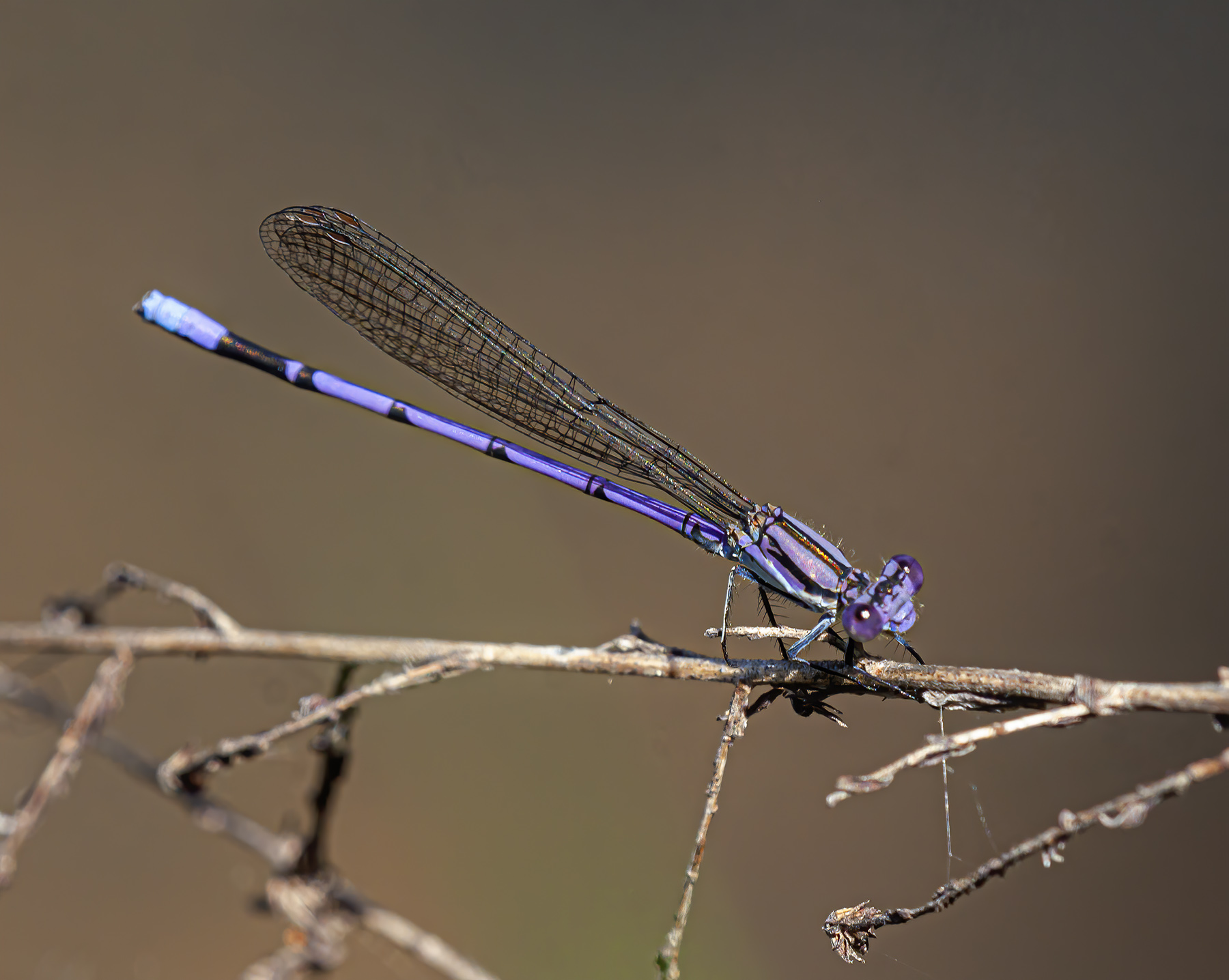
Recently I did a posting featuring a beautiful Violet Dancer (Argia fumipennis violacea), the uniquely purple damselfly that is featured in the banner of my blog. Today I thought that I would give equal time to several of the other dancers in my life. Damselflies in the genus Argia are known by the whimsical name of dancers, because of the distinctive jerky form of flight they use which contrasts with the straightforward direct flight of bluets, forktails, and other pond damselflies.

The damselfly in the first photo is a male Powdered Dancer (Argia moesta) that I spotted perched on a rock in the water while I was exploring a stream in Prince William County. I can tell that this is a rather young male, because he still has a lot of color on his thorax. Mature males turn whitish in color—you can see the powdery coating beginning at the tip of its abdomen.

The next two photos show a male Blue-fronted Dancer (Argia tibialis) that I found in the vegetation next to a small pond at Jackson Miles Abbot Wetland Refuge. This species is quite distinctive because the thorax is almost completely blue, with only hairline black stripes on its shoulders and the middle of its back.

One of the things that I particularly enjoy about photographing nature is the incredible diversity that I encounter. Even within a single species, I can spot unique beauty in each individual that I encounter, especially when I slow down and look closely. The same thing is true about people—we should celebrate and respect our diversity and engage with people who may look or act or think differently. As the Lee Ann Womack country music song says, if you get the choice to sit it out or dance, I hope you dance.


Powdered Dancer

Blue-fronted Dancer

Blue-fronted Dancer

© Michael Q. Powell. All rights reserved.

Read Full Post »

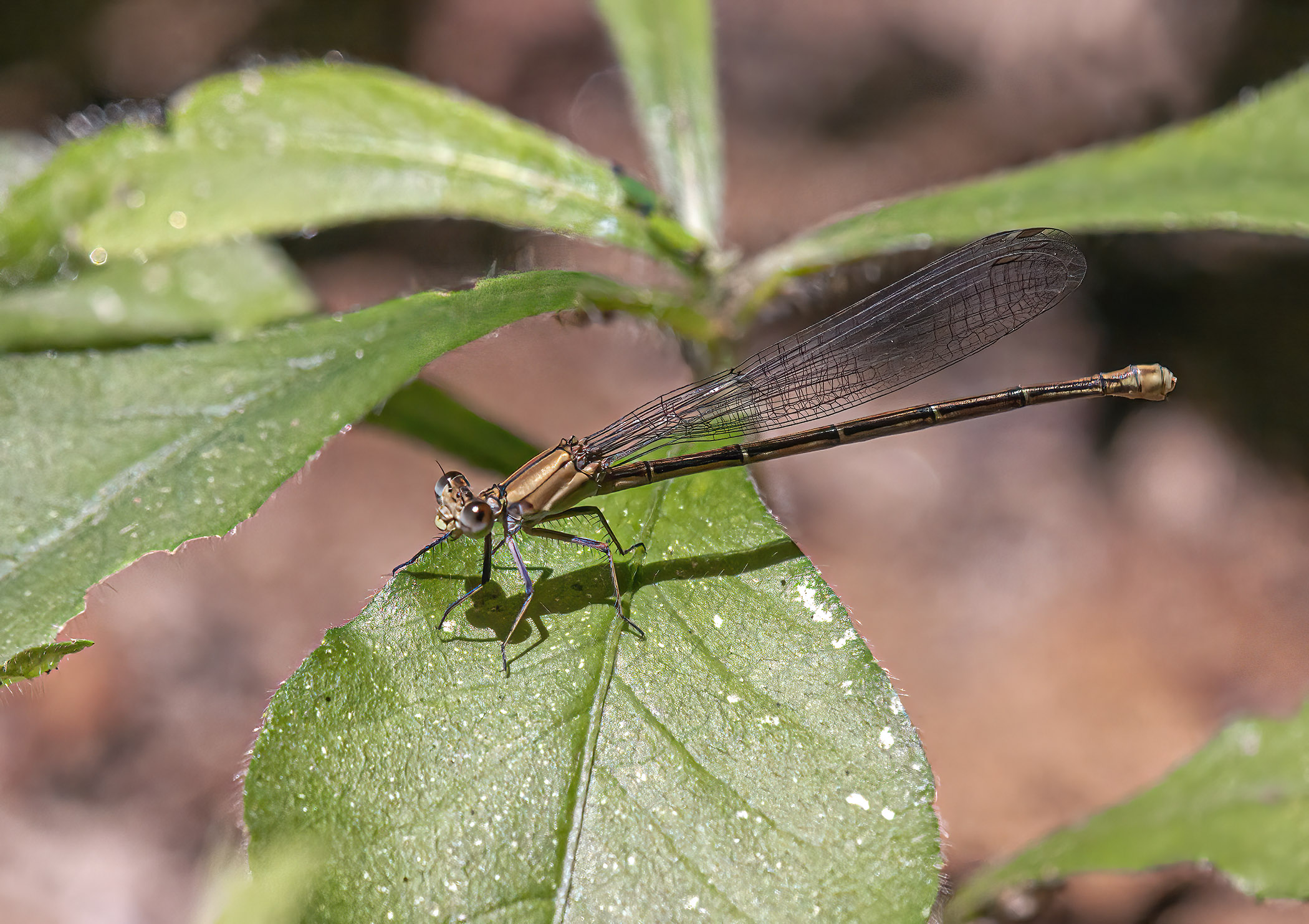
Compared to the brightly-colored male damselflies, females damselflies often seem dull-colored and less striking in appearance. This female Powdered Dancer damselfly (Argia moesta) that I spotted in early August alongside a stream in Prince William County is a notable exception to that general rule.

If you click on the photo, you will note the elegant shades of brown on her body that glisten in the sunlight. Her beautiful two-toned eyes are amazing and seem to draw in the viewer. It is hard to be sure, but she almost seems to be smiling or maybe even winking at me.

It takes some effort to see and to photograph such tiny insects, but it is definitely worth it for me to be able to share the beauty of nature with all of you.

Powdered Dancer

© Michael Q. Powell. All rights reserved.


Read Full Post »

As I was exploring a stream in Prince William County on Tuesday, I spotted a fallen tree at the edge of a rocky beach. I am not very good at identifying trees, but could not help but notice that this one had a lot of nuts on it. Someone or some creature had gathered a small pile of these green-skinned nuts at the edge of the water for unknown reasons. I think that these may be some kind of hickory nuts, judging from photos that I have seen on the internet, but I am really uncertain about that identification.

As I was examining that little pile of hickory nuts, a male Powdered Dancer damselfly (Argia moesta) flew by and landed on one of the nuts. I am always interested in photographing interesting perches for my dragonflies and damselflies and this perch is definitely out of the ordinary.

I love the graphic shape and color of the nuts and the way the image is bisected on an angle into distinct halves, each with its own distinctive colors and textures. The powdery coloration of the Powdered Dancer helps it to stand out and the damselfly helps to unify the two halves of the photo. My main subject takes up a comparatively small part of this image compared to most of my other shots, but I think the composition really works. I encourage you to click on the image to see the beautiful coloration of this little damselfly that is approximately 1.5 to 1.7 inches (38 to 43 mm) in length.

Powdered Dancer

© Michael Q. Powell. All rights reserved.

Read Full Post »

I was happy to spot these handsome Powdered Dancer damselflies (Argia moesta) in mid-June as I was exploring a rocky stream in Prince William County. Most of time when I see a damselfly it is at a pond or marshy area, but this large, distinctive damselfly seems to prefer rivers and streams. Although I occasionally spot them perched in vegetation, as in the second photo, Powdered Dancers quite often perch on bare ground or on flat stones.


Powdered Dancer

Powdered Dancer

© Michael Q. Powell. All rights reserved.


Read Full Post »

Bright, saturated colors can be wonderful, but in large doses they can overwhelm the senses and confuse a viewer’s eyes. I am often drawn to simple scenes with a limited palette of colors, scenes in which light and shadows and shapes and textures play a more prominent role than colors.

Those were my thoughts when I started to review my images of this male Powdered Dancer damselfly (Argia moesta) that I spotted on Thursday while exploring a stream in Fairfax County with fellow dragonfly enthusiast Walter Sanford. The Powdered Dancer is the closest that we come to having a monochromatic dragonfly or damselfly—the thorax and tip of the abdomen of males becomes increasingly white as they age.

I love the way that the coolness of the white on the body contrasts with the brownish-red warmth of the branch, the leaves, and the out-of-focus rocks in the background of the initial image. I like too the texture in the images, particularly in the bark in the first photo and in the rock in the second one. Shadows help to add some additional visual interest to both of these images, drawing a viewer’s attention to the damselfly’s head in the first image and to the details of its entire body in the second.

Powdered Dancer

Powdered Dancer

© Michael Q. Powell. All rights reserved.

Read Full Post »

The genus Argia, commonly known as dancers, is a large New World group of damselflies. Although the genus name Argia, αργία in Ancient Greek, is translated as “idleness,” dancers are quite active and alert damselflies, according to Wikipedia. Why are they called “dancers?” They are known as dancers “because of the distinctive jerky form of flight they use which contrasts with the straightforward direct flight of bluets, forktails, and other pond damselflies.” I wonder if I am part damselfly, because “distinctive” and “jerky” are definitely adjectives that could be used to describe my attempts at dancing.

This past week, I have seen three different species of dancers. The first one, the Variable Dancer (Argia fumipennis violacea) has perhaps the most strikingly beautiful color of any of the dragonflies and damselflies that I have seen—I love that shade of violet. Some of my longtime readers may have noted that a photo of a Variable Dancer has been the banner image for this blog for many years.

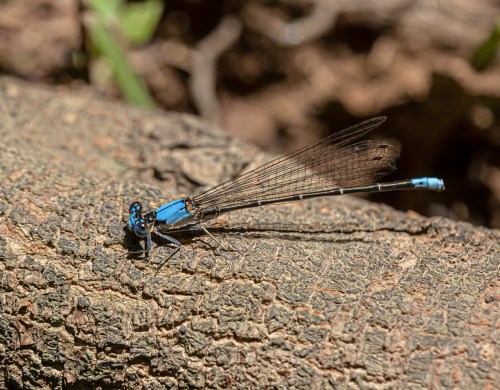
The damselfly in the second image is a Blue-fronted Dancer (Argia apicalis). The thorax of the males of this species are almost completely blue, with only hairline stripes in the middle of their backs and shoulders.

The final damselfly is a Powdered Dancer (Argia moesta), our only mostly white damselfly. As you can see in the photo, members of this species often like to perch on stones at the edge of the water. I chose to leave this image mostly uncropped, because of the way that it shows the water moving around the stone and the submerged stones on the stream bottom in the background.

All of this talk of dancers brings to mind a country music song that I really like by Lee Ann Womack called “I Hope You Dance.” I am really touched by the basic message of the song—when you get the choice to sit it out or dance, I hope you dance.

Here is the first verse of the song, just in case you have never heard it:

“I hope you never lose your sense of wonder
You get your fill to eat but always keep that hunger
May you never take one single breath for granted
God forbid love ever leave you empty handed
I hope you still feel small when you stand beside the ocean
Whenever one door closes I hope one more opens
Promise me that you’ll give faith a fighting chance
And when you get the choice to sit it out or dance
I hope you dance.”
(I Hope You Dance lyrics © Sony/ATV Music Publishing LLC, Universal Music Publishing Group, Songtrust Ave)

Variable Dancer

Blue-fronted Dancer

Powdered Dancer

© Michael Q. Powell. All rights reserved.


Read Full Post »
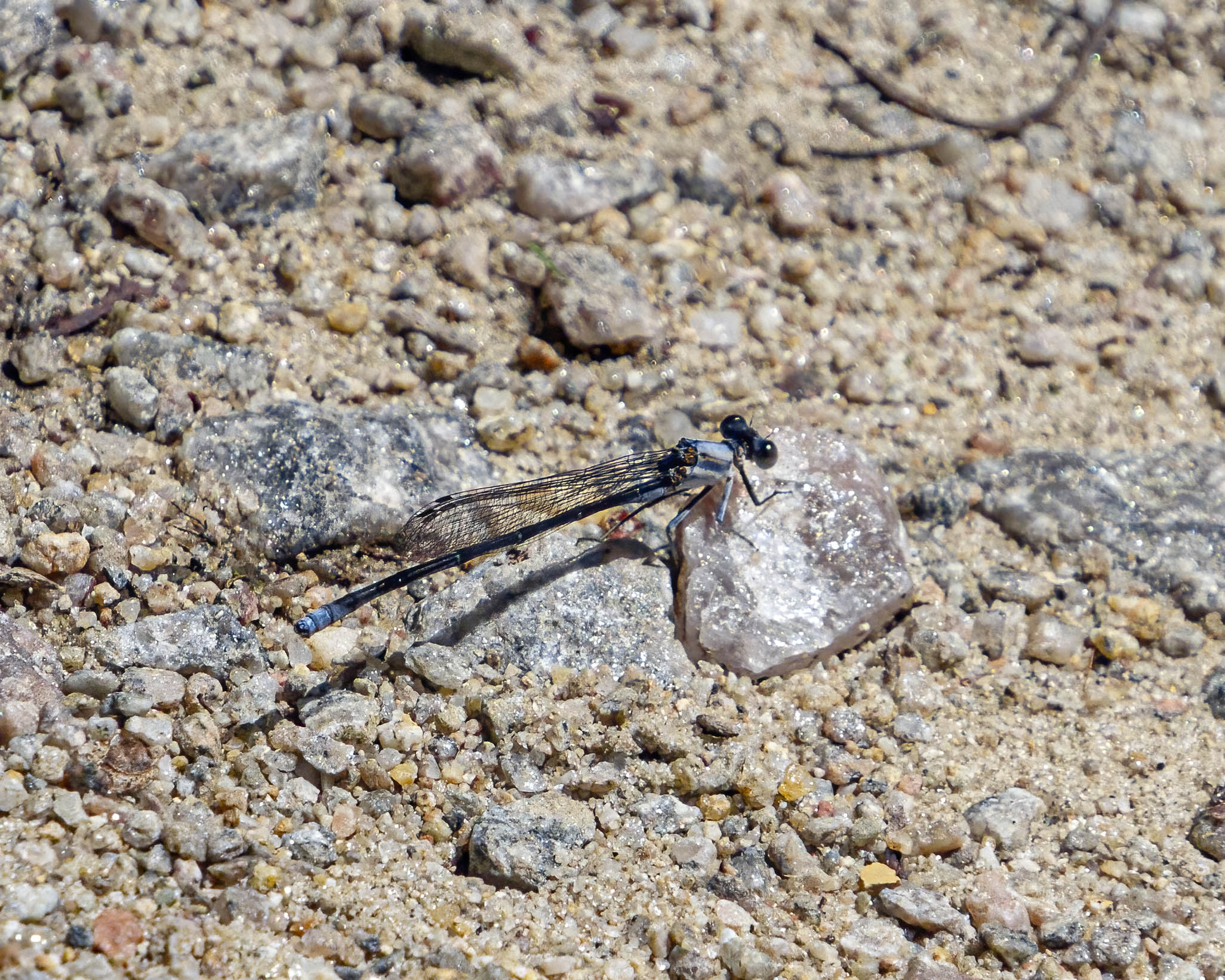
What do you see first when you look at this image? Do you see the beautiful colors, textures, and shapes of the rock that makes up both the foreground and the background? Are you drawn to the lines and somber coloration of the Powdered Dancer damselfly (Argia moesta) and its shadow? Do you focus on the damselfly’s brightly shining gray eye?

I spotted this little damselfly this past week while exploring a creek in Fairfax County with fellow dragonfly enthusiast Walter Sanford. There is a simplicity to this image that I find really appealing. I especially like the limited color palette and the sense of harmony in the way that the colors work together.

What do you think?

Powdered Dancer

© Michael Q. Powell. All rights reserved.


Read Full Post »

Yesterday as I was exploring a creek in Prince William County, Virginia I spotted this large damselfly. I marveled at its beautiful coloration and was happy to be able to capture an image that shows it off well. At the time I took the photo I was not certain of the species, but when I returned home and looked in my damselfly book, I learned that it is a male Powdered Dancer damselfly (Argia moesta).

As a Powdered Dancer male gets older, its thorax and the tip of its abdomen become covered with a powdery blue or gray substance in a process known as pruinescence. Eventually the male will look almost white, which makes it even easier to identify. So many damselflies have a lot of blue on their bodies that it is hard for me to be confident in my identification when I see a damselfly with blue coloration.

Powdered Dancer

© Michael Q. Powell. All rights reserved.

Read Full Post »
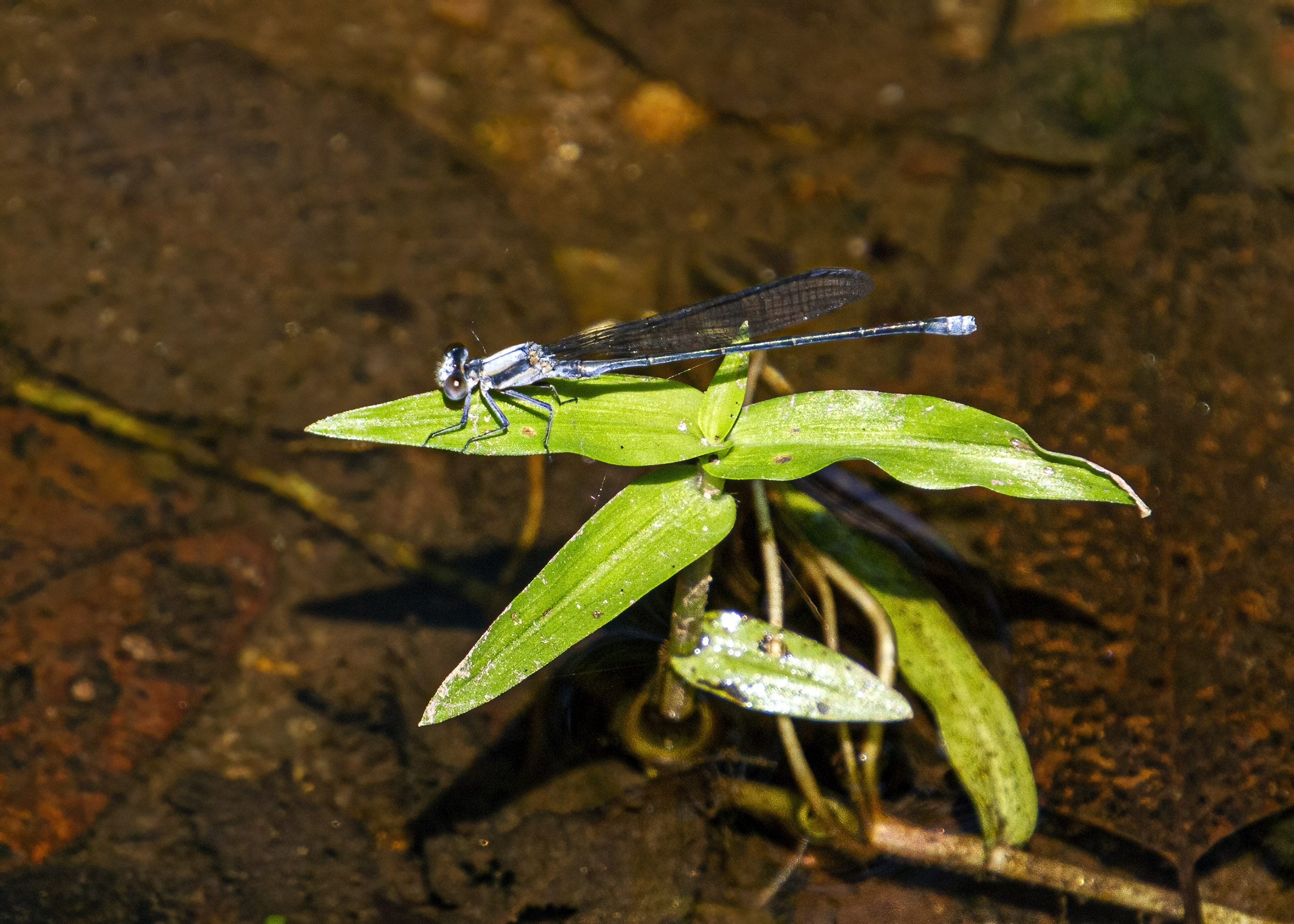
What a difference the background makes when photographing a damselfly. This past Friday I saw lots of damselflies as I was exploring Riverbend Park in Great Falls, Virginia. My eyes were repeatedly drawn to one species that a dark abdomen (the “tail” part) and speckled green eyes and I was able to photograph these damselflies in a number of different settings. I usually have problems in identifying damselflies, so I posted the third image below to a Facebook forum and one of the experts there identified it as an immature male Powdered Dancer damselfly (Argia moesta).

Normally I prefer to photograph dragonflies and damselflies in a natural environment, but the first photo is definitely an exception. I love the juxtaposition of the rust and corrosion of the curved man-made metal with the lines and color of the damselfly (and the cool shadow was a real bonus). In the second shot, the damselfly is perched on the ground and the unevenness of the surface makes for an intriguing shadow. The setting in the final shot is the most “natural” and the image gives viewers the best overall view of this damselfly species, but it doesn’t grab me as much as the first image.

Powdered DancerPowdered Dancer

Powdered Dancer

© Michael Q. Powell. All rights reserved.

Read Full Post »