Feeds:
Posts
Comments

Posts Tagged ‘Anthocharis midea’

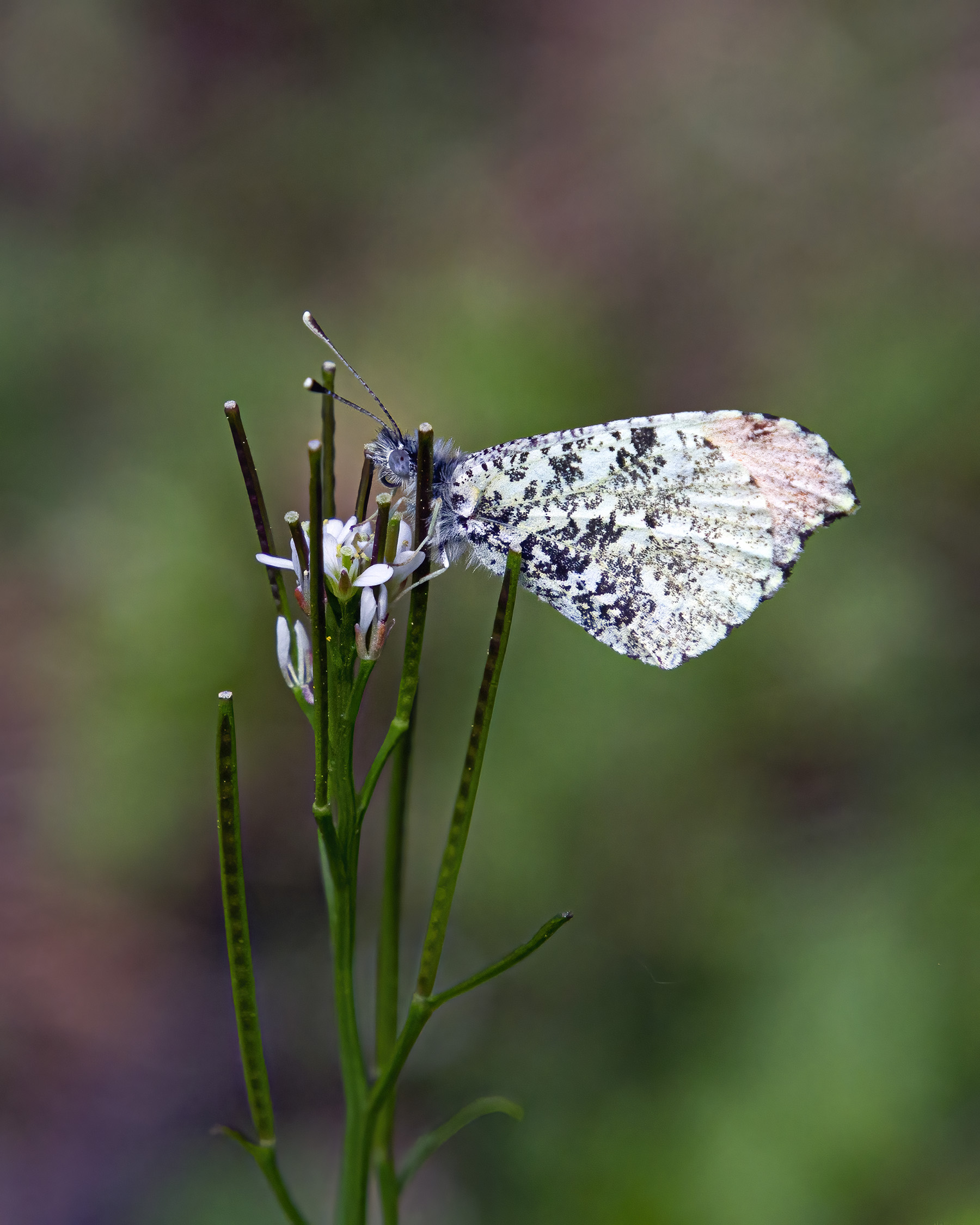
I was delighted to spot this Falcate Orangetip butterfly (Anthocharis midea) on 15 April at Occoquan Bay National Wildlife Refuge. The butterfly is somewhat nondescript when its wings are closed, but spectacular when they open, revealing the orange tips for which the species is named.

I encourage you to click on the second image to get a closer look at the beautiful details of this tiny butterfly, including its speckled gray eyes and wonderfully marbled wings.

Falcate Orangetip butterfly

Falcate Orangetip butterfly

© Michael Q. Powell. All rights reserved.

Read Full Post »

On Monday I spotted this cool little butterfly at Occoquan Regional Park in nearby Lorton, Virginia. I was a little surprised to learn that it is a Falcate Orangetip butterfly ( (Anthocharis midea), given that the butterfly has not a single visible spot of orange. Apparently only the males have the orange tips for which the species is named and this one is a female.

When I first spotted this tiny butterfly flying about, I assumed that it was a Cabbage White. However, I quickly noticed the colored pattern on the outside of the wings and realized that my initial impression were wrong—Cabbage Whites are all white except for some black spots. When I looked even closer I noticed the butterfly’s gray eyes and scallop-edged wings, unlike the Cabbage Whites that have green eyes and more even-edged wings.

Falcate Orangetip

© Michael Q. Powell. All rights reserved.

Read Full Post »

I was happy that I managed to get a shot of this tiny butterfly perched low in the vegetation at Occoquan Bay National Wildlife Refuge on Wednesday. I think it may be a Falcate Orangetip (Anthocharis midea), although the butterfly never opened its wings, so I was not able to confirm that the wings were tipped with orange.

I was a bit shocked that I was able to capture so much detail of this tiny creature, given that I was shooting with my Tamron 150-600mm zoom lens fully extended to 600mm. When I bought this lens in November 2014, I remember reading reviews about the lens that stated that it was soft at 600m. That has not really been my experience. If I pay attention to my techniques and use a monopod for additional stability (as I was doing for this shot), I can shots that are acceptably sharp to my eye.

For those of you who are especially geeky, for this shot I was shooting with a Canon 7D at f/8, 1/400 sec, and ISO 800 with an exposure compensation value of minus 1.33 stops. More important than the settings, though, is the fact that I like the image that I managed to capture—that is always my number one priority.

Falcate Orangetip

© Michael Q. Powell. All rights reserved.

Read Full Post »