Feeds:
Posts
Comments

Archive for the ‘Winter’ Category

We finally had a sunny day, so I ventured out yesterday to Occoquan Bay National Wildlife Refuge in search of subjects. I was happy to find an alert Great Blue Heron (Ardea herodias) in the open. During my most recent trips to this refuge, the weather was usually cold and overcast, the heron was often hunched over at the far edge of a pond, doing its best to stay warm.

Despite the sunshine, the wind was kicking up periodically, ruffling the heron’s feathers in an almost comical way. His “bed head” reminded me of my youth. I often had a cowlick at the back of my head and I remember my Mom licking her fingers and trying to flatten it down with her saliva.

Unlike the Great Egrets that leave our area when the weather turns cold, Great Blue Herons remain with us throughout the wind. They somehow manage to survive through the frigid weather and occasional snow—I suspect that this heron was not at all bothered by a little wind.

Great Blue Heron

© Michael Q. Powell. All rights reserved.

Read Full Post »

I was looking into the sun when I spotted this Bald Eagle (Haliaeetus leucocephalus) in a tree during a recent visit to Occoquan Bay National Wildlife Refuge. The eagle took off before I could get into a better shooting position, but I was able to capture some of the sunlight shining through its tail feathers.

I wish I had been able to frame the photo a bit better, but it is always tricky when focusing on a perched eagle to figure out how much to zoom out in order to capture its entire wingspan. In this case, I was worried more about adjusting for the backlight, so that I would not have a silhouetted shot, and was not worrying about framing the photo.

It is amazing to realize how many different considerations were coursing through my brain as I tried to analyze the situation, predict the possibilities, and react to changes. I remember how overwhelmed and paralyzed I felt in this kind of a situation when I was just starting to get serious about my photography some ten years ago. Now I am much  more comfortable with my gear and have a certain amount of muscle memory, so I am able to react more calmly and instinctively, without having to think consciously about all of the variables.

Every situation is different, though, and no matter how much I practice, there is still a spurt of adrenaline when a moment like this arrives and I realize I have to react instantaneously to take advantage of the situation. Things rarely works perfectly, but I am more than happy when they work as well as they did when I captured this image of the eagle’s takeoff.

bald eagle

© Michael Q. Powell. All rights reserved.

Read Full Post »

It has been several months since I last saw a dragonfly and I will have to wait for a couple more months before they reappear in my area. As many of you know, dragonflies are one of my favorite subjects to photograph—there is something almost magical about these beautiful aerial acrobats.

As I was shoveling snow after a recent storm, I glanced over at the front yard of my townhouse and was struck by the beautiful patina of the dragonflies that are part of a lawn sprinkler.

The metal dragonflies reminded me of the beauty that is to come, of the new life that will burst forth when spring arrives. Those thoughts filled me with hope and happiness and help to sustain me through the often bleak days of the winter.

dragonfly

© Michael Q. Powell. All rights reserved.

Read Full Post »

Recently I have been seeing Northern Mockingbirds (Mimus polyglottos) fairly frequently at Occoquan Bay National Wildlife Refuge. The long tail and the coloration of this bird makes it fairly easy to identify.

Normally mockingbirds are quite vocal, with an amazing variety of songs, but the ones that I have seen recently have been surprisingly silent. On the Cornell Lab of Ornithology website, I learned that, “Northern Mockingbirds typically sing from February through August, and again from September to early November. A male may have two distinct repertoires of songs: one for spring and another for fall.”

I also learned that the most frequent singers are unmated males. “Northern Mockingbirds sing all through the day, and often into the night. Most nocturnal singers are unmated males, which sing more than mated males during the day, too.” I wonder if that means that the best singers cease singing once they have found mates and the ones that we hear most often are the second-tier singers.

I was happy with the little portraits that I captured of this handsome mockingbird. The first photo shows a bit of the environment in which I found the bird, a beautiful mixture of mostly shades of brown. I really like the way that the background came out, but found the small branches to be a little distracting.

I changed my shooting angle for the second shot and cropped a little close to focus attention on the subject. As you can probably tell, I also used Photoshop to remove the little branch from the frame. Some photographers are purists and won’t remove elements from their photos or even crop them, but I do edit my shots, though most of the time I make only a small number of changes and adjustments.

Northern Mockingbird

Northern Mockingbird

© Michael Q. Powell. All rights reserved.
 

Read Full Post »

Sparrows are everywhere, it seems, but it is actually pretty difficult to get a clear of one. These little brown birds are hyperactive and super industrious, so they rarely seem to stop and pose. They also enjoy foraging in dense vegetation or in tall grass, further complicating my photographic efforts.

Last week I was happy to capture several decent images of sparrows. I think that they are both Song Sparrows (Melospiza melodia), though I have low confidence in my ability to identify sparrow species correctly.

In the first photo, the sparrow was foraging on the ground, where it blended in so well that I sometimes lost sight of it when it stopped moving. The second sparrow perched briefly on a branch and I was able to take a shot while looking up at the bird. The angle of view gives the sparrow’s head a distorted shape that somehow reminds me of Darth Vader’s helmet—the bird’s expression also looks a bit imperious as it surveys its surroundings.

Song Sparrow

Song Sparrow

© Michael Q. Powell. All rights reserved.

Read Full Post »

As many of you know, I have been keeping an eye on a pair of Bald Eagle (Haliaeetus leucocephalus) nests at Occoquan Bay National Wildlife Refuge, waiting for the eagles to begin sitting on the nests. I featured one of the nests, an enormous one high in a tree, several times during January, but have not yet posted any shots of the smaller nest this year until now.

The most direct roads leading to this smaller nest are blocked off at this time of the year, because the nesting tree is located near the intersection of several major trails, including one on which cars are normally permitted to drive. However, I am able to take a circuitous route to reach one of the barriers that provides a distant view of the nest from which I can take some photos.

Several weeks ago I was delighted to photograph both members of an eagle couple perched together on a limb of the tree with the small nest that has been used in each of the past three years (and maybe even longer than that). As you can see in the first photo, one of the eagles is quite a bit larger than the other—generally the female is the larger one.

When I first started watching the nest that day, only the smaller eagle to the left was perched on the limb. As I pulled back on my zoom lens to be able to show the nest in the lower righthand corner of the photo, the second eagle flew in to perch next to her mate, and I captured that moment in the second photo.

The two eagles stayed together for a short while side-by-side, when suddenly the larger eagle took off. The final shot shows the eagle extending her wings and taking off from the perch, leaving the smaller eagle to keep watch over the nesting site.

I have been back several times to the site since this encounter, but have not seen the eagles there again. I am optimistic that they will soon be sitting on some eggs. In this smaller nest, the eagle is partially visible when she is sitting on eggs, whereas the other nest is so big and deep that a nesting eagle is hidden from view.

Bald Eagle

Bald Eagle

Bald Eagle

© Michael Q. Powell. All rights reserved.

Read Full Post »

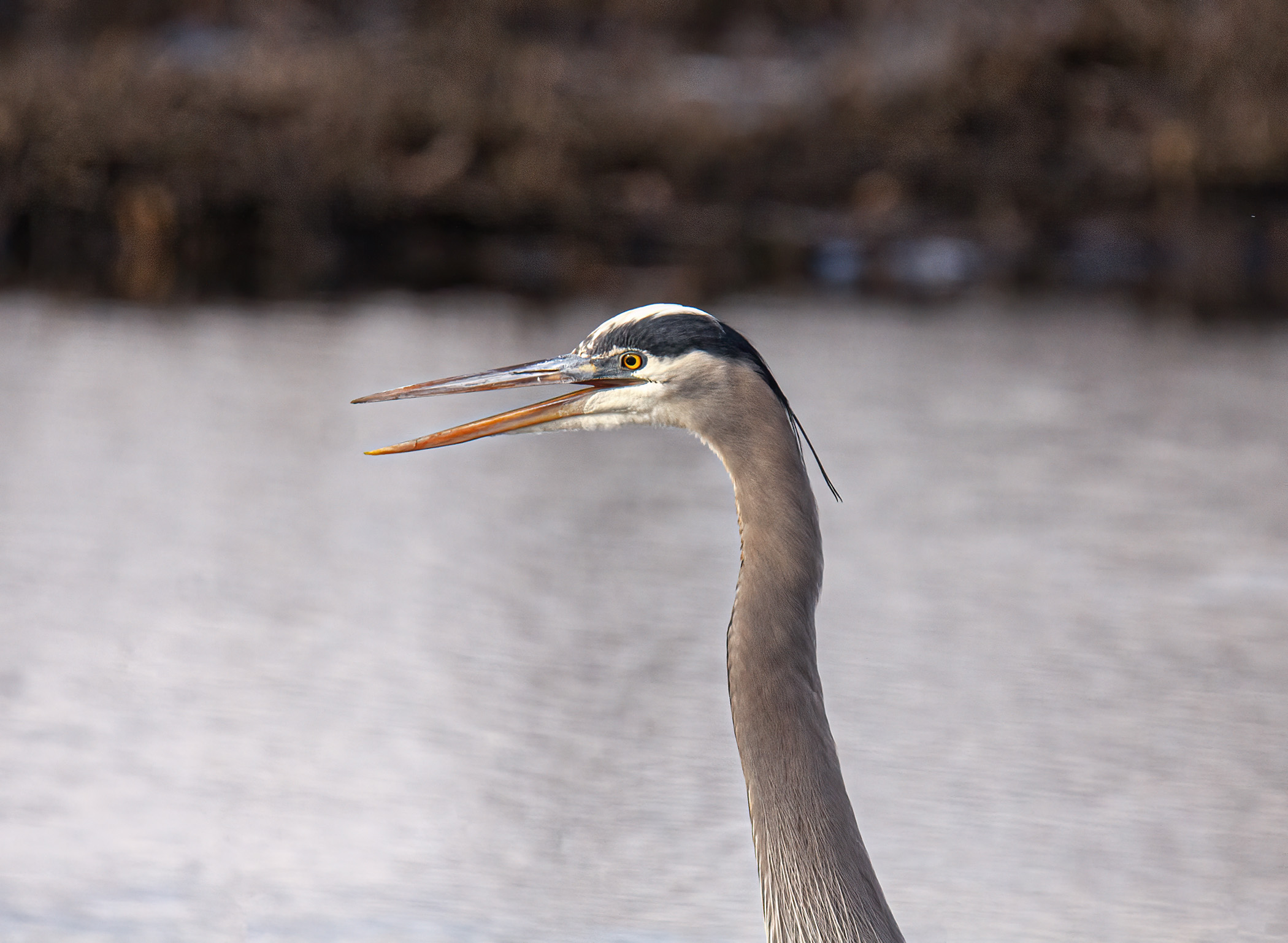
Smiling is contagious. I can’t say for sure that this Great Blue Heron (Ardea herodias) was actually smiling when I spotted him in mid-January at Occoquan Bay National Wildlife Refuge, but he seemed so happy that I could not help but smile back at him. I really enjoy trying to capture the personality of the individual birds when I photograph them and sometimes my wildlife subjects will cooperate with me.

Great Blue Herons remain in my area throughout the winter. It has to be tough on them right now, when many of the smaller ponds have iced over, but somehow the herons manage to find some open water and hopefully are able to catch enough food to survive.

Great Blue Heron

© Michael Q. Powell. All rights reserved.

Read Full Post »

Carolina Chickadees (Poecile carolinensis) are energetic little birds and seem to be in motion a lot of the time. When I see them perched, they tend to perch on horizontal branches. I was therefore a little surprised when I saw this chickadee latch onto the vertical stem of a reed and hang there for several seconds in front of me.

It almost seemed like he was deliberately posing for me and I happily captured the chickadee’s portrait during a recent visit to Occoquan Bay National Wildlife Refuge. Be sure to check out the fascinating way that the chickadee is grasping the reed in the photo in a pincer-like grip.

Carolina Chickadee

© Michael Q. Powell. All rights reserved.


Read Full Post »

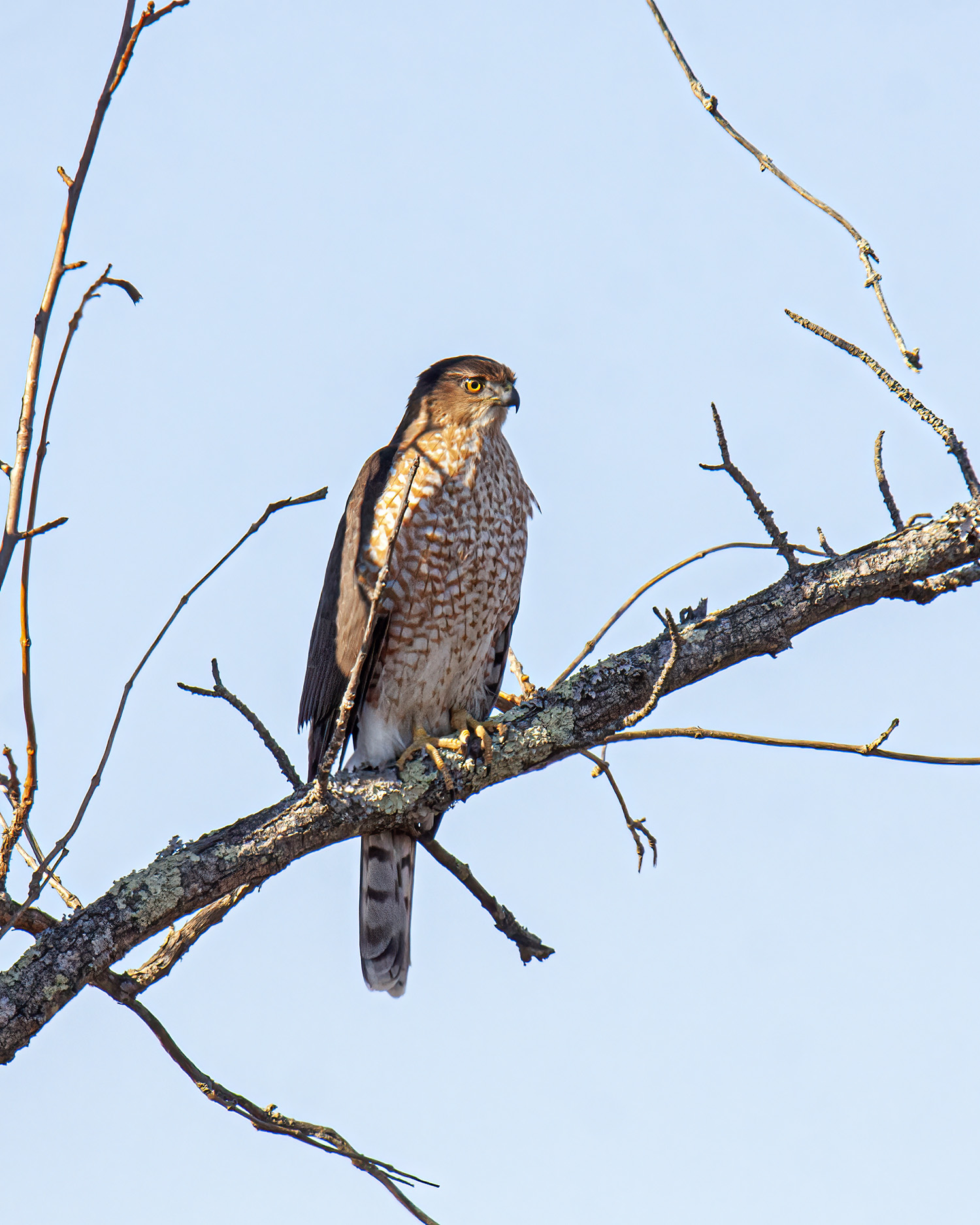
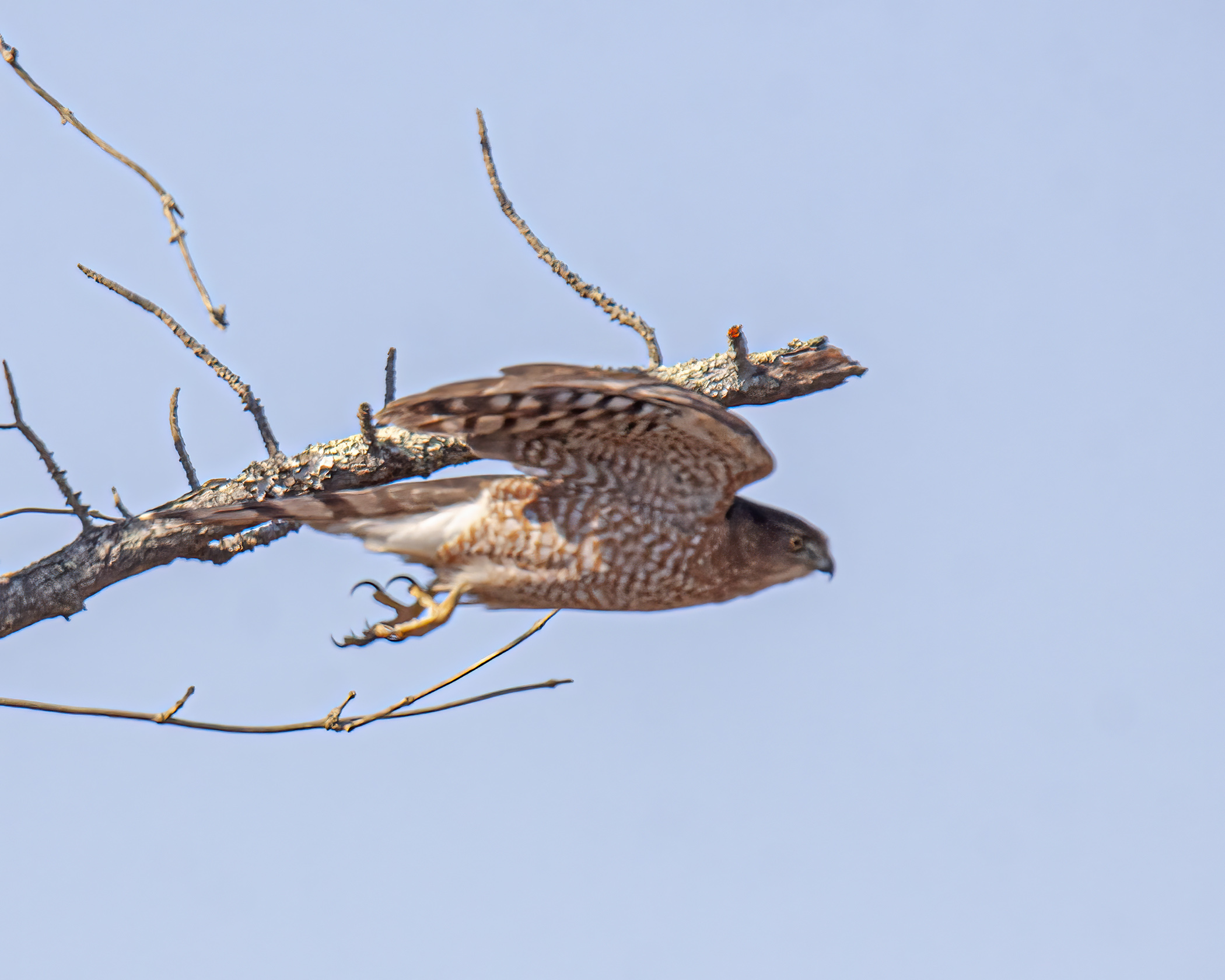
As I was finishing up my walk through Occoquan Bay National Wildlife Refuge last Wednesday, I spotted this hawk in a distant tree. The first thing that I noticed was the hawk’s long tail, which immediately suggested to me that it was a Cooper’s Hawk (Accipiter cooperii) and not a Red-shouldered Hawk, the hawk species that I am most accustomed to seeing at the wildlife refuge.

Cooper’s Hawks hang out in wooded areas rather than in open areas and when I see one, it is usually zigzagging its way through through the trees rather than flying above them. Although I was far away from the hawk, it had a clear view of me and took off shortly after I spotted it. As you can see from the second and third images, the hawk flew downwards towards the ground rather than rising up into the air.

As I was doing a little research on Cooper’s Hawks, I learned that life can be a little tricky for male Cooper’s Hawks—I am not sure if this one is a male or a female. According to the Cornell Lab of Ornithology, “As in most hawks, males are significantly smaller than their mates. The danger is that female Cooper’s Hawks specialize in eating medium-sized birds. Males tend to be submissive to females and to listen out for reassuring call notes the females make when they’re willing to be approached.”


Cooper's Hawk

Cooper's Hawk

Cooper's Hawk

© Michael Q. Powell. All rights reserved.

Read Full Post »

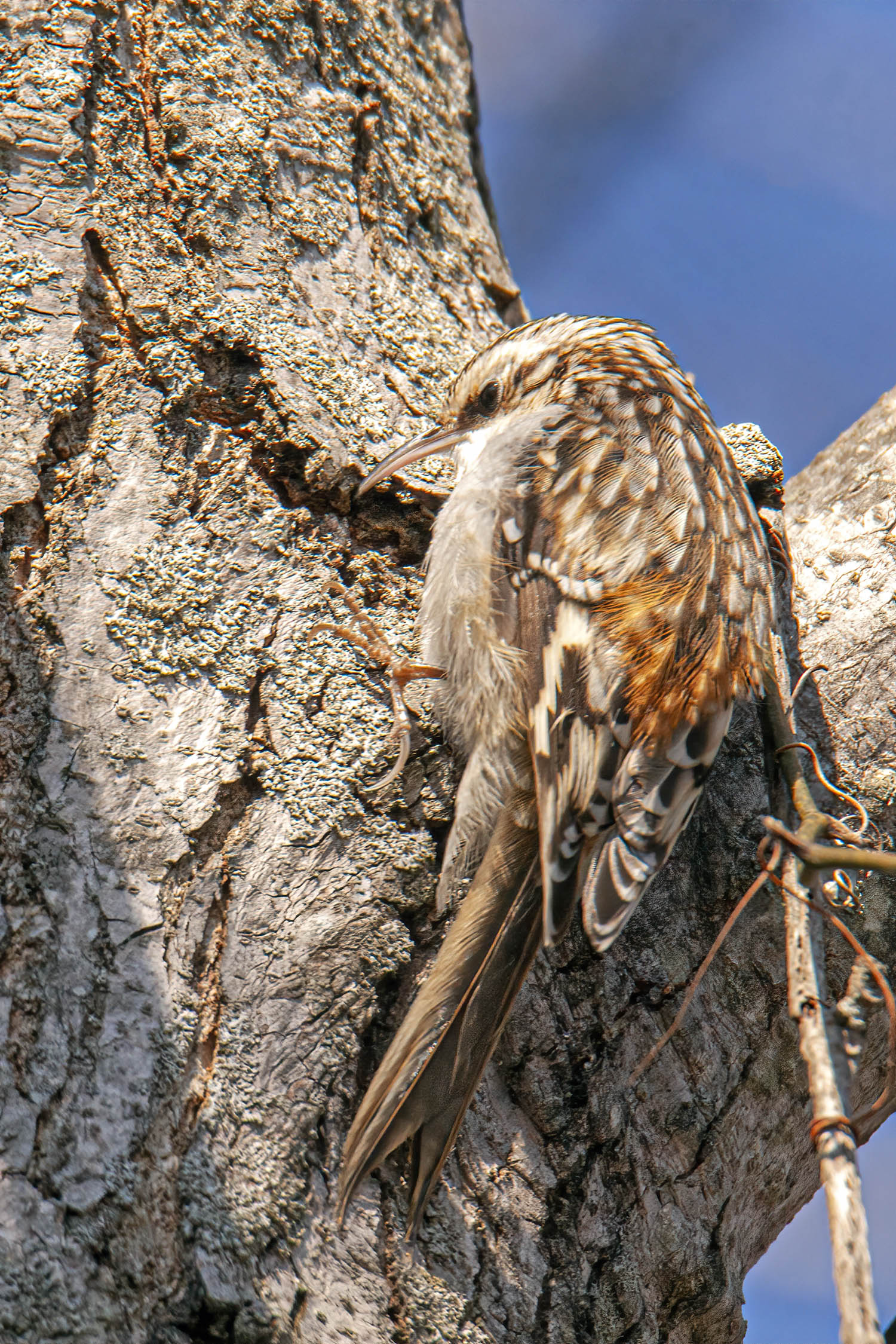
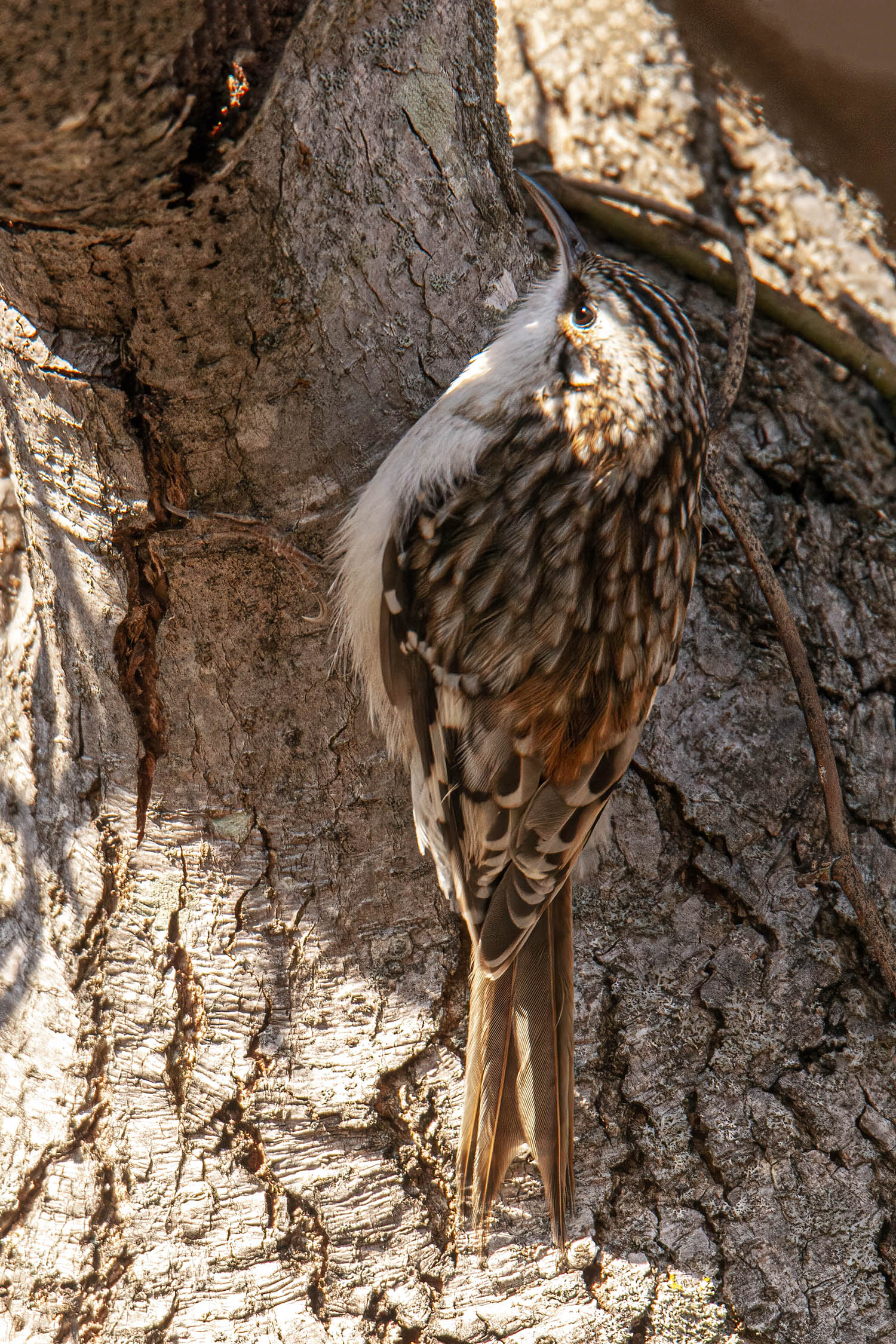
Brown Creepers (Certhia americana) are strange little birds. They crawl upwards on tree trunks and large branches in a spiraling motion, pausing periodically to probe crevices for tiny insects with their slender, downcurved bills—they never seem to perch and they rarely seem to fly.  Their mottled coloration helps them to blend in really well with the bark of the trees, so I rarely see a Brown Creeper, though I suspect they may be fairly common.

On Wednesday as I was walking along a trail at Occoquan Bay National Wildlife Refuge, my eyes detected some moment in a tree just off of the trail. By the time I spotted the bird, which I was able to identify as a Brown Creeper, it was already high up in the tree. Fortunately I was able to track the creeper when it dropped from that tree down to the base of an adjacent tree to begin another upward creep.

I took dozens of photos as the bird circled around the tree and in most of them the bird was blocked or blurred. However, I did manage to get a couple of clear shots. In the first image, you can see the Brown Creeper in action as it investigates a crevice. Note the curve in the bill and the way that it has positioned its large feet for stability. The tail is supposed to be really stiff too and provides additional support.

The second image provides a good look at the long, lanky body of this Brown Creeper. You can see the white underparts of the bird that are usually hidden against the tree trunks. I am fascinated by the patterns in its feathers and the markings on the creeper’s heads and encourage you to click on the image to get a more detailed look at these features.

I love the description of this bird on the Cornell Lab of Ornithology website that cited naturalist W.M. Tyler, who wrote in 1948 the following words:

“The Brown Creeper, as he hitches along the bole of a tree, looks like a fragment of detached bark that is defying the law of gravitation by moving upward over the trunk, and as he flies off to another tree he resembles a little dry leaf blown about by the wind.”

Brown Creeper

Brown Creeper

© Michael Q. Powell. All rights reserved.

Read Full Post »

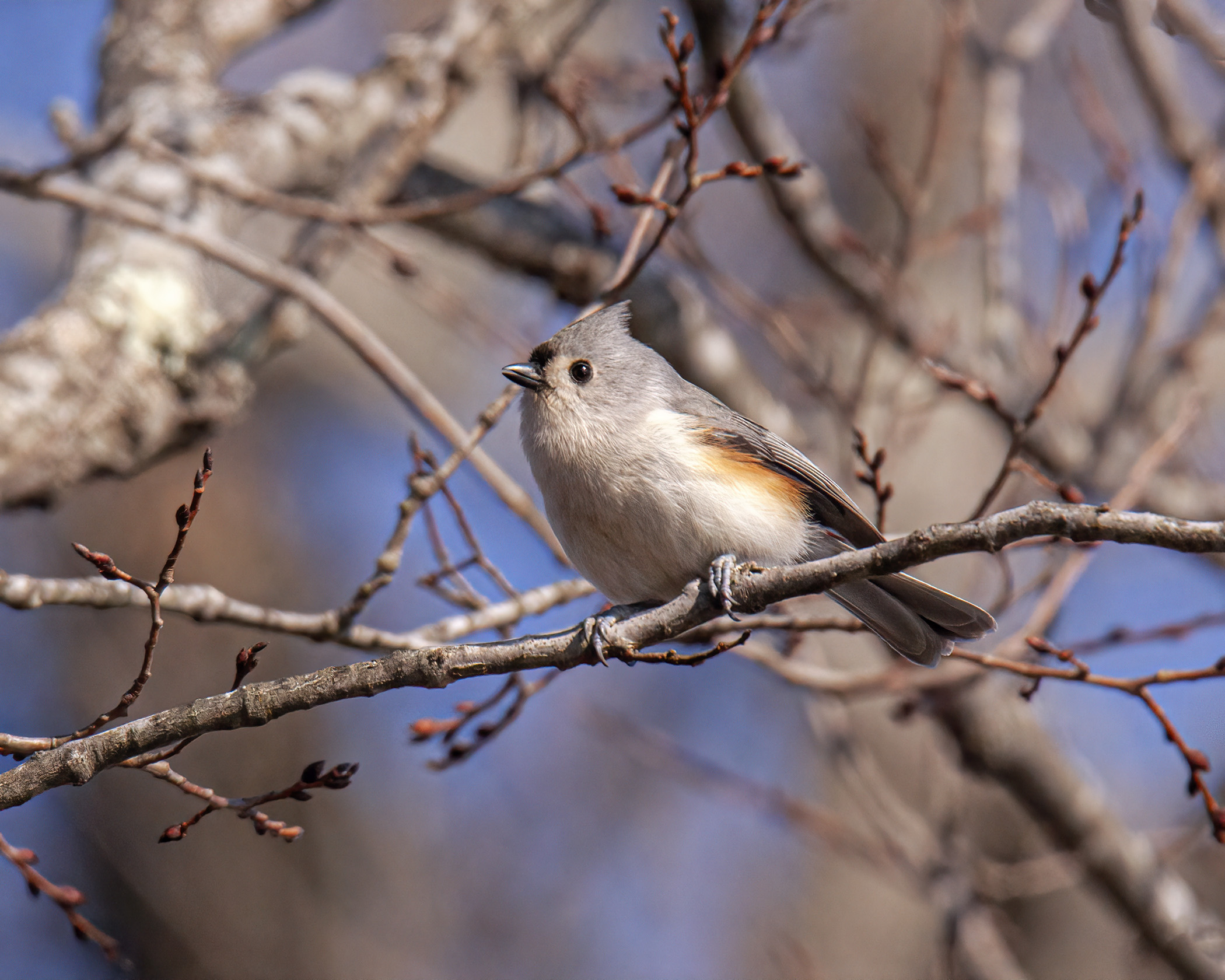
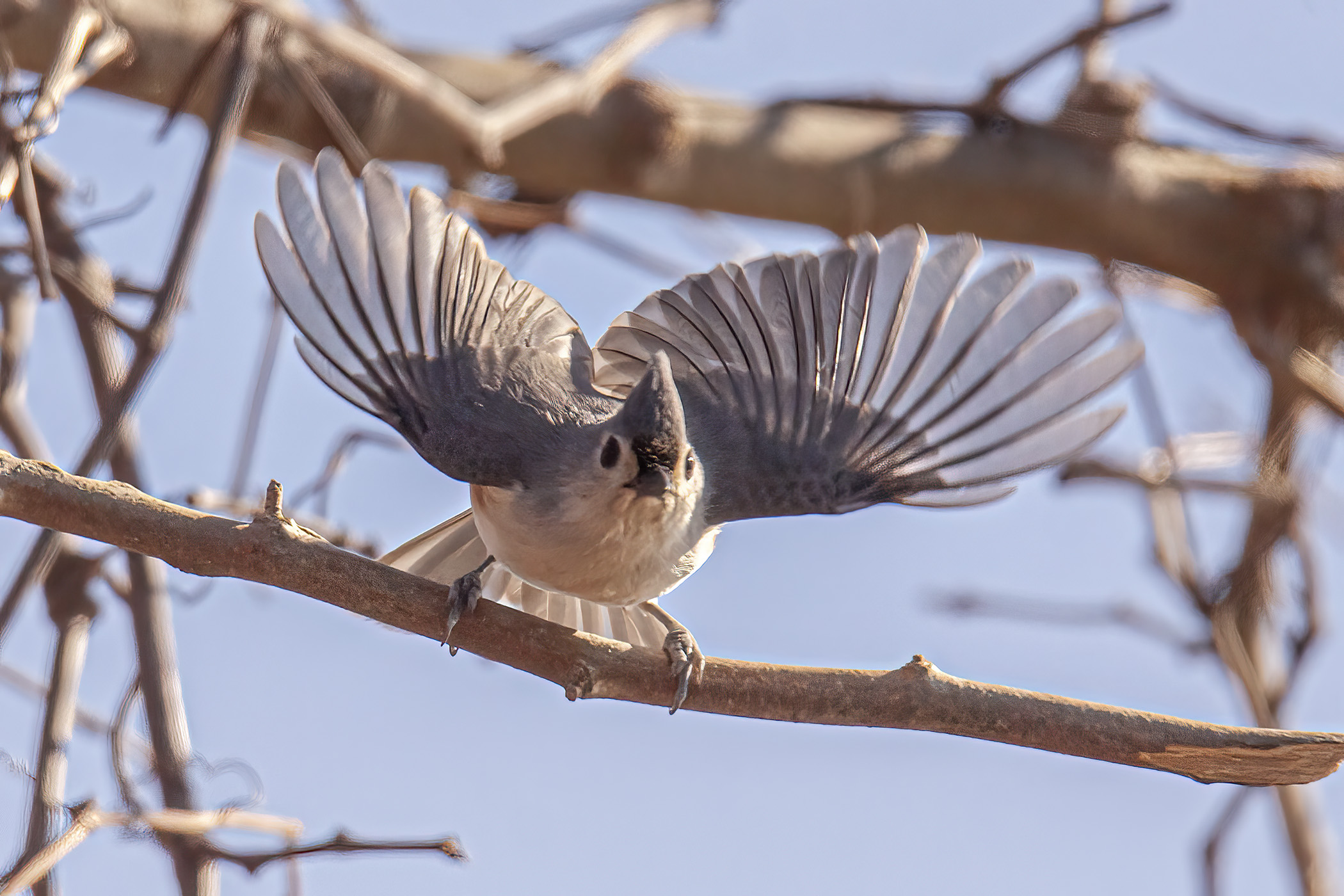
Several noisy Tufted Titmice (Baeolophus bicolor) were frantically foraging in the trees on Wednesday at Occoquan Bay National Wildlife Refuge. I tried to track them as they moved in and out of the branches, but they turned out to be remarkably swift and elusive. However, I am pretty persistent and eventually managed to capture several shots of these little gray birds with their distinctive crests.

The first shot below was a really lucky one. The titmouse had perched momentarily on an exposed branch and I pounced on the opportunity to get a clear shot. Just as I started to click the shutter release, the bird took off. Somehow I captured the moment when the bird’s wings were fully extended, but its feet were still on the branch. The titmouse appeared to be looking right at me in an almost defiant way, as though he were ready to challenge me.

The second shot provides a good look at the beautiful markings of the Tufted Titmouse. You can see its black forehead and the wonderful orangish wash under its wings. I also really like the titmouse’s pensive pose as it turned towards the sun, trying to absorb some of its warmth on a cold winter day.

Tufted Titmouse

Tufted Titmouse

© Michael Q. Powell. All rights reserved.


Read Full Post »

If I had to list my favorite birds, Eastern Bluebirds (Sialia sialis) would certainly be near the top of the list. The color combination of blue and orange is so striking and so beautiful that it delights me every time that I am blessed to spot a bluebird. Without fail, I also recall a comment I received several years ago from a young reader, Benjamin, who noted that the birds had as much orange as blue in their feathers and wondered why they were not called Orange Bluebirds. Why indeed?

I already posted a few bluebird photos from a visit to Occoquan Bay National Wildlife Refuge last week, but decided that there were a few more that I just had to share. When the subjects are this photogenic, it is so much fun to see how many different “looks” I can get by varying my shooting angle and composition. I love how each of these there photos has a distinctively different background and “feel.”

Do you have favorite birds too? It should come as no surprise to those of you who follow this blog regularly, that Bald Eagles are probably at the top of my list.

Eastern Bluebird

Eastern Bluebird

Eastern Bluebird

© Michael Q. Powell. All rights reserved.
Read Full Post »

This cool-looking bird is a female scaup—I love the white stripe on her face and her striking eyes. If I were a bit better at bird identification, I might be able to figure out is she is a Greater Scaup (Aythya marila) or a Lesser Scaup (Aythya affinis). The differences between the two species are pretty subtle, especially when it comes to females, so I will generally identify them simply as “scaups.”

Throughout this month, I have seen quite a few scaups in flocks in the deep waters off of Occoquan Bay National Wildlife Refuge. Scaups are diving ducks and therefore rarely seem to come as close to the shore as dabbling ducks like mallards and pintails. It is therefore quite a challenge to get a detailed shot of a scaup.

On the day when I took this photo, the wind was kicking up and the waters were rough, which slowed down the scaup enough for me to be able to capture this image—I recommend clicking on the image to get a good look at the facial features of this distinctive duck.

scaup

© Michael Q. Powell. All rights reserved.

Read Full Post »

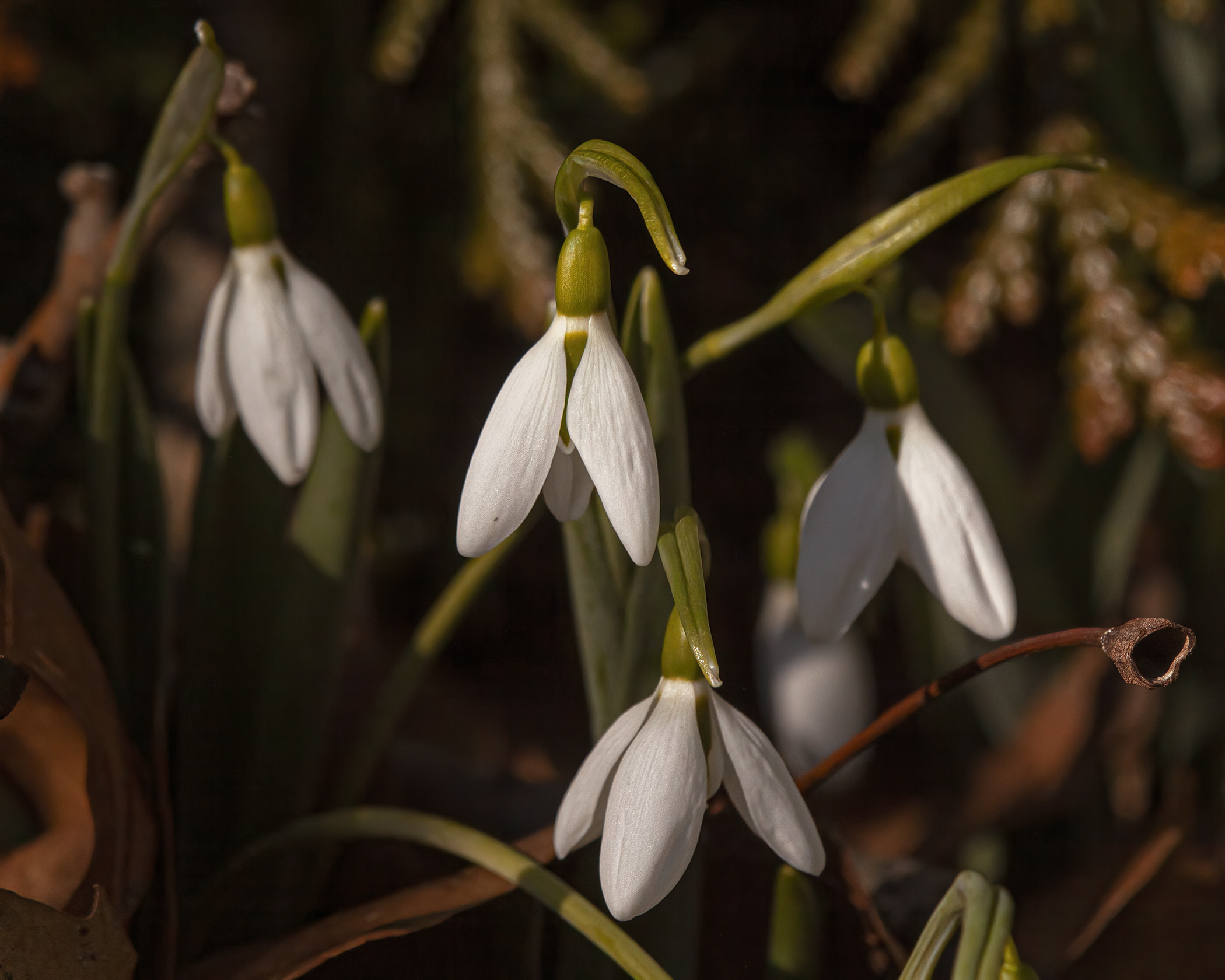
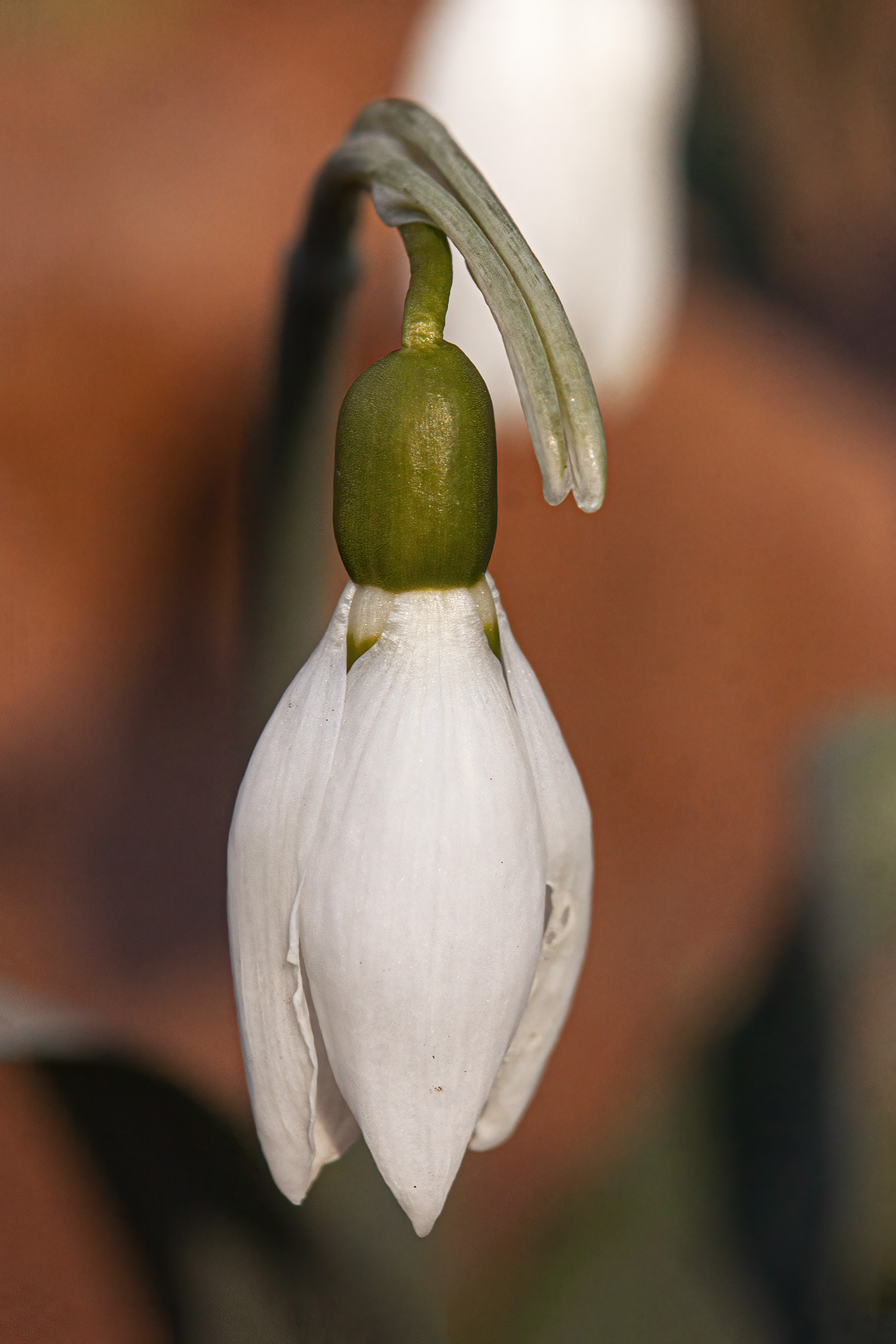
In the deepest darkest days of winter, there is still new growth, like these snowdrop flowers (g. Galanthus) that I spotted yesterday at Green Spring Gardens, a county-run historic garden not far from where I live.

I decided to mix things up a bit and put my macro lens on my camera for the first time in months, hoping that I might find flowers in bloom. What can I possibly find that would be flowering in late January? We have had over a foot (30 cm) of snow already this month and some frigid temperatures, a harsher winter than in recent years. I knew from past experience, though, that there was a good chance that some snowdrop flowers would be in bloom—my challenge was to find them.

I searched in vain in flowerbed after flowerbed, until finally I found several small patches of these pretty white flowers. The words to the song Edelweiss from The Sound of Music, one of my favorite musicals, came to mind. Although edelweiss is a completely different flower, the words of the song seemed to fit my snowdrops so well.

“Every morning you greet me
Small and white, clean and bright
You look happy to meet me
Blossom of snow, may you bloom and grow
Bloom and grow forever.”

snowdrops

snowdrop

snowdrop

© Michael Q. Powell. All rights reserved.

Read Full Post »

Sometimes Bald Eagles (Haliaeetus leucocephalus) will perch out in the open on branches or in prominent trees where they are relatively easy to spot. At other times, though, they perch in the crooks of the trees, almost hidden from view. I encountered these two semi-hidden eagles last Tuesday as I was wandering the trails at Occoquan Bay National Wildlife Refuge.

I really like the contrast between the two expressions and poses of the two eagles. The eagle in the first image seems stern and serious—I don’t think that I would want to mess with him. The eagle in the second image seems almost a little goofy with a whimsical smile and windswept hair—for some reason he reminds me of Big Bird from Sesame Street.

Bald Eagle

Bald Eagle

© Michael Q. Powell. All rights reserved.


Read Full Post »

Quite often my most beautiful photos are of the simplest, most common subjects that I find in nature, like this White-throated Sparrow (Zonotrichia albicollis) that I photographed recently at Occoquan Bay National Wildlife Refuge. The elements of this image—the lighting, the pose, the framing, and the color palette—work together almost perfectly to create a harmonious, warm feeling for me that is hard to describe with words.

It is a bit of a cliché to say that beauty is in the eye of the beholder, but it is nonetheless true. Perhaps you’d dismiss this photo because the main subject is a nondescript little bird or maybe you prefer more colorful images with more “pop.” In my photography I try a variety of approaches to capture the beauty that surrounds us and have varying degrees of success in doing so.

For me, this one image is almost perfect.  There is always the chance, however, that I will be able to capture something even more perfect in my next photos, so I’ll keep trudging on with my camera.

White-throated Sparrow

© Michael Q. Powell. All rights reserved.

Read Full Post »

Have you ever noticed the different ways that birds take to the air? Some of them flap their wings and seem able to almost levitate themselves as they rise vertically. Others make a running start in order to gain additional momentum before they lift off. No matter how they do it, the birds have to coordinate a complex series of small actions by their various body parts for a takeoff to be successful.

On Tuesday I was observing this Northern Flicker (Colaptes auratus) in a tree at Occoquan Bay National Wildlife Refuge, when it decided to depart without warning. Instinctively I pressed the shutter and was able to capture this fun little photo. It looks like the first step in the takeoff process for this flicker was to leap from the branch and then perhaps glide a bit before engaging its wings.

Northern Flickers always fascinate me. I cannot help but marvel at the amazing combination of colors and patterns on the bodies of these woodpeckers whenever I see one.

Have a wonderful weekend.

Northern Flicker

© Michael Q. Powell. All rights reserved.

Read Full Post »

If I am patient and persistent, I can usually end up with pretty good shots of most types of birds that I see. The Belted Kingfisher (Megaceryle alcyon), however, is a notable exception—I only rarely get a clean look at a kingfisher and don’t think that I have ever gotten a close-up shot of one.

Why? Belted Kingfishers are small, fast, and extremely skittish, which makes them remarkably elusive. Most of the time my first indication that a kingfisher is in the area is when I hear its distinctive rattling call as it flies away from me. It sometimes feels like the bird is taunting me. It will often fly only a short distance away, giving me hope that I will be able to creep closer, and then it will fly away again as soon as I start to move.

I have several encounters with a Belted Kingfisher this month and was happy to get this shot recently of a female. You can tell that it is a female because of the chestnut stripe on its breast. Males have only a blue stripe—it is really unusual with bird species to have the female more colorful than the male.

Kingfishers have a very distinctive look with their stocky bodies, large heads and thick, pointed bills. I always enjoy seeing photos of kingfishers from other parts of the world, including the brilliant blue Eurasian Kingfisher, a species that I hope to see in person in the future, when it becomes safe enough to travel internationally again.

Belted Kingfisher

© Michael Q. Powell. All rights reserved.

Read Full Post »

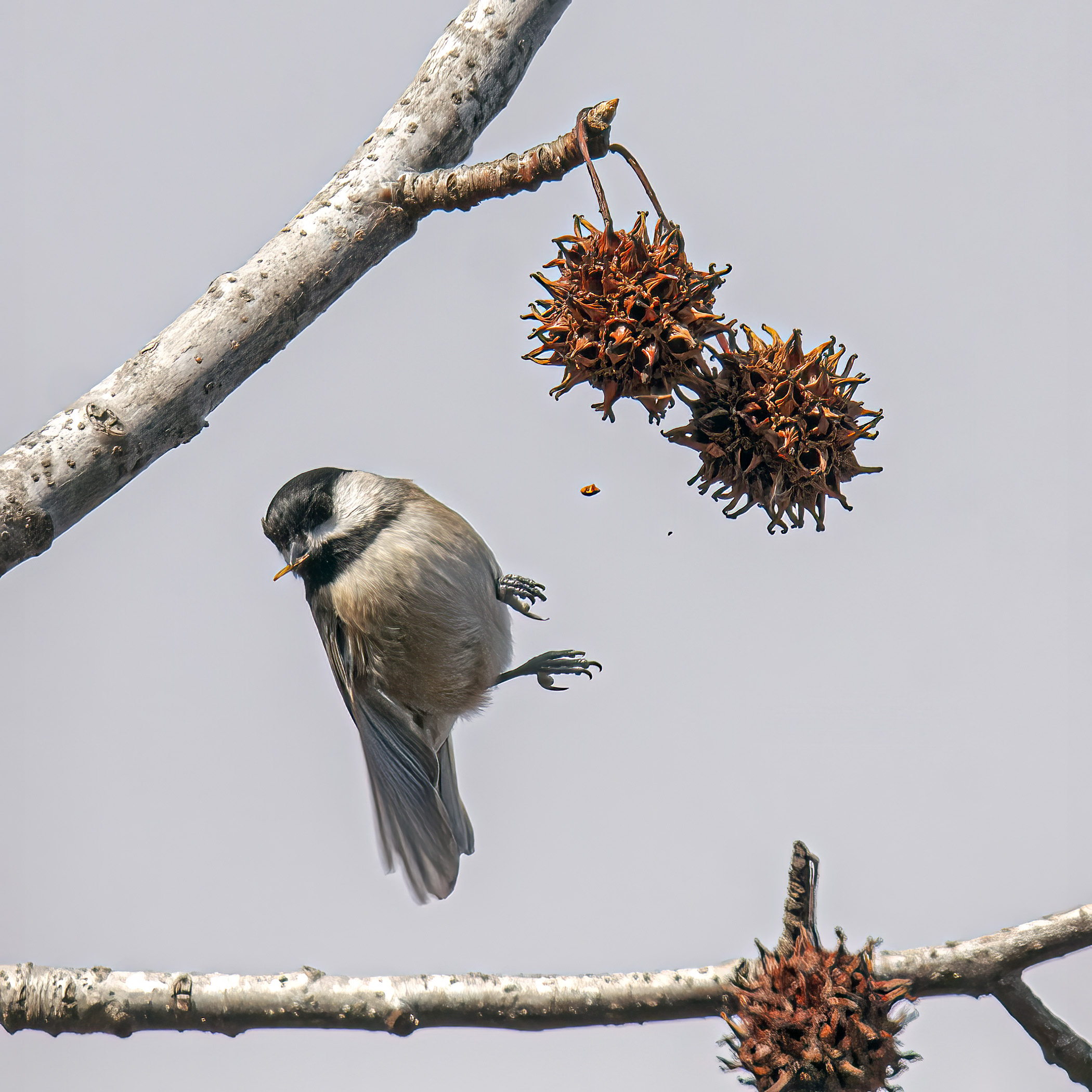
I watched in utter fascination on Tuesday at Occoquan Bay National Wildlife Refuge as this Carolina Chickadee (Poecile carolinensis) worked to extract seeds from the spiky seedpods of a sweetgum tree. The little bird would hang upside down with all of its weight on the stem of the seedpod and poke about with its bill inside the seedpod. Once it had found a seed, the chickadee would yank back its head to extract the seed.

Most of the time the bird would then fly to a nearby branch to consume the seed and then resume the process. Occasionally, though, the momentum generated in extracting the seed caused the chickadee to fall away and momentarily lose its balance and I was lucky enough to capture one such moment in the first image below.

The other two images give you an idea of some of the acrobatic positions used by the chickadee in its foraging. In the final photo, I believe the chickadee was using its extended wings to help stabilize itself as it sought to snag another seed.

It is good to know that there are potential food sources available during the winter for these little birds, but sure looks like the chickadee has to work really hard to gain access to those tiny seeds inside of those spiky gumball.

Carolina Chickadee

Carolina Chickadee

Carolina Chickadee

© Michael Q. Powell. All rights reserved.


Read Full Post »

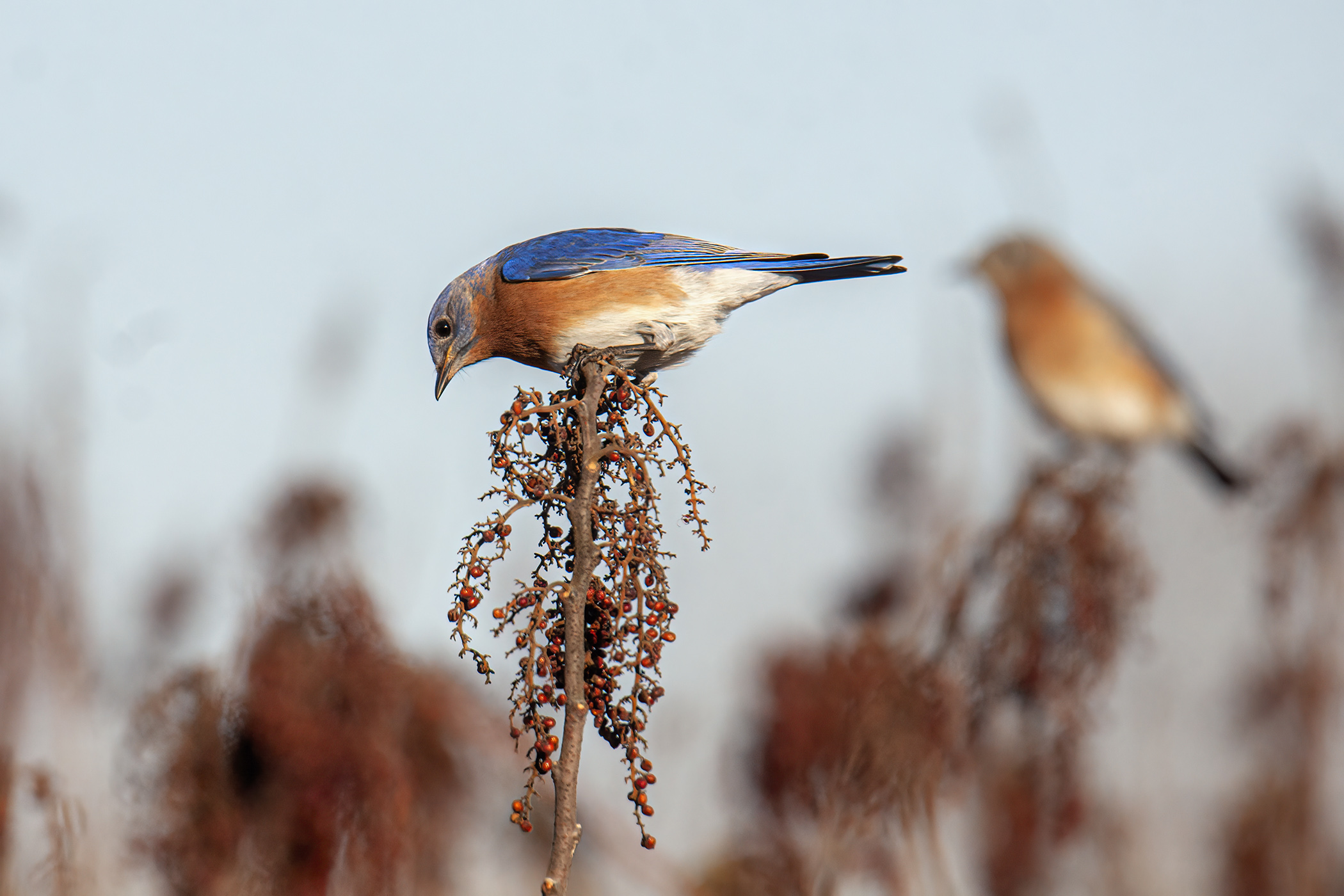
Yesterday I was absolutely delighted to spot a small flock of Eastern Bluebirds (Sialia sialis) at Occoquan Bay National Wildlife Refuge. The bright, cheery blue of their feathers never fails to bring a smile to my face, especially during the long gray days of winter.

The bluebirds spent a lot of their time foraging in a field of what I think is sumac. I may be totally wrong about the plant and would welcome a correction. Whatever the case, the bluebirds really liked it. Most of the time they foraged as individuals or as pair, but occasionally a small group of them would work in the same area, as you can see in the first image.

It was a challenge to photograph these pretty little birds because they were quite a distance away. Most of the time when they bent over to pluck a berry, they disappeared from sight.

On occasion I was able to isolate a bird and create a portrait of the bluebird. The second and third images show two different approaches that I used, with the final shot showing much more of the overall environment rather than the details of the subject. From my perspective, both images work well, albeit in different ways.

Eastern Bluebird

Eastern Bluebird

Eastern Bluebird

© Michael Q. Powell. All rights reserved.


Read Full Post »

This Bald Eagle (Haliaeetus leucocephalus) definitely did not seem to be thrilled with my presence last week at Occoquan Bay National Wildlife Refuge. Despite its looks of disapproval, though, it remained in place for our little portrait session and was still perched when I continued down the trail.

You never know how wildlife will react when they detect your presence. Most often they will crawl, swim, or fly away immediately, because they perceive you as a predator. Occasionally, particularly when they are young, they will look back at you with a mixture of wonder and may even come a little closer. On rare occasions, you seem to come to a silent agreement with your subject to peacefully coexist.

Generally I photograph wildlife subjects from a good distance away (with the notable exception of insects that I like to photograph at close range) and try not to spook them. Sometimes, though, you just can’t help it. This eagle was perched on some branches overhanging the trail that I had to use to get back to where my car was parked—I had to pass right under the perched eagle.

I tried to move slowly and stealthily, but I knew from past experience that an eagle’s eyesight is much keener than mine and its reaction time much quicker—there was no way I was going to pass by unnoticed. As you can undoubtedly tell, I took these shots shooting upwards from almost directly below the eagle. I made small adjustments to my position as I tried to frame the eagle through the branches, but I did not want to scare away the eagle.

As I departed, I was really happy with the encounter and the fact that the eagle was able to retain its chosen spot. The eagle, for its part, was probably equally happy to return to basking in the warmth of the winter sun after being momentarily disturbed by a pesky photographer.


Bald Eagle

Bald Eagle

Bald Eagle

© Michael Q. Powell. All rights reserved.

Read Full Post »

Last Wednesday was a wonderful day for photographing Bald Eagles (Haliaeetus leucocephalus) at Occoquan Bay National Wildlife Refuge. I spotted them at several locations on the refuge and even managed to get a few portrait-style shots in which the eagles look particularly regal and majestic.

Earlier in the day the sun was shining brightly and I had the brilliant blue sky as a backdrop, as you see in the second photo below. However, that eagle was buried a bit in the vegetation and the background is a little more cluttered than I would have preferred. Still, I like the expression on the eagle’s face, the kind of semi-smile that some people make when you ask them to pose.

Later in the day the skies clouded over and the color of the background was much more subdued. Somehow, that seems to fit well with the serious expression on the face of the eagle in the first image. I like too that he was perched on a “snag,” a dead or dying tree that is still standing, so there were no distracting small tree branches.

I am always happy when I manage to see a Bald Eagle, one of the symbols of the United States, and even more thrilled when I can capture images like this one.

bald eagle

Bald Eagle

© Michael Q. Powell. All rights reserved.

Read Full Post »

The Bald Eagles (Haliaeetus leucocephalus) left their big nest at Occoquan Bay National Wildlife Refuge unattended last Wednesday and several Turkey Vultures (Cathartes aura) decided to check it out. I don’t know if the eagles were eating fish in the nest in the past or if the vultures were merely curious.

Later in the day I passed the same nest and both of the eagles were perched near the nest, including the one shown in the second image below. That shot gives you a good sense of how big that nest really is. The eagles have been using it for many years and each year they seem to add on to it. It is so deep now, that it is almost impossible to tell if an eagle is sitting on eggs, but I will be checking periodically for other signs.

Turkey Vultures

eeeagle nest

© Michael Q. Powell. All rights reserved.

Read Full Post »

This Carolina Chickadee (Poecile carolinensis) was busily extracting seeds from the spiky sweetgum seed balls when I spotted it high in a tree on Wednesday at Occoquan Bay National Wildlife Refuge. The chickadee would dangle upside down from the branch to snag a seed with its bill and bring the seed back onto the branch to eat it.

In this image, the chickadee appeared to be eying its next target—the seed ball in the lower left of the shot.

Carolina Chickadee

© Michael Q. Powell. All rights reserved.
Read Full Post »

I spotted Bald Eagle couples (Haliaeetus leucocephalus) near each of the two bald eagle nests at Occoquan Bay National Wildlife Refuge this past week, but I have not yet seen them in the nest itself quite yet. I believe that it is now mating season and it probably will not be long before the eagles start nesting.

This past Wednesday I spotted one of the eagle couples perched on an osprey nesting platform that is not far from one of the eagle nests. This seems to be one of the favorite spots for the eagles to hang out together and I have seen them at this spot multiple times in the past. I was a good distance away from the eagles, but was monitoring them through my telephoto zoom lens.

I sensed that they were getting prepared to take off, so I got ready prepared in case they happened to fly in my direction. I was delighted when they zoomed past me and was even more thrilled when I managed to capture this image with both of the eagles in flight.

It is pretty hard to photograph a bird in flight under the best of circumstance and really difficult when there is more than one bird. I would consider this one to be a successful shot.

Have a wonderful weekend.

Bald Eagles

© Michael Q. Powell. All rights reserved.

Read Full Post »

They made a bit of an odd couple, but this scaup and this Pied-billed Grebe (Podilymbus podiceps) seemed happy together as they paddled around in the waters off of Occoquan Bay National Wildlife Refuge on Monday. I have the distinct impression that birds are increasingly willing to tolerate the presence of other species during the winter months and it is not uncommon for me to spot mixed flocks of birds in the water and on the land.
The Pied-billed Grebe has a very distinctive look and is easy to identify. When it comes to the scaup, however, identification is a bit more problematic, because there are Greater Scaups (Aythya marila) and Lesser Scaups (Aythya affinis). Lesser Scaups are somewhat smaller than Greater Scaups and their heads are shaped differently (the Lesser has a thinner, more peaked head than the Greater Scaup, which has a more round head), but I have never been able to tell the two species apart.
I really like the visual comparison in the photo between the size and shape of the bodies and bills of these two swimming birds as well as their very different coloration. Birds that look different from each other can live together in peace. Why is it that we humans can’t do the same?
odd couple
© Michael Q. Powell. All rights reserved.
Read Full Post »

Does a Ruby-crowned Kinglet (Regulus calendula) have a neck? Many birds look round in the winter, when they fluff up their feathers to retain heat, but that effect is exaggerated with Ruby-crowned Kinglets, because they have really large heads and no visible necks.

All in all the proportions seem all out of whack, giving the bird a cartoonish look. (Speaking of “whack,” I saw a wonderful cartoon recently. It showed an elevator with a sign that said “Out of Whack” with a subheading that added “More whack on order.” Sorry, I should have warned you that I have a warped sense of humor.)

I spotted this tiny little Ruby-crowned Kinglet on Monday as I was exploring Occoquan Bay National Wildlife Refuge. There is still a lot of snow in the untrodden, shaded areas of the refuge and there was a thin coating of ice on some of the ponds. Many birds were active, foraging feverishly in the trees and in the brush. This kinglet was full of nervous energy, constantly in motion, flicking its wings as it darted in and out of the vegetation.

Although the species name includes a ruby crown, that crown is almost always hidden. In the second photo, you can just barely see a little red stripe on the top of the bird’s head. Apparently when an adult male is excited, he flashes his brilliant red crown, but I don’t recall ever having seen anything that dramatic.

Given the modest size of the bird’s “crown” it is no wonder that he is known as a “kinglet”—if he had a more impressive crown, perhaps he would have been called a “king.”

Ruby-crowned Kinglet

Ruby-crowned Kinglet

© Michael Q. Powell. All rights reserved.
Read Full Post »

Desperate times call for desperate measures. I am sure that this Yellow-rumped Warbler (Setophaga coronata) would have preferred to find the juicy insects on which it gorges during warmer weather, but they are off the menu for the season. Instead, like many other birds, this warbler has to settle for whatever berries it can find during the winter.

In this case, even the poison ivy berries seemed to be picked over, with only a few wizen berries remaining. The warbler had to work had to snag those berries, using all of its acrobatic prowess. Momentarily satisfied it moved on, hoping perhaps that the pickings would not be so slim at its next stop.

I am always shocked to see any warblers in the winter. Most warblers pass through our area during the spring and the autumn, but Yellow-rumped Warblers hang around for most of the winter. According to the Cornell Lab of Ornithology website:

“Yellow-rumped Warblers are perhaps the most versatile foragers of all warblers. They’re the warbler you’re most likely to see fluttering out from a tree to catch a flying insect, and they’re also quick to switch over to eating berries in fall. Other places Yellow-rumped Warblers have been spotted foraging include picking at insects on washed-up seaweed at the beach, skimming insects from the surface of rivers and the ocean, picking them out of spiderwebs, and grabbing them off piles of manure.”

In addition to its versatility in foraging, the Yellow-rumped Warbler has an amazingly robust digestive system. “The Yellow-rumped Warbler is the only warbler able to digest the waxes found in bayberries and wax myrtles. Its ability to use these fruits allows it to winter farther north than other warblers, sometimes as far north as Newfoundland.”

We may complain about poison ivy when we encounter it during the summer, but its berries serve as an important food source for birds like this Yellow-rumped Warbler that help them to survive the winter. Are you willing to put up with some minor inconvenience for the sake of these beautiful little creatures with whom we share this planet?

Yellow-rumped Warbler

Yellow-rumped Warblers

© Michael Q. Powell. All rights reserved.

Read Full Post »

Did you know that woodpeckers have tongues? They use their long sticky tongues to probe the holes they peck for grubs or other small insects. Last Thursday at Occoquan Bay National Wildlife Refuge, I observed a Downy Woodpecker (Picoides pubescens) pecking away feverishly and was delighted when reviewing my photos to see that I had gotten some shots of its tongue at work. You can see the tongue clearly in the first photo below, though you may need to zoom in to do so.

As I was doing a little research, I came across a fascinating article by Rebecca Heisman on the American Bird Conservancy website entitled “The Amazing Secrets of Woodpecker Tongues.” The article explained the anatomy and function of a woodpecker’s tongue in a way that was both understandable and fun. For example, when talking about the length of a woodpecker’s tongue, it stated:

“The total length of a woodpecker tongue can be up to a third of the bird’s total body length, although the exact proportions vary from species to species. This includes both the part that sticks out past the end of the beak, and the part that stays anchored in the head. If our tongues were the same proportion, they would be around two feet long!”

So where does the tongue go when it is not in use? The tongue is retracted behind the skull and helps to protect the woodpecker’s brain when it is hammering away at a tree. Wow!

There are so many cool things to learn about nature—I often feel like I am only beginning to scratch the surface of a whole range of secrets that are waiting to be revealed to me as I explore more and more.

Downy Woodpecker

Downy Woodpecker

© Michael Q. Powell. All rights reserved.
Read Full Post »

Do Great Blue Herons (Ardea herodias) have long necks? If you looked at the first image, you undoubtedly would respond that they most certainly do. If you looked at the second image, though, you might hesitate in responding to my question.

Where does the neck go? In the first photo, the heron seems to have a neck-to-body ration relatively equivalent to that of a giraffe, but a giraffe, as far as I know, is not able to retract its neck the way that the heron can.

I sometimes imagine that a heron can contract its neck like the Slinky that I remember from my childhood. You could stretch out its coils a long way and it would return to its original shape. On a side note, my favorite “trick” was getting the Slinky to walk down a set of stairs.

I do not know heron physiology very well, but I think the heron’s neck is flexible enough that it can pull the neck into a tight S-curve against its body. From certain angles, it looks like the heron’s neck has gotten considerably shorter when it does this.

So what about you? Are you willing to stick out your neck when something grabs your attention or do you tend to hunker down and move slowly and cautiously forward? It is a good question to ask yourself as we begin a new year, full of new opportunities and possibilities. How bold or fearful do you feel?

Great Blue Heron

Great Blue Heron

© Michael Q. Powell. All rights reserved.
 

Read Full Post »

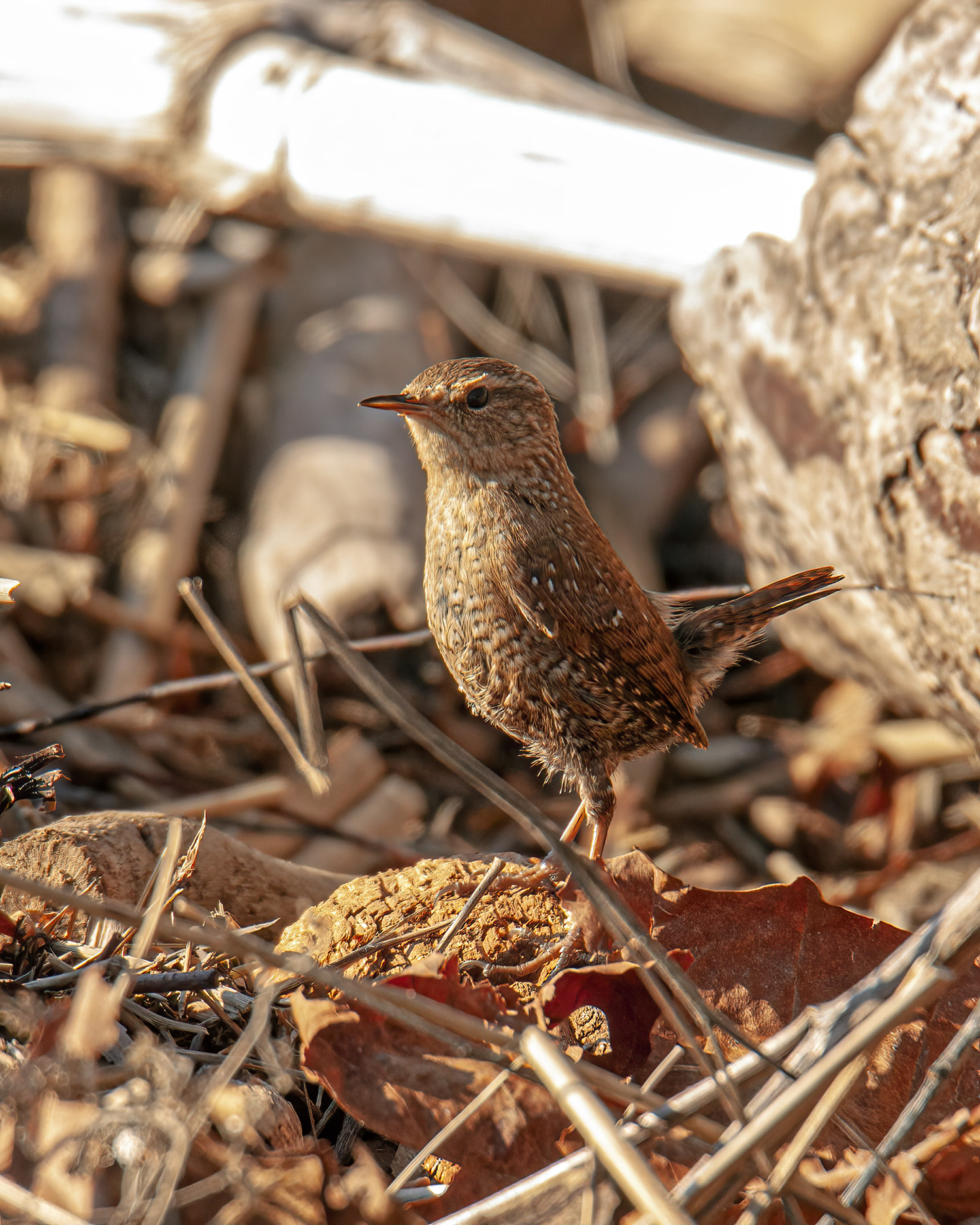
I used to think that all sparrows looked alike and would dismiss them all as nondescript little brown birds. Over time I have started to be able the differences among several sparrow species.

When I spotted this sparrow on Thursday at Occoquan Bay National Wildlife Refuge, I could tell it was not one of the ones that I am used to seeing. Its rounded head, pinkish bill, and white eye ring gave it an unusual look that I had never seen before. As is usually the case, I did not think a lot about identifying this little bird while I was out in the field.

Upon returning home, however, I went through my bird identification book and decided that it looked like it might be a Field Sparrow (Spizella pusilla). I posted the image in a birding forum on Facebook and several experts there confirmed my initial identification. 

Most of the sparrows that I saw that day were White-throated Sparrows and Song Sparrows. I was intrigued to read on the Cornell Lab of Ornithology website that Field Sparrows are be found in mixed flocks with these other sparrow species during the winter—it pays dividends to look carefully at all individuals when you see a group of birds as there may be some surprises, as was the case for this Field Sparrow, which was a new bird for me.

“In winter, Field Sparrows may form mixed feeding flocks with other species, including White-throated and Song Sparrows. Smaller and less aggressive than other sparrows, Field Sparrows are usually at the bottom of the dominance hierarchy in these mixed flocks. Their subordinate role means that they may have to take extra risks to gain access to food, such as returning to a feeding site first after a predator has flushed the flock.”

Field Sparrow

© Michael Q. Powell. All rights reserved.
Read Full Post »

« Newer Posts - Older Posts »