Feeds:
Posts
Comments

Archive for the ‘Bugs’ Category

This evening I spotted something unusual hanging from a lavender plant in my neighbor’s garden. I like to visit her garden when I come home from work in the evening because there are always flowers and insects to photograph, many of which she photographs and features in her blog.

The strange object looked a little like a misshapen pine cone and seemed to be covered in pine needles and little twigs. It was hanging from the lavender plant, swinging in the gentle breeze.

Suddenly in front of my eyes the “pine cone” thing began to shake a little, an opening appeared in the top, and a caterpillar (I think that’s what it is) began to emerge. Fortunately I had my camera in my hand because I had been taking some shots of bees.

The caterpillar emerged only partially and then returned to the homemade structure. The opening closed shut, leaving no evidence that there was a living creature inside.

My preliminary research suggests this is a kind of bagworm, although it seems a little unusual for it to make its home on a lavender plant. Wikipedia indicates that there are many species of bagworms, including one whose pupae are collected as a protein-rich food.

I don’t know if you noticed the claws on this caterpillar in the close-up photograph, but I may now have nightmares about giant clawed caterpillars (to go along with the soul-sucking robber flies of a few days ago).

Close-up of bagworm caterpillar emerging

Stepping back to see the whole “bag”

Caterpillar has gone back inside

© Michael Q. Powell. All rights reserved.

Read Full Post »

This butterfly looks so drab until he opens his wings and reveals his hidden beauty. It was there all the time but we couldn’t see it.

I haven’t been able to identify this butterfly that I photographed this past weekend in a meadow in Massachusetts but like the way the shot turned out.

UPDATE: I am now pretty sure this butterfly is a Common Wood Nymph (Cercyonis pegala).  Check out the Butterflies and Moths of North America website for additional details.

How much beauty do we miss each day because we fail to see past the ordinary exteriors of things (and people) in our lives and neglect to look more deeply?

© Michael Q. Powell. All rights reserved.
Read Full Post »

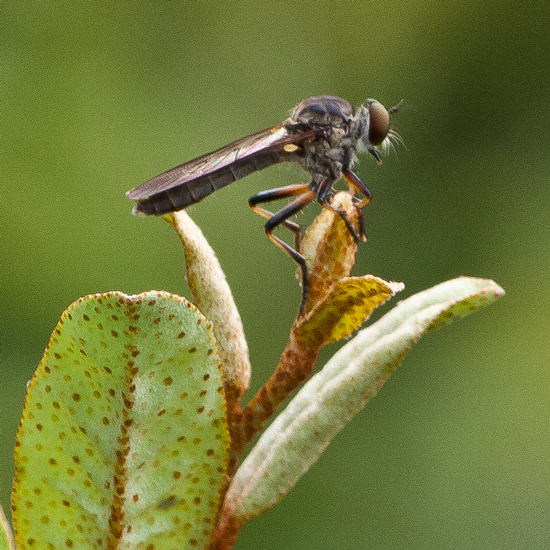
My eyes were so attuned to dragonflies yesterday that my first thought when I stumbled upon this insect perched at the top of a plant was that it was a tiny dragonfly. The pose especially looked familiar.

The more I looked at it, however, the more I realized that the legs and winds were all wrong and the head, which in this profile shot looks a bit like a dragonfly’s, was really different. From another angle it sort of looked like a fly, but not any fly that I had ever seen. What is it?

I think that what I have here is a robber fly (from the insect family Asilidae). So far I have not been able to get any more precise in identifying this guy’s species. The description of robber flies in Wikipedia, however, is pretty. scarey.

“The short, strong proboscis is used to stab and inject victims with saliva containing neurotoxic and proteolytic enzymes which paralyze and digest the insides; the fly then sucks the liquefied meal through the proboscis.”

Yikes! That description alone is enough to bring back flashbacks of alien movies and zombie thrillers.

I may not sleep well tonight.

© Michael Q. Powell. All rights reserved.

Read Full Post »

A flash of emerald green whizzed past my eyes as I was walking in a meadow near my hotel in Massachusetts. What could it be? I waited a few minutes and recognized the familiar flight patterns of a dragonfly.

Most of the dragonflies that I see are drab by comparison with this one that is almost tropical in the brightness of its color. I am pretty sure this is a female Eastern Pondhawk (Erythemis simplicicollis). For more details about this dragonfly check out BugGuide.

Female Eastern Pondhawk

I stayed for a while longer in the meadow to see what else might appear and was pleased when a pretty bluish-green dragonfly flew into view. At first I thought it was a Blue Dasher but after examining him more closely I realized he was a different type.  I think he is a male Eastern Pondhawk (Erythemis simplicicollis).

Male Eastern Pondhawk

© Michael Q. Powell. All rights reserved.

Read Full Post »

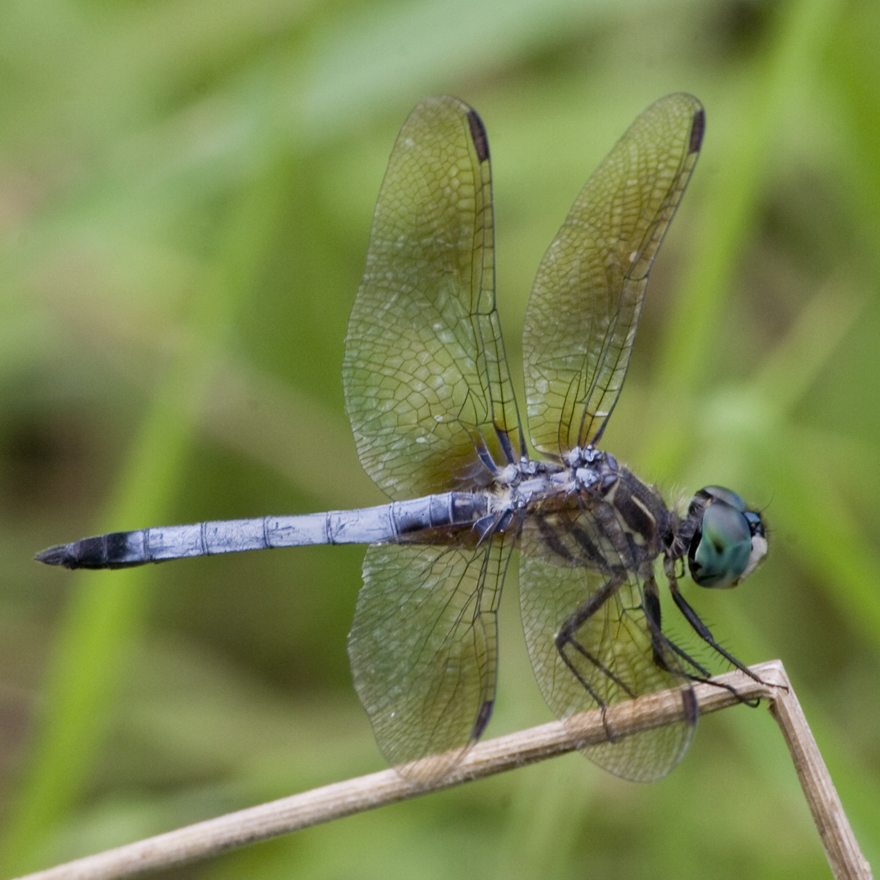
Perhaps I am going through a blue period for my favorite members of the Odonata family this weekend (one damselfly and two dragonflies) all turned out to be different shades of blue. I photographed the dragonflies in a marshy area where I expected to find them. I didn’t at all expect to see the damselfly in a garden setting but was able to get a shot when my friend Cindy Dyer pointed her out to me. (I’m calling the damselfly a “her” because it seems strange for me to refer to anything with “damsel” in its name as a “him.”)

It’s easy for me to identify the dragonfly in the middle as a Blue Dasher but I have not yet been able to identify the other two insects by name.

For now they will have to remain strangers, nameless but beautiful.

© Michael Q. Powell. All rights reserved.

Read Full Post »

What do you want to emphasize in a photograph that you display to others? It is a creative choice that each of us faces every time we take a photo or manipulate an image.

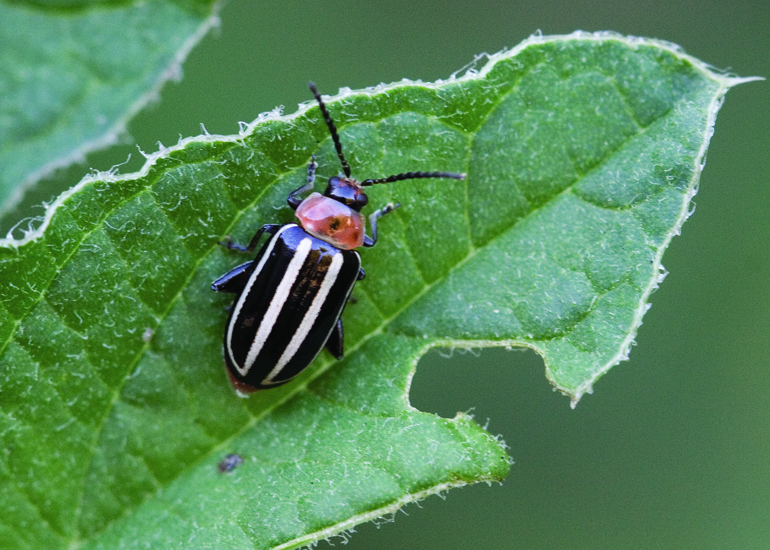
I enjoy shooting subjects with friends and comparing our results. Earlier in the week I was with Cindy Dyer, my photography mentor, and spotted an interesting looking little beetle on a plant in her garden. I did not have my macro lens on my camera and suggested that she photograph the little striped beetle, a type she had never previously encountered. She later identified the beetle as a Striped Cucumber beetle (Acalymma vittata).

Cindy took a wonderful photo of the beetle staring over the edge of a leaf and entitled her posting “The Abyss.” Her photo is graphic and colorful and full of a sense of mystery and contemplation. I took some photos this evening of what is possibly the same beetle. I tried to convey the same impression that Cindy did in my second photo below, but that was not really what I wanted to stress. This first photo shows my “take” on the subject.

I decided that I wanted to contrast the beauty of the beetle with its destructiveness and chose to include the damaged leaf in the initial photo that is most prominently featured on the blog. The rest of the photos are variations of the themes of beauty and destruction, sometimes depicting only one of the two themes or juxtaposing them both in a single frame.

Our choices influence how our viewers are likely to react to our photos.  It is liberating to have that kind of creative freedom. It is who we are and what we do.

© Michael Q. Powell. All rights reserved.
Read Full Post »

Let me begin with a disclaimer—no actual stabbing of bugs took place in the making of this posting. Believe it or not, this bug really is called the Twice-stabbed Stink Bug (Cosmopepla lintneriana). Why? The namer of bugs (whoever that is) decided the two red spots on the bug’s back look like stab wounds.

Yesterday I spotted this little bug while photographing with my friend and photo mentor Cindy Dyer. Cindy has a wonderful posting with a sharper photo of this specific bug and some fun information about him, including the fact that he is also known as the Wee Harlequin Bug. For additional information on the bug, check out his page at Bugguide.

I like the overall effect of this photo, acknowledging that it is far from perfect technically. I’m looking forward to improving my skills as I practice and learn new techniques.

© Michael Q. Powell. All rights reserved.

Read Full Post »

It’s pretty cool to photograph big, gaudy butterflies but today I photographed the smallest butterfly I’ve ever seen. I was shooting photos with my mentor Cindy D. and her husband when Cindy spotted this little guy. He seemed too small to make a good photo and they needed to leave.

Undeterred I lay on my stomach and got as close as my lens would permit me (I did not have time to switch to my macro lens and had to make do with the 18-55mm kit lens that happened to be on the camera). To give you an idea of his size, note that he is perched on a single clover flower.

I’m pretty happy with the result and hope eventually to figure out what kind of butterfly he is. For now, though, I am content to have gotten this shot.

Image

Tiny butterfly on a clover flower

© Michael Q. Powell. All rights reserved.
Read Full Post »

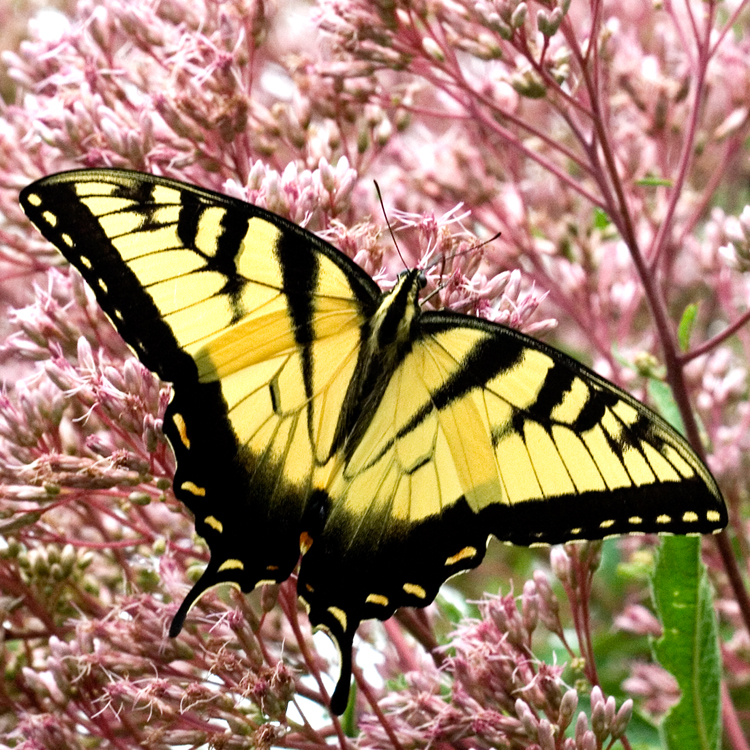
I haven’t seen too many butterflies yet this season so I was happy yesterday to encounter several Eastern Tiger Swallowtail (Papilio glaucus) butterflies at a local garden. The few that I have seen during the past few weeks have been pretty damaged but the male I photographed was in great condition. The female had some damage to one of her “tails” but otherwise was almost perfect.

Eastern Tiger Swallowtail male in perfect condition

Eastern Tiger Swallowtail female with damaged tail

© Michael Q. Powell. All rights reserved.

Read Full Post »

What do bees do when it’s raining? I never really gave the question much thought until this morning when I saw a really cool photo by the unUrban Studio showing a bee seeking shelter in an orchid in an early morning rain. In an earlier post today I showed a bee clinging to the underside of a leaf for protection from the rain.

During a walk in the light rain this afternoon I was pleased to also discover the bee shown below, sheltered inside of a red hibiscus flower. He appeared to be completely protected and may have been napping. As you can probably tell, I had to lighten the image a little to reveal the bee more clearly. This caused the sky, which was light already, to go totally white and produced an effect that I really like.

I enjoy walking in the rain and sometimes carry my camera under an umbrella if it is not raining too hard. From now on I’ll make a point of peeking into flowers and under leaves to discover more secret hiding places of the bees.

© Michael Q. Powell. All rights reserved.

Read Full Post »

What do bees do when it’s raining? I never really gave the question much thought until this morning when I saw a really cool photo by the unUrban Studio showing a bee seeking shelter in an orchid in an early morning rain.

When I took a walk in the light rain earlier this afternoon I decided to look carefully to see if I too could find bees hiding from the rain. Much to my surprise I found the bee shown below, clinging to the underside of a leaf. Apparently it protects him pretty well, though you can see a couple of drops of water on his lower body. The moisture also seems to have caused his hair to frizz a little.

I remember when I too had hair that frizzed when it was humid but those days, alas, are long gone (as is my hair).

© Michael Q. Powell. All rights reserved.

Read Full Post »

One of my earlier post identified my obsession with the red milkweed beetle (Tetraopes tetrophthalmus). As I hang around the milkweed plants, it’s hard not to notice another really colorful creature, especially because this seems to be its prime mating season. After a little research I’ve started to become better acquainted with the large milkweed bug (Oncopeltus fasciatus). Wikipedia provided me with some good information to start and BugGuide added some additional details. I am still getting used to shooting with my macro lens so I apologize in advance that not all of the photos are super sharp. I think they help, though, in explaining some of the traits of these fascinating bugs.

It has been relatively easy to get shots of the mating milkweed bugs and my research identified why. Milkweed bugs while mating can remain connected for up to 10 hours, according to Wikipedia. Yikes! I guess those television commercials about seeing your doctor after four hours don’t apply to these bugs.

What happens after mating? An article from the Life Sciences Depart at the University of Illinois at Urbana noted that a female lays about 30 eggs a day and 2,000 during her lifetime. Egg-laying begins 1 to 15 days after mating and peaks at about 20 days.

A few days ago I came across this group of milkweed bugs. The photo is technically lacking (it was hard to get the needed depth of field) but it gives you an idea of what the large milkweed bug looks like in various stages of development. As a “true” bug, milkweed bugs undergo incomplete metamorphosis. They go through a series of nymph stages, known as instars. For the large milkweed bug there are five instars. Buzzle has an article that explains the bug’s life cycle.

At each stage the bug is covered by an inflexible exoskeleton that constrains its growth. Periodically he bursts out of the exoskeleton and can grow to twice his size in minutes as the new exoskeleton develops and hardens, according to the Buzzle article. Here’s a shot of a bug in one of the earlier nymph stages.

As the milkweed bugs get older the wing pads increase in size in each molt. In the next three photos the wing pads are visible but not yet really prominent.

The wings on this nymph are much more prominent, leading me to think he might almost be an adult. The Buzzle article noted that the entire process of metamorphosis, from egg to adult takes 4-8 weeks, depending on the temperature of the habitat.

Once the large milkweed bug has become and adult (as shown in the last couple of photos) mating begins 5 to 12 days after the last molt for females and two to three days for males, according to the University of Illinois article. And the circle of life continues.

© Michael Q. Powell. All rights reserved.

Read Full Post »

« Newer Posts