Feeds:
Posts
Comments

Archive for the ‘Birds’ Category

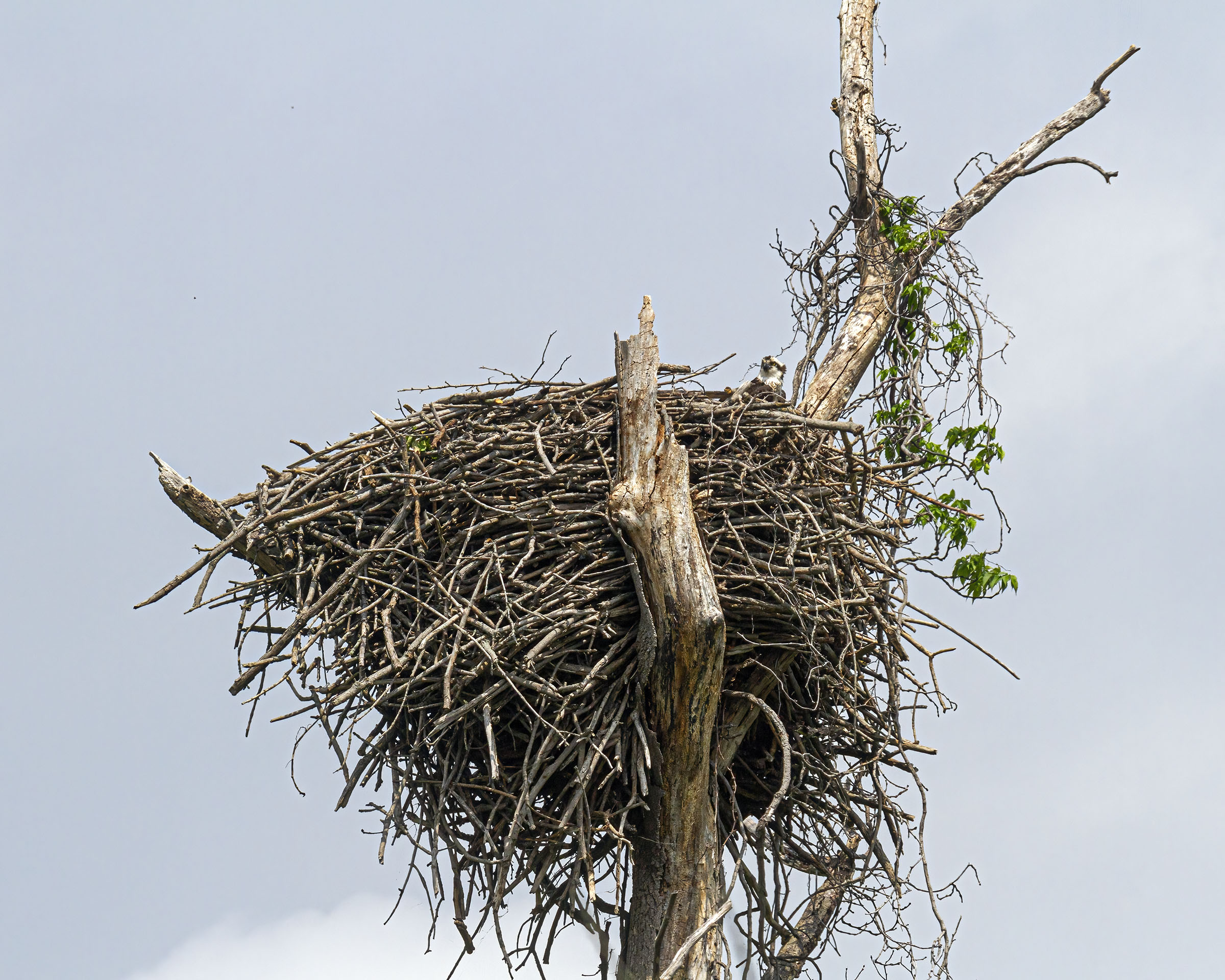
There is one extremely large eagle nest (plus one or two smaller ones) that I monitor each year at Occoquan Bay National Wildlife Refuge. Earlier this year I spotted a lot of eagle activity around that nest and I assumed that the eagles would be nesting in it.

However, recently both members of an eagle couple were spotted on the outside of the nest and ospreys began to display a lot of interest in the nest. I assume that means that the eagles were not successful in incubating eggs, but I do not know for sure what happened.

Last week I photographed an osprey in the nest and captured a few shots of it. The osprey looks absolutely tiny in the nest and the nest is far larger than the typical ones that osprey use.

I will continue to keep an eye on the nest and see if I eventually see some baby ospreys there. The big challenge is that the nest is so large and deep that osprey (or eagles) are not visible when they are sitting on eggs.

osprey


osprey

© Michael Q. Powell. All rights reserved.

Read Full Post »

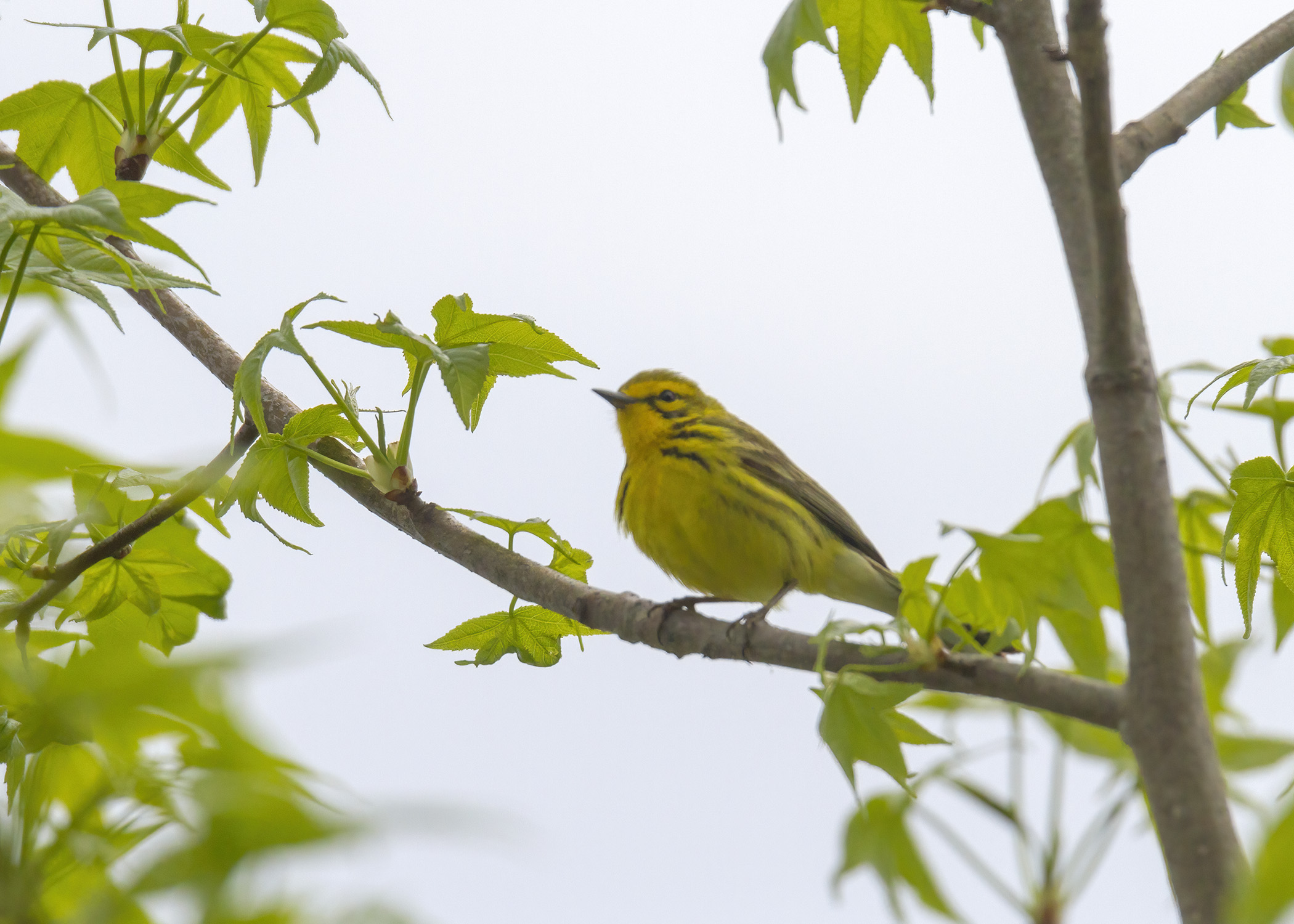
This male Prairie Warbler (Setophaga discolor) was signing loudly and proudly when I captured this image on Thursday at Occoquan Bay National Wildlife Refuge. I just love the way the little bird tilts back his head and sings with all of his might, seemingly putting his entire body into the effort.

Prairie Warbler

Prairie Warbler

© Michael Q. Powell. All rights reserved.

Read Full Post »

I was absolutely thrilled to capture some shots of this White-eyed Vireo (Vireo griseus) on Thursday at Occoquan Bay National Wildlife Refuge. It was a cloudy, overcast day and it seemed like the vireo was mostly in the shadows, which caused the first and last images to look a bit drab. Fortunately, though, I was able to catch the bird mid-song in the first shot, which definitely added some visual interest.

In many ways the second shot is my favorite of this set, even though the body of the vireo is partially blocked by the foliage. Somehow the colors in this image seem brighter and more true to life. In all of the shots, I really like the way that the light eyes of the subject pop, giving the vireo a very distinctive look.

White-eyed Vireo

White-eyed Vireo

White-eyed Vireo

© Michael Q. Powell. All rights reserved.

Read Full Post »

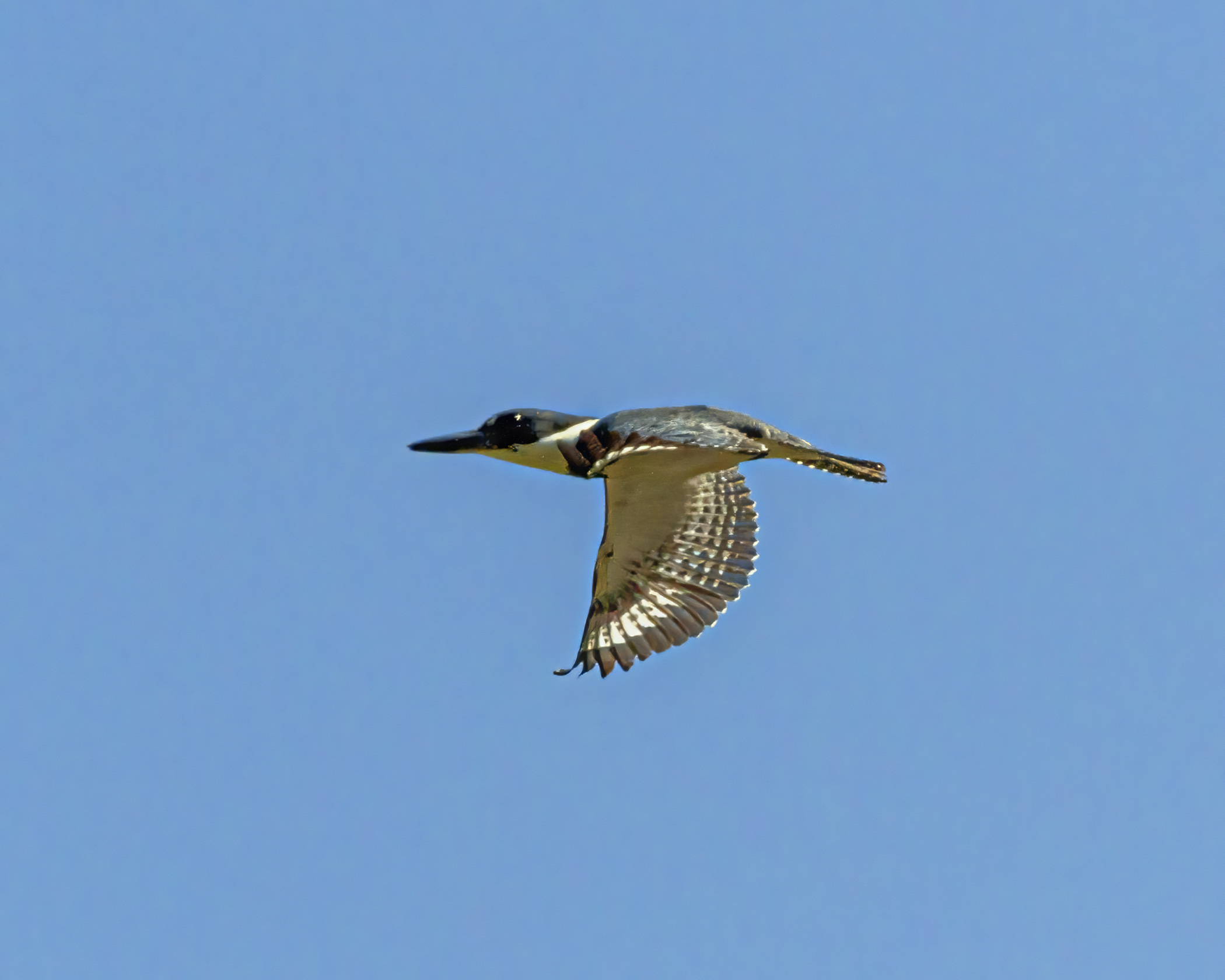
On Monday at Occoquan Regional Park, I was thrilled to capture some shots of this male Belted Kingfisher (Megaceryle alcyon) as he flew by me overhead. Kingfishers are really skittish and quite often I am aware of their presence of these speedy little birds when I hear their rattling call as they fly away from me. This kingfisher, however, flew across my field of view, which allowed me to track it and focus on it as it passed.

How do I know this is a male kingfisher? Normally male birds are more colorful than their female counterparts, but that is not true for Belted Kingfishers—females have a chestnut-colored band across their chests that the males do not have.

Belted Kingfisher

Belted Kingfisher

© Michael Q. Powell. All rights reserved.

Read Full Post »

I spotted these cool-looking ducks last week in the waters off of Occoquan Bay National Wildlife Refuge. Some research and help for on-line experts helped me determine that these are Red-breasted Mergansers (Mergus serrator), a duck species that I do not see very often. I really like the spiky hairdos and long bills of these ducks that give them a distinctive punk vibe. I kept hoping that they would swim closer to shore, but, alas, they drifted farther and farther away, so I could not capture any close-up images.

Red-breasted Merganser

Red-breasted Merganser

© Michael Q. Powell. All rights reserved.

Read Full Post »

An Osprey (Pandion haliaetus) raised a wing as it flew by me on Monday at Occoquan Bay National Wildlife Refuge, displaying the fish that it had just caught. There are quite a few osprey at the refuge at this time of the year and it is not uncommon for me to see one clutching an osprey in its talons. However, it is rare that I am able to get a good look at the prey, because it is often hidden by the osprey’s wing movements.

Normally I attempt to capture shots of birds in flight with my longest lens, a Tamron 150-600mm. At this time of the year, though, I am just as likely to want to photograph butterflies and dragonflies as birds, so most of the time I keep my Tamron 18-400mm lens on my camera that lets me focus on a much closer subject. I sacrifice a bit of reach by using this lens, but, as you can see in the image of the osprey captured with this lens, it can produce good results even when fully extended. I encourage you to click on the image to see the feather details of the osprey and the details of the hapless fish too.

osprey

© Michael Q. Powell. All rights reserved.

Read Full Post »

As many of you know, I keep an eye on several eagle nests at Occoquan Bay National Wildlife Refuge at this time of the year, waiting with hopeful expectation for the birth of new eaglets. In one nest that is relatively small, the adult Bald Eagle (Haliaeetus leucocephalus) is now sitting upright, rather than hunkering down over the eggs to keep them warm. I suspect that there is at least one eagle baby, but I have not yet seen any tiny eagle heads pop up over the edge of the nest.

I am not sure what’s happening with the much larger eagle nest. I had assumed that the eagles were sitting on eggs. However, on Tuesday I watched as an osprey perched on one of the trees supporting the nest and buzzed a nearby perched eagle. Several other photographers have reported seeing osprey actually sitting in the eagle nest.

As I observed the nesting area on Tuesday afternoon, two eagles in a tree overlooking the nest briefly engaged in what looked like mating behavior. Was an earlier nesting attempt unsuccessful? Are the eagles going to make another attempt to have babies this season?

It is a bit late in the year for the eagles to begin nesting, but I think there is still time for them to do so. Normally this process begins earlier in the year before the ospreys have returned, so there is no competition for the nest. Although there appears to be competition now, I would put my money on the eagles, which I believe are larger and stronger than the osprey.

I will continue to monitor the nesting situation. There may be more drama there this spring than in previous years.

Bald Eagle

© Michael Q. Powell. All rights reserved.


Read Full Post »
Each spring a lot of colorful warblers pass through our area on their northward migration. Most of them stay for only a short time, so it is a hit-or-miss proposition for me to find them. This is also the time of the year when the trees are budding, flowering and pushing out new leaves. All of this new growth is beautiful, but it makes it even harder for me to spot the little birds as they flit about, often at the tops of the trees.

Yesterday I was thrilled to spot this Yellow-throated Warbler (Setophaga dominica) high in a distant tree at Occoquan Bay National Wildlife Refuge. Initially my view of the colorful little bird was blocked by the vegetation, but I bent, twisted, stretched, and leaned in all directions and was eventually was able to get a clear view of the warbler.

My eyes are really active during the spring as I look up to try to find birds and look down to search for dragonflies. I manage to observe lots of cool things, but suspect that there is so much more going on that I do not see or notice.

Yellow-throated Warbler

© Michael Q. Powell. All rights reserved.


Read Full Post »
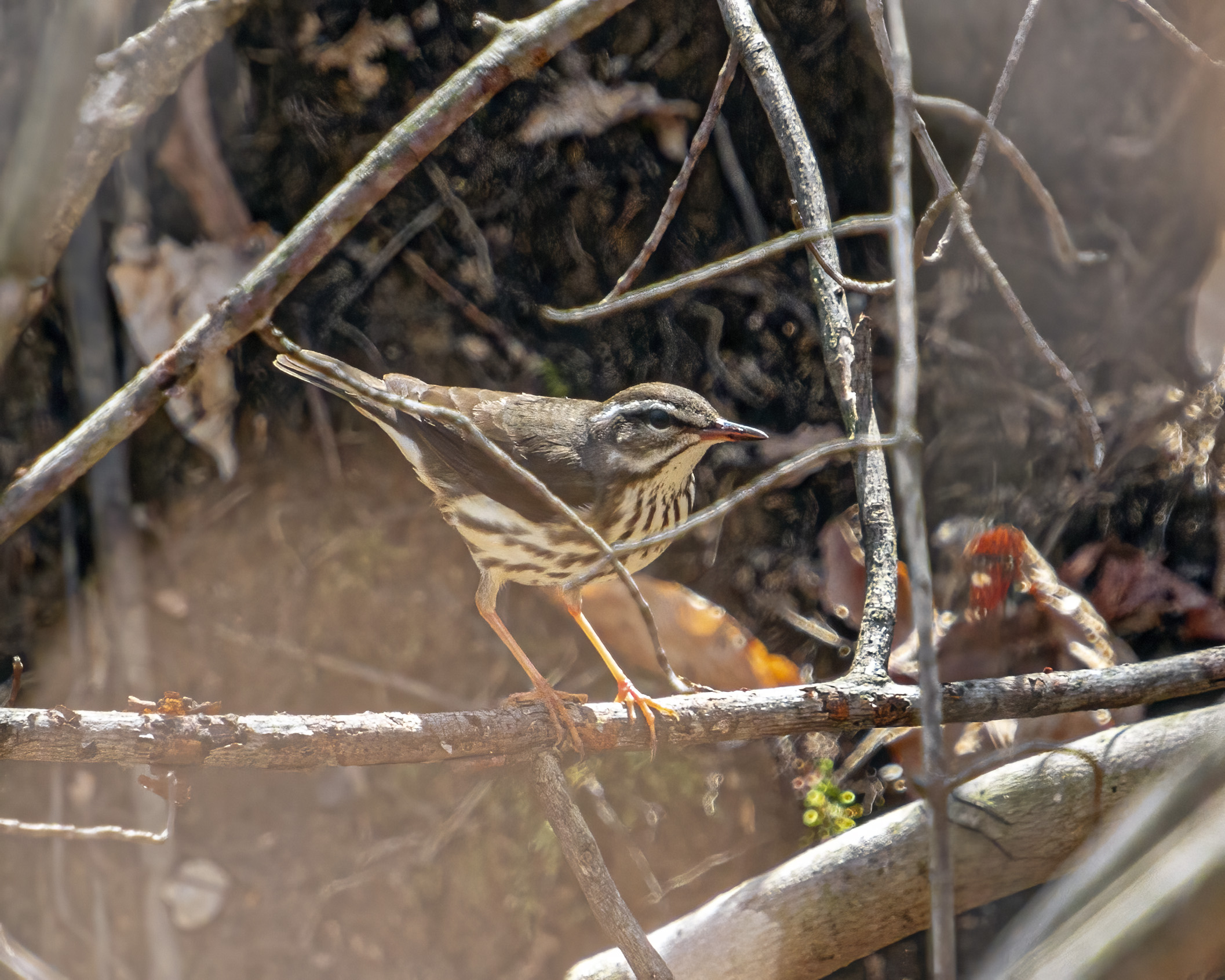
Last week I spotted this bird hopping about in a small creek in Prince William Forest Park. The bird was in constant motion and I could not get close to it, so I was was not able to get a really good shot of it. I vaguely remembered seeing a similar bird a few years ago in the same location, so I checked my old blog entries and determined that it might be a Louisiana Waterthrush (Parkesia motacilla). Several more experienced birders confirmed my tentative identification in a Facebook group for birding forum.

Despite its name, a Louisiana Waterthrush is actually a warbler, not a thrush. The Cornell Lab of Ornithology website provides the following overall description of the species:

“The ringing song of the Louisiana Waterthrush, in cadence so like the rushing streams that are its home, is one of the first signs of spring in eastern North America. Its brown plumage and bold streaking help explain why this member of the warbler family has the word “thrush” in its name. At all seasons, this species stays close to moving water—especially forested streams and creeks—and bobs its rear end almost constantly. In both spring and fall, Louisiana Waterthrushes are among the earliest migrant warblers.”

Several local photographers have started posting photos of more colorful warblers, so I will be keeping my eyes open for them. Leaves are starting to cover the trees, so I will probably have my usual problem of not being able to spot the little birds even when I can hear them singing.

Louisiana Waterthrush

Louisiana Waterthrush

© Michael Q. Powell. All rights reserved.

Read Full Post »

I was excited yesterday to spot this cool-looking Horned Grebe (Podiceps auritus) in breeding plumage in the waters off of Occoquan Bay National Wildlife Refuge. In addition to the golden tufts that sometimes look like horns, this grebe has striking red eyes.

There were not very many birds on the water yesterday, only a few geese, cormorants, and scaups, so I was quite shocked when I saw the head of this Horned Grebe emerge from the water after a short dive. I hoped that the grebe would come a bit closer with each dive, but instead it seemed to get farther and farther away from me.

I suspect that the Horned Grebe was stopping over on a migration flight northward. Although I read that migrating grebes usually form small flocks when migrating, this one appeared to be by itself. I too like to travel alone.

Horned Grebe

© Michael Q. Powell. All rights reserved.

Read Full Post »

Now that we have moved into April, I have begun to really search for dragonflies. On Thursday, I explored a creek in Prince William County, Virginia where I have found early-season dragonflies in past years, but, alas, I was not able to photograph any. However, I am pretty sure that I spotted a dragonfly flying low over the waters of the creek, so I am somewhat optimistic that the dragonfly season for me will soon start. The lighting was not good and the dragonfly was pretty far away, so I am not sure what kind it was, but there are so few insects flying this early in the year that the few that are in the air readily catch my eye.

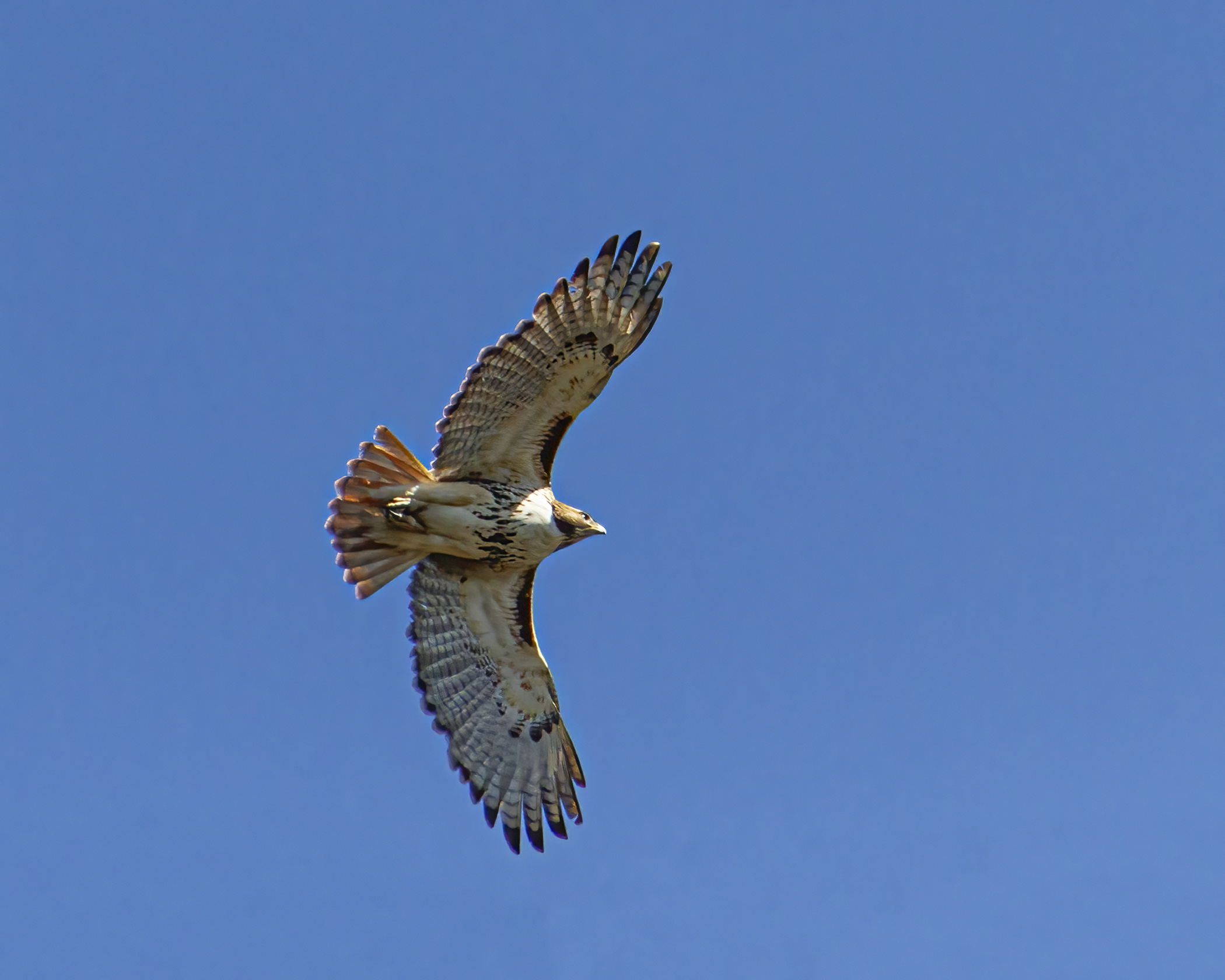
While I was searching along the edges of the creek, I spotted a hawk soaring overhead and was able to get a few shots of it. I am pretty confident that this is a Red-tailed Hawk (Buteo jamaicensis), judging from the coloration of the tail and the prominent “belly band” of darker feathers.

I was using my versatile Tamron 18-400mm lens, so I did not have the reach of the “normal” lens that I use for birds, i.e. the Tamron 150-600mm telephoto zoom lens. I have to say, though, that I am quite happy with the images that I was able to capture of this beautiful soaring hawk.

Red-tailed Hawk

Red-tailed Hawk

© Michael Q. Powell. All rights reserved.

Read Full Post »

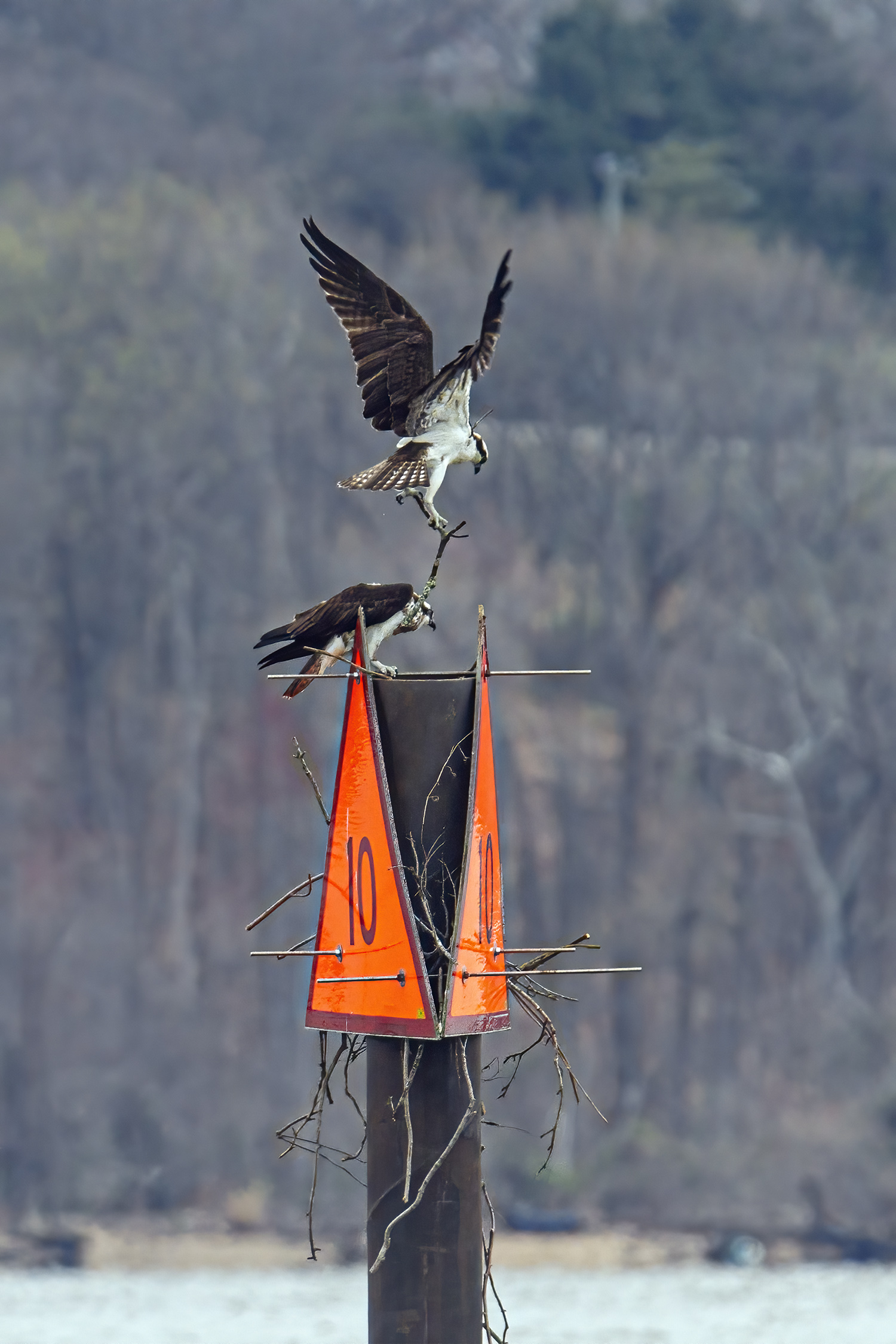
Real estate is at a premium in Northern Virginia, and new houses are jammed into the tiniest of spaces. Unfortunately, this channel marker did not appear to be quite big enough to support the nest of an osprey couple. During a recent visit to Occoquan Bay National Wildlife Refuge I watched the ospreys (Pandion haliaetus) carry a number of sticks to the marker as they unsuccessfully attempted to construct a nest—most of the sticks simply fell off the sides of the marker.

Osprey

Osprey

Osprey

Osprey

© Michael Q. Powell. All rights reserved.

Read Full Post »

This Bald Eagle (Haliaeetus leucocephalus) was partially hidden by tree branches when I first spotted during a recent visit to Occoquan Bay National Wildlife Refuge. I tried to move as stealthily as I could to try to get a clearer view of the eagle, but the eagle detected my presence. I captured this image as the eagle was preparing to take off. The eagle flew downwards from its perch and my view was completely obstructed, so I was not able to capture any in-flight shots of the eagle.

As you can see, many of the trees in my area have buds now. I think this tree might be a Sweet Gum tree, because I can see some of its distinctive spiky seed balls still hanging from the tree.

Bald Eagle

© Michael Q. Powell. All rights reserved.

Read Full Post »

It was cool, cloudy, and windy when I visited Occoquan Bay National Wildlife Refuge last Friday. I did not see any activity at the two eagle nests that I checked, but suspect that there was an eagle in each of them, hunkered down keeping the eggs warm.

I did encounter solitary adult eagles several times as I walked along the trails. Perhaps these Bald Eagles (Haliaeetus leucocephalus) were the mates of the eagles sitting in the nests. Whatever the case, these eagles looked to be hypervigilant and serious, keeping a close watch over the entire area. This eagle kept its head moving a lot, so I was happy when I managed to capture this profile shot as it perched in what I believe is a Tulip tree.

Bald Eagle

© Michael Q. Powell. All rights reserved.


Read Full Post »

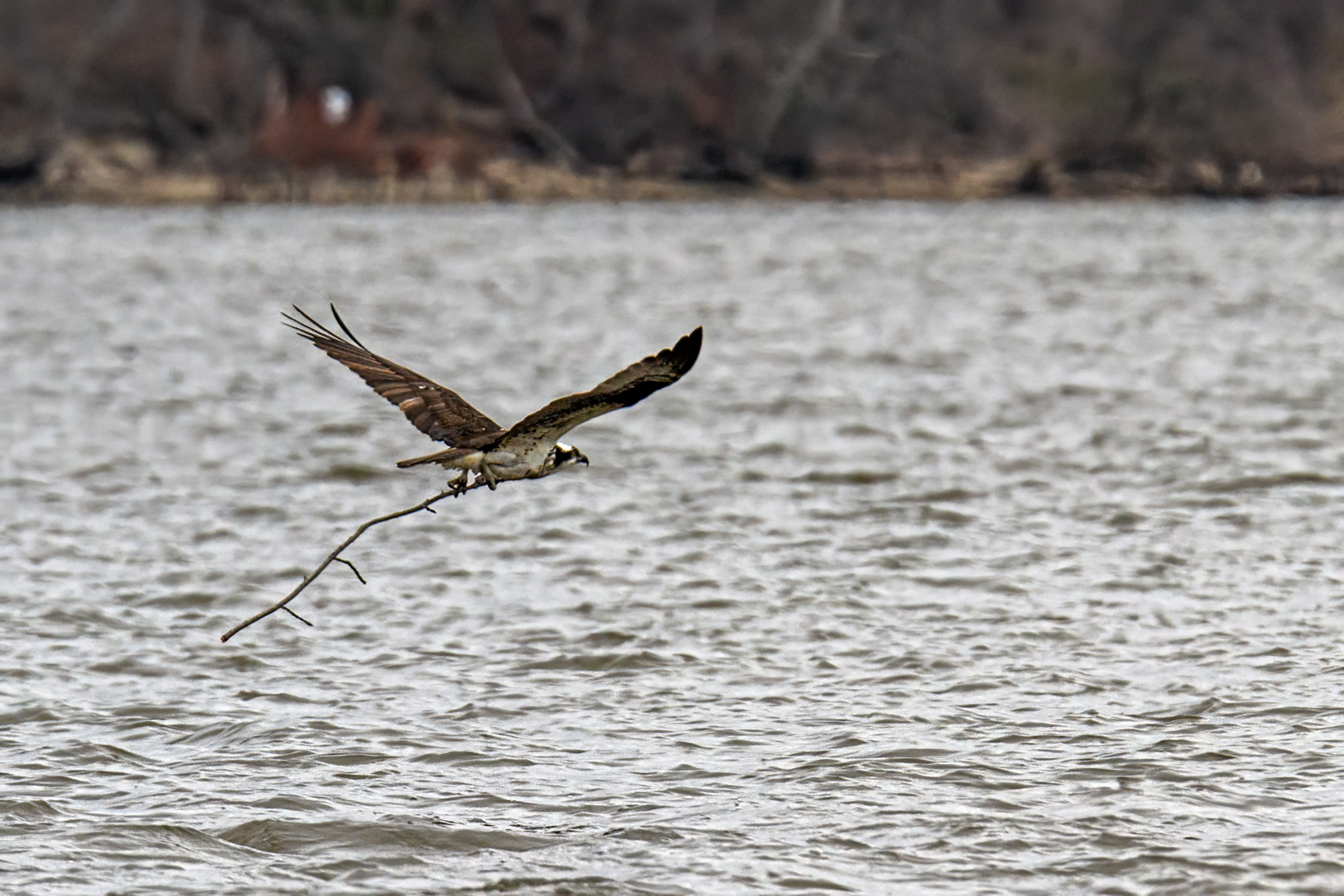
I was delighted on Friday to see that Ospreys (Pandion haliaetus) have returned to Occoquan Bay National Wildlife Refuge. Each autumn we bid farewell to the ospreys, which are also known as fish hawks or sea hawks, and each spring we greet their return.

Unlike eagles, which use large, well-constructed nests year after year, ospreys seem content to throw a bundle of sticks together and call it a nest. Many of these makeshift homes are blown down or fall apart during the winter, so a first priority for the returning ospreys is to construct nests.

During this visit I managed to capture several photos of ospreys overhead in flight with branch in their talons. As both photos show, ospreys often grab branches at one end, rather than in the middle where the weight would be better balanced. I am amazed by the ability of the ospreys to fly so well with those long trailing branches, though I suspect that the branches weigh a whole lot less that the fish that I hope to see them catch later in the season.

Osprey

osprey

© Michael Q. Powell. All rights reserved.


Read Full Post »

Although it was sunny, the wind was kicking up quite a bit during my visit on Thursday to Occoquan Bay National Wildlife Refuge. Bird activity seemed lighter than usual. Perhaps the birds were all taking shelter from the wind,

At the far edge of a small pond, I spotted a Great Blue Heron (Ardea herodias) hunched over in a one-legged pose. The wind was whipping around the wispy feathers on the heron’s chest, head, and back. I encourage you to click on the photo to get a closer look at the heron’s “flyaway” feathers.

Have a wonderful weekend.

Great Blue Heron

© Michael Q. Powell. All rights reserved.

Read Full Post »

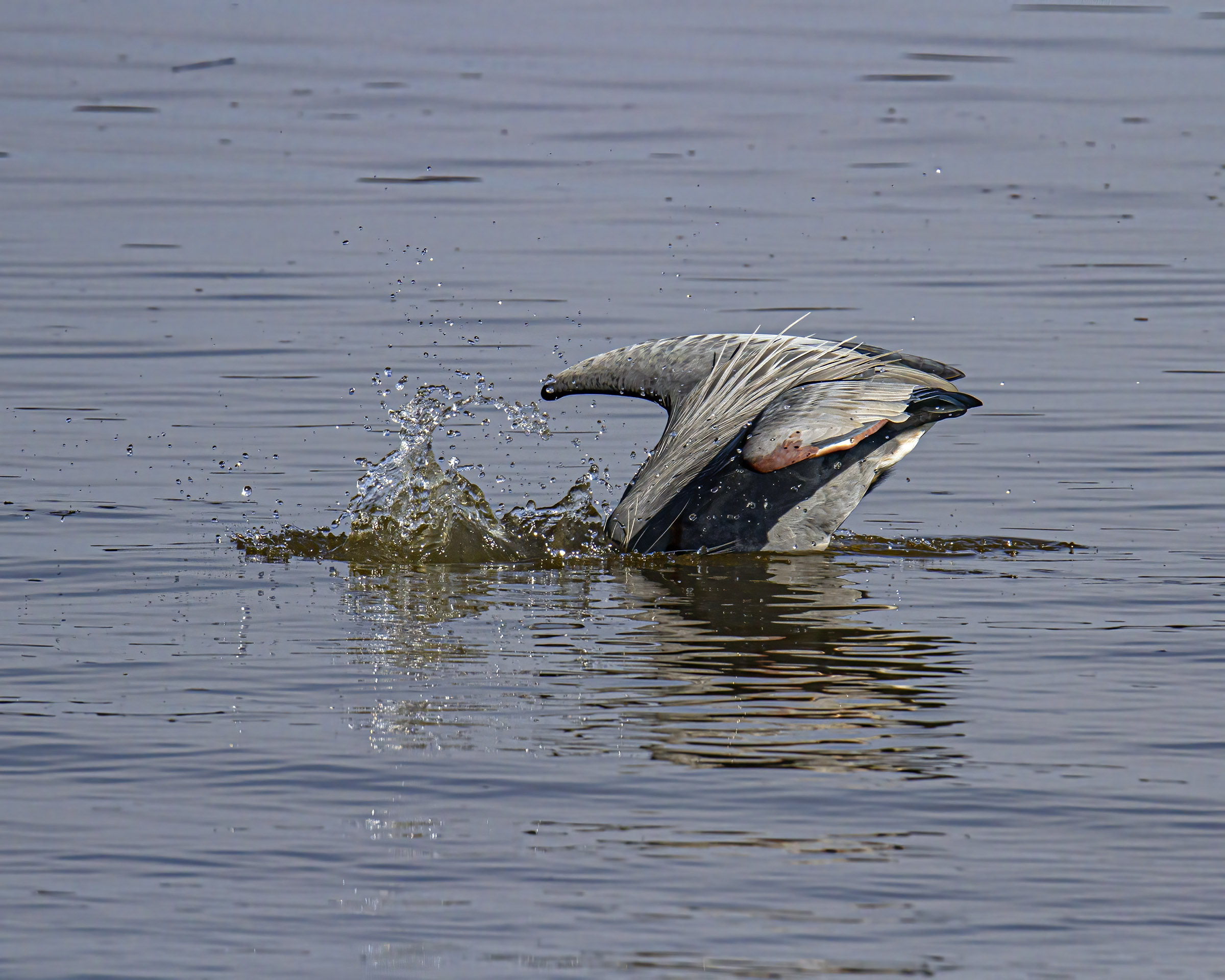
It is hard to anticipate when a Great Blue Heron (Ardea herodias) will strike. Herons have an amazing amount of patience and will often stand stationary for extended periods of time and then without much warning they will strike swiftly and violently.

Last week I was fortunate to be able to capture a sequence of shots of a heron in action at Occoquan Bay National Wildlife Refuge. I was amazed at how deeply the heron plunged its head, neck, and upper body into the water, creating quite a splash in doing so.

It seemed like the heron kept its head underwater for quite a while, but my sense of time is sometimes distorted in these kinds of situations. In any case, I impatiently waited for the heron to lift its head, anxious to see what it had caught. The heron slowly lifted its head and eventually it became clear that it had caught nothing but water. It may be my imagination, but I seem to see a mix of disbelief, dismay, and disgust in the heron’s expression in the final photo.

Undeterred, the heron returned to fishing and I moved on down the the trail, undoubtedly happier with my “catch” than the heron was with his.

Great Blue Heron

Great Blue Heron

Great Blue Heron

Great Blue Heron

Great Blue Heron

© Michael Q. Powell. All rights reserved.

Read Full Post »

It is always cool to capture an image with multiple birds of the same species, especially when they are at different stages of development. This past Monday at Occoquan Bay National Wildlife Refuge I spotted two Bald Eagles (Haliaeetus leucocephalus) perched next to each other in some distant trees.

The larger eagle on the left was clearly an adult, with a white head and yellow beak. This eagle had its head raised and was calling out loudly. In similar circumstances in the past, it appeared to me that one member of a couple was calling out to its mate. I am not at all sure if that was the case this time.

The eagle on the right is quite a bit smaller than the adult. I cannot see all of its markings, but I would guess that it is about two to three years old—it takes almost five years for a bald eagle to mature.

Was this younger eagle related to the adult? Perhaps it was a parent-child relationship. For some reason I imagined a teenager that had left home to live on its own and then decided that it wanted or needed to move back in with its parents.


Bald Eagle

© Michael Q. Powell. All rights reserved.

Read Full Post »

As I was walking along a trail on Monday at Occoquan Bay National Wildlife Refuge, I happened to glance to my left  and was shocked to see that I was almost face-to-face with a Wild Turkey (Meleagris gallopavo). This turkey, along with several of his friends, was foraging in the underbrush and apparently had not heard me approaching. I immediately stopped in my tracks, fearful of scaring the turkeys away and contemplate my next steps.

Should I try to move into another position for a better shot? Should I zoom out and try capture the turkey’s entire body that was mostly hidden in the vegetation? The clock was ticking and I knew that the turkeys would soon sense my presence.

I had a pretty clear view of the turkey’s head from where I was standing, so I decided to go for a portrait close-up portrait shot. I carefully focused on the turkey’s eye and was happy to be able to capture quite a bit of detail in a profile shot when the turkey turned his head to the side.

In a funny way I felt almost like I was looking a mirror, because the turkey had a lot of wrinkles and hairs sprouting out of various parts of his head, features that have become increasingly noticeable for me as I have gotten older. When I was younger, I don’t think I realized how much hair would eventually be growing out of my nose and ears.

After I had grabbed a few shots, I move on quietly down the trail and the turkeys continued their foraging .

Wild Turkey

© Michael Q. Powell. All rights reserved.

Read Full Post »

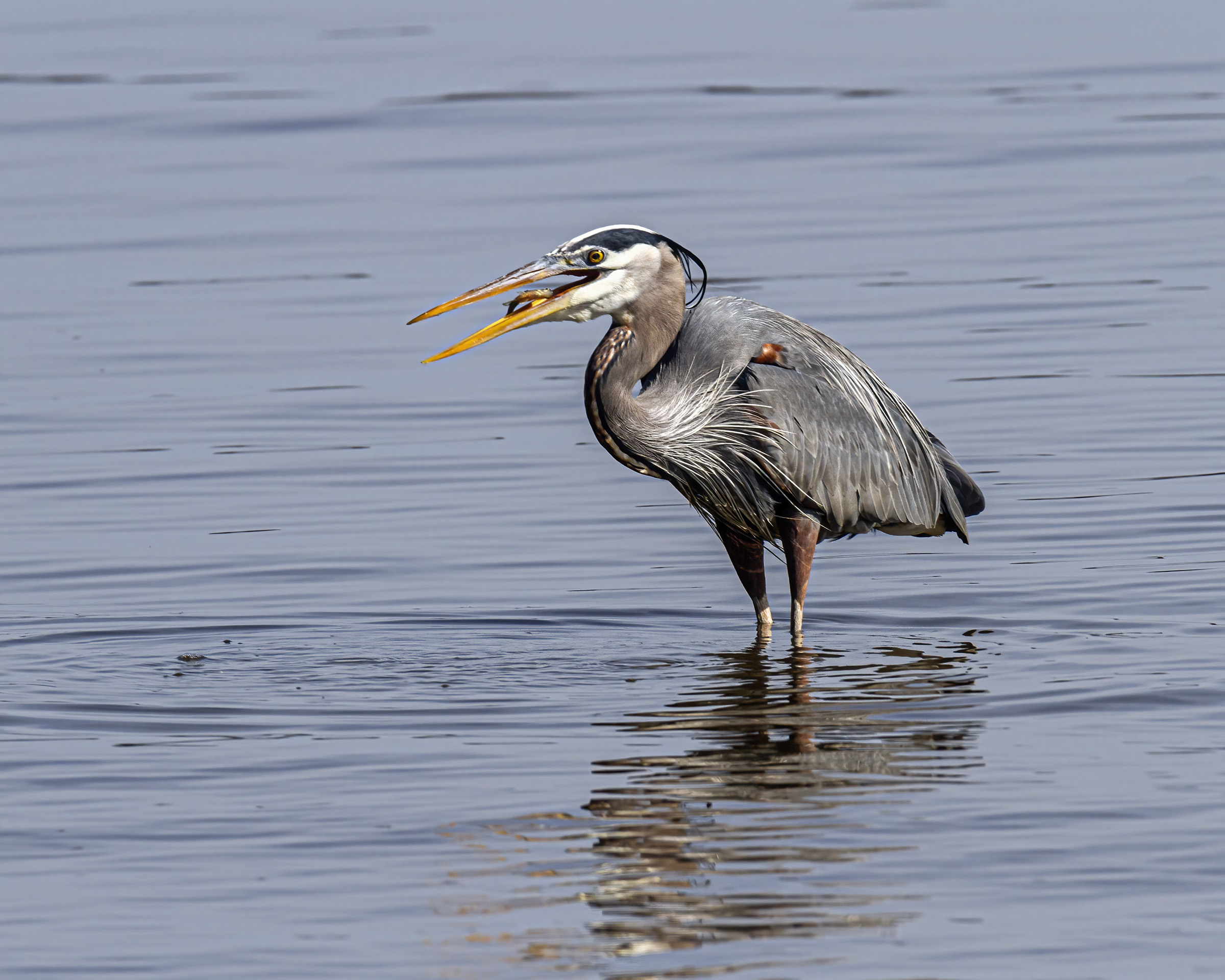
The tide was going out on Monday when I spotted a Great Blue Heron (Ardea herodias) in the shallow waters off of Occoquan Bay National Wildlife Refuge. The heron was walking slowly, stopping periodically as it scanned the water, patiently searching for prey. I decided to stop, wait, and watch the heron.

I know from long experience that herons are very patient—it is hard to remain constantly alert for extended periods of time, hoping to anticipate the moment when the heron will strike.

On this occasion, I was able to capture some of the action when the heron plunged its head into the water. Time seemed to slow down as I waited to see what, if anything, the heron had caught. As you can see in the first photo, the heron’s catch was a modestly-sized fish. The heron flipped its head to the side to reposition the fish—herons swallow fish headfirst in a single gulp. The final photo shows the fish’s final repositioning in the heron’s long bill. A split second later the heron tilted it bill upward and the fish disappeared from sight.

As I looked a these three photos, I was struck by the way that the heron’s long head feathers moved around as it twisted and turned its head. That little detailo revived distant memories of the 1970’s when I had long hair—I remember flipping my head from time to time to keep the hair out of my eyes.

Great Blue Heron

Great Blue Heron

Great Blue Heron

© Michael Q. Powell. All rights reserved.


Read Full Post »

Yesterday was a beautiful day, with blue skies and temperatures soaring above 60 degrees (16 degrees C). I visited Occoquan Bay National Wildlife Refuge and was thrilled to have multiple sightings of Bald Eagles (Haliaeetus leucocephalus).

One eagle seemed particularly vigilant, keeping careful watch over the entire area. Initially the eagle was mostly hidden from view by the heavy vegetation, but eventually I found a visual tunnel that gave me a mostly unobstructed view of the majestic eagle.

Photographing bald eagles can be quite challenging—the extreme contrast between the bright white heads and the dark bodies means that I have to choose the exposure for the image carefully to avoid blowing out the highlights in the head or losing the details of the body in the shadows.

Bald Eagle

© Michael Q. Powell. All rights reserved.

Read Full Post »

The last few days I have been really busy and have not had a chance to get out very much with my camera to capture new images. I went over the shots from my visit to Occoquan Bay National Wildlife Refuge and decided to post some more shots of the subadult Bald Eagle (Haliaeetus leucocephalus) that I photographed as it flew about, twisting and turning in the air above my head.

Previously I posted a shot of the eagle with outstretched wings (the 20 February posting was called Eagle Gyration). Today’s posting shows the same eagle in a number of other positions. I am always intrigued by the way that birds use their wings and tails in combination to move in the desired direction. Eagles make flying seem so effortless.Bald Eagle

Bald Eagle

Bald Eagle

© Michael Q. Powell. All rights reserved.

Read Full Post »

How good is your balance? This morning I was reading an article in AARP magazine about measuring your fitness level and one of the tests was a one-legged balance test. I tested myself and was able to hold the pose for only a few seconds. Yikes!

A Great Blue Heron (Ardea herodias) that I spotted on Monday at Occoquan Bay National Wildlife Refuge would have aced the test. The heron seemed to be perfectly stable as it relaxed in an open area adjacent to a small pond while standing on a single leg. It was a cold morning and I suspect that the heron’s other leg was tucked under its feathers to conserve body heat.

As I get older, I have become more conscious of the need for balance in all areas of my life. When I worked for the federal government a lot of lip service was given to the importance of “work-life balance,” but the sad reality was that few of my co-workers achieved that sense of balance—most of us, myself included, tended to be workaholics. Retirement has provided me a lot more freedom to use my time in a way that attempts to balance my physical, mental, spiritual, relational, and creative needs. It’s a constant juggling act, but I’m working on it.

In the meantime, I think I would do well to emulate the Great Blue Heron and practice my one-legged pose some more.

Great Blue Heron

© Michael Q. Powell. All rights reserved.


Read Full Post »

When I watched a Bald Eagle (Haliaeetus leucocephalus) fly into a nest on Monday at Occoquan Bay National Wildlife Refuge, I was not sure if it was occupied. We have reached the time of the year when the eagles at this refuge begin to sit on their eggs, but I did not know if the process had begun at this small nest that was used for the first time last year. As you can see in the first photo, the nest is only about as wide as the eagle’s outstretched wings.

After the eagle had landed and settled down, the body of a second eagle appeared from within the nest. I never did get a good look at the second eagle, because it kept its head down as it made some adjustments in the nest while the newly arrived eagle waited patiently to take over nest responsibilities.

One eagle flew away and the remaining one sank lower from view as it spread its body to cover the eggs. The nest is quite shallow, though, so I could still see the top of the eagle’s head most of the time. Occasionally the eagle would raise its head a little and I was able to capture a few shots like the final one here in which the eagle was looking up into the sky, wondering perhaps when its mate would return to the nest.

Bald Eagle

Bald Eagle

Bald Eagle

© Michael Q. Powell. All rights reserved.

Read Full Post »
I raised my camera to my eye when I spotted a Carolina Chickadee (Poecile carolinensis) extracting seeds from spiky Sweet Gum balls on Monday at Occoquan Bay National Wildlife Refuge. As I pressed the shutter release, the chickadee took off and I captured this fun photo of the departing little bird.

I really like the way the head is tilted upward and how the tiny claws are still extended. Most of all, though, I love the way that I was able to capture the feather details in the extended wing.

Sometimes it is better to be lucky than good—this was definitely not the shot that I thought I was taking.

Carolina Chickadee

© Michael Q. Powell. All rights reserved.


Read Full Post »

It takes about five years for a Bald Eagle (Haliaeetus leucocephalus) to develop into adulthood and acquire the bright white heads and tails that we generally associate with this species. When they are young, the eagles have dark feathers and beaks and during the intermediate years their feathers have a mottled appearance.

Yesterday I watched a subadult eagle flying about in the skies over Occoquan Bay National Wildlife Refuge. Judging from its coloration, I’d guess that it was about three to four years old.

The eagle put on quite an aerial show for me, twisting and turning in an amazing display of aerial prowess. I was particularly impressed by the way that the eagle would stretch wide its wings and flare its tail as it changed directions, as you can see in the photo below.

When an eagle or any other raptor is moving about like that, it is quite a challenge to track it and keep it within the frame. Suffice it to say, I have quite a few shots in which the eagle is partially cut off at the edge of the frame or occasionally is completely absent from the photo.

Bald Eagle

© Michael Q. Powell. All rights reserved.

Read Full Post »

Most of the time when I see a male Red-bellied Woodpecker (Melanerpes carolinus), its head is buried in the shadows or is turned away from me as he feverishly pecks away at a tree. Last Wednesday at Occoquan Bay National Wildlife Refuge, however, I spotted a Red-bellied Woodpecker in the open at a distant tree and he accommodated me by presenting his head in profile, allowing me to capture this image.

I really like the way that you can see his striking red cap so well in this photo, as well as the beautiful black and white markings on his back.

Red-bellied Woodpecker

© Michael Q. Powell. All rights reserved.

Read Full Post »
I see and hear crows quite often when I am walking about at Occoquan Bay National Wildlife Refuge. Frequently there are large, noisy flocks of them moving about as a group. In my area, there are two types of similar-looking crows—the American Crow (Corvus brachyrhynchos) and the Fish Crow (Corvus ossifragus)—and I reluctantly admit that I have not yet learned to tell them apart.

This past Wednesday, which happened to be Valentine’s Day, I spotted a single crow all by itself atop a broken-off tree. Apparently it had not been able to get a date for the special day or perhaps, like me, it preferred spending some peaceful moments alone.

I was happy to be able to capture some details of the crow’s eye in this shot. Quite often the eye blends it with the dark feathers and looks like a black, featureless hole.

Have a wonderful weekend.

crow

© Michael Q. Powell. All rights reserved.

Read Full Post »

Have you ever tried to sneak up on a Bald Eagle (Haliaeetus leucocephalus)? Given the eagles’ superior eyesight and quicker reactions, they almost always detects me before I can get within camera range and often my first indication of an eagle’s presence is when I see it flying away from me.

As many of you know, there are several eagle nests at Occoquan Bay National Wildlife Refuge and this is the time of the year when eagles begin nesting in them. The roads are blocked in the area surrounding one of the nests, so it is hard to get a good look at it. The largest nest, though, is set way back in the trees, but is visible from one of the main trails, which remains open.

During a visit to the refuge on Wednesday (Valentine’s Day), I noticed through the trees that both members of an eagle couple were perched atop the nest. Male eagles are often smaller than the females, so I think that the eagle to the left in the first photo is a male. I was still a long way from the nest when I captured that first photo, but experience has taught me that it is best to capture a “record” shot, before trying to get closer for a better one.

I continued down the trail in the direction of the eagle nest doing my best to walk near the high vegetation at the edge of the trail that blocked the eagle from seeing me and, alas, prevented me from seeing the eagle.

I know where the spots are where there is an open view of the nest and I prepared myself as I approached the best one. As I stepped partially into the open and raised my camera, one of the eagles took off and I captured the second shot below. As I was trying to track that eagle in the air, the second one took off too and I watched as they both flew away over the waters of the bay.

Before long, the eagles should be sitting on one or more eggs in the nest. The nest is quite deep and high up that it is almost impossible to tell if there is an eagle in the nest when they are incubating the eggs. The members of the couple rotate the responsibility for sitting on the eggs and I have been lucky on a couple of occasions to see the “changing of the guards.” Perhaps I will have that same good fortune this year.

Bald Eagle

Bald Eagle

© Michael Q. Powell. All rights reserved.

Read Full Post »

Yesterday I traveled to Occoquan Bay National Wildlife Refuge, my favorite local place for wildlife photography, for the first time in over a week. Things were kind of slow and most of the birds that I spotted, primarily scaups, ruddy ducks, and buffleheads, were out of range in the deep water. There was a good bit of sunshine, though, that lifted my spirits and helped to compensate for the scarcity of subjects.

As I walked along the trails, I heard this Downy Woodpecker (Picoides pubescens) before I was able to spot him. He was hammering away on a branch and had his head lowered and mostly to the side. I kept my camera trained on him and eventually he raised his head and I was able to capture this image of him that I really like. The shot provides a good look at the large claw on his foot that helps him grip the branch and it also shows how he uses his tail to give him additional leverage.

Downy Woodpecker

© Michael Q. Powell. All rights reserved.


Read Full Post »

At this time of the year male Hooded Merganser ducks (Lophodytes cucullatus) do all that they can to attract the attention of potential mates. They may go through elaborate displays or simply chase after the females, as the two males in this photo appeared to be doing. It is often hard to read the body language of birds, but both females seemed to be sending the clear message that they were not interested (or were playing hard to get).

It struck me that many human males go through similar gyrations in their efforts to attract the attention of females of the species, particularly on this day, when thoughts turn to romantic love.

Happy Valentine’s Day!

Hooded Mergansers

© Michael Q. Powell. All rights reserved.

Read Full Post »

« Newer Posts - Older Posts »