Feeds:
Posts
Comments

Archive for the ‘Birds’ Category

It was cool and gray yesterday with intermittent periods of drizzle and I considered staying indoors. However, I had been cooped up inside for almost a week by teh daily rain showers, so I decided to venture out anyways. I did not see very many insects, only one dragonfly and one damselfly, but I did see a good number of birds. Actually, it is probably more accurate to say that I heard a lot of birds—most of them stayed hidden in the still abundant foliage or were visible from a long ways off.

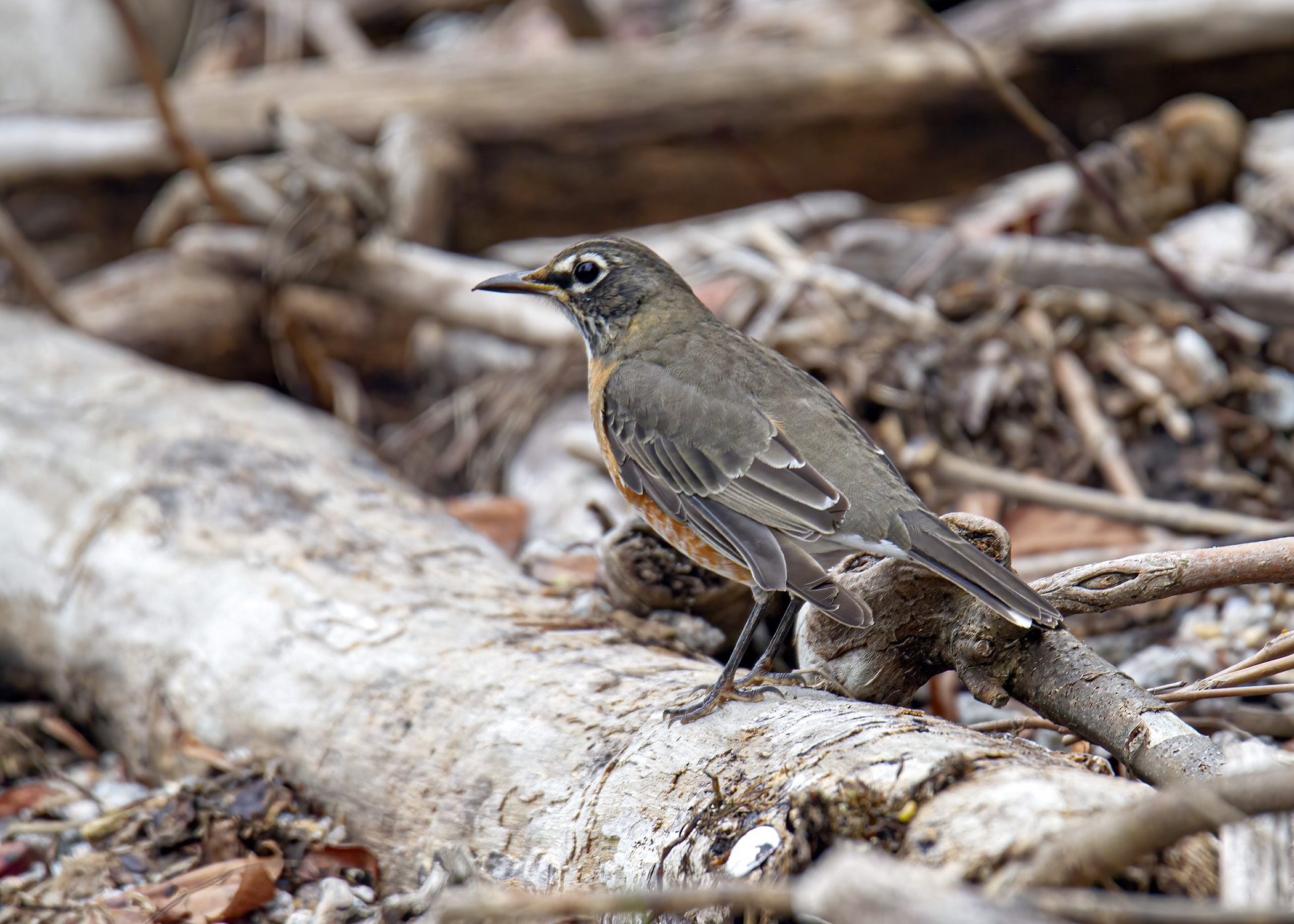
During my time at Occoquan Bay National Wildlife Refuge, I encountered several flocks of American Robins (Turdus migratorius). Growing up in Massachusetts, I tended to think of American Robins as harbingers of spring, but here in Virginia they seem to be present throughout most of the year. I used to refer to thesr birds as simply “robin,” but ever since I started to photograph birds, I have been more careful in identifying them as “American Robins,” in order to distinguish them from European Robins that are somewhat similar in coloration, but quite different in overall appearance.

The American Robin in this photo was busily foraging in the debris on the trail alongside the water. Fortunately the tides had receded a lot since my previous visit to the refuge, so the trail was no longer under water. I love the way that all of the leaves and branches in the image are an almost perfect match for the colors of the bird, giving the shot a nice sense of harmony.

American Robin

© Michael Q. Powell. All rights reserved.

Read Full Post »

The weather has been uncooperative this past month and I’ve spent more time indoors than usual, so I have not been able to take as many bird photos as I have in some other months. Now that the leaves are starting to fall off of the trees, I am hoping that I will have the chance to spot and photograph more birds. As the weather gets cooler, there will also be fewer and fewer insects around, I will inevitably have to switch my focus.

Last week I spotted this Northern Mockingbird (Mimus polyglottos) perched in a nearby tree while I was wading my way through Occoquan Bay National Wildlife Refuge. It was a gray and overcast day and many birds seemed to be sheltering in the trees, hidden by the foliage. This mockingbird was hopping about in the tree and I was happy to capture this shot before it flew away.

Northern Mockingbird

© Michael Q. Powell. All rights reserved.

Read Full Post »

Last Thursday I captured my first shot of a Bald Eagle in a few months during a visit to Occoquan Bay National Wildlife Refuge. I have spotted Bald Eagles several times this summer, but I did not see them from a distance, because of the foliage on the trees, and my first indication of their presence was when they were flying away from me.

There are still quite a few leaves on the trees, so I was startled when I flushed an eagle last week. I was fortunate, though, the eagle flew across my field of view and I was able to snap off a couple of shots before it disappeared from sight. This is a crop of the image that came out of my camera and I am pretty happy with the results, especially considering the fact that I had no time to make any adjustments to my camera before taking the shot.

I am still trying to focus primarily on insects, but know that before long I will be switching my focus to birds. However, as this photo shows, I will rarely pass up an opportunity to get a shot of a Bald Eagle, irrespective of the season.

Bald Eagle

© Michael Q. Powell. All rights reserved.

Read Full Post »

The leaves are still on the trees, which makes it tough for me to spot perched birds, which is one the reasons why I focus on insects in the summer months. Nonetheless, I tend to scan the trees when I am out with my camera, hoping to spot a bird perched in the open.

On Monday at Occoquan Bay National Wildlife Refuge, I spotted an unfamiliar shape through the foliage as I was hiking along one of the trails. As I moved a bit to the side to get a better view, I realized that it was a Great Blue Heron (Ardea herodias). Now I know that herons will roost in the trees at night, but it is a little unusual for me to see on in a tree at midday. The bird appeared to be keeping an eye on something, almost like a sentinel, though I have no idea on what its attention was focused.

I moved slowly and stealthily to get a better shooting angle and eventually captured this image of the heron. As you can see in the photo, the heron was definitely alert and paying attention—it did not appear to be relaxing in the tree. Maybe the heron felt like the king of the world and was taking a moment to survey his realm.

Great Blue Heron

© Michael Q. Powell. All rights reserved.

Read Full Post »

Earlier this week I watched a distant Great Egret (Ardea alba) as he stared at the waters at Huntley Meadows Park. Initially he was standing tall, but slowly the egret bent over, carefully balancing himself on a floating tree trunk. We both watched and waited until the moment came when he plunged his head into the water. I fired off some shots, wondering if the egret had caught a fish.

I can’t say for certain that the egret was unsuccessful, but it sure looks to me like there was no fish in his bill as he withdrew his head from the water. It appeared to me like the egret was fishing for tiny fish, because he did not plunge his head very deep into the water. After this attempt, the egret stood upright and relaxed for a few moments, before eventually resuming his efforts.

I moved on, wishing him the best of luck in his pursuit of his next fish, as I continued to hunt for dragonflies.

Great Egret

© Michael Q. Powell. All rights reserved.


Read Full Post »

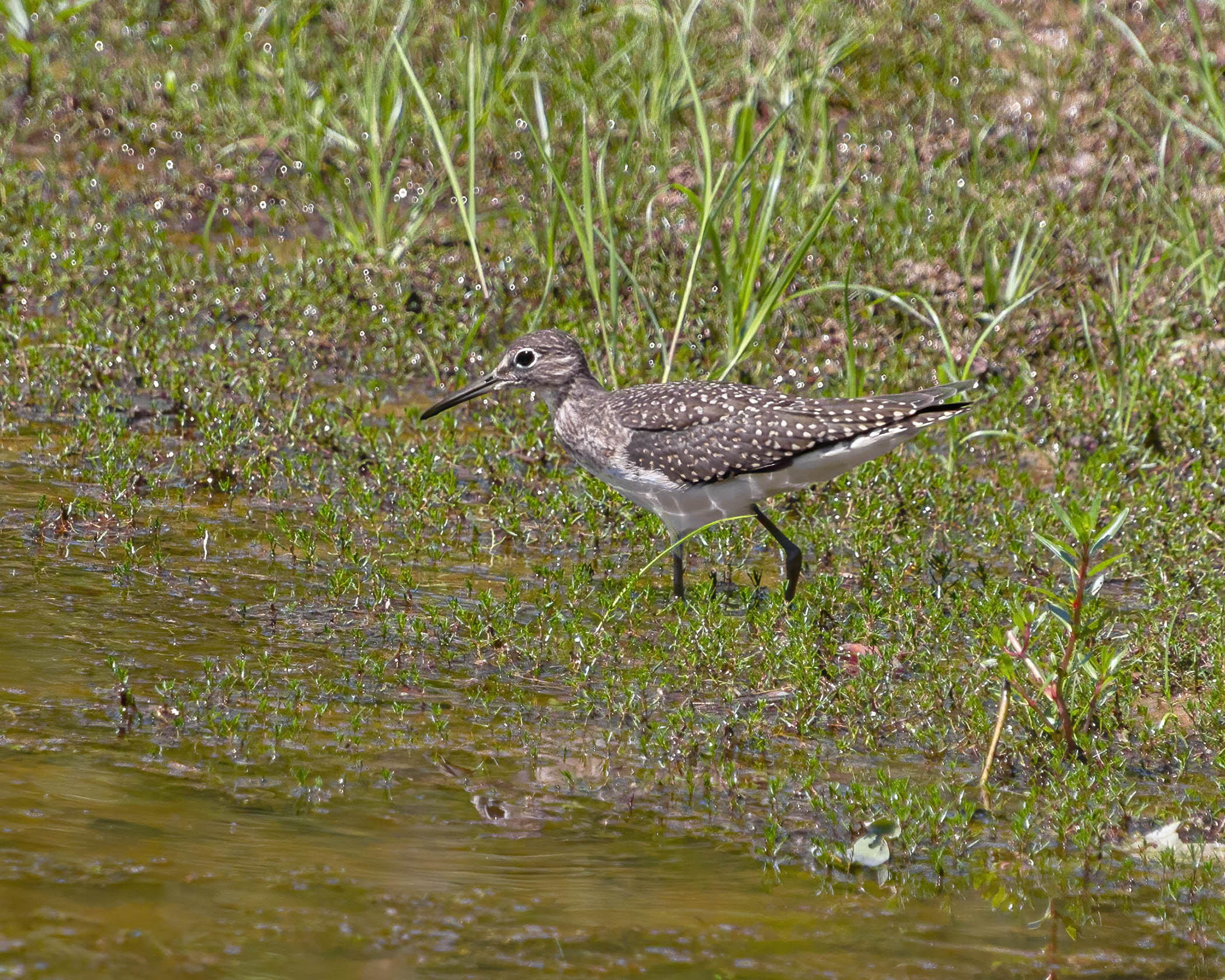
Shorebirds are always tough for me to identify—so many of them are similar in appearance. When I spotted this little bird on Monday at Occoquan Bay National Wildlife Refuge, I noticed that it was all alone. Half-jokingly, I thought to myself that maybe it is a Solitary Sandpiper (Tringa solitaria).

When I later checked my bird identification guide I was shocked to discover that it probably is a Solitary Sandpiper. As its name suggests, this bird was by itself, foraging for food in the shallow water at the edge of a pond. I watched it for a while, but when I moved closer to get a better shot, the bird flew away to a spot across the small pond.

Solitary Sandpiper

© Michael Q. Powell. All rights reserved.

Read Full Post »

With so many of the trees covered in leaves, it is a bit difficult for me to spot a perched bird. Sometimes, though, I get lucky and a bird will perch in the open on a dead tree and I will be able to get a clean shot of it. Otherwise, they can remain perched, hidden by the shadows of the trees.

We are in the doldrums of summer right now and many of the birds do not appear to be active during the warm, daylight hours. I was therefore delighted to spot this Osprey (Pandion haliaeteus) as it perched on the dead branches of a tree. This Osprey seemed to be relaxing and did not fly away immediately as I attempted to get a little closer. Occasionally it would turn its head from side to side, but otherwise remained in a relaxed position.

After I had taken a couple of shots, I continued on, leaving the Osprey at peace in the tree.

Osprey

Osprey

© Michael Q. Powell. All rights reserved.

Read Full Post »

There was a lot of activity at one of the Osprey (Pandion haliaetus) nests last Tuesday at Occoquan Bay National Wildlife Refuge. When I first noticed the nest, there were a several Osprey sitting in the nest—initially I thought there were only two in the nest, but when I looked more carefully, I could see that there were at least three osprey there.

As I watched, another osprey flew into the nest as you can see in the first photo below. The nest does not appear to very large, so the the birds had to rearrange themselves a bit to accommodate the new arrival. In the second photo, one of the osprey seemed to be expressing its displeasure with the need to move a bit.

I think this may be a family unit, though I can’t be absolutely sure of that. When I look closely at the eyes of the osprey, some of them appear to be orangish in color, unlike the paler eyes of adults.

I especially love the body language in the second photo. It’s fun to imagine the conversation that is taking place. Perhaps, for example, the osprey with the flapping wings is complaining that the newly arrived osprey did not have a fish in its talons to share with the rest of the family. What do you think?

Osprey

Osprey

© Michael Q. Powell. All rights reserved.

Read Full Post »

This Black Vulture (Coragyps atratus) took a long look at me last week at Occoquan Bay National Wildlife Refuge before deciding that I was not dead, though I was moving quite slowly because of the heat and the humidity. Most of the vultures that I see in my area are Turkey Vultures, which have red, featherless heads, but, as you can in the photo, we also have Black Vultures.

I readily acknowledge that vultures play an important role in our ecosystems by eating dead animal carcasses and preventing the spread of diseases that could affect local food webs and human health. However, I admit that I, like most people, find these amazing birds a little creepy. Perhaps it is the result of watching countless Westerns on television as a child, movies in which circling vultures were always seen as a foreboding sign of death.

I like the way that this stark, naked tree enhances the spookiness of the vulture. One of my Facebook friends suggested that this would make a good Halloween image. For now, the image serves to remind us that life is ephemeral, tomorrow is not guaranteed.

Black Vulture

© Michael Q. Powell. All rights reserved.
Read Full Post »

The entrance to a partially-open flower on a trumpet vine was so narrow that a bumblebee really struggled to gain access to the sweet goodness inside last Thursday at Occoquan Bay National Wildlife Refuge. Eventually the bee was able to wiggle its way inside and add to the pollen baskets on its hind legs.

I could not help but recall how much easier it is for Ruby-throated Hummingbirds (Archilochus colubris) to access the nectar in trumpet vine flowers using their long, slender bills. I have not yet been able to photograph any hummingbirds this season, but thought that I would reprise a photo from an August 2015 blog posting entitled “Hummingbird and trumpet vine.” Click on the link to see some additional photos of hummingbirds feeding on trumpet vines and learn more about my encounter that day.

bumblebee

Ruby-throated Hummingbird

© Michael Q. Powell. All rights reserved.


Read Full Post »

The main subject of one of my photos is usually pretty clear—I try to fill as much of the frame as possible with the insect or bird on which I am focusing at that moment with a telephoto or macro lens. Of course, it is often impossible to “fill the frame,” because my wildlife subjects frequently are skittish and are likely to depart if I move too suddenly or get too close to them.

As I was reviewing my photos from a visit to Occoquan Bay National Wildlife Refuge last week, I came across this shot of a Carolina Wren (Thryothorus ludovicianus). The wren was pretty far away and had its back to me. The only thing that saved this from being another “butt shot” was the slight turn of the wren’s head that provided me with a chance to get a profile shot.

The shot of the wren is ok, but it was the amazing background that took my breath away. I dabble with watercolor painting and I would be absolutely thrilled to be able to paint a background like this, with all of those different shades of green and the deliciously soft “bokeh ball.” Wow!

I decided that the main subject of the photo that I wanted to show you all was actually the background, not the Carolina Wren. Consequently I did not crop very tightly and left it to the viewers to focus their attention on the linear structure of the branches and on the wonderful background. I am not sure that a thumbnail view of the image will grab folks’ attention, but I am ok with that—the photos in my blog are intended to provide an interesting view of some aspect of the beauty of nature and not serve as click-bait to maximize the number of views.

Carolina Wren

© Michael Q. Powell. All rights reserved.


Read Full Post »

Earlier in the season, when the trees were bare, it was very easy to spot Ospreys (Pandion haliaetus) when they returned to our area from their wintering grounds. Now, though, the trees are covered in leaves and Ospreys are increasingly hard to see as they perch among the leaves, especially if they remain silent.

I was delighted to spot this vigilant osprey last week at Occoquan Bay National Wildlife Refuge. He was alert and focused—he seemed to be paying attention to something, though I am not sure of the subject of his surveillance.

The winds were kicking up periodically, causing a cowlick of feathers to stand up in the back of the osprey’s head. When I was a child, I had a similar problem and had to use a bit of Brylcreem to keep the unruly hair in place. (My Mom used to be able to accomplish the same thing with my hair using only a bit of her saliva and her fingers.)

Osprey

© Michael Q. Powell. All rights reserved.

Read Full Post »

I was delighted to see some Red-winged Blackbirds (Agelaius phoeniceus) last week at Occoquan Bay National Wildlife Refuge. In the first photo, a male  Red-winged Blackbird seemed to be showing off for me as he balanced himself on a single leg, glanced in my direction, and seemed to smile. Eventually he climbed to the tip of the small branch and appeared to be complaining about something that he observed.

A short distance away I captured the final image of a female Red-winged Blackbird. As you can she, she is not black nor does she have any red on her wings, so it feels a little strange to call her a Red-winged Blackbird. Although I was not able to get very close to her, I really like the overall composition of the image and the moment of action that I was able to capture as she called out.

Red-winged Blackbird

Red-winged Blackbird

Red-winged Blackbird

© Michael Q. Powell. All rights reserved.


Read Full Post »

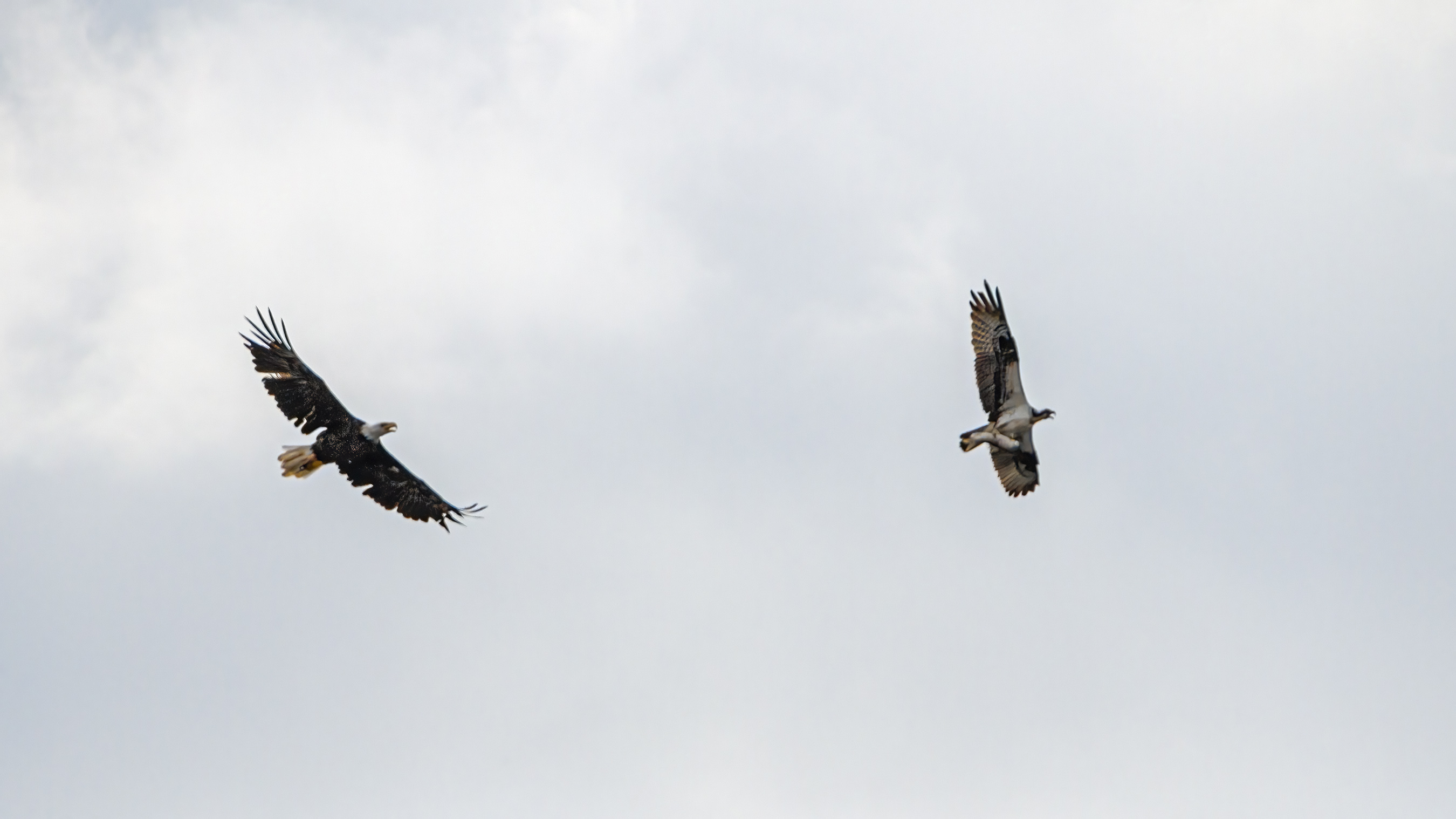
On Wednesday I watched as a Bald Eagle (Haliaeetus leucocephalus) chased an Osprey (Pandion haliaetus) high in the sky above the waters off of Occoquan Bay National Wildlife Refuge in a vain attempt to steal its freshly caught fish. I captured the second shot when the eagle flew past me after giving up on its chase.
It has been several months since I last photographed a Bald Eagle, so I was thrilled to capture these images. As most of you know, I concentrate most of my photographic attention on dragonflies and other insects during the warmer months. However, I am always alert to the possibility of photographing birds when I manage to spot them.
During the winter months I generally use a 150-600mm telephoto zoom lens that gives me a long reach, but in the summer I tend to rely on a 180mm macro lens or the 18-400mm zoom lens that I used for these shots. This lens gives me a good deal of versatility, allowing me to capture my close-in tiny subjects and some longer distance ones like these raptors in flight.
Eagle and Osprey
Bald Eagle
© Michael Q. Powell. All rights reserved.
Read Full Post »

I was a little shocked yesterday to see a Green Heron (Butorides virescens) while I was searching for dragonflies at a small pond at Occoquan Bay National Wildlife Refuge. In the past I have seen Green Herons at other locations at the refuge, but never before at this pond. Green Herons are smaller and squatter than the Great Blue Herons that I am more accustomed to seeing.

When I initially spooked the Green Heron, it flew to a mucky, shallow end of the pond, where I was able to capture the first two images. I am always amazed at the length of the neck of a Green Heron when it extends it fully—it looks so much taller and slimmer in the second shot. I also really like the floppy head feathers that sometime look like a Mohawk hairstyle.

The Green Heron eventually sensed my presence and flew to a nearby tree. The heron was partially hidden by the abundant foliage, but eventually I was able to capture the final image of it among the leaves.

It was hot and humid yesterday, so I limited my trekking to a couple of hours and drank plenty of water. Still, it was nice to get out in the wild with my camera after a week of spending most of my time indoors.

Green Heron

Green Heron

Green Heron

© Michael Q. Powell. All rights reserved.

Read Full Post »

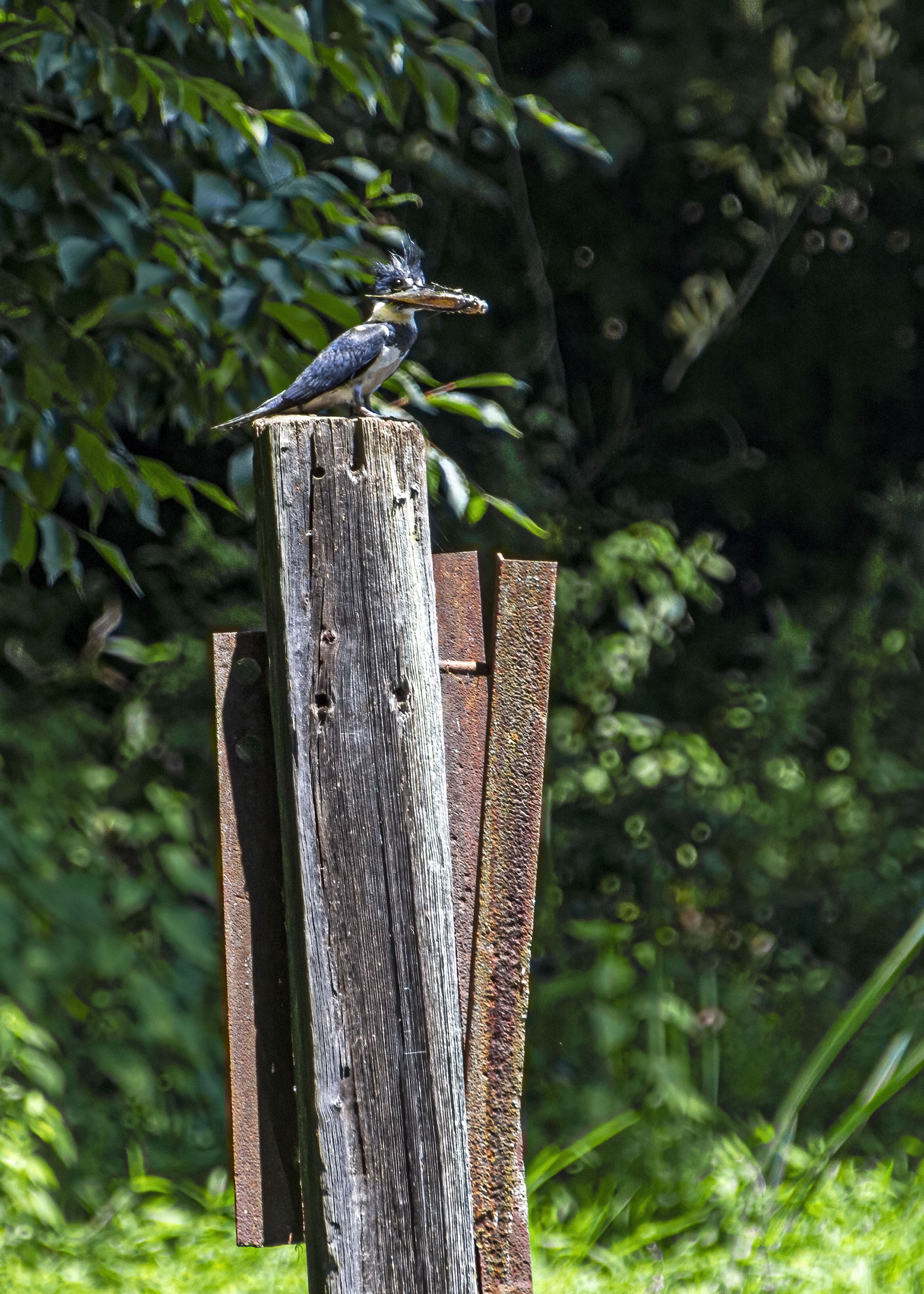
As I was searching the edge of a pond for dragonflies earlier this week I suddenly heard the unmistakable call of a Belted Kingfisher (Megaceryle alcyon). As I lifted my head, the kingfisher flew across my field of view and perched on a wooden post sticking out of the water. Even though the kingfisher was quite far away, I could see that it had a relatively large fish in its bill.

Normally a kingfisher will beat its catch against a branch to subdue it before swallowing it head-first. I was hoping to be able to see if the kingfisher would be successful in swallowing this prey—it looked too big for it to swallow in one gulp, but I have been surprised in the past when herons and cormorant have swallowed large fish.

Alas, the kingfisher flew away before I could see if it would be successful in swallowing its prey.

Belted Kingfisher

© Michael Q. Powell. All rights reserved.


Read Full Post »

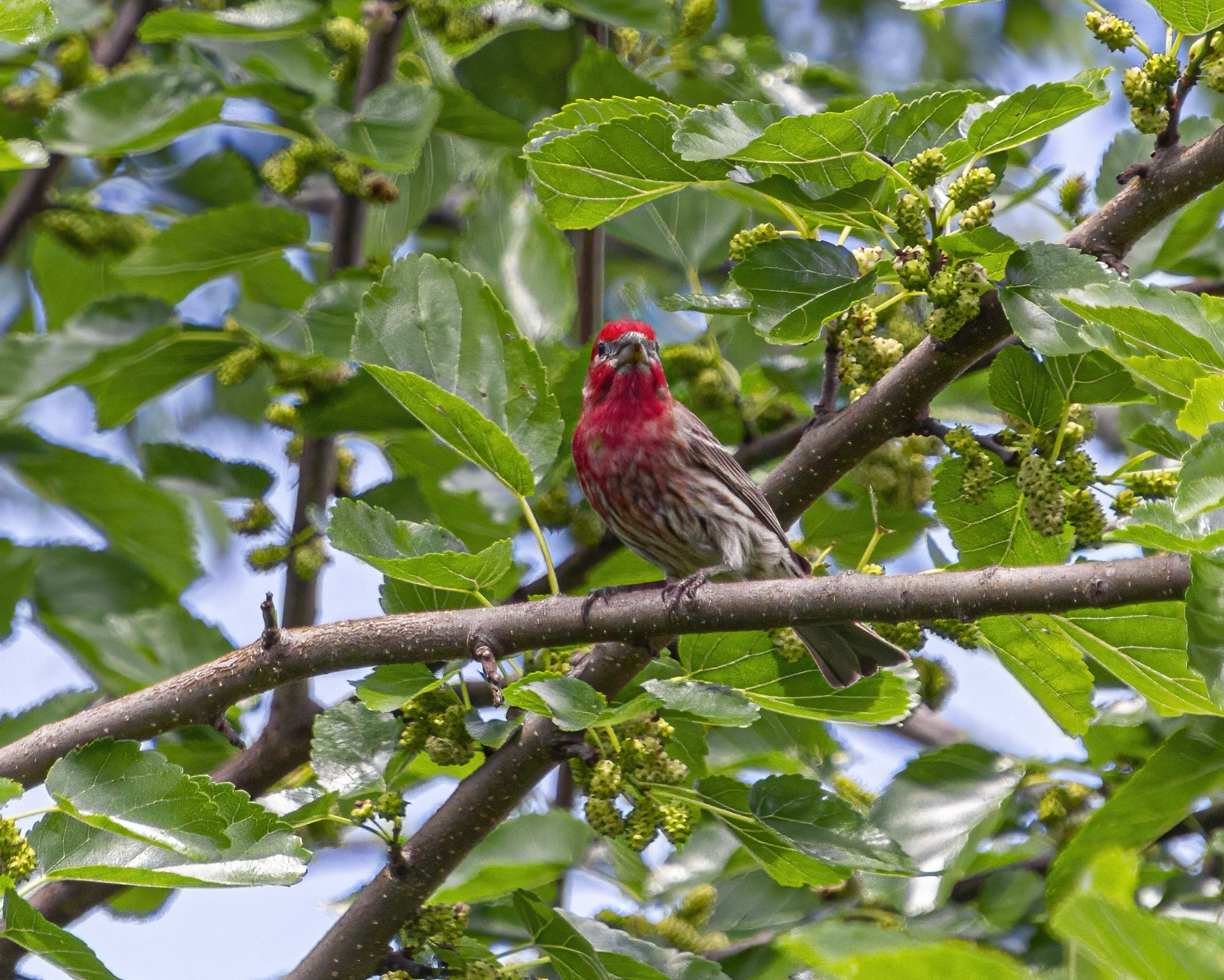
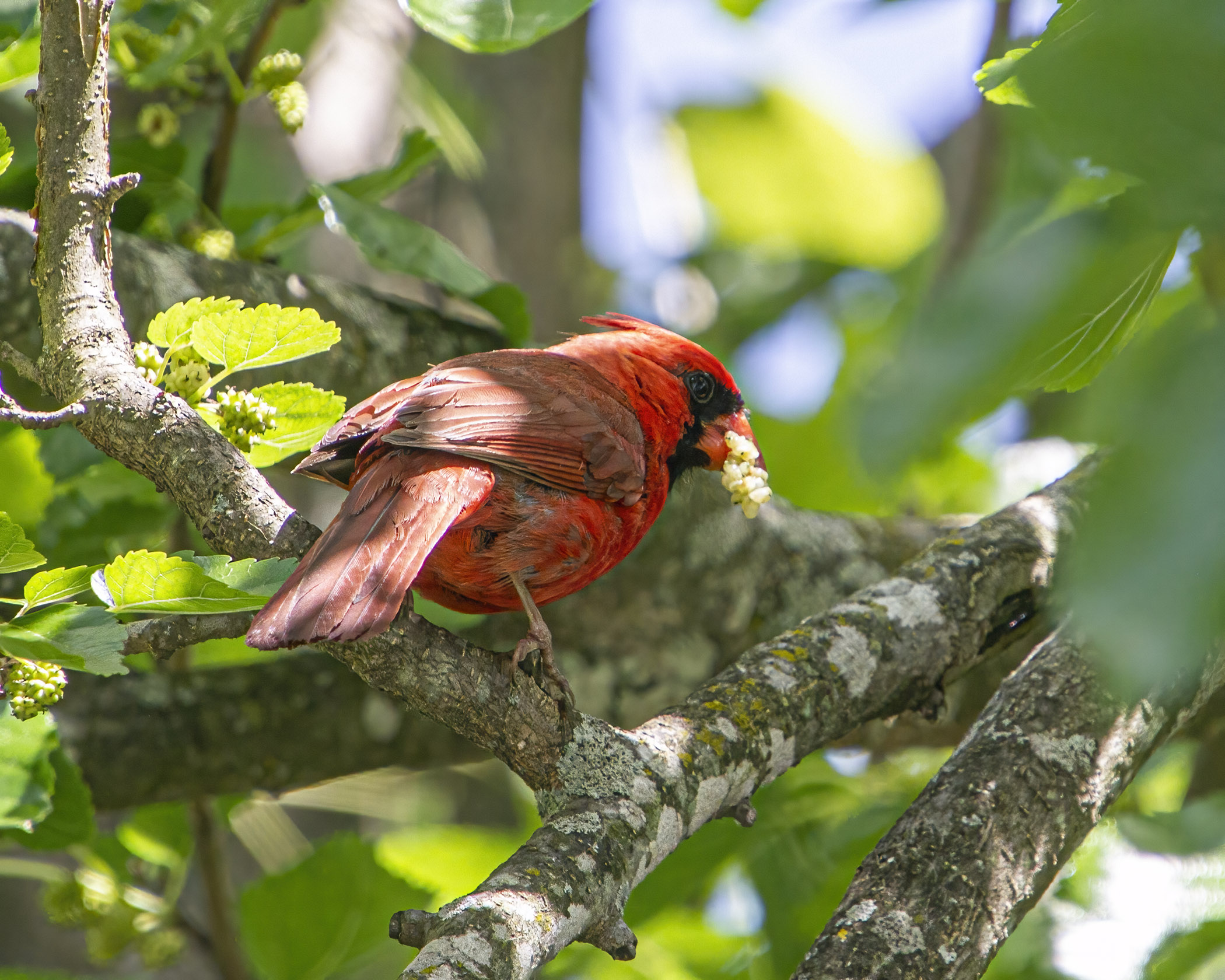
The bright red color of this male House Finch (Haemorhous mexicanus) really caught my eye last week at Occoquan Bay National Wildlife Refuge. For a split second I thought it was a cardinal until I looked more closely at the bird, it was clear that it was a different species.

Later that same day I spotted an equally bright red male Northern Cardinal (Cardinalis cardinalis) that seemed quite pleased with whatever treat it had found. I think it may be plant material, but I can’t exclude the possibility that it is some kind of insect.

From a photography perspective, it is really helpful when a bird is this boldly colored and makes no effort to blend in with its surroundings, especially at this time of the year when there are so many leaves on the trees.

House Finch

Northern Cardinal

© Michael Q. Powell. All rights reserved.
Read Full Post »

Most warblers nest either on the ground, in shrubs, or in trees, according to the Cornell Lab of Ornithology website, but the Prothonotary Warbler and the Lucy’s Warbler build their nests in holes in standing dead trees or may use nest boxes when available. On Monday I was delighted to spot a Prothonotary Warbler (Protonotaria citrea) at Occoquan Bay National Wildlife Refuge checking out a nest box from the outside and eventually from the inside too.

The nest box is old and may have a leaky roof, but the warbler seemed happy to have found it. The real estate market is tight in Northern Virginia right now and finding any place to live is difficult. After a short stay on the roof, the Prothonotary Warbler flew away and made an aerial approach from the front, perching at the entrance for a moment before entering the nest box.

I obviously could not see what was going on in the box, but periodically I could see flashes of yellow as the warbler moved about inside the box. Perhaps there are already eggs in the box. The warbler stayed inside the box for about five minutes before it poked its head out of the entrance and began to look around, as you can see in the final photo. I was hoping to capture a shot of the bird exiting the nest box, but it left more quickly and unexpectedly and I missed the shot.

I will be checking this spot out during my next visits to the wildlife refuge, hoping that I will be lucky enough to see some baby warblers.

Prothonotary Warbler

Prothonotary Warbler

Prothonotary Warbler

© Michael Q. Powell. All rights reserved.

Read Full Post »

This colorful bird was a long way away yesterday at Occoquan Bay National Wildlife Refuge and I assumed it was a Northern Cardinal, but I decided to photograph it anyways. When I was reviewing my photos, I was shocked to discover that it was an immature male Summer Tanager (Piranga rubra), a new species for me. Truth be told, I was not very certain what kind of bird it was, so I did some searching on-line and came up with the correct answer, as confirmed by some experts in a birding forum on Facebook.

I will take photos of anything that catches my eye, knowing that many of them will not be “keepers.” I will take photos of subjects that are really familiar and those that may be rare or unique. My general rule is to take a lot of photos, following what I call the Law of the Wild West, i.e. “Shoot first and ask questions later.”

Summer Tanager

© Michael Q. Powell. All rights reserved.

Read Full Post »

I spotted this beautiful female Red-winged Blackbird (Agelaius phoeniceus) poking about in the marshland vegetation last Thursday at Jackson Miles Abbott Wetland Refuge. As is the case with many birds, the name of the species matches the coloration and/or features of the male, but not those of the female, e.g. this Red-winged Blackbird is not black nor does it have red wings.

I had my first encounter with a female Red-winged Blackbird in June 2012, a few months before I started this blog. I remember well my initial difficulties in trying to identify the bird and my shock in learning that it was a blackbird—I assumed it was a sparrow of some sort. In September 2012, I posted some photos of that bird in a blog entry entitled “Intense bird.” I encourage you to click on that link and make your own judgment about the degree to which my photography “style” has remained consistent over the years.

In 2012 I was just starting to get serious about photography and my dear friend and photography mentor Cindy Dyer had lent me a Nikon D300 and a Tamron 180mm macro lens that day. I fell in love with that lens and quickly purchased one for my Canon, the brand that I mostly use. The Tamron 180mm macro lens remains one of my favorite lenses.

It was quite enjoyable to watch this blackbird last week exploring the vegetation protruding from the water. She would perch on some rather small stems, appearing to flare her tail to maintain her balance, as you can see in these photos, occasionally calling out to a male blackbird that I could hear, but did not see.

Red-winged Blackbird

Red-winged Blackbird

© Michael Q. Powell. All rights reserved.

Read Full Post »

I don’t know how much longer the migrating warblers will be in my area, but this past few weeks I have been trying to get outside with my camera as often as I can, hoping to be able to photograph these colorful little birds.  On Tuesday I spotted a Prairie Warbler (Setophaga discolor) in the patient and patiently tracked it as it moved about.

The first photo was a bit of an anomaly, because the warbler momentarily gave me an unobstructed view when it jumped to a high branch. The second photo gives you a much better idea of the typical challenge I face, with the warbler barely showing itself from behind the wall of foliage. Fortunately, I reacted quick and got a shot that is one of my favorites of this warbler season, which has been my most successful one to date.

Prairie Warbler

Prairie Warbler

© Michael Q. Powell. All rights reserved.

Read Full Post »

Prothonotary Warblers (Protonotaria citrea) are probably my favorite warblers. I just love their brilliant yellow plumage that seems to glow. Many warblers have touches of bright yellow, especially during the spring breeding season, but the Prothonotary Warbler outdoes them all and is almost completely covered in yellow.

I spotted this little beauty yesterday (1 May) at Occoquan Bay National Wildlife Refuge. I initially caught sight of the warbler as it was flitting about in the foliage. I would see flashes of yellow as it foraged, but could not get a clear look at it. All of the sudden the warbler flew across the trail and landed in a bush, momentarily give me a clear shot.

Quite often I strain my neck when trying to photograph warblers, a phenomenon that is colloquially called “warbler neck.” It is so common that the Audubon website has an article entitled, “A Birder’s Workout Guide for Preventing Warbler Neck.” I was very fortunate in this case, though, that the bird was perched below eye level, so I was able to capture a lot of detail without harming my neck, detail that is often hidden when I am shooting upwards at a sharp angle.

Prothonotary Warbler

© Michael Q. Powell. All rights reserved.
Read Full Post »

I spotted this spectacular Yellow-throated Warbler (Setophaga dominica) on Monday at Occoquan Bay National Wildlife Refuge as it perched amidst the hanging seed pods of what I believe is a sycamore tree. I love the round shape and texture of the seed pods and the warbler was much more in the open than he was when he was hidden amidst the foliage.

Yellow-throated Warbler

© Michael Q. Powell. All rights reserved.

Read Full Post »

Yesterday I spotted several Indigo Buntings (Passerina cyanea) at Occoquan Bay National Wildlife Refuge. It is probably more accurate to note that I heard the buntings before I actually saw them. Unlike recent warblers that I have photographed that seem to hide behind the leaves while they sing their songs, Indigo Buntings like to fly to the top of the trees in order to be seen and heard.

I really like the basic description of this species on the Cornell Lab of Ornithology website:

“The all-blue male Indigo Bunting sings with cheerful gusto and looks like a scrap of sky with wings. Sometimes nicknamed “blue canaries,” these brilliantly colored yet common and widespread birds whistle their bouncy songs through the late spring and summer all over eastern North America. Look for Indigo Buntings in weedy fields and shrubby areas near trees, singing from dawn to dusk atop the tallest perch in sight or foraging for seeds and insects in low vegetation.”

The bird in the third photo has mottled feathers and may be in the process of molting, but I think that it is another Indigo Bunting. The only other species in our area at this time of year with equally brilliant blue feathers is the Blue Grosbeak. It is a little hard to tell, but it seems to me that the bill on the bird in this photo is too small for it to be a “grosbeak.” UPDATE: Some more experience birders in a Facebook group say that this Indigo Bunting is immature and/or in the process of molting, while others say this is a Blue Grosbeak.


Indigo Bunting

Indigo Bunting

Indigo Bunting


© Michael Q. Powell. All rights reserved.


Read Full Post »

I don’t know if this Yellow-rumped Warbler (Setophaga coronata) that I spotted last week at Occoquan Bay National Wildlife Refuge was in a transitional plumage stage, but it looked awfully scraggly to me. The colors on the warbler’s face and body were mottled, but the yellow patches on its chest helped me to identify it as a Yellow-rumped Warbler.

I feel very fortunate when I am able to get any shots of a warbler. The trees are now covered in leaves and I can’t help but feel a bit of frustration when I can hear all kinds of birds singing, but can’t spot them. That’s the reality for a wildlife photographer—sometimes all I can do is watch, listen, and wait patiently, hoping that a subject will come into view.

Yellow-rumped Warbler

Yellow-rumped Warbler

© Michael Q. Powell. All rights reserved.

Read Full Post »

There is one extremely large eagle nest (plus one or two smaller ones) that I monitor each year at Occoquan Bay National Wildlife Refuge. Earlier this year I spotted a lot of eagle activity around that nest and I assumed that the eagles would be nesting in it.

However, recently both members of an eagle couple were spotted on the outside of the nest and ospreys began to display a lot of interest in the nest. I assume that means that the eagles were not successful in incubating eggs, but I do not know for sure what happened.

Last week I photographed an osprey in the nest and captured a few shots of it. The osprey looks absolutely tiny in the nest and the nest is far larger than the typical ones that osprey use.

I will continue to keep an eye on the nest and see if I eventually see some baby ospreys there. The big challenge is that the nest is so large and deep that osprey (or eagles) are not visible when they are sitting on eggs.

osprey


osprey

© Michael Q. Powell. All rights reserved.

Read Full Post »

This male Prairie Warbler (Setophaga discolor) was signing loudly and proudly when I captured this image on Thursday at Occoquan Bay National Wildlife Refuge. I just love the way the little bird tilts back his head and sings with all of his might, seemingly putting his entire body into the effort.

Prairie Warbler

Prairie Warbler

© Michael Q. Powell. All rights reserved.

Read Full Post »

I was absolutely thrilled to capture some shots of this White-eyed Vireo (Vireo griseus) on Thursday at Occoquan Bay National Wildlife Refuge. It was a cloudy, overcast day and it seemed like the vireo was mostly in the shadows, which caused the first and last images to look a bit drab. Fortunately, though, I was able to catch the bird mid-song in the first shot, which definitely added some visual interest.

In many ways the second shot is my favorite of this set, even though the body of the vireo is partially blocked by the foliage. Somehow the colors in this image seem brighter and more true to life. In all of the shots, I really like the way that the light eyes of the subject pop, giving the vireo a very distinctive look.

White-eyed Vireo

White-eyed Vireo

White-eyed Vireo

© Michael Q. Powell. All rights reserved.

Read Full Post »

On Monday at Occoquan Regional Park, I was thrilled to capture some shots of this male Belted Kingfisher (Megaceryle alcyon) as he flew by me overhead. Kingfishers are really skittish and quite often I am aware of their presence of these speedy little birds when I hear their rattling call as they fly away from me. This kingfisher, however, flew across my field of view, which allowed me to track it and focus on it as it passed.

How do I know this is a male kingfisher? Normally male birds are more colorful than their female counterparts, but that is not true for Belted Kingfishers—females have a chestnut-colored band across their chests that the males do not have.

Belted Kingfisher

Belted Kingfisher

© Michael Q. Powell. All rights reserved.

Read Full Post »

I spotted these cool-looking ducks last week in the waters off of Occoquan Bay National Wildlife Refuge. Some research and help for on-line experts helped me determine that these are Red-breasted Mergansers (Mergus serrator), a duck species that I do not see very often. I really like the spiky hairdos and long bills of these ducks that give them a distinctive punk vibe. I kept hoping that they would swim closer to shore, but, alas, they drifted farther and farther away, so I could not capture any close-up images.

Red-breasted Merganser

Red-breasted Merganser

© Michael Q. Powell. All rights reserved.

Read Full Post »

An Osprey (Pandion haliaetus) raised a wing as it flew by me on Monday at Occoquan Bay National Wildlife Refuge, displaying the fish that it had just caught. There are quite a few osprey at the refuge at this time of the year and it is not uncommon for me to see one clutching an osprey in its talons. However, it is rare that I am able to get a good look at the prey, because it is often hidden by the osprey’s wing movements.

Normally I attempt to capture shots of birds in flight with my longest lens, a Tamron 150-600mm. At this time of the year, though, I am just as likely to want to photograph butterflies and dragonflies as birds, so most of the time I keep my Tamron 18-400mm lens on my camera that lets me focus on a much closer subject. I sacrifice a bit of reach by using this lens, but, as you can see in the image of the osprey captured with this lens, it can produce good results even when fully extended. I encourage you to click on the image to see the feather details of the osprey and the details of the hapless fish too.

osprey

© Michael Q. Powell. All rights reserved.

Read Full Post »

« Newer Posts - Older Posts »