Feeds:
Posts
Comments

Archive for the ‘Birds’ Category

Although it may look like this Double-crested Cormorant (Nannopterum auritum) was trying to recreate the “I’m Flying” scene from the movie Titanic (with Jack and Rose on the bow of the ship), it was simply trying to dry its feathers. It baffles my mind a bit to think that a bird that spends most of its time in the water has feathers that are not waterproof. According to the Cornell Lab of Ornithology, “They have less preen oil than other birds, so their feathers can get soaked rather than shedding water like a duck’s. Though this seems like a problem for a bird that spends its life in water, wet feathers probably make it easier for cormorants to hunt underwater with agility and speed.”

The little grouping of cormorants that I spotted last Thursday at Occoquan Bay National Wildlife Refuge looks like a family to me, with two parents and a juvenile, judging from their poses. In case you are curious, the little duck in the left-hand corner is probably a scaup.

As most of you know, I like to include the Latin name for my subjects whenever possible. Some of my readers live in other countries and may encounter the same or similar birds and insects, but know them by their names in their own languages. Strange as it sounds, Latin becomes our common language. According to Wikipedia, the Double-crested Cormorant has a relatively new Latin name. “It was formerly classified in the genus Phalacrocorax, but a 2014 study supported reclassifying it and several American cormorant species into the genus Nannopterum. The International Ornithology Committee followed this classification in 2021.”

Double-crested Cormorant

© Michael Q. Powell. All rights reserved.


Read Full Post »

Recently I have featured a number of photos of Bald Eagles (Haliaeetus leucocephalus) and their nests. Some of the photos make it look like I am close to the nests, but in fact I took the photos from quite a distance away with a telephoto zoom lens. In mid-December each year, the authorities at Occoquan Bay National Wildlife Refuge put up barriers to keep people from disturbing the nesting eagles.

The first photo below shows one of the barriers. The tallest tree to the left of the road is where the eagle nest is located. If you read yesterday’s posting entitled Three eagle nests, you make recognize the nest as the one in the sycamore tree in the third photo.

This year, a sign was posted at each of the barriers that explains the potential negative impact of the close presence of humans on the eagles. Hopefully these signs will help deter visitors from walking past the barriers. I have been told that in past years trespassers have in fact been apprehended and have paid hefty fines.

bald eagle

Bald Eagle

© Michael Q. Powell. All rights reserved.

Read Full Post »

It is fascinating to compare the size and construction of these three Bald Eagle (Haliaeetus leucocephalus) nests that I photographed last Thursday at Occoquan Bay National Wildlife Refuge. The first nest is by far the largest and is one that I feature quite regularly in my blog, including in yesterday’s posting. The second nest is new this year and, according to some fellow photographers, may be a converted osprey nest.

In recent months I have not seen any eagle activity at the nest in the sycamore tree in the third photo, so was not sure if it was being used this year. I was therefore delighted when I spotted a bald eagle in the nest last week and watched as its mate also flew in and they both perched on one of the branches of the tree. Although this nest was used in previous years, I believe that there were no eaglets born in it last year. It appears that one of the supporting branches for the nest broke off a year or so ago, dumping part of the nest, which was never very large, onto the ground.

Bald Eagle nest

Bald Eagle nest

Bald Eagle nest

© Michael Q. Powell. All rights reserved.

Read Full Post »

The sky was almost completely overcast last Thursday morning at Occoquan Bay National Wildlife Refuge and looked almost white in my photos, making some of my shots look like they were taken in a studio. Still, the uncluttered backdrop helps to draw the viewers attention to these cool images of a Bald Eagle (Haliaeetus leucocephalus) as it took off from the very large eagle nest at the refuge. The final photo, taken with my iPhone a few days earlier, gives you an idea of the setting in which the nest is located—the photos make it look like I was a lot closer to the nest than I actually was.

I spotted eagles perched on or in three separate nests that day, a clear sign that nesting season is almost here. The fact that the eagles did not remain continuously in the nest suggests to me that they are not yet sitting on eggs. I will continue to monitor the nests and with a little luck I may be able to see some eaglets in the upcoming months.

Bald Eagle

Bald Eagle

eagle nest

© Michael Q. Powell. All rights reserved.

Read Full Post »

Last Thursday I observed an apparent territorial dispute between two Double-crested Cormorants (Phalacrocorax auritus) over a prime perch in the waters off of Occoquan Bay National Wildlife Refuge. A third cormorant seemed to be conflict-averse and had turned its back on the loud disagreement.

In many of my photos, the subjects are stationary and the resulting portraits may be pretty, but they are not very exciting. I love it when I am able to capture action, especially when it involves the interaction of multiple subjects. Images like this one tell a story or perhaps they tell multiple stories, depending on your interpretation of the elements in the image.

This image is kind of cool too, because of the pops of orange in the area surrounding the bills of the cormorants. The rest of the image is mostly monochromatic and the viewers’ eyes are inevitably drawn to those brighter colors.

Double-crested Cormorant

© Michael Q. Powell. All rights reserved.

Read Full Post »

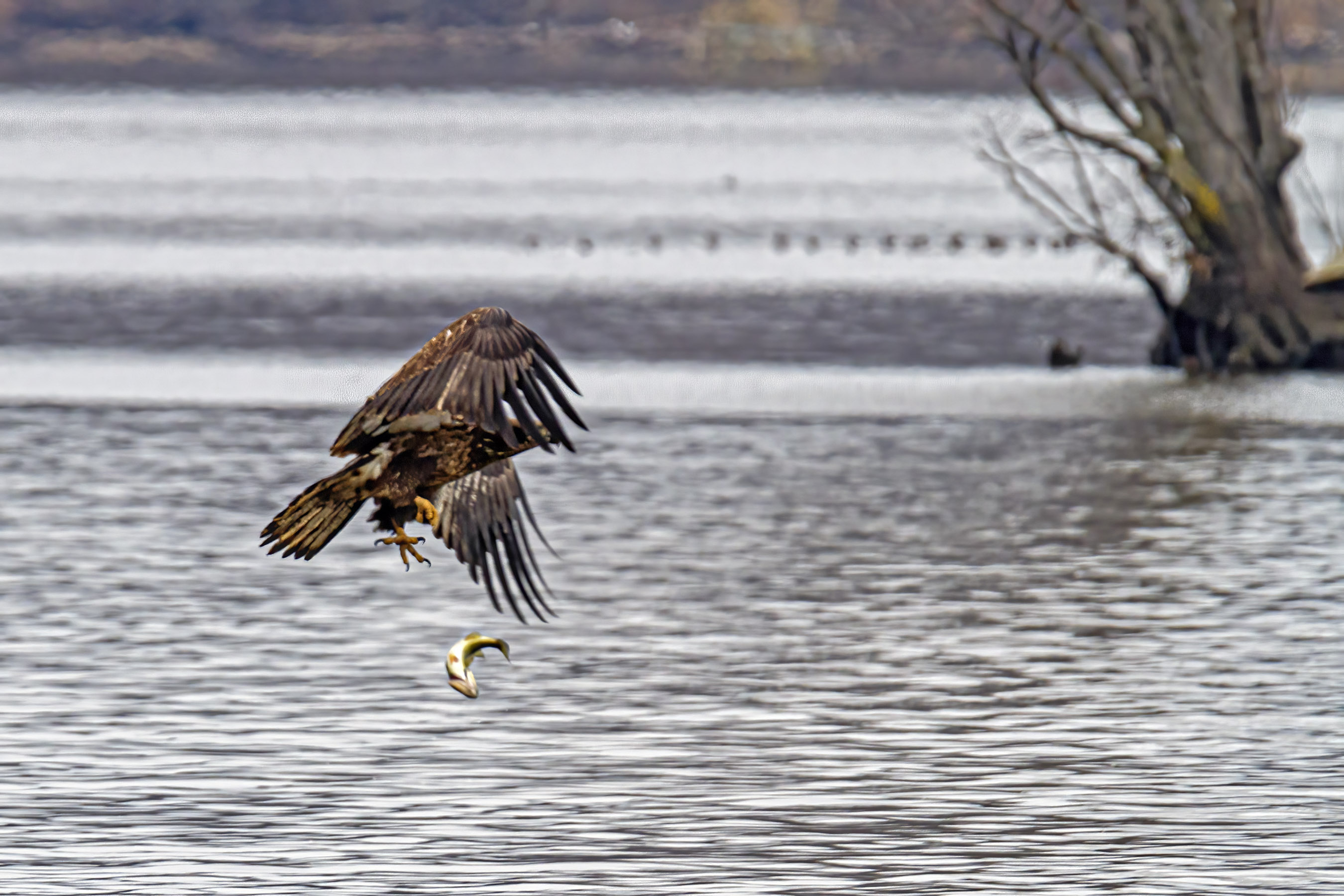
Last Thursday I spent some time observing a juvenile Bald Eagle (Haliaeetus leucocephalus) at Occoquan Bay National Wildlife Refuge that, judging from the coloration of its plumage, I guessed was about a year old. The eagle unexpectedly dropped to water level and I saw a small splash, suggesting to me that it had caught a fish. I snapped off a couple of quick shots as the eagle took to the air, hoping to capture an image of the eagle and the fish. I was so far away, though, that I doubted that I had captured an in-focus shot of the action.

When I later reviewed my photos on my computer, I was shocked to discover that the eagle had dropped the fish and that a couple of my photos actually showed the fish in mid-air. Perhaps the eagle was inexperienced at fishing or was distracted by some of the other eagles in the area. Whatever the case, the eagle did not yet seem aware that it had lost the fish when I captured the first image. A split second later, the eagle looked down and saw the falling fish that, alas, it was unable to recover.

Like most other fishermen, this eagle now has a story to share with his friends of “the one that got away.”

Bald Eagle

Bald Eagle

© Michael Q. Powell. All rights reserved.
Read Full Post »

Sometimes I am able to carefully compose my photos and ensure that I have the proper settings on my camera.  Frequently, though, I am forced to react instantaneously and merely point and shoot, with a primary goal of keeping my subject within the frame and hopefully in focus. Landscape and studio photographers may have the luxury of using  a slower, more deliberate process, but wildlife photographers rarely do.

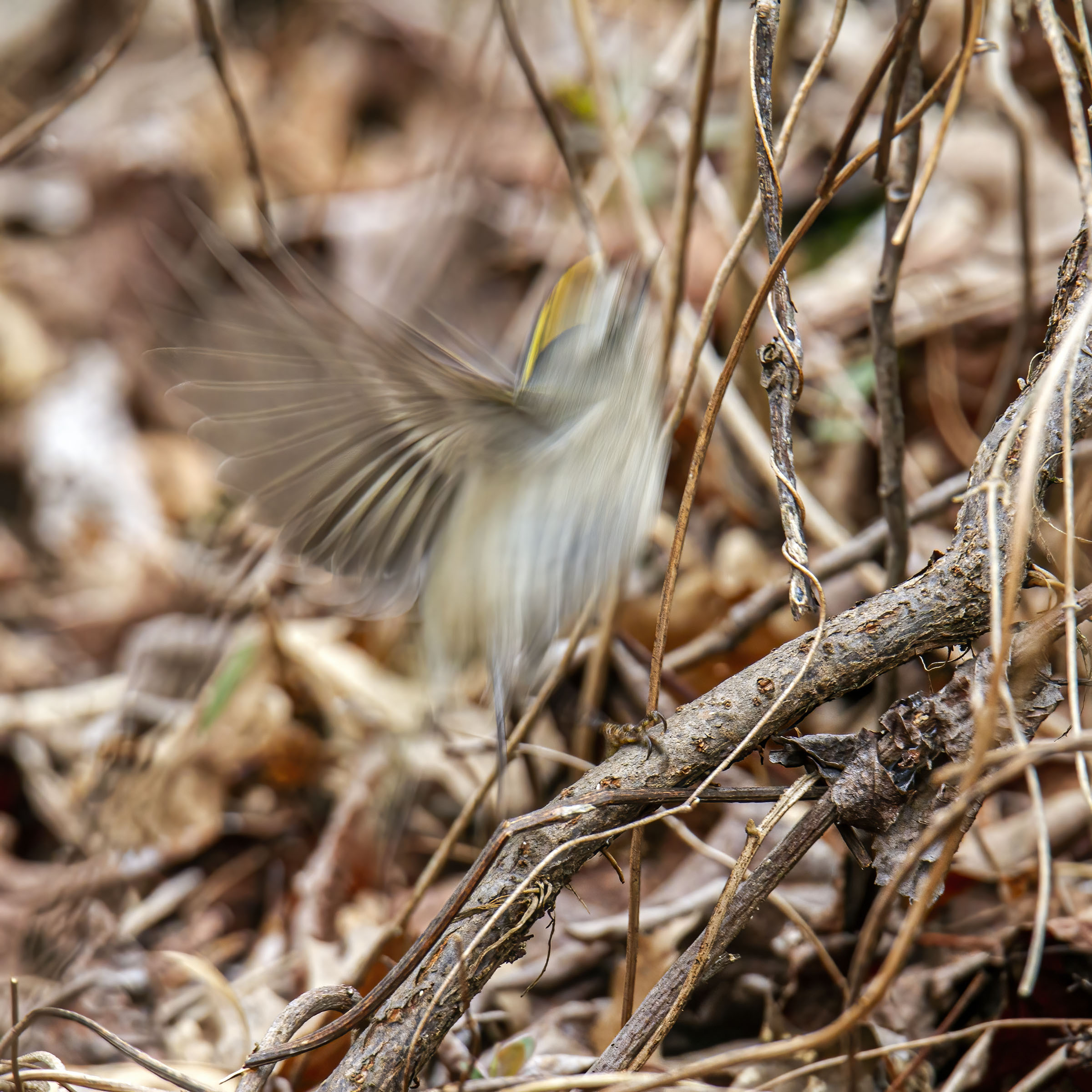
On Thursday I spotted a tiny Golden-crowned Kinglet (Regulus satrapa) in a tree at Occoquan Bay National Wildlife Refuge. The kinglet, which is only about four inches (10 cm) in length, was frenetically moving from branch to branch and I had trouble tracking it in my viewfinder. Suddenly it dropped down to ground-level and was briefing in the open.

I reacted quickly and fired off a short burst of shots. Amazingly, one of them came out pretty well, the first image that you see below. Why do I say “amazingly?’ My Tamron 150-600mm lens was fully extended  to 600mm and the lens is supposed to be “soft” at that focal length. More importantly, the shutter speed was only 1/125th of a second. However, I was able to get away with such a slow shutter speed because I was using a monopod, which helped to steady my camera.

A slow shutter speed may have been ok for a stationary subject, but it was no match for a moving one. A split-second after the first image, I captured the second image below in which the kinglet is almost completely blurry, though the branch on which it is perched is still pretty sharp. Note, however, that one of the kinglet’s feet is still on the branch and is in focus. Apparently I capture the moment when the kinglet was starting to flap its wings, but had not yet pushed off from the branch.

Although I have referred to “my” technique as “point and shoot,” there actually is some pre-planning involved. I am familiar enough with my favorite wildlife refuge that I know which subjects are likely to be found in specific locations. I also try to pay attention to my camera settings and adjust them to the amount of light available to increase the chances of getting a proper exposure for my reactive shots.

Golden-crowned Kinglet

Golden-crowned Kinglet

© Michael Q. Powell. All rights reserved.

Read Full Post »

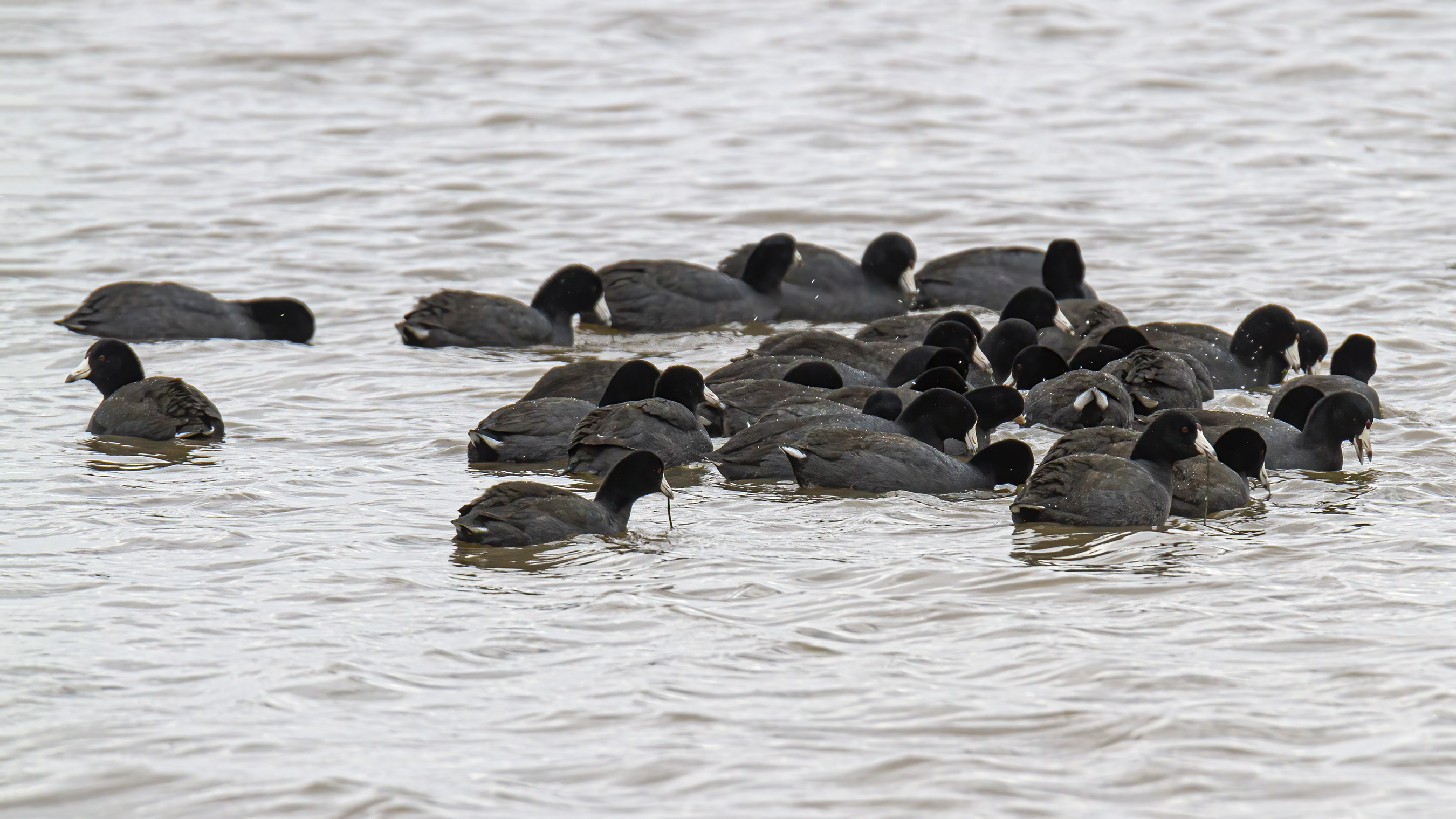
On Monday I spotted a large raft of American Coots (Fulica americana) in the waters off of Occoquan Bay National Wildlife Refuge. Some of the coots were clustered so tightly together that that it reminded me of the Metro at rush hour. Many of us seem to like a bit more “personal space,” but these coots did not seems to mind being shoulder-to-shoulder with each other. Do birds have shoulders?

I have no idea how many coots were in this group, but there seemed to be hundreds of them, as you can see in the second image. If you look closely at that photo, you may notice some other species, including some scaups, intermixed with the coots. The image is mostly made up of shades of gray, which make the brown tones of several of the ducks near the center of the frame really stand out.

I visited the same wildlife refuge yesterday and did not see a single coot—I guess they were just passing through our area.

American Coots

American Coots

© Michael Q. Powell. All rights reserved.
 

Read Full Post »

Whenever I am walking on the trails at Occoquan Bay National Wildlife Refuge, I am always on the lookout for Bald Eagles (Haliaeetus leucocephalus). At this time of the year especially I keep my eyes for signs of new eagle nests. At the moment, I am aware of three nesting sites on the refuge, although I am not sure if all three are being used this year.

On Monday I spotted the bright white head of a mature Bald Eagle in a distant tree. As I trained my long telephoto lens on the eagle, I noticed that it was perched just above what looked to be a nest. I moved a bit further down the trail to get a somewhat less obstructed view of the nest and looked carefully to see if I could spot an eagle sitting in the nest.

Although I was standing quite still and was partially hidden from view by heavy vegetation, the eagle seemed to sense my presence and took off. I was happy to be able to capture a couple of shots of the eagle as it was flying away.

This may be another new nesting site or it may be a view of one of the newest nest from a different angle than I usually see it. Several roads at the refuge are not closed to protect the nesting eagles, so there is really only one nest that I can monitor closely—the very large nest that I have repeatedly featured in blog postings.

Bald Eagle

Bald Eagle

Bald Eagle

© Michael Q. Powell. All rights reserved.

Read Full Post »

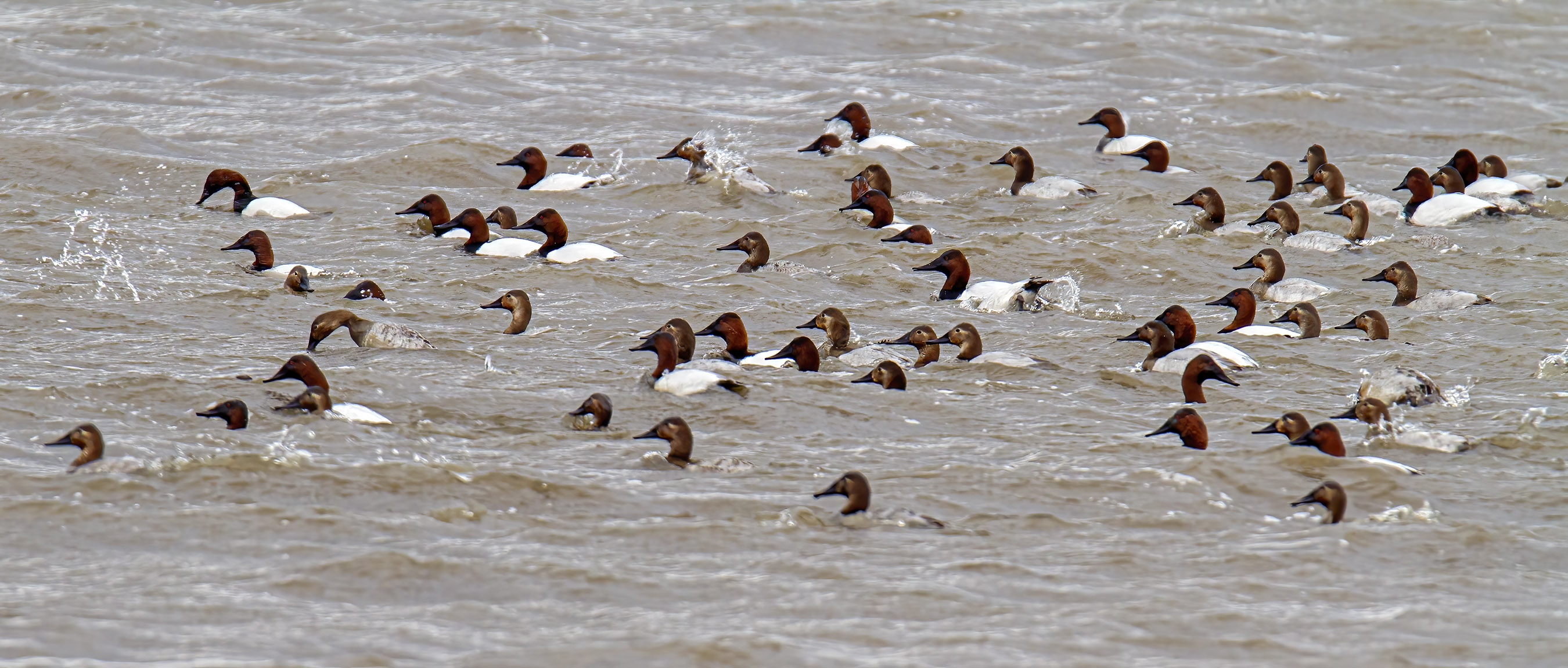
There were lots and lots of ducks in the waters off of Occoquan Bay National Wildlife Refuge on Monday, including this group of what look to be Canvasback ducks (Aythya valisineria), a species that I do not see very often. As the Cornell Lab of Ornithology notes, the Canvasback is a “diving duck that is gregarious during the nonbreeding season, forming large single-species rafts or mixing with Redheads and scaups. It dives underwater to feed on plant tubers, seeds, and clams.” If you look closely at the first photo, you can see several Canvasbacks in the process of diving as the group slowly swam by me in the deep waters of the bay.

Most of the ducks were quite far away and stayed with the group, but one of them came a little bit closer to shore. I am not certain what the duck was doing, but it was bending, twisting, and stretching its body, coming partially out of the water several times, as you can see in the second image. As the Canvasback was doing those “exercises,” a smaller Pied-billed Grebe swam into view in the background and I captured the third image—I love it when I can capture two different species in a single frame.

Canvasback ducks

Canvasback

canvasback

© Michael Q. Powell. All rights reserved.

Read Full Post »

This Great Blue Heron (Ardea herodias) was slowly striding through the shallow water at Occoquan Bay National Wildlife Refuge when I spotted him yesterday afternoon. He seemed to have a swagger in his step, showing off like he was walking on a catwalk and knew how handsome he looked. I really liked his pose and posture and the cool reflection in the water was a nice bonus.

Great Blue Heron

© Michael Q. Powell. All rights reserved.

Read Full Post »

During a visit in late January to Occoquan Bay National Wildlife Refuge, I was thrilled to spot a female Belted Kingfisher (Megaceryle alcyon). The kingfisher was perched relatively in the brush a pretty good distance away and surprisingly did not seem to be aware of my presence. Normally kingfishers are really skittish and often fly away before I am within the range of my camera.

This kingfisher seemed to be a little distracted by a helicopter that was flying overhead and kept glancing upwards, as you can see in the second photo. The chestnut-colored stripe on the breast of the bird helps me to identify it as a female, because males have no such stripe.

Belted Kingfisher

Belted Kingfisher

Belted Kingfisher

© Michael Q. Powell. All rights reserved.
Read Full Post »

Most of the times when I see a Bald Eagle (Haliaeetus leucocephalus) couple, one or more of the eagles is partially hidden from view. I spotted these two eagles in a sweetgum tree during a recent visit to Occoquan Bay National Wildlife Refuge and was delighted to see that I had an unobstructed view of both of them. Equally important for me was the fact that they were both at approximately the same distance from me, which meant that I could get them both in focus.

The eagles were alert and appeared to be surveying the landscape. I do not know for sure, but I suspect that the eagle on the right is the female, which tend to be larger in size than the male counterparts.

Bald Eagle couple

© Michael Q. Powell. All rights reserved.

Read Full Post »

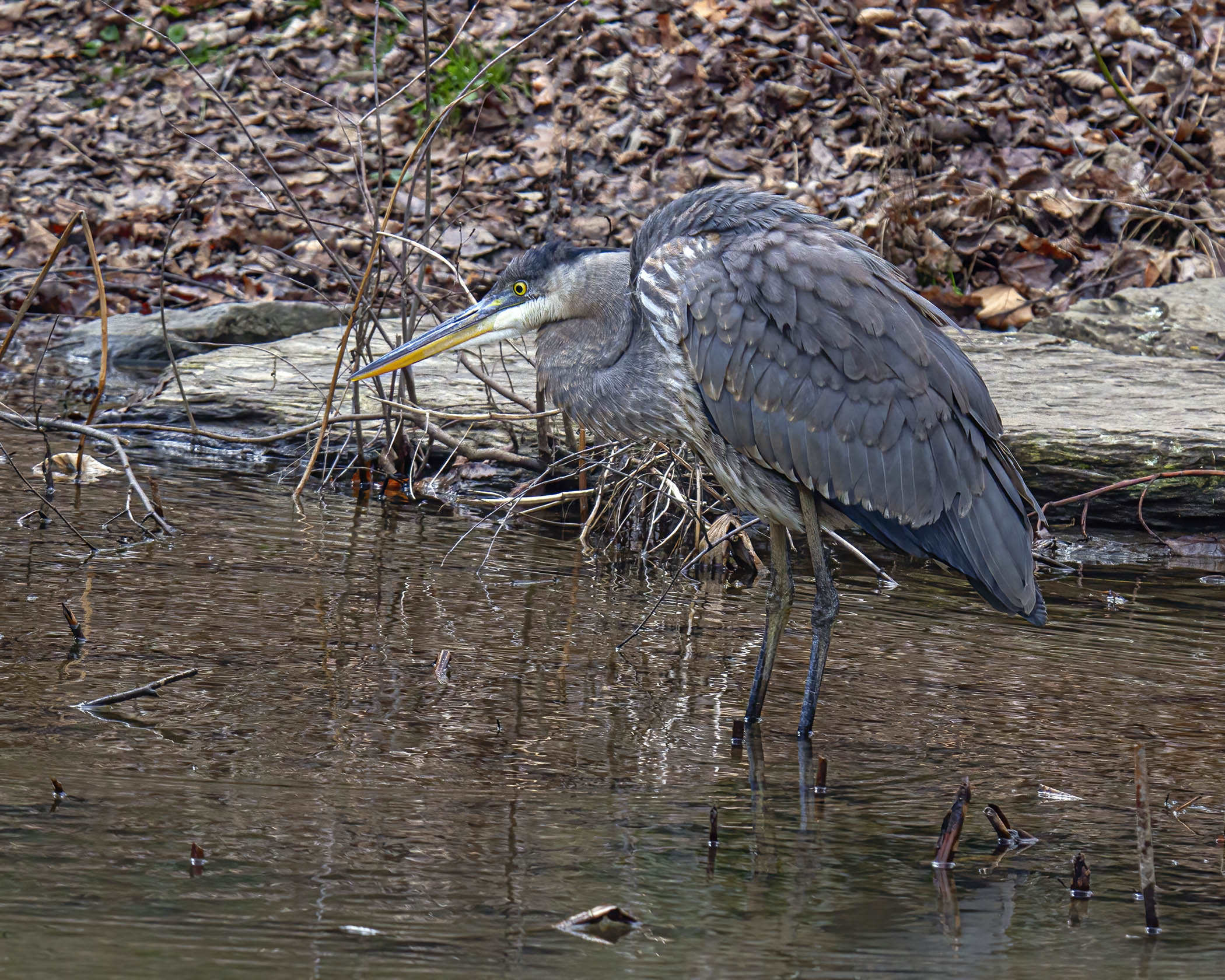
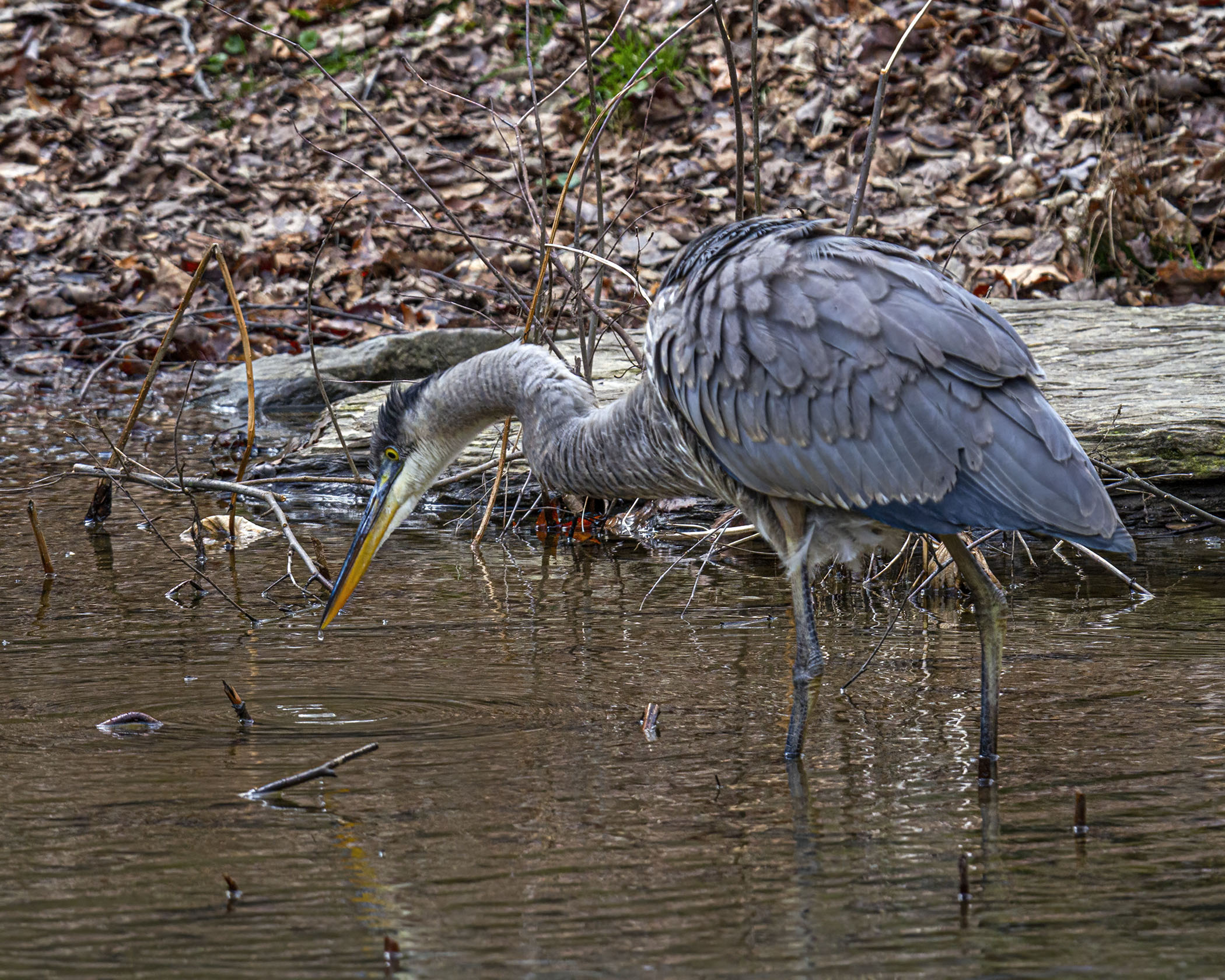
During a recent visit to Green Spring Gardens, a county-run historic garden in my area, I spotted a Great Blue Heron (Ardea herodias) that looked extra fluffy. I suspect that the heron had just fluffed up its feathers in an effort to stay warm.

Despite the cold weather, the heron was standing in the shallow water of a small, man-made pond, attempting to catch something to eat. The heron seemed to be carefully tracking some prey and plunged its beak into the water several times. During the time that I was observing it, however, the heron was unsuccessful in its fishing efforts.

Great Blue Heron

Great Blue Heron

© Michael Q. Powell. All rights reserved.

Read Full Post »

I love the way that the coloration of this Great Blue Heron (Ardea herodias) is an almost perfect match for the environment where I spotted it last week at Occoquan Bay National Wildlife Refuge.

Great Blue Herons are one of my most frequently photographed  subjects, especially during the winter months, and I am always looking for unique ways to capture images of them. From a technical perspective, this image is far from perfect, but its aesthetic appeal really pleases my eye—in addition to the colors, I really like the variety of textures in the photo..

Have a wonderful weekend.

Great Blue Heron

© Michael Q. Powell. All rights reserved.


Read Full Post »

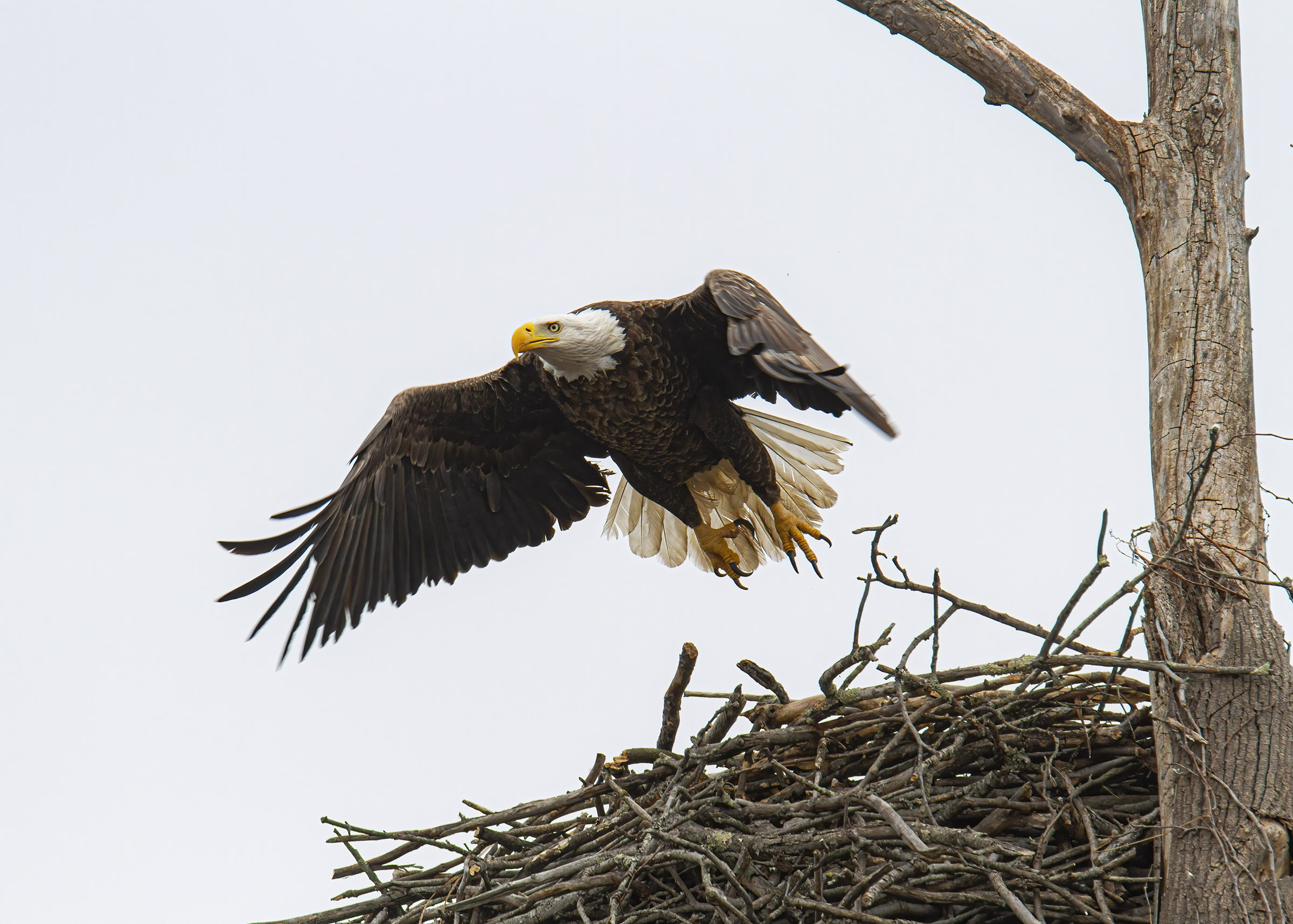
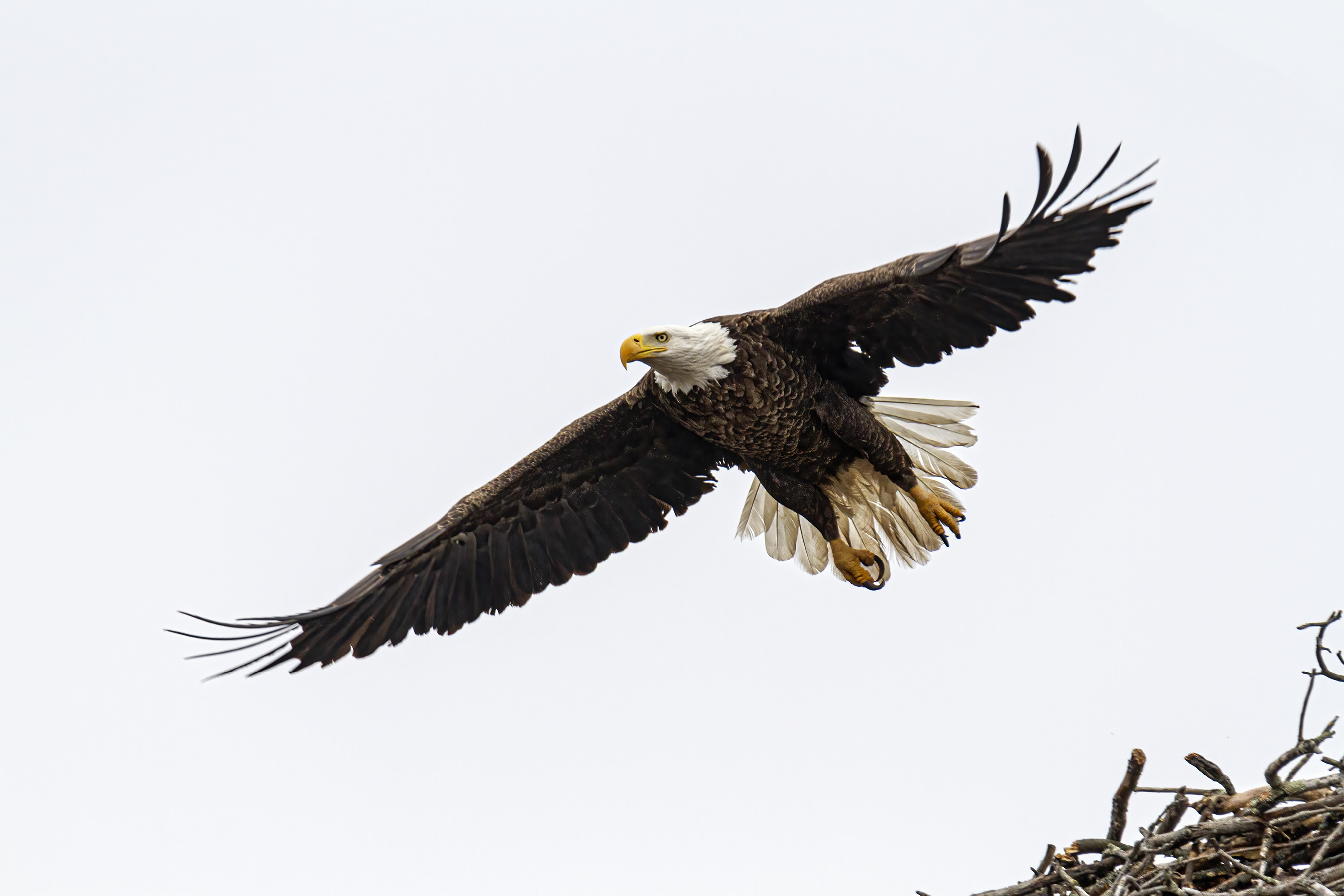
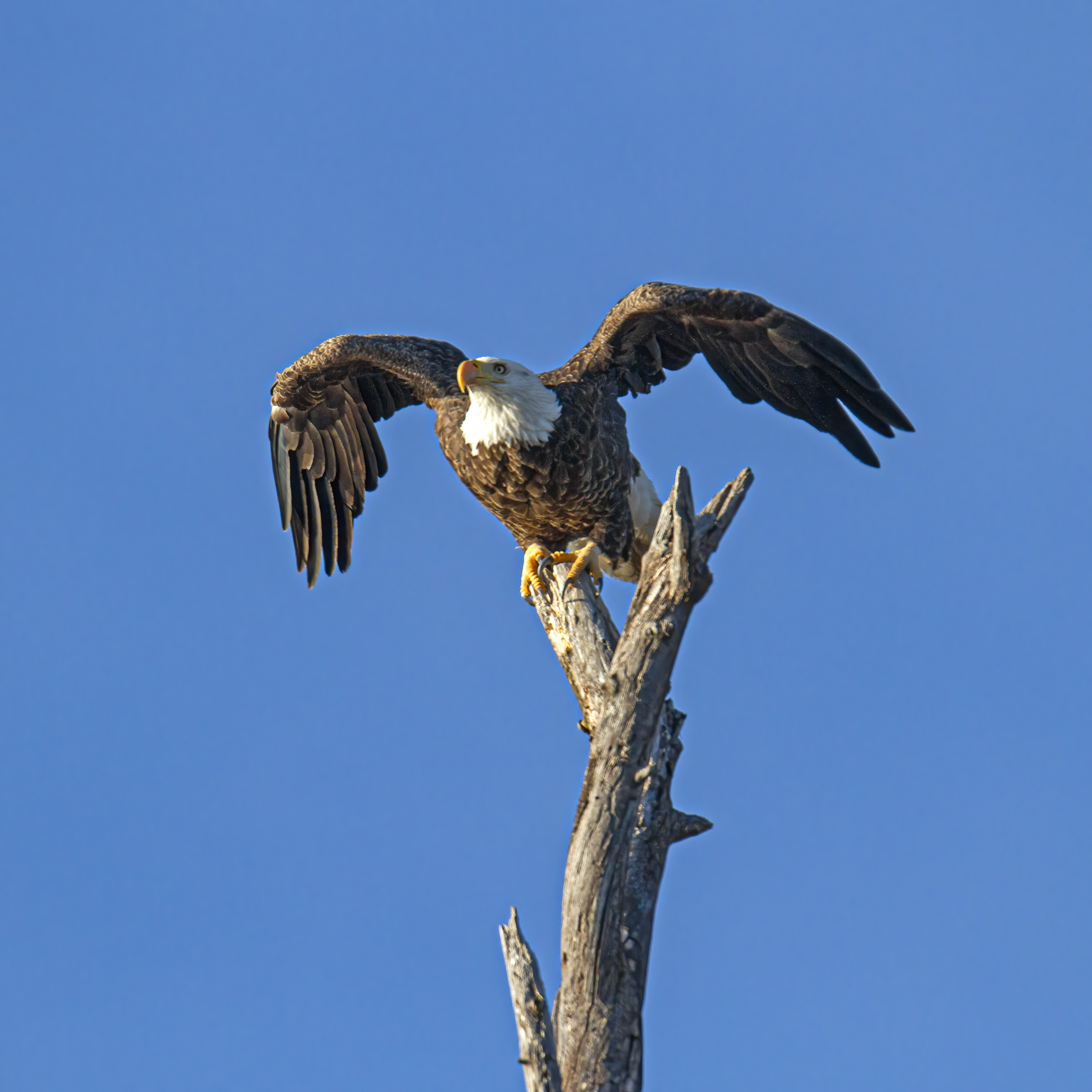
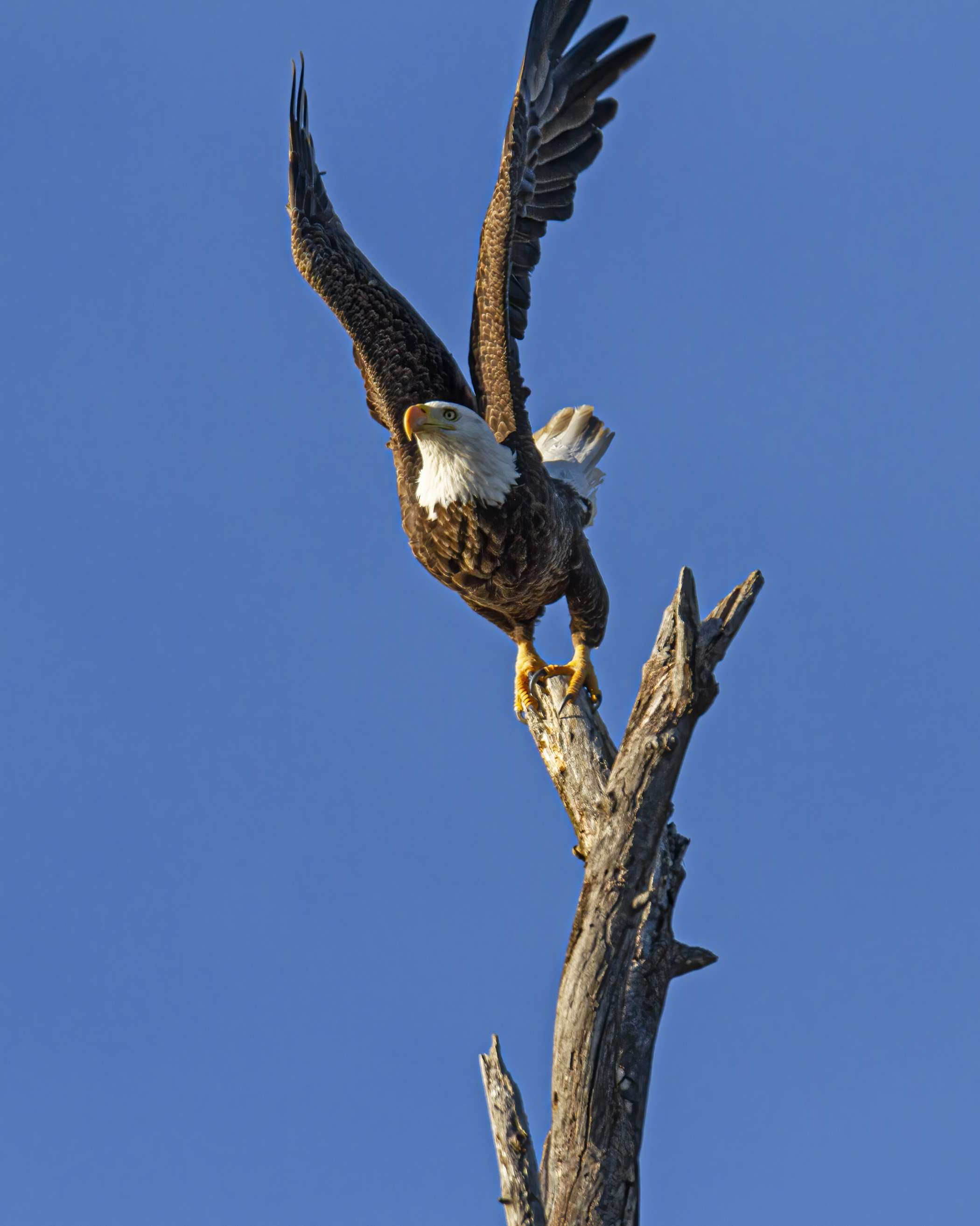
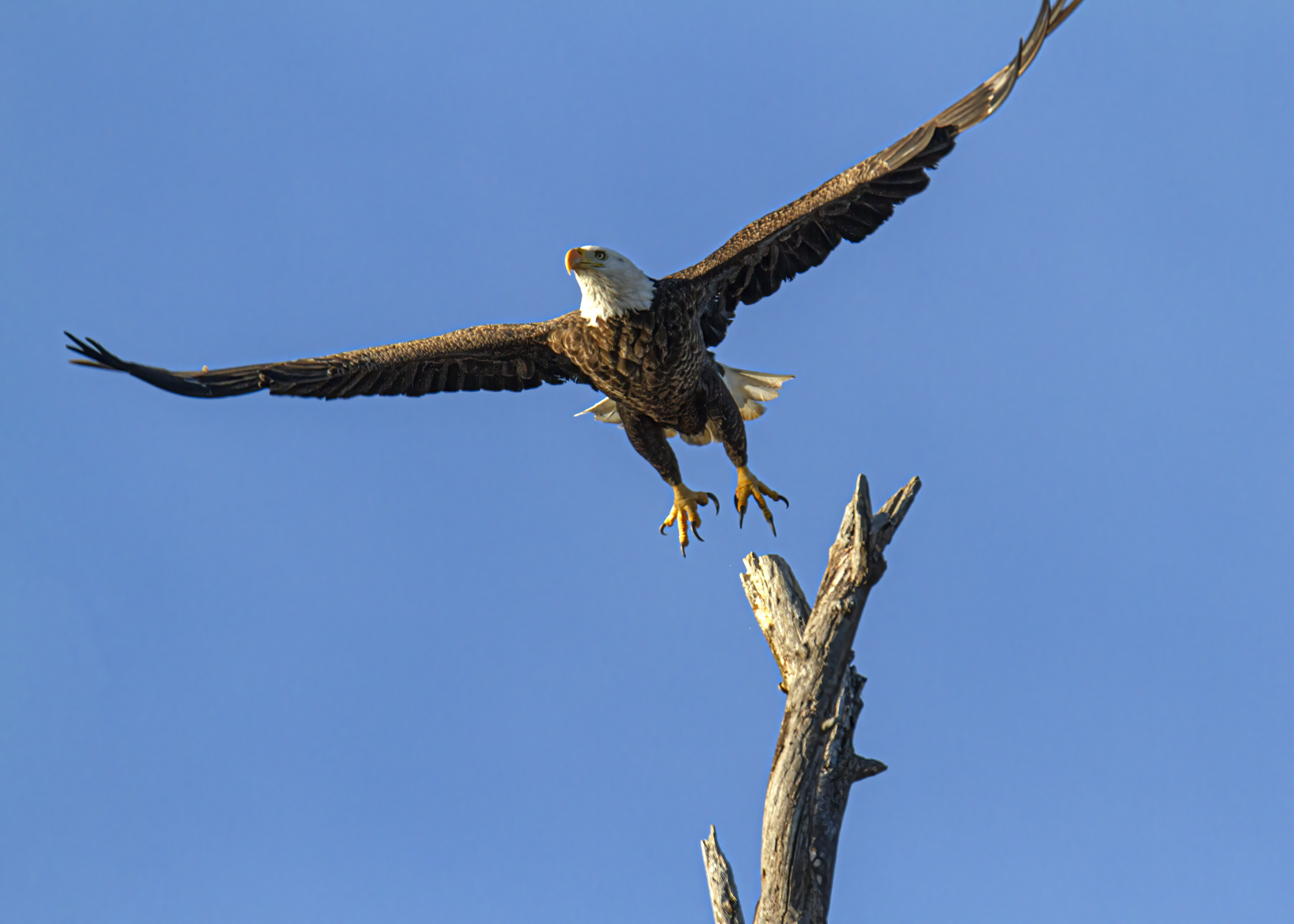
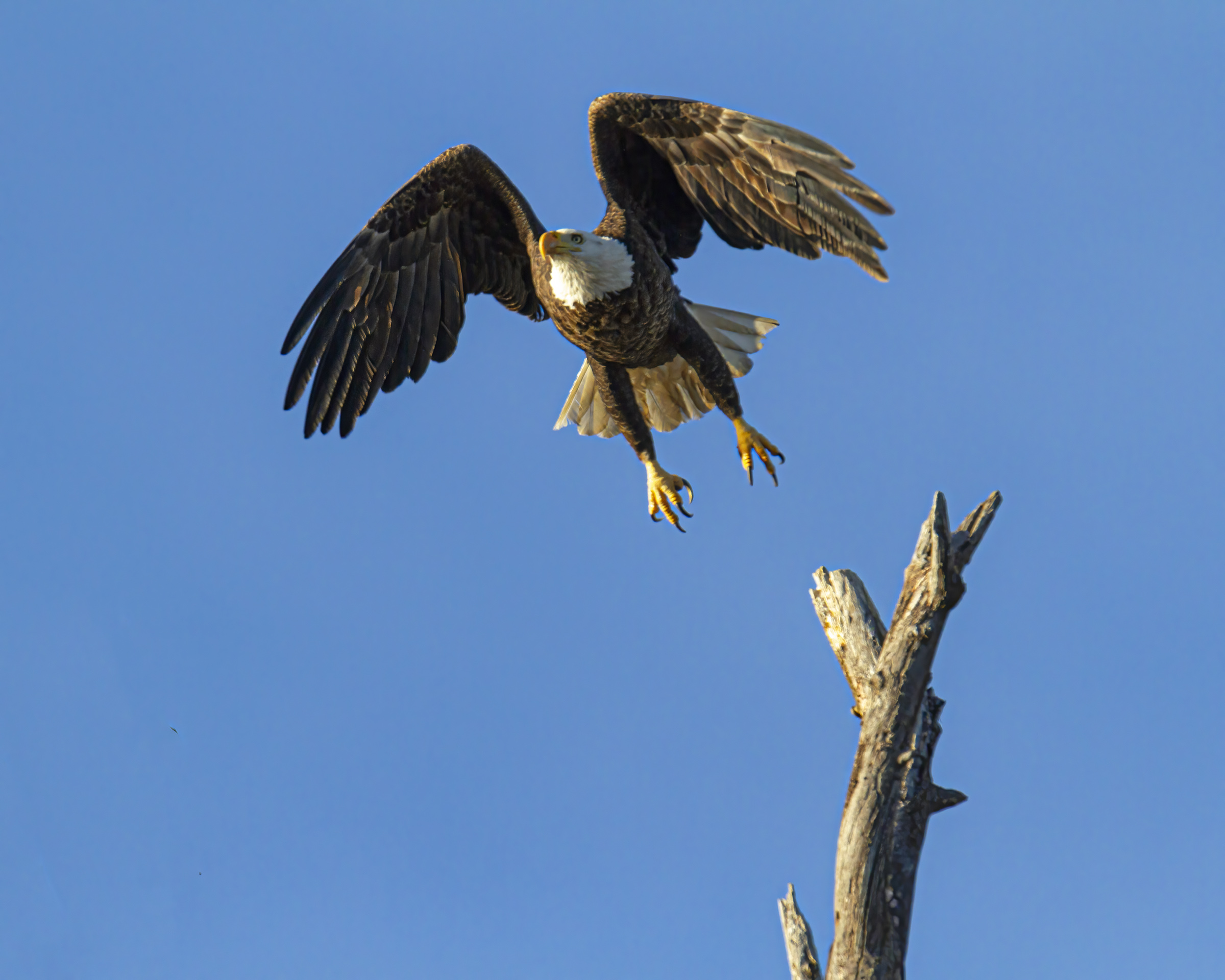
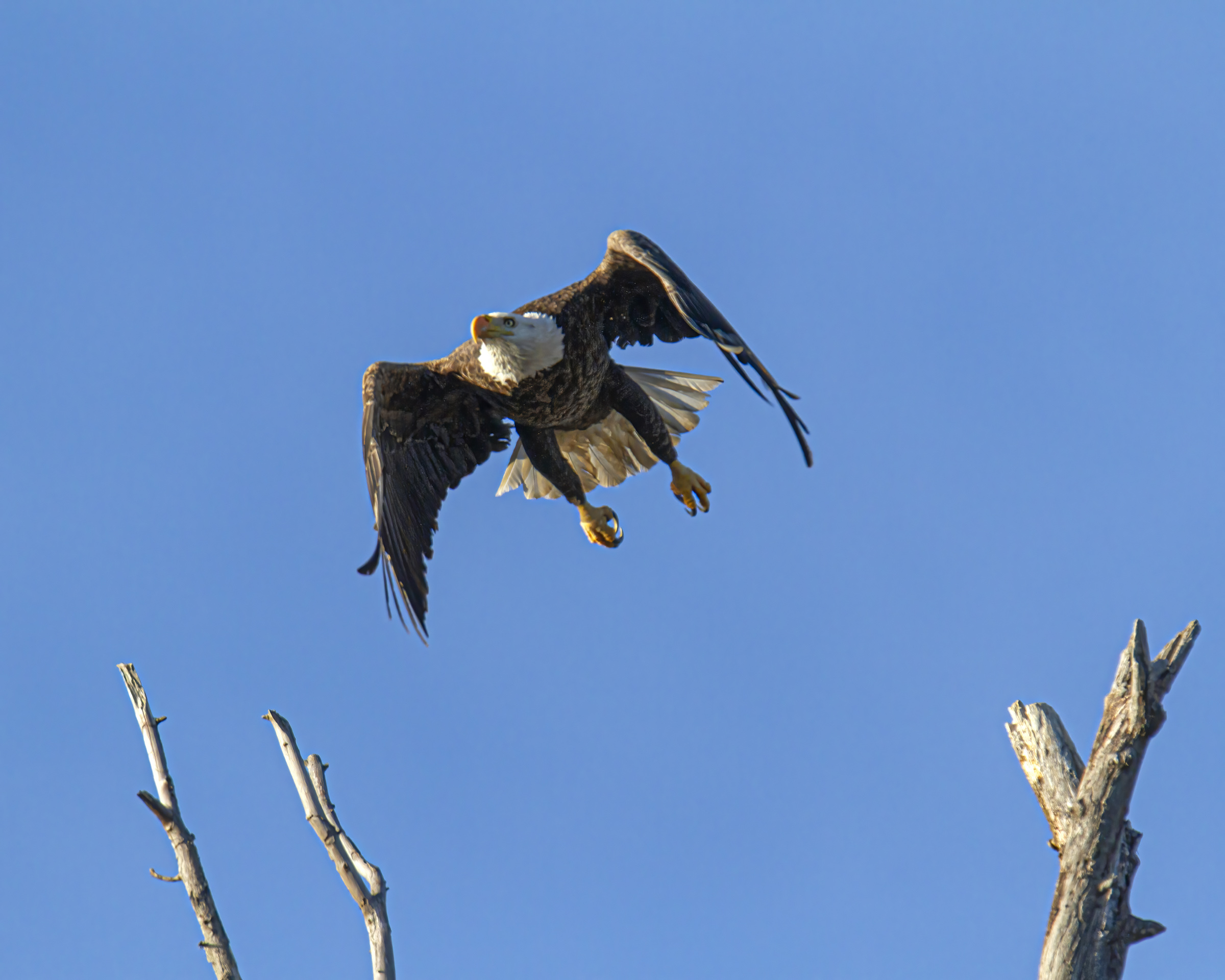
This Bald Eagle (Haliaeetus leucocephalus) was perched just above the large nest last Tuesday at Occoquan Bay National Wildlife Refuge. I was ready when the eagle started to extend its wings, as you can see in the first photo, and managed to capture a series of shots during its takeoff. The images show a variety of the wing positions used by the eagle to lift off and fly forward.

The wings of the eagle were so long that when it extended them upwards, the tips were out of the frame—note that the eagle’s feet were still on the perch in the second photo. When the eagle extended its wings fully to the side and moved upwards into the air, I once again was not quick enough to zoom out and clipped the tips of one wing in the third shot. The final two photos show some additional positions of the wings as the eagle continued to move away from its perch.

The day when I captured these images was an unusually fruitful one for me. I had multiple encounters with eagles and came away with some pretty good shots. As most wildlife photographers are well aware, those kind of day are quite rare, so I was happy to take advantage of my good fortune when the opportunities arose.


Bald Eagle

Bald Eagle

Bald Eagle

Bald Eagle

Bald Eagle

© Michael Q. Powell. All rights reserved.

Read Full Post »

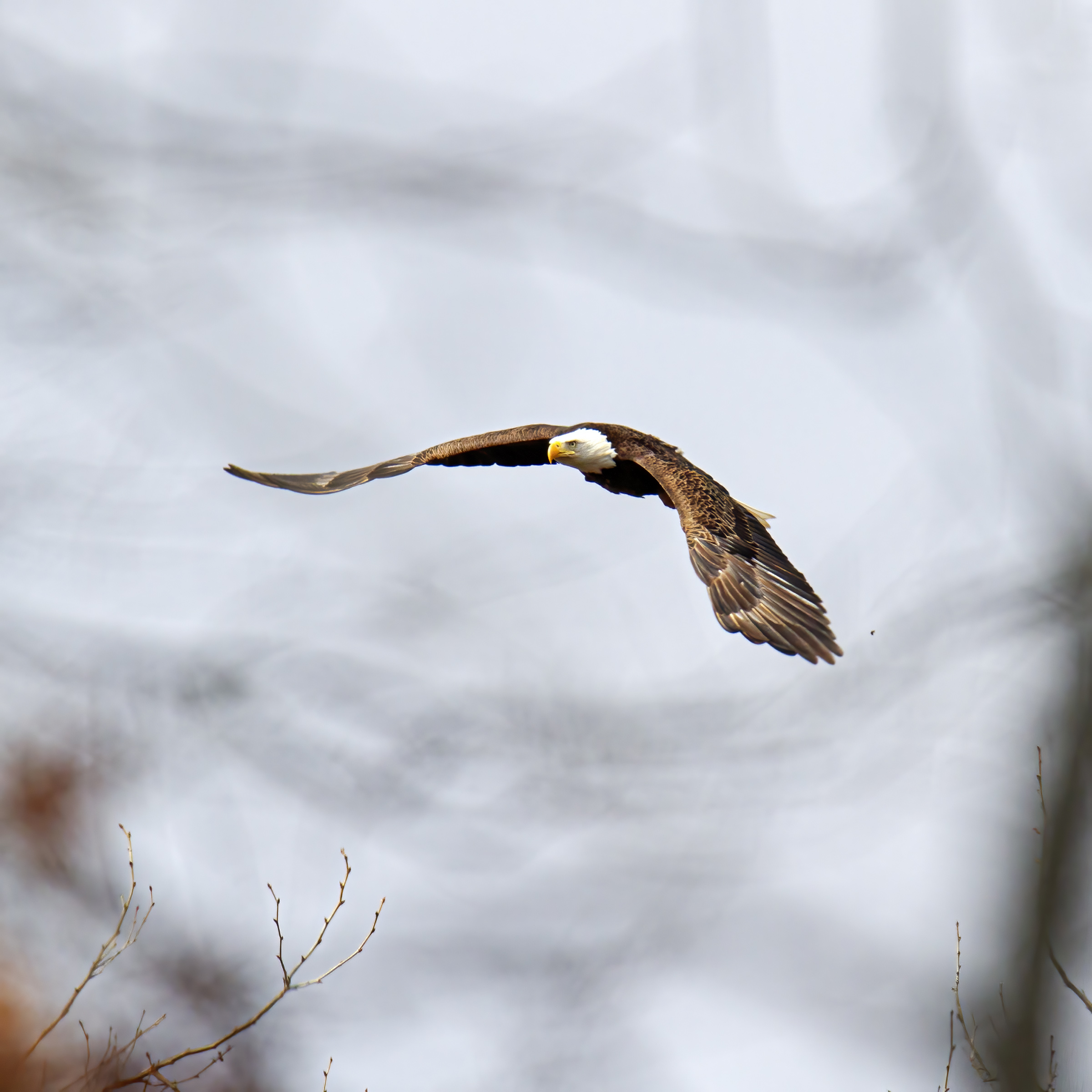
I initially hesitated to post another sequence of shots of a Bald Eagle (Haliaeetus leucocephalus) takeoff, given that I posted a similar set of photos in yesterday’s blog posting. However, I never tire of seeing eagles and I hope that you agree with me. Unlike yesterday’s eagle that flew downward and away from me, the eagle in these shots had a more level flight path and I was able to capture a couple of images as it zoomed past me.

Eagles are a tough subject to photograph because of the extreme contrast between the white feathers on their heads and the dark feathers on their bodies. If the exposure is too far off from what it should be, it is easy to blow out the highlights on the head or to have super deep shadows on the body, both of which lead to a loss of details. When I took these shots, the light was pretty bright, creating shadows that further complicated my efforts.

None of these images is quite as sharp as I would like them to have been, but I am pretty happy with the overall results. Eagles are special and I consider any day when I spot one to be a good day. Capturing shots of one is a bonus.

Bald Eagle

Bald Eagle

Bald Eagle

© Michael Q. Powell. All rights reserved.

Read Full Post »

Whenever I am observing a perched Bald Eagle (Haliaeetus leucocephalus), I look for signs that it is preparing to take off. Sometimes there are little clues, like a flex of the wings or a slight movement of the feet, but quite often there is no warning. Usually I have my camera on a monopod, so my arms do not get fatigued as I try to stay ready and focused.

When the eagle actually takes to the air I have to track the movement and anticipate the direction in which the eagle will fly so that I can keep my subject within the frame. In the second image, for example, the eagle could have flown up into the air, but instead, as you can see in the third image, the eagle flew downwards. I was a little slow in following the bird and in the next frame, which I did not post, only half of the eagle was visible.

During a typical visit to the wildlife refuge, I am fortunate if I have one or two encounters of this sort, so I feel a little pressure to take advantage of each opportunity. There are so many variables over which I have no control that success is far from being guaranteed. No matter how good my shots may be, I am always convinced that I can get better ones, which helps to motivate me to go out again and again with my camera.

Technology is always advancing and some of the newer cameras have amazing capabilities to track moving subjects and stay focused on their eyes. Recently I watched a video on YouTube entitled “What is the SKILL and TALENT of a Wildlife Photographer” in which Scott Keys, a wildlife photographer, discussed the relative importance of personality traits, skill, talent, and gear in getting good photos. I highly recommend that you watch this video if you have ever thought about this issue.

Scott and I both agree that the most important of these four is the personality—you need to be patient and persistent, observant and aware in order to maximize the number of opportunities to get “the shot.” Knowledge and practice, which is how I would define skill, would be next in priority order for me. Gear would be in third or even fourth place and talent, i.e. God-given ability, occupying the remaining slot.


Bald Eagle

Bald Eagle

Bald Eagle

© Michael Q. Powell. All rights reserved.

Read Full Post »

I love the quirky, almost abstract feel of this image of a Northern Cardinal (Cardinalis cardinalis) that I captured last Tuesday at Occoquan Bay National Wildlife Refuge. The cardinal was foraging at water’s edge in the debris left behind by the receding tide.

One of the things that I most like about this shot is the contrast between the warmth of the color of the cardinal and the cool colors of the background. That contrast really helps the cardinal to “pop,” although male cardinals stand out in almost any circumstance during the winter, when gray tones seem to dominate and bright colors are exceedingly rare.

Northern Cardinal

© Michael Q. Powell. All rights reserved.

Read Full Post »

It can be a real challenge to get shots of tiny little songbirds, like this Ruby-crowned Kinglet (Corthylio calendula) that I spotted last week at Occoquan Bay National Wildlife Refuge. These kinglets are only about 4 inches (10 cm) in length and move about continuously in the vegetation. I love the description of them on the Cornell Lab of Ornithology website, “A tiny bird seemingly overflowing with energy, the Ruby-crowned Kinglet forages almost frantically through lower branches of shrubs and trees. Its habit of constantly flicking its wings is a key identification clue.”

Generally I strive to isolate my subject from the background, but that is virtually impossible with this species, which rarely seems to perch in the open. In this case, I took over a dozen shots of the kinglet and this was the only one that came out ok.

Some of you may have noticed that I have not posted for several day, which is somewhat unusual for me—I try to do a blog posting every day. This weekend, however, I drove to Massachusetts, about 600 miles (965 km) each way, for a family funeral. During my time there, I chose to disconnect myself from the internet and am only now catching up on my e-mail and blog postings.

Ruby-crowned Kinglet

© Michael Q. Powell. All rights reserved.

Read Full Post »

I was thrilled on Tuesday to capture this image of a Great Blue Heron (Ardea herodias) as it flew by me, low over the waters off of Occoquan Bay National Wildlife Refuge. I love the way that the heron was stretched out, almost as straight as an arrow in flight.

Great Blue Heron

© Michael Q. Powell. All rights reserved.

Read Full Post »

My head was spinning a little as I tried to track a small bird that was moving up and down and around and around a tree last week at Occoquan Bay National Wildlife Refuge. At first I thought it might be a woodpecker, but when I finally got a good look at it, I realized that it was a White-breasted Nuthatch (Sitta carolinensis).

In the past, most nuthatches that I have seen were moving downwards on a tree trunk, but this one was moving upwards most of the time that I was observing it. I was happy to be able to capture some shots of the nuthatch in action.  Eventually I even managed to capture the “traditional” nuthatch pose in the final photo in which the nuthatch is perched upside-down with its head craned upward and backward.

White-breasted Nuthatch

White-breasted Nuthatch

White-breasted Nuthatch

© Michael Q. Powell. All rights reserved.


Read Full Post »

It is hard to read body language in humans and almost impossible to do so with other species. It is still fun, though, to engage in a bit of anthropomorphism and imagine what was going on between the two Bald Eagles (Haliaeetus leucocephalus) that I spotted last Wednesday at Occoquan Bay National Wildlife Refuge.

The two eagles were sitting closely together on a single branch of a sweetgum tree and are almost certainly a couple. Despite their physical closeness, there seems to be a psychological distance between the two and the eagle on the right has its back turned to its partner. I can’t tell if the eagle on the right is angry or disappointed, but it appears to me to be pouting a bit. What ever the case, I sense a certain amount of tension between the two.

What do you think is going on in this image? I’d love to hear your creative thoughts about the eagle interaction.

Bald Eagle

© Michael Q. Powell. All rights reserved.

Read Full Post »

This Gray Catbird (Dumetella carolinensis) had to extend its wings for balance as it reached down to grab a berry on Wednesday at Occoquan Bay National Wildlife Refuge. A second or so the catbird seemed to be planning its angle of attack on the berry as you can see in the second photo below. I am always amazed at the degree to which a bird can calibrate its actions to keep from falling off of a branch on which it is perched.

Judging from the range maps in my bird guides, Gray Catbirds are in my area throughout the year, but I rarely see one. According to the Cornell Lab of Ornithology, “The Gray Catbird belongs to the genus Dumetella, which means “small thicket.” And that’s exactly where you should go look for this little skulker.” As you may be able to tell from the photos, the catbird remained pretty well-hidden in the vegetation and I consider myself lucky to have gotten these relatively unobstructed shots of the bird.

Gray Catbird

Gray Catbird

© Michael Q. Powell. All rights reserved.

Read Full Post »

The weather had warmed up enough that by Wednesday all of the ice had melted at Occoquan Bay National Wildlife Refuge. This made things a bit easier for the Great Blue Heron (Ardea herodias) that I spotted patiently fishing in the shallow waters of one of the small ponds at the refuge.

Although he did not catch any large fish while I was observing him, he did catch a number of small ones, including the one that I captured in this sequence of photos.

Great Blue Heron

Great Blue Heron

Great Blue Heron

© Michael Q. Powell. All rights reserved.

Read Full Post »

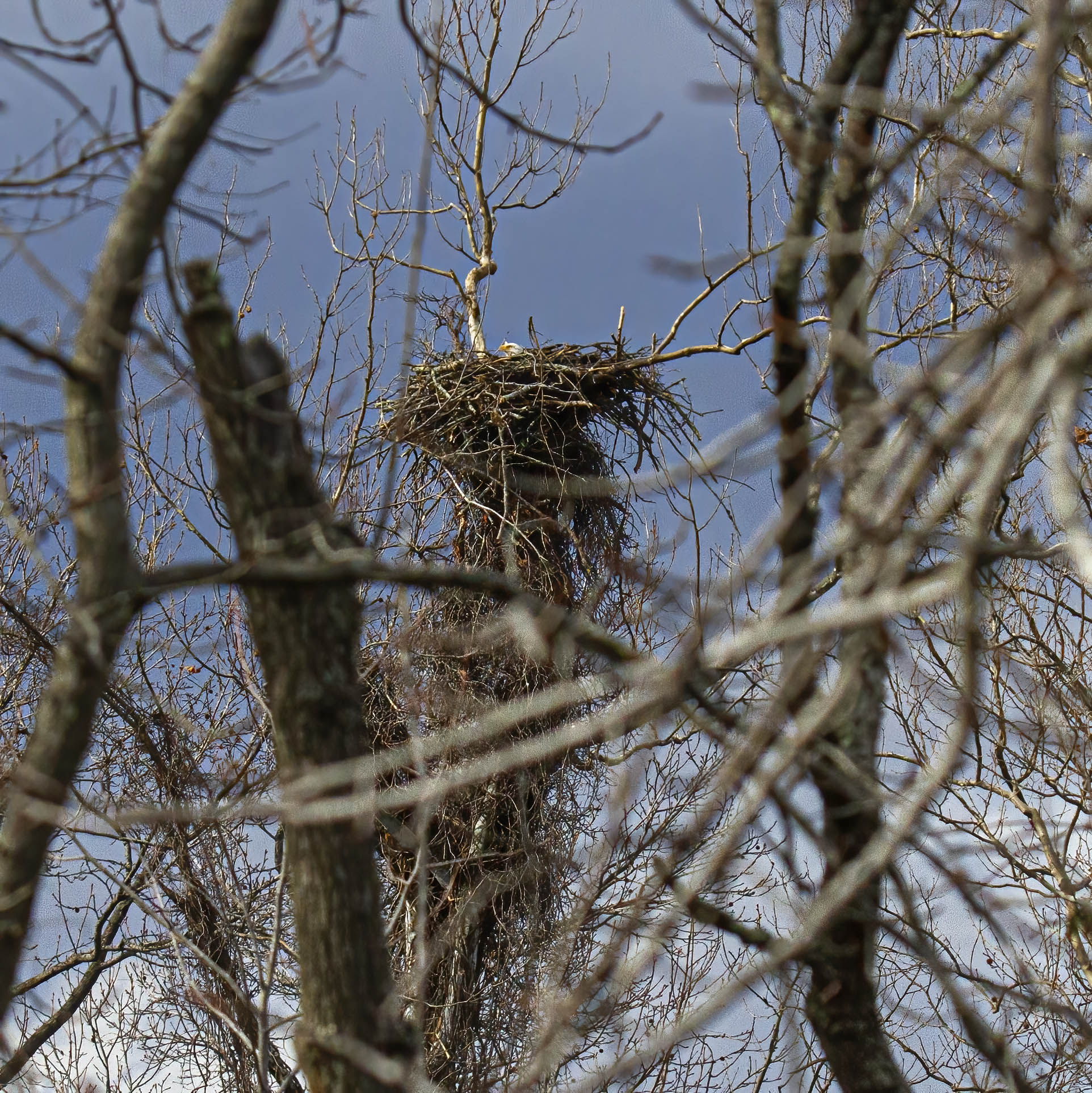
For several years I have keeping an eye on two Bald Eagle (Haliaeetus leucocephalus) nests at Occoquan Bay National Wildlife Refuge. One of them is adjacent to several trails, so each year the authorities close portions of those trails to keep the nesting eagles from being disturbed. This year, an additional area was closed and a sign was posted indicating eagle nesting activity.

I knew more or less where the new nest was located, but I had trouble spotting it from the trails that are still open. On Wednesday, I was delighted to spot an eagle in the nest, as you can see in the first photo below. A second eagle was keeping watch over the nest from a nearby tree and I managed to get the second shot by zooming out with my Tamron 150-600mm telephoto lens.

There was quite a bit of vegetation between me and the tree where the new nest is located, so I had to move about a lot to get a relatively unobstructed view of the nest. I suspect that the nest will be completely hidden when leaves reappear in a few months. Until then, I will continue to observe the new nest with a hope of seeing some eaglets. The incubation period is about 36 days for bald eagle eggs, but I do not think that any eggs have yet been laid.

Bald Eagle

Bald Eagle

© Michael Q. Powell. All rights reserved.

Read Full Post »

Male Ring-necked Ducks (Aythya collaris) are rather odd ducks. They have an unusual pointed head and striking yellow eyes. However, they have a striped pattern on their bills that make them pretty easy to identify. Although they paddle about a lot like dabbling ducks, they will periodically dive to the bottom to eat submerged plants and aquatic invertebrates.

Despite their name, it is unusual to be able to see the chestnut collar on a Ring-necked Duck’s black neck. According to the Cornell Lab of Ornithology, the ring is “not a good field mark to use for identifying the bird, but it jumped out to the nineteenth century biologists that described the species using dead specimens.”

Like several other species that I have featured recently, this Ring-necked Duck was part of a small flock that I spotted swimming about in a small suburban pond not far from where I live. Sometimes in the winter I will make a quick visit to this pond when I to experience nature, but don’t have the time to devote to a trip to the larger wildlife refuges in my area.

Ring-necked Duck

Ring-necked Duck

© Michael Q. Powell. All rights reserved.

Read Full Post »

I love the spiky reddish “hairstyle” of a female female Hooded Merganser duck (Lophodytes cucullatus). I spotted this little beauty on Monday at a small suburban pond not far from where I live. Technically this is a “stormwater management facility,” but the pond is big enough and deep enough that a number of different duck species (and a lot of Canada Geese) are resident there during the winter months.

Hooded Merganser

© Michael Q. Powell. All rights reserved.

Read Full Post »

Normally Double-crested Cormorants (Phalacrocorax auritus) are distant dark-colored waterbirds. However, when the lighting is right, you can sometimes get a good look at their orange-colored faces and their striking blue eyes.

As you can see from these two images that I captured yesterday at a small suburban pond, cormorants tend to ride low in the water. It sounds strange for a bird that spends its time in the water, but the feathers of a cormorant are not completely waterproof and can become waterlogged. That is why you can sometimes spot cormorants perched with their wings spread open in an effort to dry them out.

Double-crested Cormorant

Double-crested Cormorant

© Michael Q. Powell. All rights reserved.


Read Full Post »

One of the tiniest birds that I see in the winter months is the Ruby-crowned Kinglet (Corthylio calendula). Birds of this species so small—about  3.5-4.3 in (9-11 cm) in length—and frenetic that it is rare for me to get an unobstructed view of one.

Even rarer, though, is a look at the ruby “crown,” which is usually hidden. If you look really closely at the top of the kinglet’s head in the first photo you can see a trace of red, but nothing more. The second shot provides a good look at the body of a kinglet with its head buried in the vegetation.

According to the Cornell Lab of Ornithology, Ruby-crowned Kinglets are “restless, acrobatic birds that move quickly through foliage, typically at lower and middle levels. They flick their wings almost constantly as they go.” Despite their energetic behavior, they do not need much food. “Metabolic studies on Ruby-crowned Kinglets suggest that these tiny birds use only about 10 calories (technically, kilocalories) per day.” Yikes!

Ruby-crowned Kinglet

Ruby-crowned Kinglet

© Michael Q. Powell. All rights reserved.

Read Full Post »

It is wonderful to capture images of Bald Eagles (Haliaeetus leucocephalus) in action, but most of the time when I spot one, the eagle is merely perching in a tree. Although the eagle is immobile, it is clearly keeping an eye on what is going on and is ready to spring into the air without warning.

Here are a couple of shots of perched eagle from a couple of recent visits to Occoquan Bay National Wildlife Refuge in Northern Virginia, about 15 miles (24 km) from where I live. The images are not spectacular or prize-worthy, but I nonetheless feel a special thrill whenever I see a Bald Eagle and doubly so when I manage to take a photo of it.

Have a wonderful weekend.

Bald Eagle

Bald Eagle

© Michael Q. Powell. All rights reserved.

Read Full Post »

« Newer Posts - Older Posts »