Feeds:
Posts
Comments

Archive for the ‘Bees’ Category

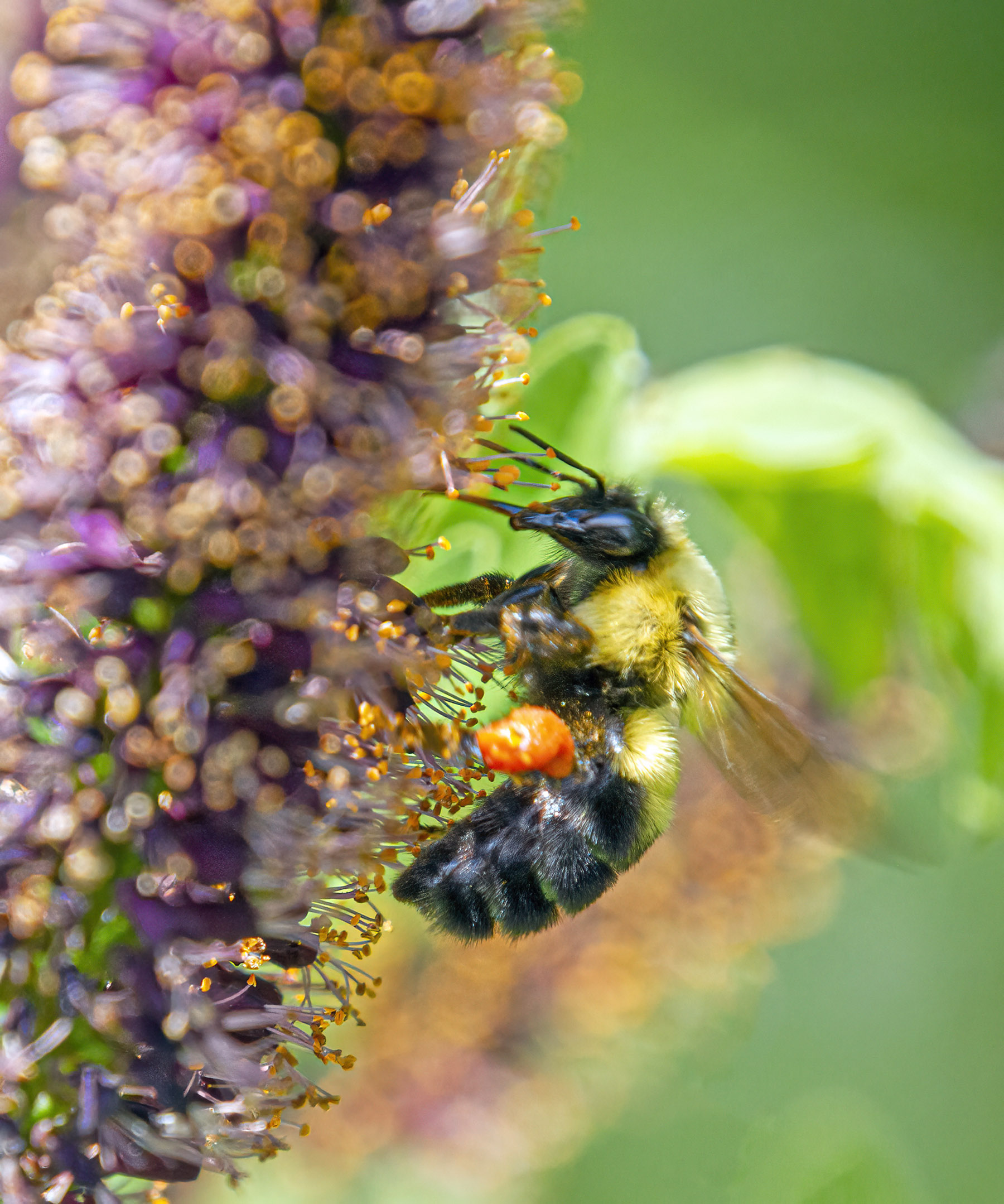
The colors of the False Indigo Bushes (Amorpha fruticosa) were spectacular on Monday at Occoquan Bay National Wildlife Refuge, attracting my attention as well as that of an energetic honey bee (g. Apis) whose pollen sacs were already filled to bulging. I was initially paying so much attention to focusing on the moving bee that I did not realize that my shutter speed had dropped to 1/400—I was in aperture priority mode. The first photo was a “happy accident: in which the bee’s face was in focus, but its rapidly-moving wings were a blur.

In the second shot, the bee had landed and was crawling all around the stalks of the false indigo bush. I am really happy with my snapshot of that action that captured the color and movement of my brief encounter with the honey bee.

honey bee and false indigo bush

honey bee and false indigo bush

© Michael Q. Powell. All rights reserved.

Read Full Post »

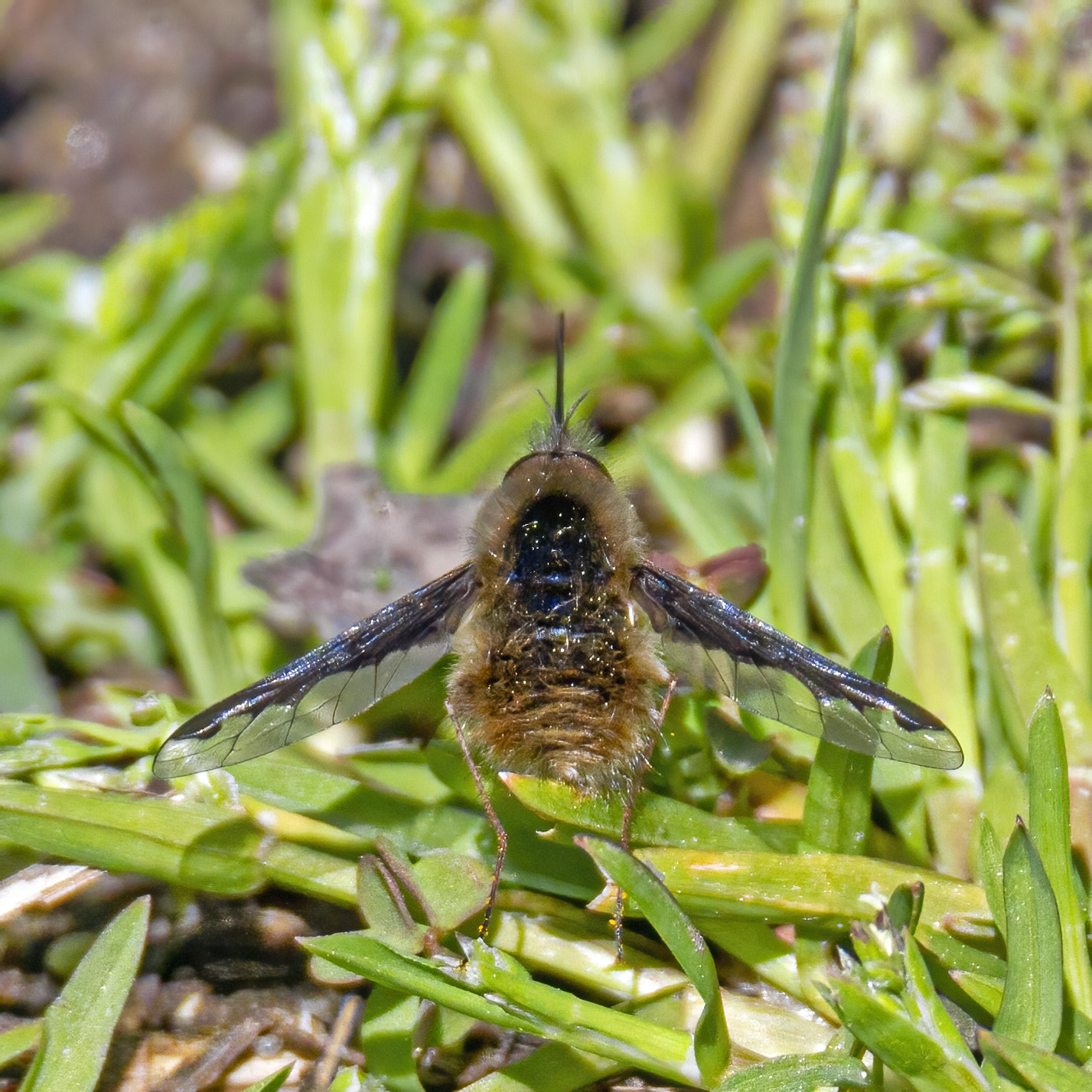
Is it a bee? Is it a fly? Well, it has a fuzzy body like a bumblebee and has a long, rigid proboscis that looks like a stinger, but its patterned wings and long legs look more like those of a fly. In actuality, it is a Greater Bee Fly (Bombylius major), a parasitic bee mimic that is one of the earliest spring pollinators of wildflowers. I photographed this bee fly last week at Occoquan Bay National Wildlife Refuge.

I was quite happy to be able to capture so many of the details of this curious creature, including its long proboscis, spindly legs, patterned wings, and fuzzy body. In case you are curious, the body of one of these bee flies is about six-tenths of an inch (15mm) in length and its wing span is about one inch (25mm). I recommend that you double-click on the image to get a better look at the little details of this bee fly.

If you would like to learn more about these fascinating little bee flies, including their parasitic behavior, check out this article on the US Forest Service website by Beatriz Moisset entitled “A Pollinator with a Bad Reputation.

Bee Fly

© Michael Q. Powell. All rights reserved.

Read Full Post »

The entrance to a partially-open flower on a trumpet vine was so narrow that a bumblebee really struggled to gain access to the sweet goodness inside last Thursday at Occoquan Bay National Wildlife Refuge. Eventually the bee was able to wiggle its way inside and add to the pollen baskets on its hind legs.

I could not help but recall how much easier it is for Ruby-throated Hummingbirds (Archilochus colubris) to access the nectar in trumpet vine flowers using their long, slender bills. I have not yet been able to photograph any hummingbirds this season, but thought that I would reprise a photo from an August 2015 blog posting entitled “Hummingbird and trumpet vine.” Click on the link to see some additional photos of hummingbirds feeding on trumpet vines and learn more about my encounter that day.

bumblebee

Ruby-throated Hummingbird

© Michael Q. Powell. All rights reserved.


Read Full Post »

The poppies at Green Spring Gardens were well past their prime when I spotted them during a visit last week. Nonetheless I was drawn in by the shapes and colors of these cool flowers and captured some fun photos. The images have a kind of abstract feel to them that I really enjoy, a departure from my normal realistic style.

If you look closely at the final photo, you will notice that a bee really liked the flower too and was busily collecting pollen.

poppy

poppy

poppy

© Michael Q. Powell. All rights reserved


Read Full Post »

This bumble bee was busily filling its pollen sacs and sucking up nectar when I spotted it recently during a visit to Occoquan Bay National Wildlife Refuge. I cannot identify the plant on which the bee was feeding, but I love its beautiful colors and the blurry bokeh balls that were created in the out-of-focus areas of the plant.

As many of you know, when you move in close to a subject, the depth of field becomes really narrow, which means that only certain elements will be in sharp focus. My goal as a photographer is to try to make sure that the most critical areas, which usually include the eyes of the subject, are in focus. In this case, I was delighted that both the eye and the extended proboscis are relatively sharp.

bumble bee

© Michael Q. Powell. All rights reserved.

Read Full Post »

Most of the insects that I have observed feeding on Virginia Spring Beauty wildflowers (Claytonia virginica) have been equally small in size. I was a bit shocked, therefore, earlier this week to spot a large Eastern Carpenter Bee (Xylocopa virginica) gathering nectar and/or pollen from a small patch of Spring Beauties at Prince William Forest Park. The bee looked to be at least twice as large as each tiny flower. Wow!

The lighting was quite good and the bee was a bit distracted, so I was able to zoom in close and capture a lot of the details of the bee. I particularly like the speckled green eyes that look like they were carved out of a semiprecious stone. You can also see the bee’s tiny feet as it grasped the edges of the flower. I encourage you to click on the photos, especially the first one, to get a better look at the bee.

carpenter bee and spring beauty

carpenter bee and spring beauty

© Michael Q. Powell. All rights reserved.

Read Full Post »

Early spring wildflowers, like the Virginia Spring Beauty (Claytonia virginica), are an important source of food for a host of small bees and other insects. Many insects gather pollen from these flowers and in doing so help to pollinate the plants. One species, the Spring Beauty Miner Bee (Andrena erigeniae), is so specialized that it reportedly feeds only on this ephemeral flower.

According to the Bug of the Week website that featured this species in an article, “Using jaws and legs the female bees excavates a gallery in the soil, leaving a small pile of dirt near the entrance hole. This gallery can be as long as 15 centimeters and contain numerous lateral brood chambers. During the daytime she forages for pollen on flowers of spring beauties, which apparently are the sole source of food for her brood. Pollen from these blossoms is formed into balls and placed into brood chambers…As brood chambers are built and provisioned with pollen, the bee deposits a single egg on a pollen cake. During spring and early summer developing larvae consume the pollen, and later in summer they will form pupa. By late autumn development of the adult is complete and winter is spent in the adult stage within the brood chambers. Newly minted adults emerge each spring coincident with the appearance of spring beauty’s’ blossoms.” Wow!

On Monday I was fortunate to capture a shot of a Spring Beauty Miner Bee in action gathering pollen. If you look closely at the image, you will see how the tiny bee has collected pollen on its back legs.

Last year I posted an image of a Cuckoo Bee on the same kind of flower. That bee does not collect pollen. Instead it enters the nests of a host and lay eggs there, stealing resources that the host has already collected. From what I understand the cuckoo bee waits for the miner bee to leave its burrow and then lays its egg there. The offspring of the cuckoo bee eats the pollen in the burrow and then eats the larva of the miner bee. Yikes!

Spring Beauty Miner Bee

© Michael Q. Powell. All rights reserved.


Read Full Post »

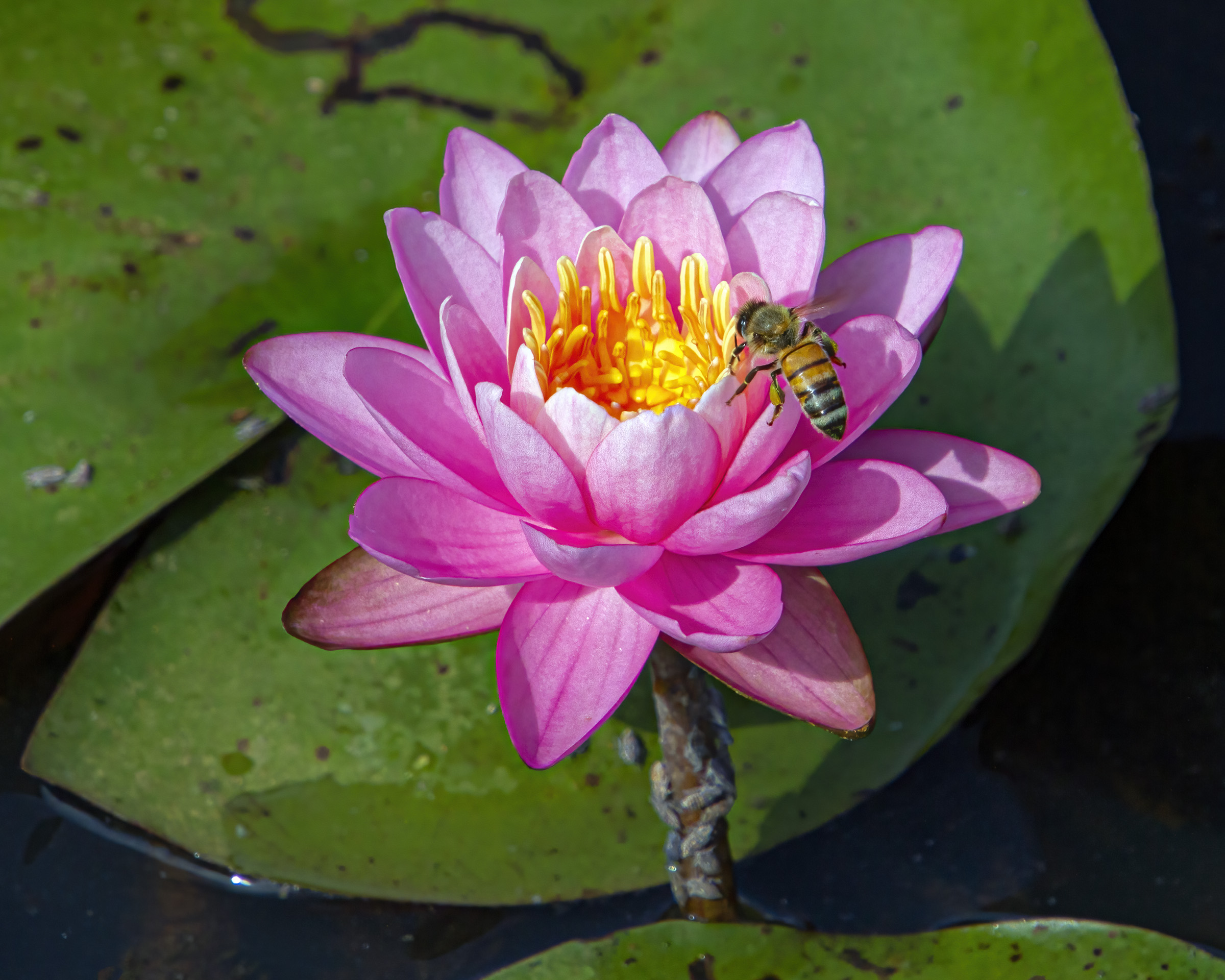
There must have been something really special about this pretty pink water lily at Kenilworth Aquatic Gardens. A honey bee was attracted to it and plunged headfirst into the center of the flower after perching momentarily on a petal. A bumble bee decided to join in the action and for a brief period worked side-by-side with its smaller cousin gathering pollen and nectar.

As I was looking at the photos on my computer, I couldn’t help but notice the cluster of tiny insects on the stem of the water lily. What were they? I posed the question in a Facebook forum and it turns out that they are probably Common Waterlily Planthoppers (Megamelus davisi).  I took photos of several other nearby water lilies, but this was the only one in which I saw the planthoppers. There must have been something really special about this pink water lily that caused it to attract so many insects.

water lily

water lily

© Michael Q. Powell. All rights reserved.

Read Full Post »

On Wednesday at Green Spring Gardens, a county-run historic garden just a few miles from my home, I got a really good look at this bee’s proboscis, the long, straw-like tongue that it uses to collect nectar. From my angle, it looked more like a deadly weapon. Yikes! As you can probably tell, I have switched to using my macro lens most of the time now that the warmer weather has caused more insects to reappear.

One of my friends on Facebook named this bee the “Gene Simmons” bee, because it reminded him of an iconic pose by the singer from the band KISS in which his extended tongue reached to the tip of his chin. It is hard to know if it is true, but according to urban legend, Simmons had his tongue insured for a million dollars during the 1970’s, when KISS was at its height of popularity. The popular rumor at the time that he had a cow’s tongue grafted onto his own, however, has been disproven.

bee tongue

© Michael Q. Powell. All rights reserved.


Read Full Post »

On Wednesday I visited Occoquan Bay National Wildlife Refuge to check on the eaglets in the nests there.  As the leaves continue to grow, it is becoming harder and harder to observe activity at several of the nests of the Bald Eagles (Haliaeetus leucocephalus). In one of them, though, I managed to find a small visual tunnel and was fortunate to capture the first two images that show some sweet little moments between an eaglet and one of its parents.

The third image shows an eaglet in a different nest. As you can see, the leaves on the sycamore tree hid most of the nest. Previously I spotted two eaglets in this nest, so there may be another hiding out of view.

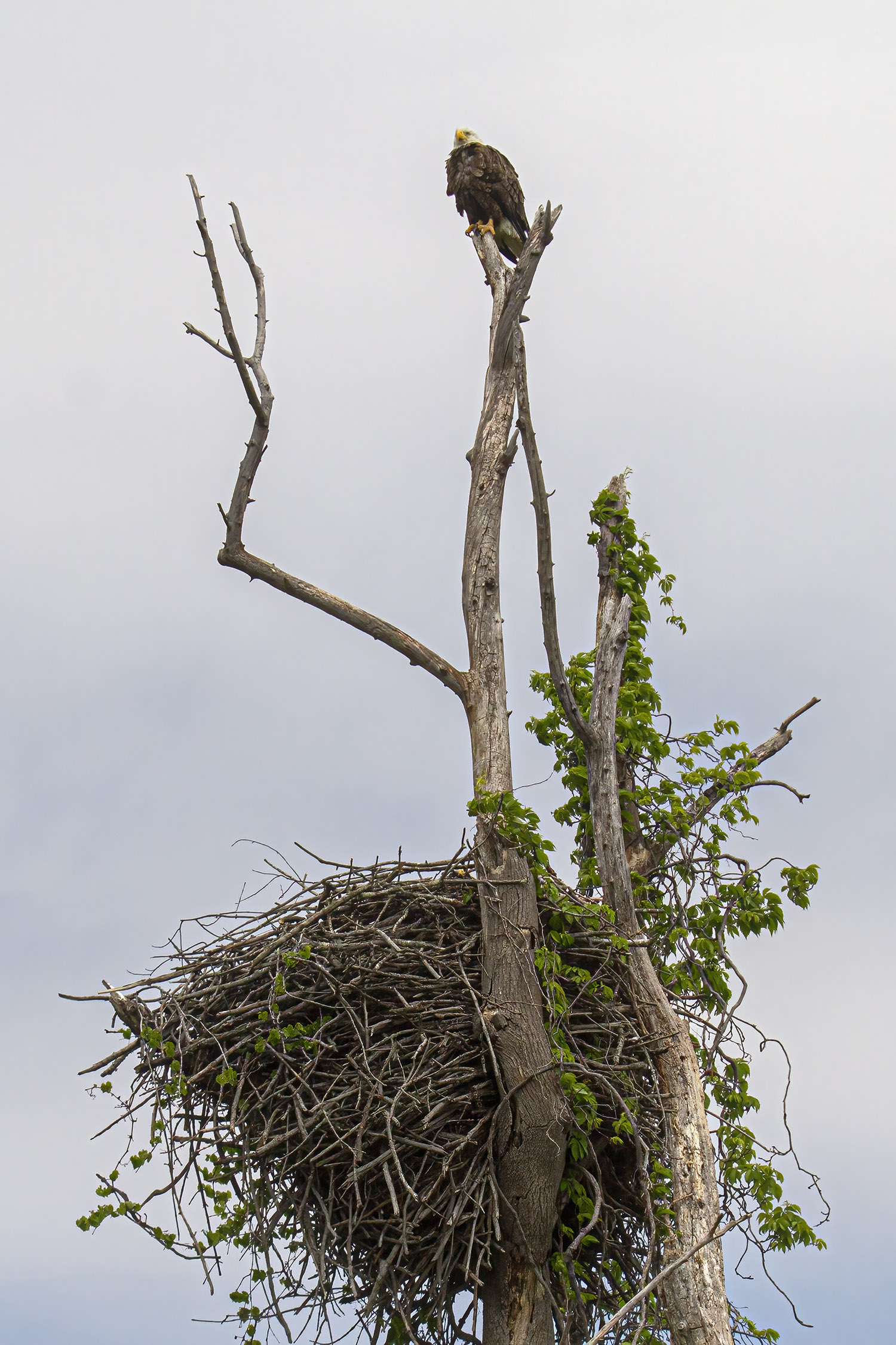
The final two shots shows the largest eagle nest at the refuge. The nest is so big and so high in the trees that it is difficult to tell what is going on inside of the nest. One eagle was keeping watch and the other adult appears to be in the nest. If you look closely at the nest right below the tree on which the eagle is perched, you can just make out the yellow beak of an adult eagle. The final image is a close-up shot of the nest that I cropped to show more clearly the eagle’s beak. The adult eagle is perched so high in the nest that it is possible that there is an eaglet or two in the nest as well—when an eagle is incubating eggs it tend to hunker down really low to keep the eggs warm.

Bald Eagle

Bald Eagle

Bald Eagle

Bald Eagle

Bald Eagle

© Michael Q. Powell. All rights reserved.


Read Full Post »

I love the way that this acrobatic bee was able to position its antennae for optimized access to the nectar in this bee balm flower last Friday at Green Spring Gardens. The bee was so focused on the flower that it paid me no attention, allowing me to get really close to it to capture this image.

I believe that the bee is an Eastern Carpenter Bee (Xylocopa virginica). As for the flower, there was quite a variety of flowers in different colors that looked like this one. I think that it is a type of bee balm (g. Monarda), though I really do not know flowers very well.

bee

© Michael Q. Powell. All rights reserved.

Read Full Post »

I am always fascinated by interactions between species. It is impossible to know exactly what is going on in the minds of the participants, but sometimes the behavior is one of curiosity, co-existence, or confrontation.

As I was preparing to photograph a pretty pink water lily at Green Spring Gardens last Friday, a honey bee flew into the frame. The bee dove right into the center of the flower, so I waited for it to emerge and continued to watch through the viewfinder of my camera.

I was just getting ready to finally take a shot when suddenly a small hover fly flew into the frame. I timed it right and managed to captured this image when the hover fly was right above the honey bee.

The hover fly seemed to be on a reconnaissance mission and the honey bee seemed to be telling him to buzz off. Somehow the posture of the bee reminded me of that of a policeman at the scene of a crime as he repeatedly tells onlookers, “Move along, there is nothing to see here.” Was this a confrontation? I don’t think that it rose to that level, but it was clear to me (and probably to the hover fly) that the bee did not want to share his golden treasure with anyone else.

water lily

© Michael Q. Powell. All rights reserved.


Read Full Post »

We have had rain and clouds the last few days and I feel the need for a pop of color today. This blanket flower (g. Gaillardia) provided a wonderfully colorful backdrop for a little bee that I spotted during a recent trip to Green Spring Gardens. I think that it may be some kind of sweat bee, but I did not get a close enough look at it to be able identify it.

bee

© Michael Q. Powell. All rights reserved.


Read Full Post »

It did not seem like there was much pollen inside of each little phlox flower, but bees were busily collecting it when I spotted several of them last Saturday at Meadowlark Botanical Gardens in Vienna, Virginia. I love the way that some bees, including honeybees, collect pollen in little pouches on their back legs. When the pickings are really good, I have seen those pouches, which technically are called corbiculae, so full and bulging that they seem ready to burst—that was not the case this early in the spring, when not very many flowers were in bloom.

I was pleasantly surprised when I managed to capture a bee in flight in the second photo below as it surveyed the phlox flowers and planned its next assault. My 180mm macro lens is notoriously slow to acquire focus, so I rarely try to use it to try to capture moving subjects. The lens also is so noisy when focusing that one of my friends calls it “The Grinder.” Nonetheless, my trusty Tamron lens is my constant companion during the warm months and it is the one I use most often for my insects and other macro shots.

bee and phlox

Bee and Phlox

© Michael Q. Powell. All rights reserved.


Read Full Post »

I was delighted to spot some Virginia Bluebells (Mertensia virginica) during a trip last week to Lewis Ginter Botanical Garden. This spring ephemeral plant has beautiful bell-shaped sky-blue flowers and is native to eastern North America. The bees seemed to be equally excited to see these flowers. My photos suggest that the bees, which appear to be Carpenter Bees, were getting to the nectar through the tube of the flowers rather than through the bell.

I really like the varied shades of blues and pinks in the bluebells in different shades of development. The colors work well together, sometimes even combining to produce a lovely shade of violet.

Virginia Bluebells

Virginia Bluebells

Virginia Bluebells

© Michael Q. Powell. All rights reserved.

Read Full Post »

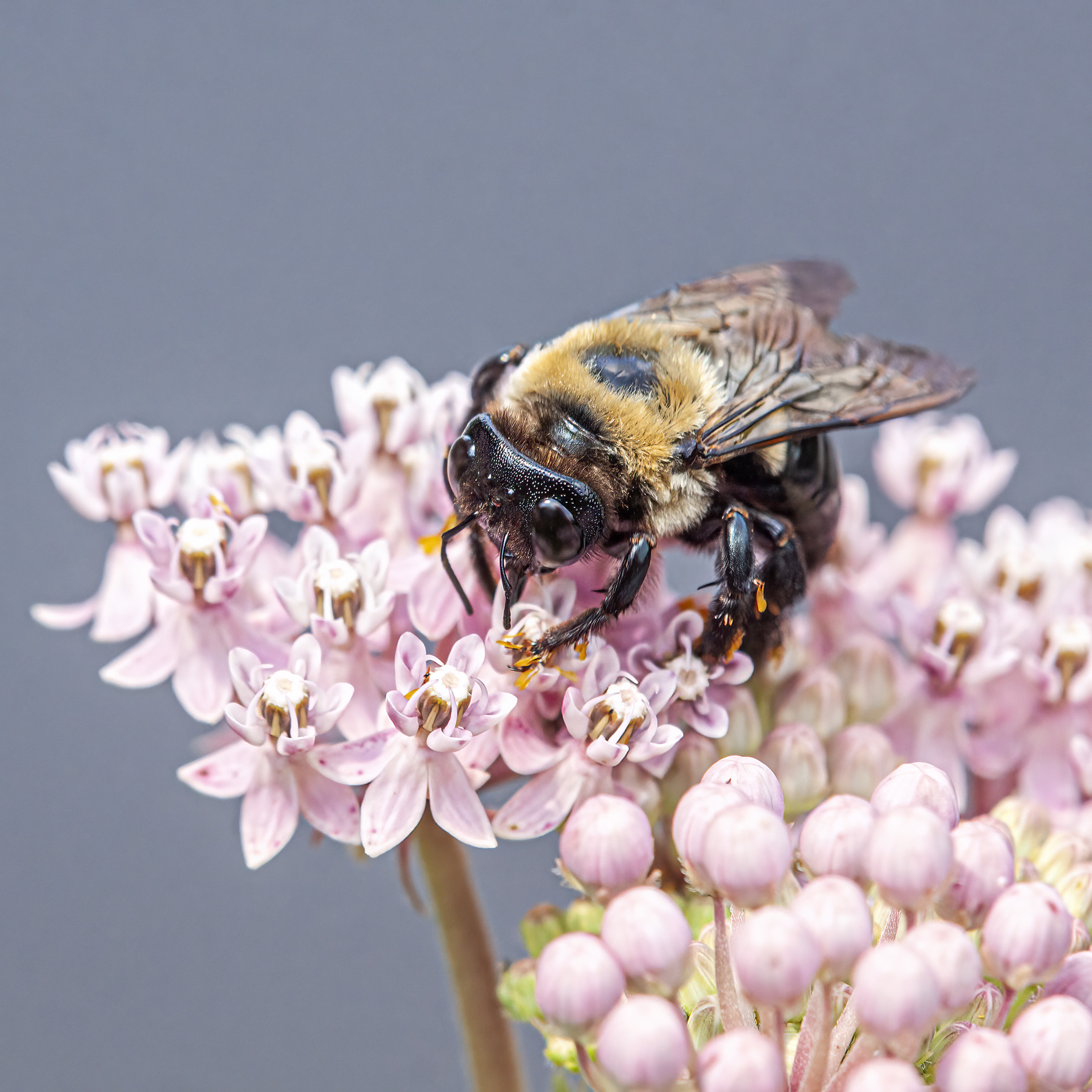
I was hoping to find a Monarch butterfly when I checked out some patches of milkweed last week at Jackson Miles Abbott Wetland Refuge, but ended up instead with some action shots of an Eastern Carpenter Bee (Xylocopa virginica). The bee was quite distracted while feeding, so I was able to get really close to it for these shots.

I like the way that I was able to capture some wonderful details of the bee as well as those of the beautiful pink milkweed.

carpenter bee

carpenter bee

© Michael Q. Powell. All rights reserved.


Read Full Post »

It was pretty early this morning when I walked over to the garden of my dear friend and neighbor Cindy Dyer, but a bee was already busy on one of her lavender plants. A shot like this is easy to get with my 180mm macro lens, which lets me stand back farther from my subject. However, I happened to have a much shorter 60mm macro lens on my camera, which meant that I had to be almost on top of the bee. The bee was focused on the flower and did not seem to be bothered by my presence.

bee

© Michael Q. Powell. All rights reserved.

Read Full Post »

How do you draw attention to the main subject in your photograph? One effective way is to choose a camera setting that will give you a shallow depth of field, so that only the subject is in sharp focus and the rest of the image is blurred. Another way is to ensure that the colors and texture of the background contrast with those of the subject.

I used both of these techniques yesterday morning when I spotted this metallic green sweat bee (g. Agapostemon) on one of the Shasta daisies growing in the garden of my neighbor and photography mentor Cindy Dyer. I love these little bees with their large speckled eyes and shiny green bodies and got as close to this one as I dared with my Canon 60mm macro lens.

I opened the aperture of the lens all the way to f/2.8 to let in lots of light and to achieve the narrowest possible depth of field. That is why the center of the daisy falls so quickly out of focus. As I was composing the shot, the flower reminded me of an egg that had been fried “sunny-side up” and I chose an angle that emphasized that look. (In case you are curious about the other camera settings, the ISO was 800 and the shutter speed was 1/800 sec.)

There is nothing super special about this image, but it is a fun little photo taken close to home that reminds me that beauty is everywhere. A series of creative choices in camera settings and composition by the photographer can often help to draw a viewer’s attention to that beauty. (I encourage you to click on the image to get a better view of the beautiful details of the little green bee.)

green sweat bee

© Michael Q. Powell. All rights reserved.

Read Full Post »

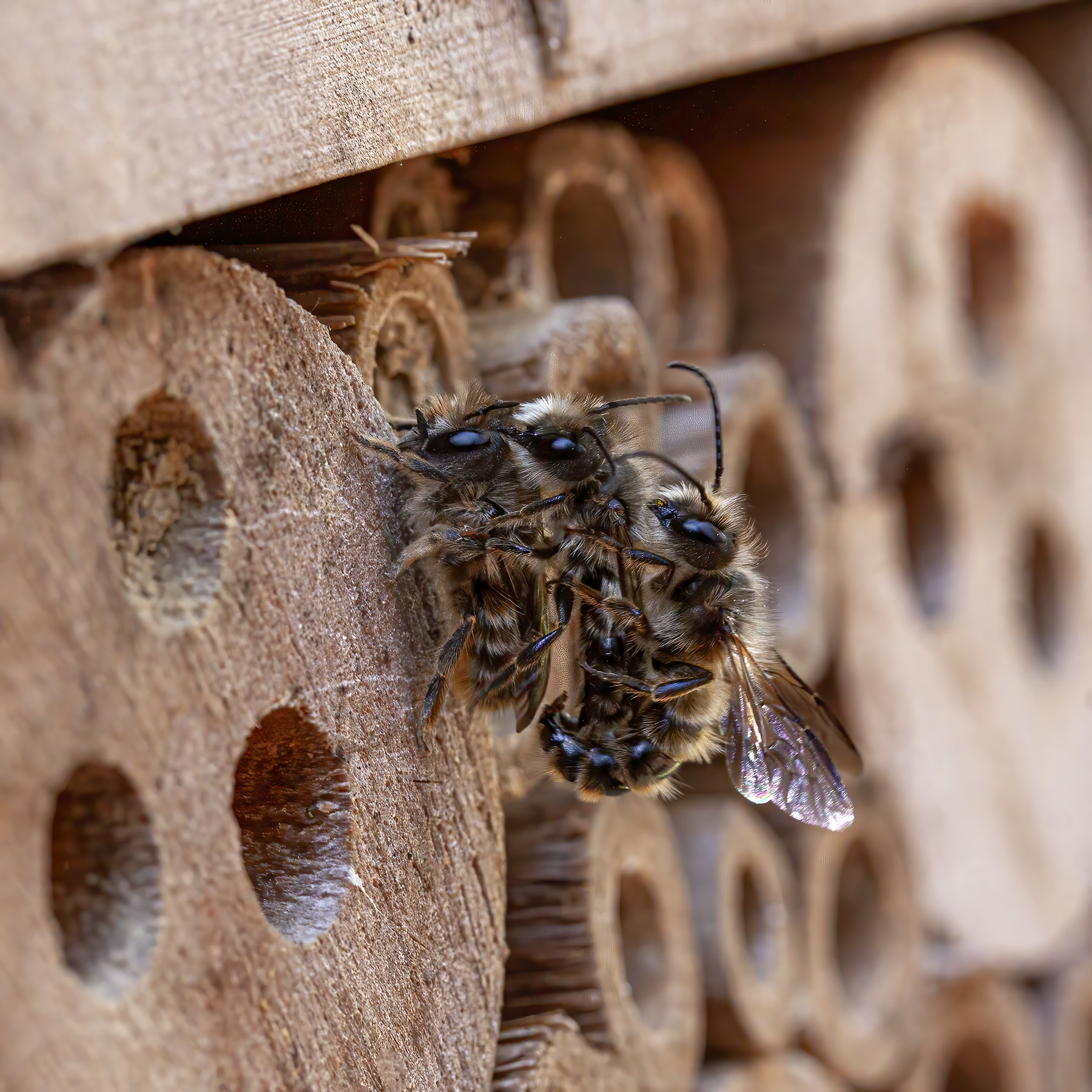
When it comes to mating, many male insects are really aggressive—they will do everything they can to prevent their rivals from hooking us with a desirable female. I think that is what was going on in this image I captured on Sunday of three bees outside of a bee house in the garden of my friend and neighbor Cindy Dyer. It looks to me that the top bee in this ménage à trois was trying to dislodge a rival and somehow gain access to the female. Yes, as the old song simply states, “birds do it, bees do it.”

Perhaps you have a better explanation of what was transpiring, like they were simply playing piggyback and wanted to see how strong the bottom bee was. What do you think? I encourage you to click on the image to see the details better.

I often tell you that I was not as close as it seems, because I generally shoot with a telephoto lens or a long macro lens. In this case, though, I was shooting with a 60mm macro lens and was only a few inches away from the “action” and had to dodge bees that were entering and exiting the tubes of the bee house.

bees

© Michael Q. Powell. All rights reserved.

Read Full Post »

A bee and a flower—it’s such a simple, yet beautiful composition. I photographed this Eastern Carpenter Bee (Xylocopa virginica) on a globe thistle flower this past Tuesday in the garden of my neighbor and dear friend Cindy Dyer.

Some folks might suffer a little cognitive dissonance when they look at the flower in the photo and hear the name “globe” thistle. I thought about renaming it “hemisphere thistle” for the purposes of the picture.  🙂

Beauty is everywhere.globe thistle

© Michael Q. Powell. All rights reserved.

Read Full Post »

My eyes were attracted to the pinkish-colored asters when I spotted them last Friday at Jackson Miles Abbott Wetland Refuge and I moved closer to investigate them more closely. I was delighted to see several green metallic sweat bees (g. Agapostemon) busily gathering pollen. I have always loved the coloration of these sweat bees that are so much smaller than the bumblebees and carpenter bees that I am more used to seeing.

The sweat bees were in almost constant motion and I got a little dizzy as I tried to track their circular movement around the center of the little flowers. I was happy that I was able to get a few shots in which the speckled eyes of the bees are visible—you may want to double-click on the images to enlarge them and see this cool little detail.

Asters generally appear in my area in late summer and early fall, another sign that the seasons are starting to change. I am not ready to let go of summer, though I must confess that I enjoy the somewhat cooler weather that we have been experiencing, especially during the nighttime hours.

sweat bee

sweat bee

© Michael Q. Powell. All rights reserved.


Read Full Post »

This bee seemed to be having a great time inside of a lotus flower when I spotted it last Tuesday during a brief visit to Green Spring Gardens with my friend and photography mentor Cindy Dyer. This county-run historical garden has only a relatively limited number of lotuses and waterlilies at a small pond, but it is much more accessible and less crowded that Kenilworth Park and Aquatic Gardens, an amazing facility in Washington D.C. operated by the National Park Service that has multiple acres of cultivated ponds with a wide array of water lilies and lotuses.

lotus

© Michael Q. Powell. All rights reserved.

Read Full Post »

When I was photographing bees on Monday at Green Spring Gardens, I had no idea that it was the start of Pollinator Week (22-28 June 2020), “an international celebration of the valuable ecosystem services provided by bees, birds, butterflies, bats and beetles,” according to the pollinator.org website. All I knew was that I love bees and enjoy trying to photograph them.

I was reminded of this week’s celebration yesterday in an e-mail from Benjamin, a knowledgeable budding naturalist who is almost certainly the youngest reader of my blog, and his grandmother Ellen (Gem). The two of them were busily making special honey treats to celebrate the week.

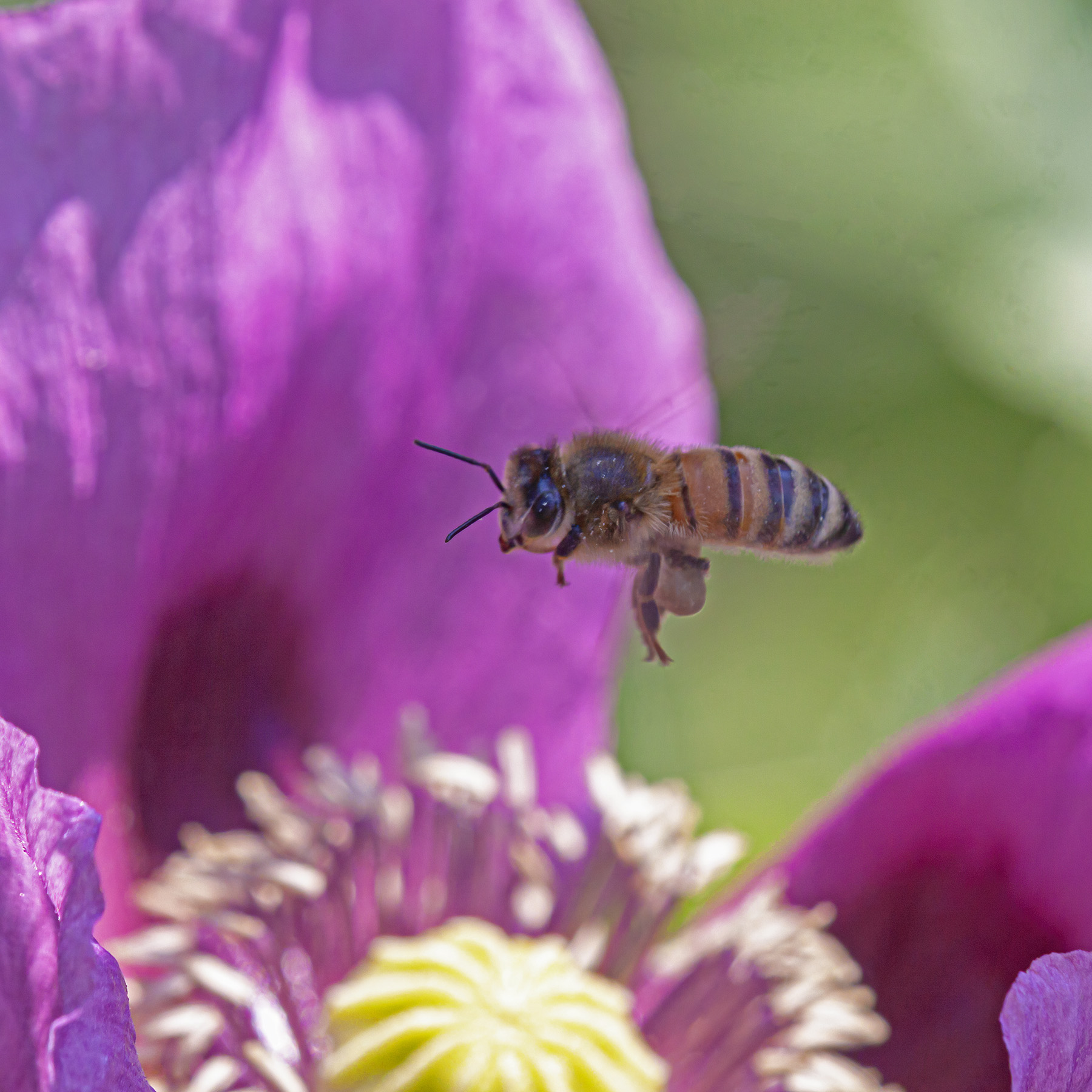
A honeybee came buzzing by me as I was attempting to photograph a poppy on Monday. Although the poppy was quite beautiful, I quickly abandoned it and decided that it was more fun to focus on the bee. The bee seemed to have been quite successful in gathering pollen and, as you can see in the first two photos, one of its pollen sacs seemed to be filled to its maximum capacity.

The final photo shows a honeybee at work in a Stokes’ Aster flower (Stokesia laevis) that I spotted in another part of the gardens. If you double-click on the image, you will see little white grains of pollen covering different many parts of the bee’s body.


honeybee

honeybee

© Michael Q. Powell. All rights reserved.


Read Full Post »

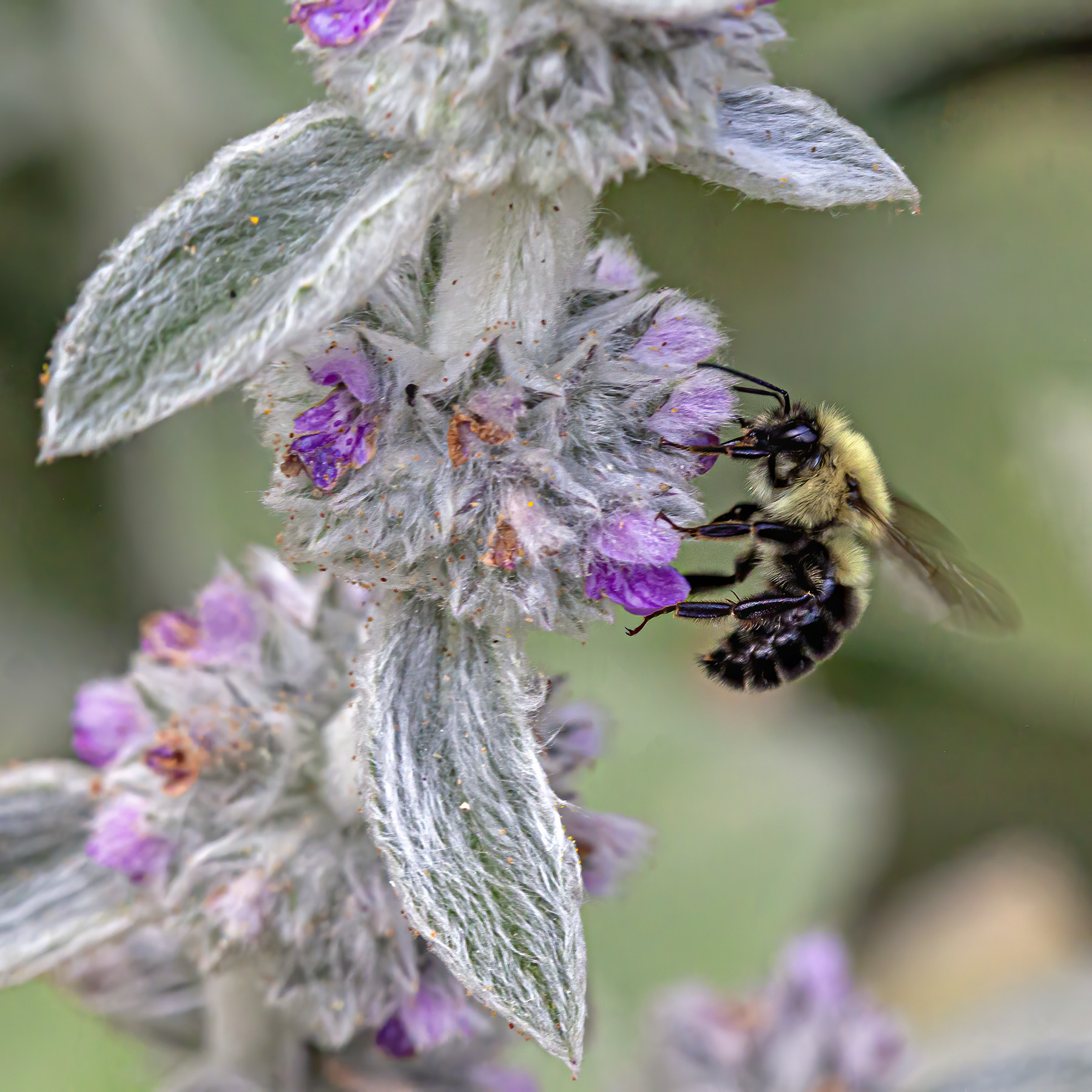
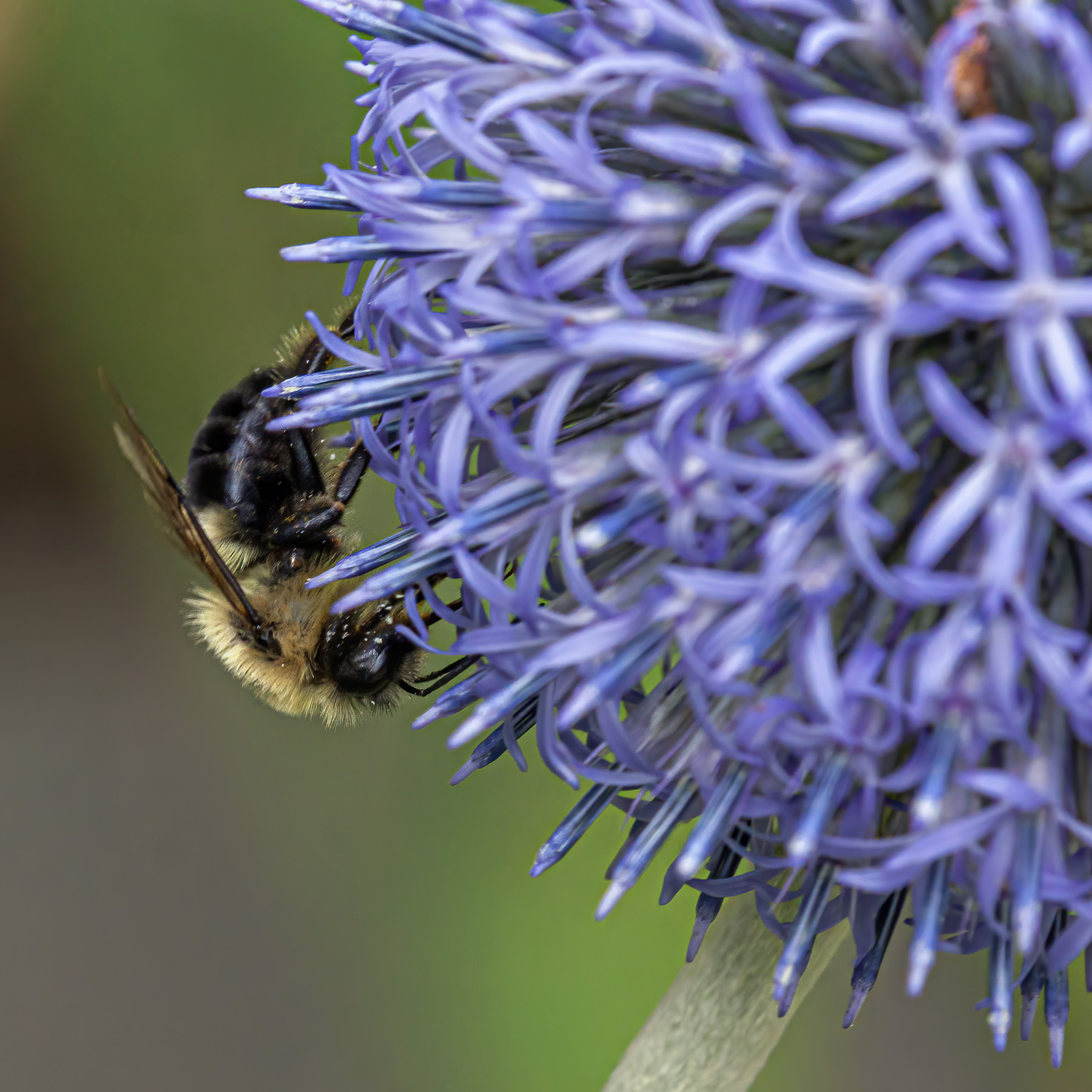
I love bees and spent quite a while on Monday in the garden of my friend and neighbor Cindy Dyer observing them and trying to photograph them. I had no idea that lamb’s ear plants produce flowers, but the bee in the first photo certainly was aware of that fact when I spotted it busily at work. The bee in the second shot decided to try an acrobatic move to gain access to the nectar in the lavender plant that swung wildly each time the bee landed on it. In the final shot, I captured the bee as it was crawling all over a flower of a cool-looking globe thistle plant.

I am not very good at identifying bees, but I think these bees are all Eastern  Carpenter Bees (Xylocopa virginica). Unlike bumblebees that have fuzzy abdomens, carpenter bees have shiny, relatively hairless abdomens.


lamb's ear

lavender

globe thistle

© Michael Q. Powell. All rights reserved.


Read Full Post »

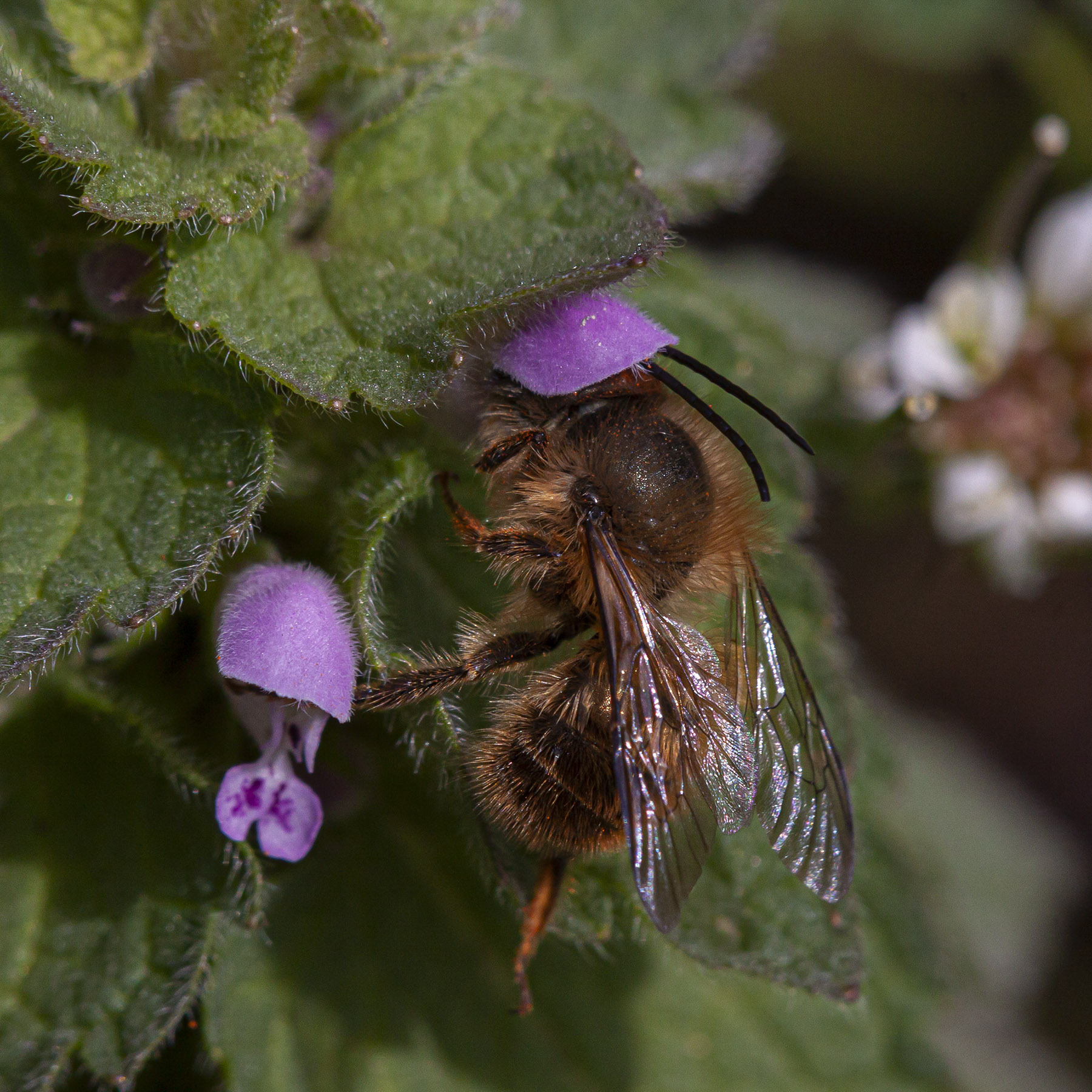
I tend to think of pollen as yellow, but it comes in other colors too. This past weekend I captured this shot of a bee covered in bright red pollen from the Purple Deadnettle flowers (Lamium purpureum) on which it was feeding. Earlier this spring I did a posting with a somewhat similar shot, but misidentified the plant as the closely-related Henbit (Lamium amplexicaule).

Purple Deadnettle is in the mint family and seems to be everywhere at this time of year. I was in a fairly remote area when I took this shot, but I have seen large patches of it in gardens, where it is considered to be a weed. According to an article entitled “Foraging for Purple Dead Nettle: an edible backyard weed,” the plant is not only a wild edible green, but a highly nutritious superfood. The leaves are edible, with the purple tops being even a little sweet. It can also be used in combination with other “weeds” like chickweed and dandelion greens to make pesto and can also be added to soups, salads, or blended into smoothies.

But wait, there is more. Purple Dead Nettle also has purported medicinal benefits. It is known in the herbal world as being astringent, diuretic, diaphoretic and purgative. It’s also anti-inflammatory, anti-bacterial, and anti-fungal and can be used to make salve, poultices, and teas.

As an interesting aside, in Great Britain this plant is apparently known as Red Deadnettle. Why is there a difference in names? I do not know why, but it is not all that surprising considering the number of different words the British use for common objects and the different spellings for common words.

bee

© Michael Q. Powell. All rights reserved.


Read Full Post »

When I saw this insect sipping nectar from a Spring Beauty wildflower on Tuesday, I was sure that it was some kind of wasp or hornet. Bees, I thought, do not have such narrow waists. I was wrong. Some of the experts at bugguide.net identified my insect as a male Nomad Bee (genus Nomada).

Nomad Bees are the largest genus of kleptoparasitic “cuckoo bees,” according to Wikipedia. “Kleptoparasitic bees are so named because they enter the nests of a host and lay eggs there, stealing resources that the host has already collected.” Nomad bees do sip nectar like other bees, as you can see in my photos, but do not collect pollen to feed their offspring.

I remember being shocked the first time that I read about cuckoos and cowbirds deliberating laying their eggs in the nests of other birds to avoid having to build their own nests and raise their own babies. I guess I can add nomad bees to the list of deliberately delinquent parents.


nomad bee

nomad bee

© Michael Q. Powell. All rights reserved.

Read Full Post »

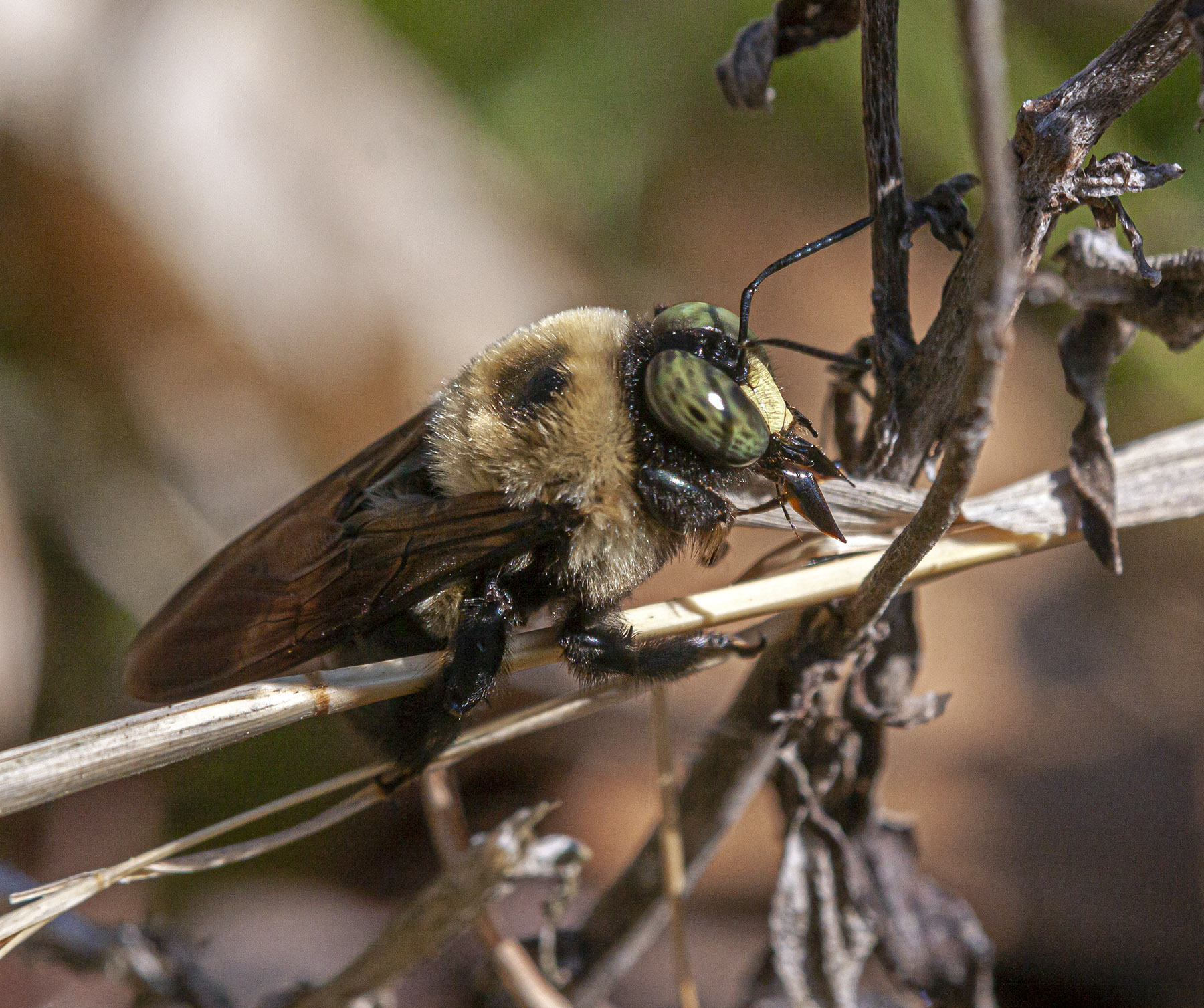
Did you know that some bees have green speckled eyes? I was really startled by the brightness of this bee’s eyes as I was taking its photo last Monday while exploring in Prince William County, Virginia. Some research on-line revealed that this is a male Eastern Carpenter Bee (Xylocopa virginica).

I was pretty sure that I had never before seen a bee like this, but I was wrong. As I was preparing this posting, I discovered that I had seen a similar bee in October 2012 and published a posting entitled “Green-eyed Eastern Carpenter bee.” Wow. It’s been a long time between sightings, so maybe I can be forgiven for having forgotten about the previous time, though at my age I can simply claim that I had a “senior moment.” Ages has its privileges.

Eastern Carpenter Bee

© Michael Q. Powell. All rights reserved.

Read Full Post »
Although the temperatures were cool on Tuesday afternoon, this little bee was busy in the garden of my neighbor and friend Cindy Dyer. The plant on which the bee was feeding technically bight be considered to be a weed, and not a flower, but the bee surely did not mind.

Most of the pollen that I am used to seeing is bright yellow, but in this case it appeared to red in color. As you can see in the second photo, the bee was using a headfirst approach—for extended periods of time it would bury its head among the small petals of this plant.

I went searching around on internet trying to identify the plant and I think it might be Henbit (Lamium amplexicaule). I would welcome a confirmation or correction of this identification by someone more familiar with flowers than I am.

bee

bee

© Michael Q. Powell. All rights reserved.

Read Full Post »

One of the highlights of my visit on Monday to Green Spring Gardens was photographing a blossoming Japanese Apricot tree (Prunus mume). It was a little strange to see a tree with blossoms during the winter, but apparently it is normal for this species to blossom in mid-winter and late winter. The flowers are commonly known as plum blossoms and are a frequent theme in traditional painting in China and in other East Asian countries—the blossoms were also a favorite with the honey bees.

According to Wikipedia, the plum blossom is “one of the most beloved flowers in China and has been frequently depicted in Chinese art and poetry for centuries. The plum blossom is seen as a symbol of winter and a harbinger of spring. The blossoms are so beloved because they are viewed as blooming most vibrantly amidst the winter snow, exuding an ethereal elegance, while their fragrance is noticed to still subtly pervade the air at even the coldest times of the year. Therefore, the plum blossom came to symbolize perseverance and hope, as well as beauty, purity, and the transitoriness of life.”

I do not use my macro lens very much during the winter months and usually leave it at home. However, the mild weather that we have been having made me suspect that some flowers would be in bloom, so I put the macro lens on my camera—the busy bees turned out to be a big bonus.

I especially admired the efforts of the bee in the first photo. This bee did not want to wait for the bud to open, but instead burrowed its way to the pollen-filled center of the blossom-to-be.

Japanese Apricot tree

Japanese Apricot tree

Japanese Apricot tree

© Michael Q. Powell. All rights reserved.

Read Full Post »

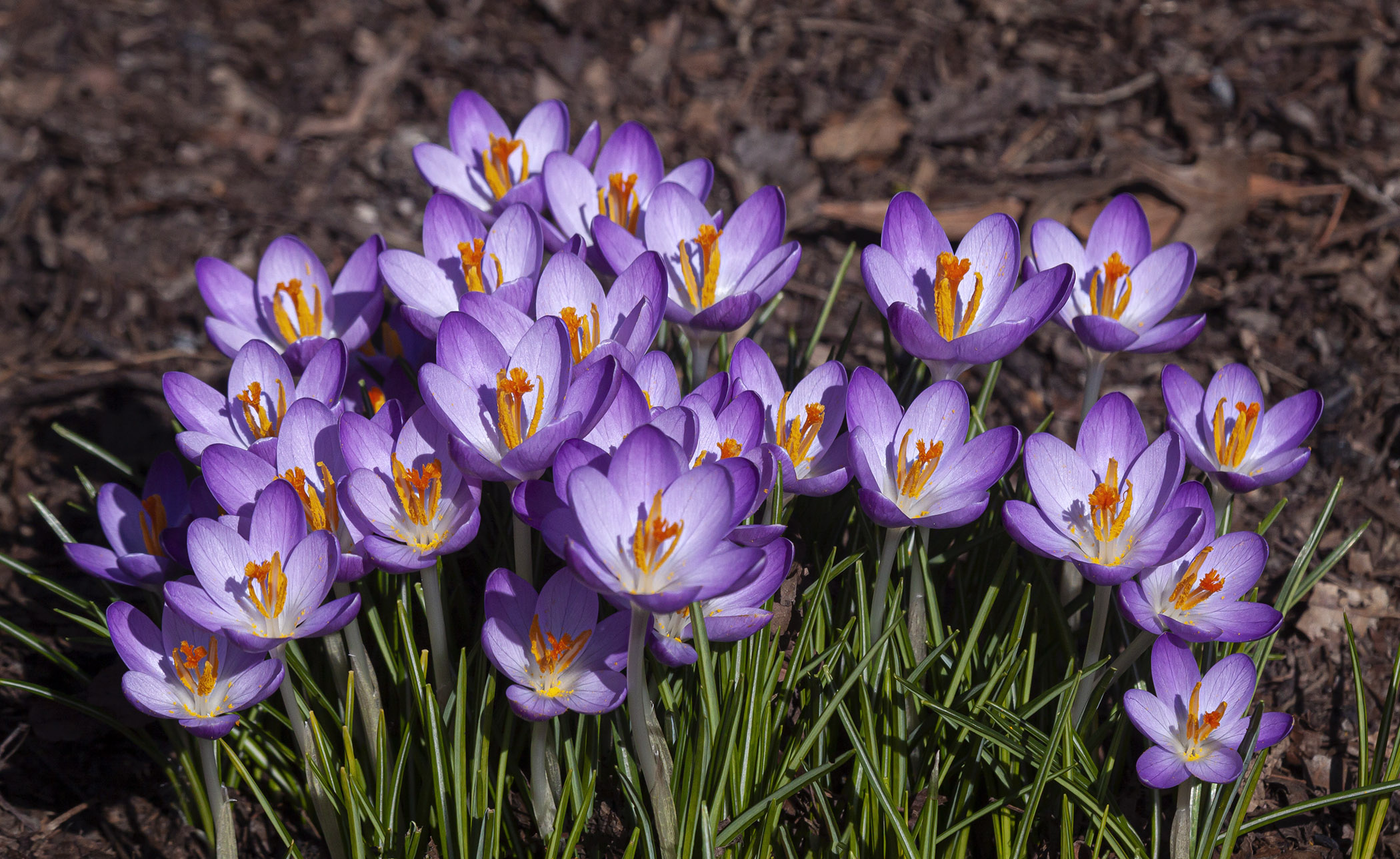
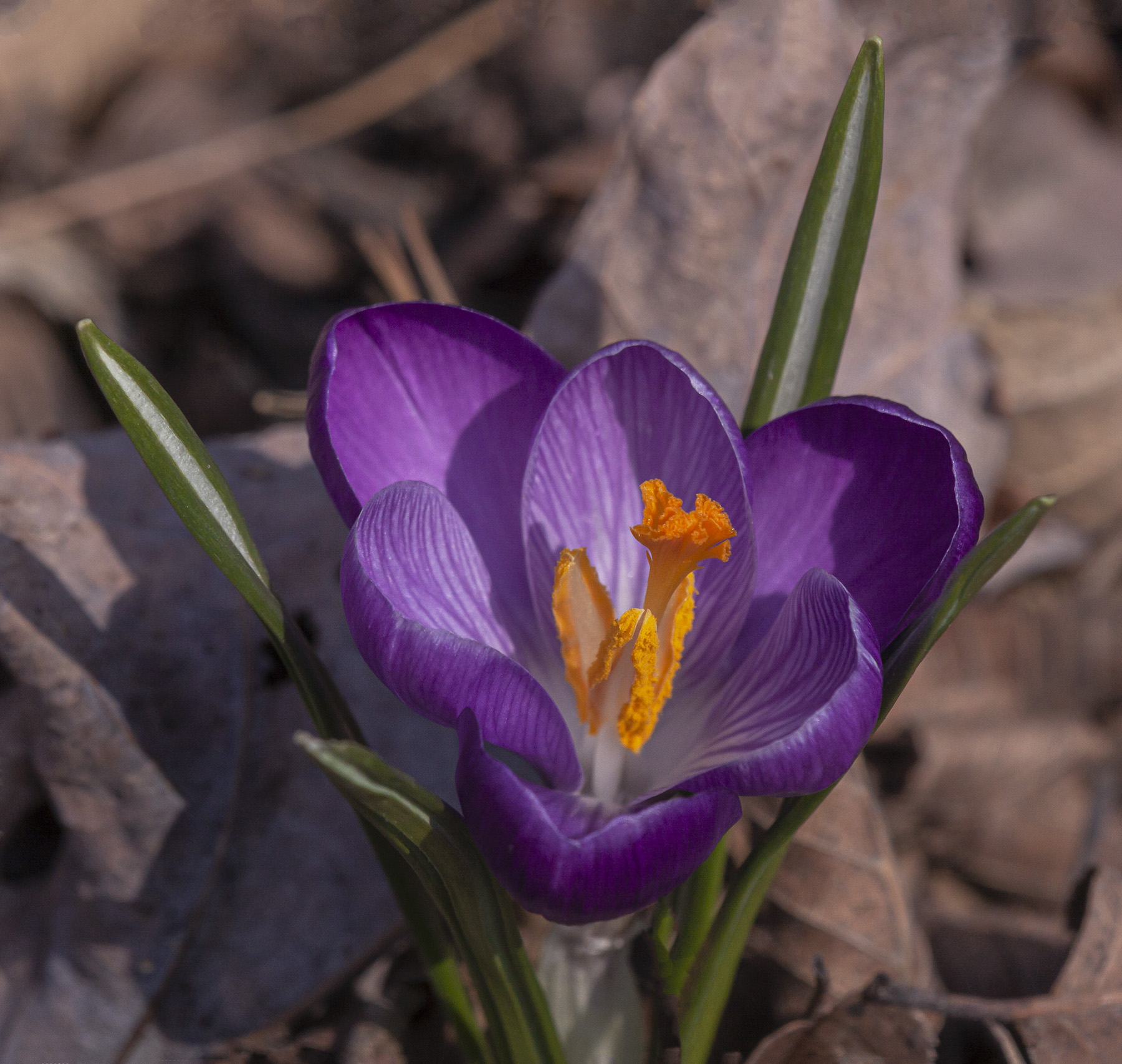
This winter has been usually mild and spring color is already starting to appear in our area. During a visit yesterday to Green Spring Gardens, a local county-run historical garden, I spotted crocuses in bloom at several locations. Finding crocuses was not too much of a surprise, since they are usually among the first flowers to appear each spring.  However, it was an unexpected bonus to be able to photograph a honey bee collecting pollen inside of one of the crocuses.

In many ways yesterday’s photography was a return to my roots. When I started getting more serious about photography seven years ago, I did a lot of shooting with my friend and mentor, Cindy Dyer. One of her many areas of specialization is macro photography of flowers and some of her flower images have even appeared on US postage stamps. From her I learned a lot about the technical aspects of photography, like composition and depth of field, but more importantly she encouraged and inspired me back then and continues to do so to this day. Thanks, Cindy.

I started off photographing flowers with a few insects, but gradually realized that I was more interested in shooting insects with a few flowers. I can appreciate the beauty of the crocuses in the second and third images below, but the first shot is more representative of my desired shooting style.

crocus

© Michael Q. Powell. All rights reserved.

Read Full Post »

With all of the hot weather we have been having recently, I have absolutely no desire to be as busy as a bee. I spotted this bee busily at work this past Tuesday morning at Occoquan Bay National Wildlife Refuge.

Temperatures in our area are forecast to rise to 100 degrees (38 degrees C) today and the high humidity will make it feel even more intolerable. I will probably spend most of the days indoors, but fortunately I have plenty of recent photos in reserve that I can process and post.

This image is the kind of simple shot that I really like. I remember my sense of wonder the first time I used a macro lens and I still feel excitement when I immerse myself in the details that a macro lens reveals.

bee

© Michael Q. Powell. All rights reserved.


Read Full Post »

Older Posts »