Feeds:
Posts
Comments

Archive for the ‘animals’ Category

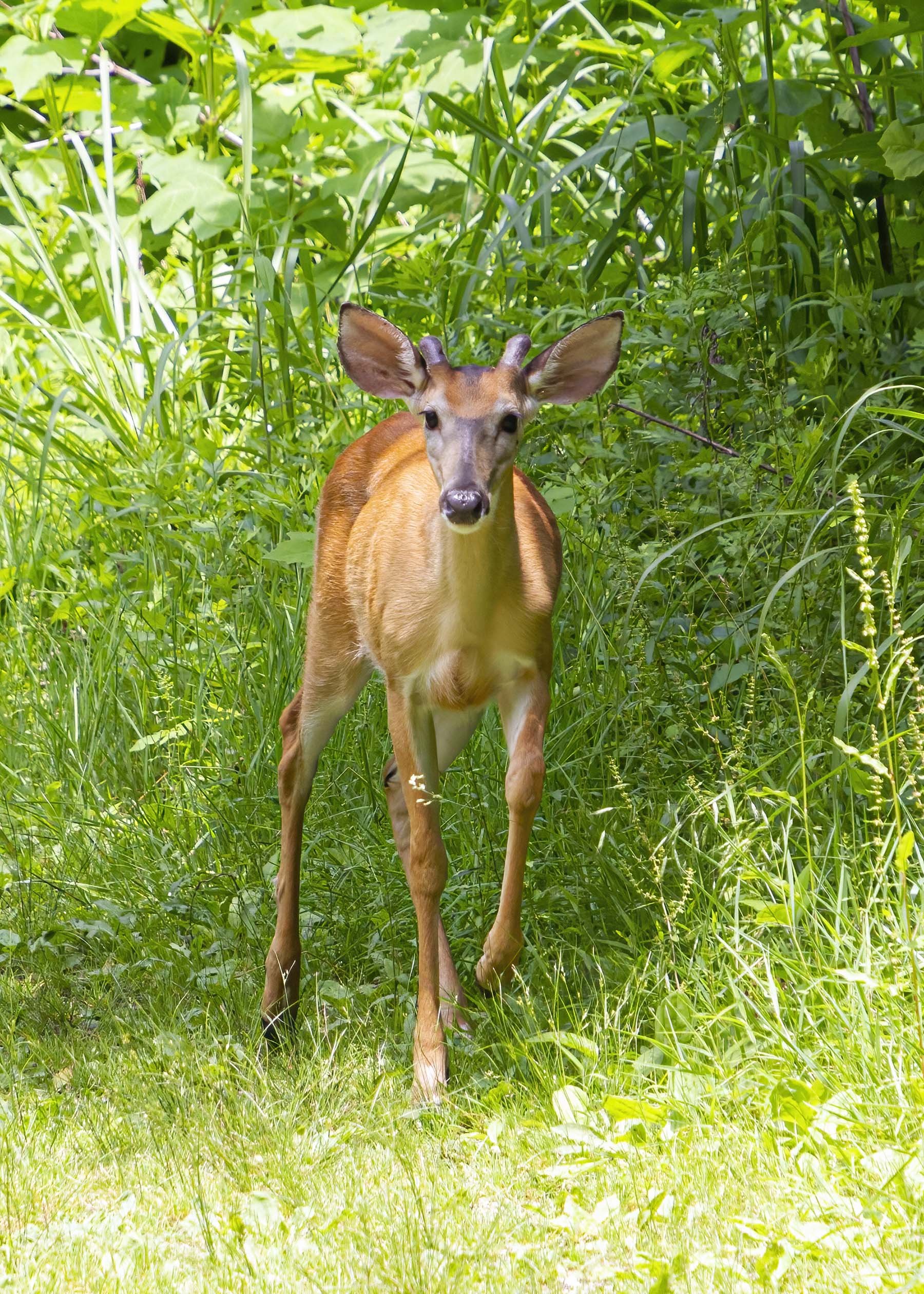
Last Friday I almost literally stumbled upon a young White-tailed Deer (Odocoileus virginianus) during a visit to Occoquan Bay National Wildlife Refuge. As I turned a corner, I suddenly spotted this little deer slowly coming towards me. I immediately stopped, but the deer initially kept on walking. I noticed that the deer had nubs on its head instead of antlers. Was this a buck who was too young to grow antlers or was this a somewhat older deer who was regrowing his antlers?

I grew up in the suburbs of Boston and confess that I know very little about deer. I do know that male deer shed their antlers during the fall and winter and then regrow them in the spring each year. According to the Fish and Wildlife Service, antlers are the fastest bone growth in the world and the antlers of an adult White-tailed Deer can grow 1/4 inch (6 mm) a day and those of an elk can grow an inch (25 mm) a day.

This deer seemed more curious about me rather than afraid of me and eventually moved only a few feet off of the trail to let me pass. I was happy to see this beautiful young animal in its natural habitat. In many parts of the suburban area surrounding Washington D.C. there is an overpopulation of deer and a variety of measures are used to try to control the population. At this wildlife refuge, for example, several deer hunts are conducted each year.

I personally am not a hunter, but I do recognize the dangers that deer overpopulation poses to the habitat, to the human population, and to the deer themselves. When I am out with my camera, though, I am not thinking about these things, but instead am focused on sharing the beauties of nature and peacefully coexisting with my fellow creatures, like this young deer.
White-tailed Deer

© Michael Q. Powell. All rights reserved.

Read Full Post »

I was a bit surprised to spot this North American Beaver (Castor canadensis) swimming in Accotink Creek yesterday afternoon and managed to capture this image before it sensed my presence and disappeared under the water. Beavers are primarily nocturnal, so most of my beaver sightings in the past have been at dusk or dawn. I am not sure why this beaver was active in the early afternoon on a bright sunny day. Perhaps it was looking for food to feed a newborn beaver baby. Who knows?

Accotink Creek is part of the Accotink Bay Wildlife Refuge, a nature preserve mostly on the grounds of the U.S. Army installation Fort Belvoir in Fairfax County, Virginia, where I live. However, parts of the refuge, including the areas that I visited yesterday, are open to the public and do not require entry onto the military installation.

I am including a photo of a suspension bridge across Accotink Creek that is currently closed. The stairs from the two banks of the creek to the bridge are gone and I do not know if they were removed intentionally or were washed away in a flood. The photo gives you the relative sense of the size of the creek and the overall habitat in which I spotted the swimming beaver.

North American Beaver

Accotink Creek suspension bridge

© Michael Q. Powell. All rights reserved.

Read Full Post »

I photographed this raccoon on Monday (27 January) as it foraged in an open water area of a small pond at Occoquan Bay National Wildlife Refuge. Although the weather was considerably warmer, i.e. above the freezing level, the water in the small interior ponds and in the shore areas was still almost completely frozen over.

I couldn’t tell for sure if the raccoon had any success in finding something to eat, because I was quite a good distance away from it.  It was fascinating nonetheless to watch the raccoon at work, repeatedly dipping a paw into the frigid water.

The second image below provides a much clearer view of the raccoon’s face, but there is something about the body and head position in the first photo that appeals to be a slight bit more. What do you think? Do you have a preference for the first photo or the second one?

raccoon

raccoon

© Michael Q. Powell. All rights reserved.

Read Full Post »

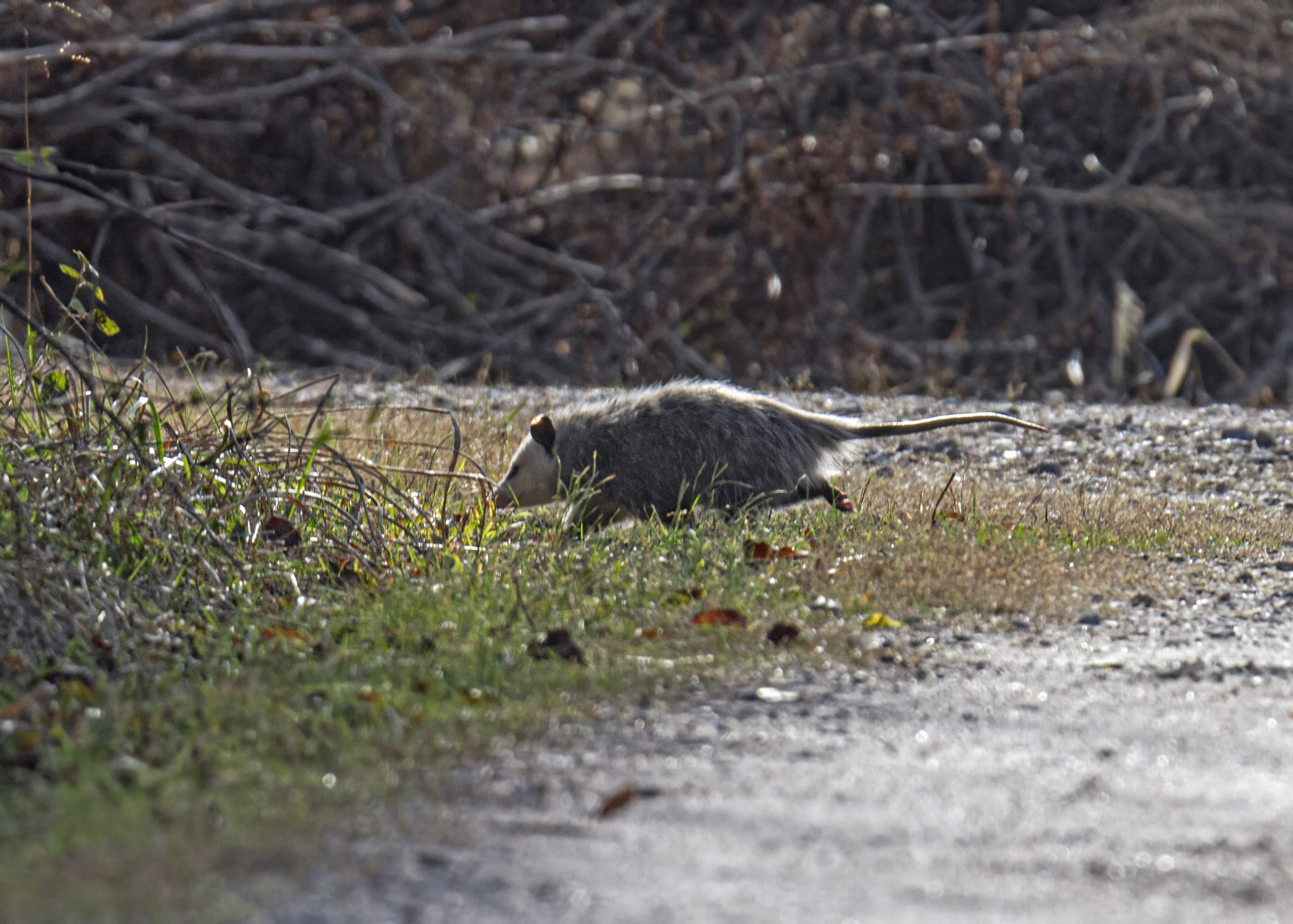
My mind was busy trying to identify the animal crossing the trail ahead of me on Thursday at Occoquan Bay National Wildlife Refuge, but my reflexes took over and I was able to capture these shots of what turned out to be an opossum (Didelphis virginiana), an animal that I rarely see. When I was doing a little research I learned that Virginia Opossums, also known as North American Opossums, are the only marsupial in the United States—most marsupials, including kangaroos, wallabies, and koalas, are found in Australia and New Guinea.

opossum

opossum

© Michael Q. Powell. All rights reserved.

Read Full Post »

I am finally nearing the end of my photos from my brief stay in Theodore Roosevelt National Park in North Dakota at the beginning of November. I captured quite a few images of wild horses, bison, and prairie dogs at the national park and it has been a real joy reviewing the photos on my computer and relive the memories after my return home. Normally I try to post images on my blog that are a week old or less, but I figure that you will forgive me for posting images that are three weeks old.

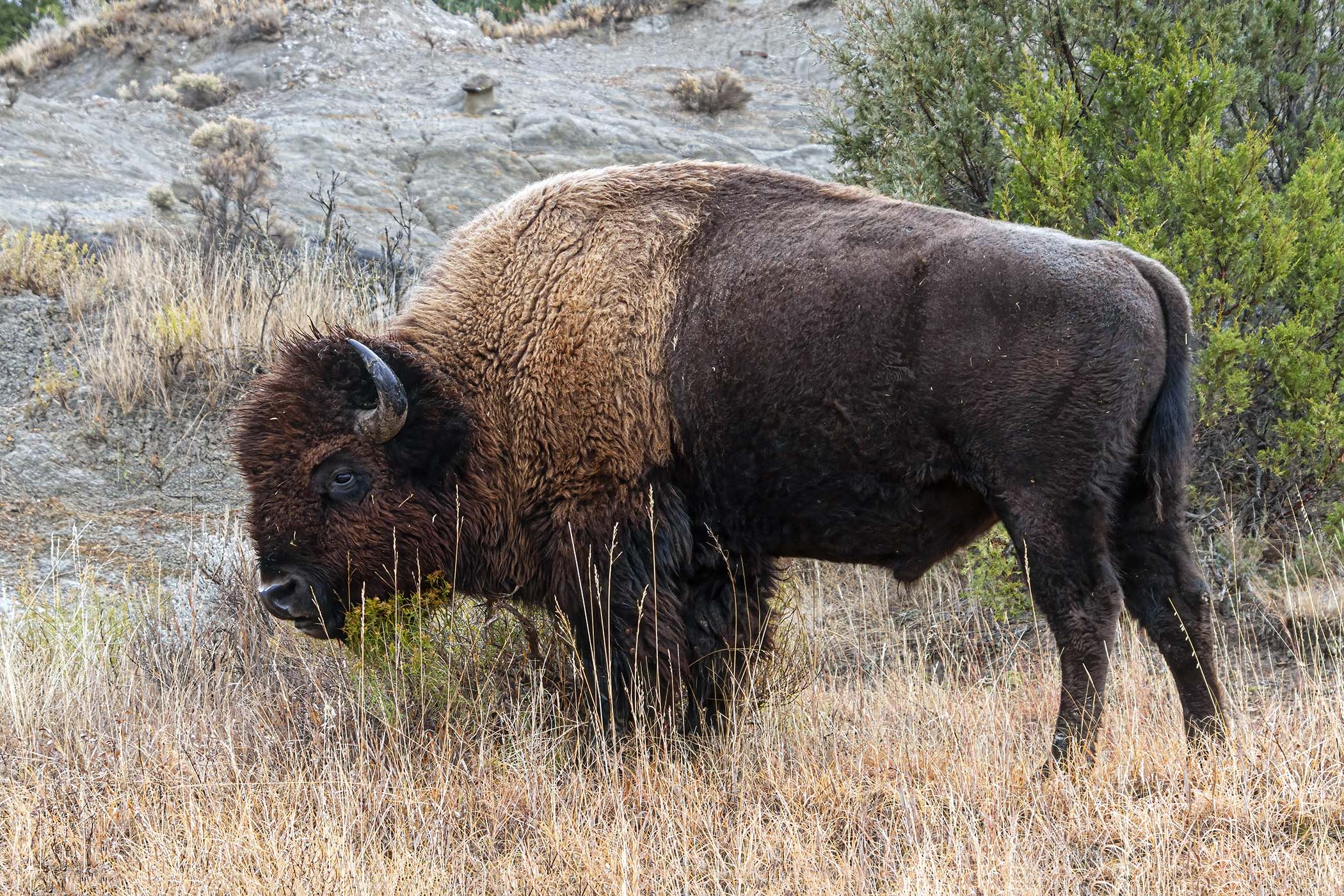
Here are a few selected images of American Bison (Bison bison) that I spotted at the park in early November. Most often the were simply grazing, so frequently I would try to capture some interesting background, as in the first photo below. I was quite excited to spot the young bison in the second photo. It was quite a bit smaller than the adults, but already seemed to be growing horns.

The bison in the final photo lifted its head momentarily, allowing me to capture this informal portrait. It may look like I was really close to the bison, but I was using a telephoto zoom lens on my camera and I am pretty sure that I took the shot from inside my car. However, the bison was close enough that I had to zoom out a little to 322mm (on an 18-400mm lens) to fit the bison’s enormous head in the frame.

American Bison

American bison

American Bison

© Michael Q. Powell. All rights reserved.


Read Full Post »

Although I returned from my road trip out West several weeks ago, I am still going through some of the images that I captured. One of the real highlights of the trip was staying for a few nights in Theodore Roosevelt National Park in North Dakota. Unlike some other national parks in that part of the USA, like Yosemite and Glacier National Parks, this park is uncrowded and I was able to drive slowly on its roads and observe a variety of wildlife species.

One of my favorites was the bands of wild horses that live in the national park. It’s estimated that there are about 200 wild horses in the park, though it is hard to know for sure. Most of the time I spotted some of the horses at a distance, out of the range of my telephoto lens, but I did have a few closer encounters and was able to capture some decent images of them.

It was interesting to note that the horse in the final photo is wearing what looks to be some kind of tracking collar. I am not sure if this is a normal practice at the national park or if the horse is part of some special study.

I grew up watching lots of Western show on television, like The Rifleman, Bonanza, and Gunsmoke. As a result, I have a special fondness for cowboys and find it really cool to see wild horses and bison herds.

wild horses

wild horse

wild horse

© Michael Q. Powell. All rights reserved.
Read Full Post »

When I was a child, I recall hearing and singing an old American folk song called “Home on the Range.” Its lyrics speak of a home where buffalo roam and “the deer and the antelope play.” Those words kept coming back to me earlier this month during my brief stay at Theodore Roosevelt National Park in North Dakota.

Over the years I have learned that the song is technically inaccurate, because there are no antelopes in North America. However, the Pronghorn (Antilocapra americana) closely resembles the antelopes of the Old World and are known colloquially as “American antelope.” The closest living relatives of pronghorn, though, are the giraffe and the okapi, an animal often referred to as the “forest giraffe” found in the Democratic Republic of the Congo. Of note, the pronghorn is the fastest land mammal in the Americas, capable or reaching speeds of up to 55 miles per hour (88 km/h).

When I first spotted these pronghorns, they were coming down the side of a hill and preparing to cross the road on which I was traveling. There were two young pronghorns and one an adult, that I presumed was their mother. I focused primarily on the young ones, as you can see in the first two photos, and finally got a shot of the adult as the the pronghorns were climbing a hill on the other side of the road. If I remember correctly, I took the first two photos through the windshield of my car.


pronghorn

pronghorn

Pronghorn

© Michael Q. Powell. All rights reserved.
Read Full Post »

Early in the morning on 5 November, I encountered some mule deer (Odocoileus hemionus) at Theodore Roosevelt National Park in Medora, North Dakota. Initially the deer were lapping up water that had accumulated alongside the road after a rainstorm.

I remained in my car as I captured a few shots of the deer, who looked at me with what appeared to be curiosity rather than fear. I was happy to be able to capture views of the tails and the ears of the mule deer, two of their most distinctive features, before they slowly moved into the underbrush.

mule deer

mule deer

mule deer

© Michael Q. Powell. All rights reserved.

Read Full Post »

Earlier this month I spotted a coyote (Canis latrans) at Theodore Roosevelt National Park in North Dakota. The coyote was hanging around a prairie dog town (you can see a prairie dog in the background) and magpies accompanied it, hoping to scavenge some tasty remnants.

I took these photos from inside my car with the windows open, hoping that no other cars would come by and disturb the coyote. Fortunately it was early in the morning and I was able to watch the coyote without interruptions. The coyote was unsuccessful in its hunt while I was there and eventually moved on.

Although we have coyotes at the wildlife refuge where I do a lot of my photography in Northern Virginia, this was my first time seeing and photographing one.

coyote

coyote

coyote

© Michael Q. Powell. All rights reserved.

Read Full Post »

It is always a challenge to shoot directly into the sun. You never quite know what kind of sun flares will make their way into you photo or how much your subject will become a silhouette. Still I can’t help but attempt to capture a photo whenever the opportunity presents itself.

My gamble paid off last week when I captured this cool image of an American Bison (Bison bison) last week at Theodore Roosevelt National Park in Medora, North Dakota. It was just after sunrise and the sun was still quite low on the horizon, creating a distorted, elongated shadow of the bison. You can see only a few details of this magnificent animal, but the shape of the profile of the bison makes it easy to identify the primary subject.

Luck plays often plays a significant role when it comes to wildlife photography, but I can’t help but think of the old adage, usually attributed to Wayne Gretzky, “You miss 100 % of the shots that you don’t take.” While I am not a fan of the “spray and pray” approach to photography, I do think it is worthwhile to take a shot whenever something catches your eye—sometimes you will be pleasantly surprised by the results.

© Michael Q. Powell. All rights reserved.

Read Full Post »

Two years ago I had the awesome opportunity to view some of the wild horses at Theodore Roosevelt National Park in North Dakota at relatively close range. During my recent visit to the same national park, I was not quite as lucky and spotted wild horses only in the distance.

The horses were grazing on an elevated spot, so I was forced to shoot at an upward angle. Consequently my shots of them all had only the sky in the background. Still, I was really happy to be able to spot some wild horses during the somewhat limited time that I spent at the park.

wild horse

wild horse

© Michael Q. Powell. All rights reserved.


Read Full Post »

During my recent visit to Theodore Roosevelt National Park in North Dakota I encountered several colonies of Prairie Dogs (Cynomys ludovicianus). It was a lot of fun observing these active little creatures scurrying in and out of their interconnected holes.

Some of them seemed to be foraging for food, but many of them seemed to be playing and/or interacting with each other. I had the impression that some of them were youngsters, but they never stood still long enough for me to get an impression of their relative sizes.

prairie dog

prairie dog

prairie dog

© Michael Q. Powell. All rights reserved.

Read Full Post »

One of the highlights of my recent visit to Theodore Roosevelt National Park in Medora, North Dakota was having the chance to see quite a few American Bison (Bison bison). Unlike during a previous visit there two years ago, the bison were not blocking the road, but some of them were alongside the edges of the road.

These mammoth creatures seemed to be almost as large as my KIA Soul, so I often stayed inside my car when taking photographs of them. I ventured outside of the relatively friendly confines of my little car only when the bison were a good distance away from me.

bison

bison

bison

© Michael Q. Powell. All rights reserved.

Read Full Post »

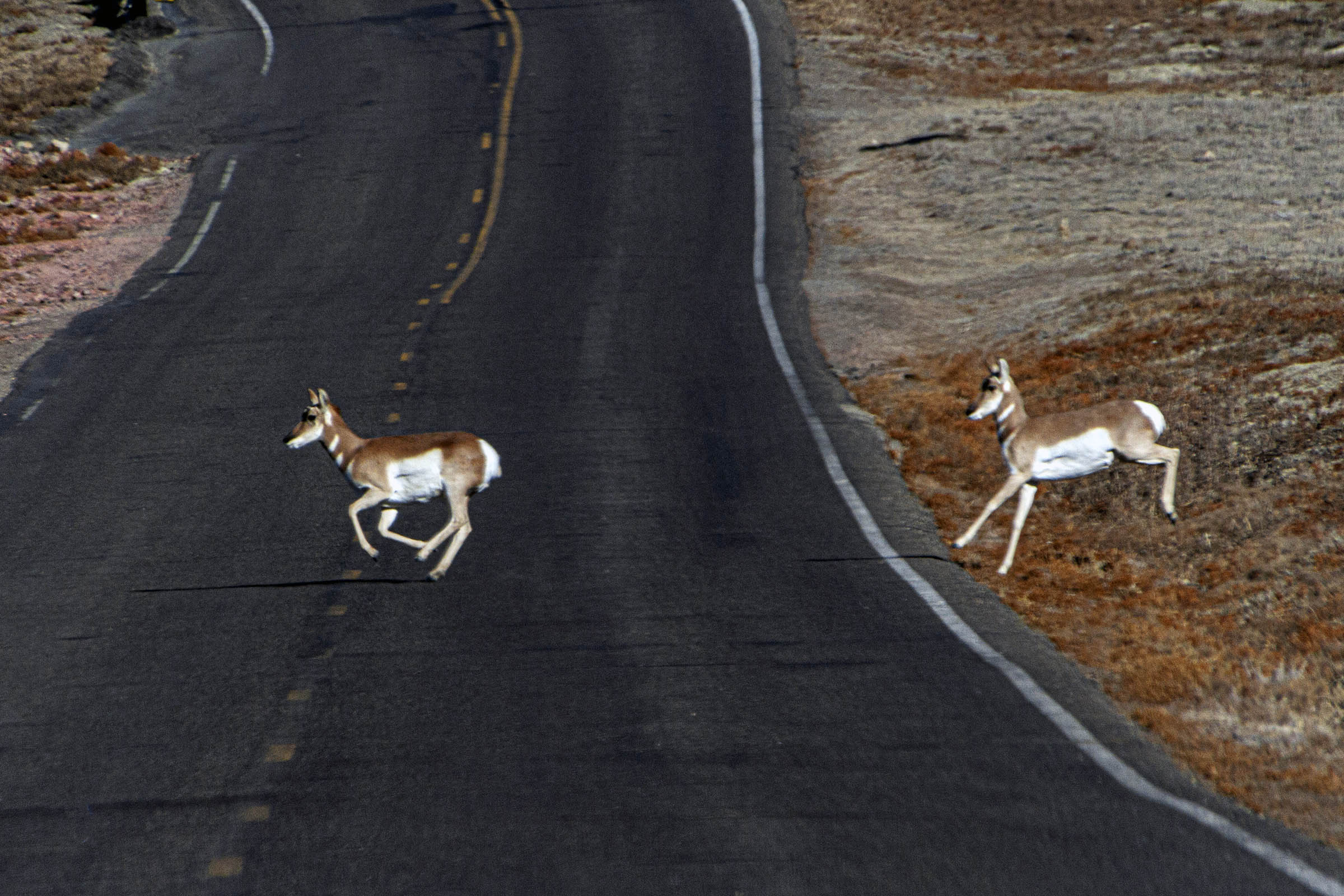
I captured this shot of a mule deer (Odocoileus hemionus) early in the morning during my recent visit to Theodore Roosevelt National Park in Medora, North Dakota. I woke up before dawn and crawled out of my warm sleeping bag on a frigid morning to drive slowly through the park.

I spotted several small groups of mule deer grazing alongside the park roads and this was my favorite shot of one of them.

© Michael Q. Powell. All rights reserved.
Read Full Post »

I do not see deer very often at Occoquan Bay National Wildlife Refuge. A few times a year, the refuge is closed for for a few days for deer hunting, so I know that there must be plenty of deer, but they remain hidden most of the time.

On Friday I photographed a White-tailed Deer (Odocoileus virginianus) at the refuge. It was part of a group of at least four deer that I spotted as they grazed alongside the trail that I was following. Three of the deer moved into the brush on the side of the road as soon as they detected my presence, but one remained in place and stared at me with what appeared to be curiosity.

I had the impression that the deer was young, though I must confess that I have so little experience with deer that I have no idea how to tell their age. The deer appeared to be in good health. Some of my fellow photographers are virulently against hunting, but I recognize that deer overpopulation is a problem in our suburban area. Periodic hunting is a viable way of controlling the population size, though I personally am not a hunter and do not even own a gun.

My goal is to capture images with my camera of the wonders of the natural world and I felt blessed to be able to spend a few moments with this beautiful creature. After a few moments of staring at each other, the deer slowly made its way into the vegetation and disappeared from sight.

White-tailed Deer

© Michael Q. Powell. All rights reserved.


Read Full Post »

I realized this morning that I do not photograph very many mammals. During the summers I tend to focus my attention on insects and during the winters I mostly photograph birds. Only occasionally will I spot some deer, opossums, hedgehogs, raccoons, or beavers.

There is one mammal, however, that I see all of the time—the Eastern Gray Squirrel (Sciurus carolinensis). Most of the time these squirrels are in motion, scrambling up and down the trees or running through the underbrush.

Last week at Occoquan Bay National Wildlife Refuge, I spotted a squirrel that was momentarily at rest and captured this image. I like the way that the coloration of the squirrel matches its surroundings. I am happy too that I was able to capture the different textures in the scene, including the fluffy tail of the squirrel, the roughness of the tree bark, and the relative smoothness of the branch on which the squirrel was perched.

Eastern Gray Squirrel

© Michael Q. Powell. All rights reserved.

Read Full Post »

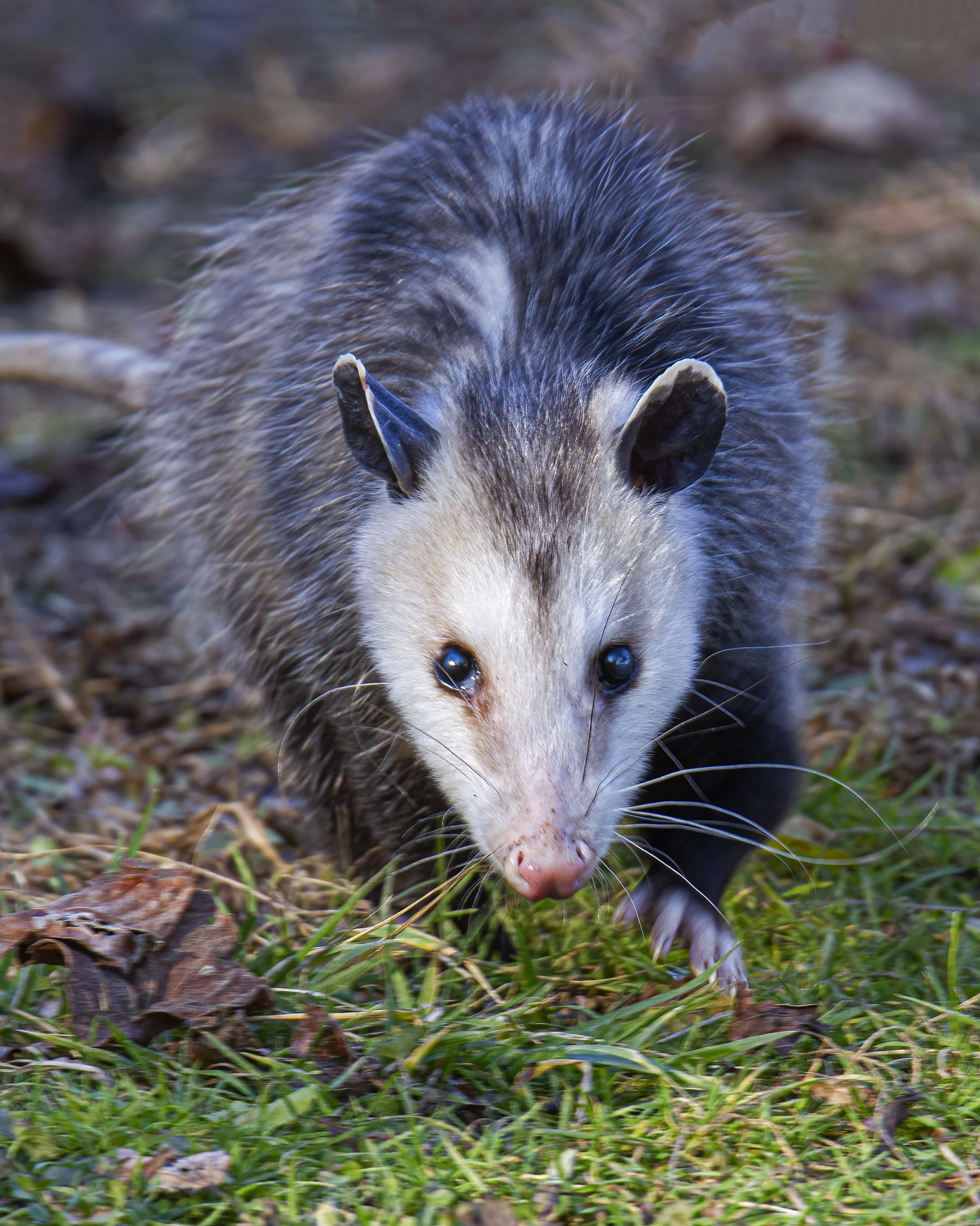
Yesterday I encountered a cool-looking Virginia Opossum (Didelphis virginiana) at Occoquan Bay National Wildlife Refuge. It was walking down the middle of a trail straight towards me and did not seem aware of my presence. Opossums are mostly nocturnal, so I do not see them very often—apparently they do not seem me very often either. An opossum’s eyesight is much better in the dark than it is in daylight, so the opossum may not have initially seen me, even though it was looking right at me in a number of these photos.

Virginia Opossums, also known as North American Opossums, are the northernmost marsupial in the world, and the only one living north of Mexico, according to Wikipedia. Like other marsupials such as a kangaroos, kolas, and wombats, opossums give birth to incompletely developed babies that develop further in a pouch—he word “marsupial” comes from the Latin word “marsupium”, which means pouch.

The gestational period lasts only 11-13 days, according to Wikipedia, and the average litter size is 8–9 infants, although over 20 infants may be born. “Newborns are the size of a honeybee. Once delivered through the central birth canal, newborn opossums climb up into the female opossum’s pouch and latch onto one of her 13 teats. The young remain latched for two months and in the pouch for 2+12 months. The young then climb onto the mother’s back, where she carries them for the remainder of their time together. It is during this time that the young learn survival skills. They leave their mother after about four or five months.”

If you want to learn more about opossums, check out an article called “50 Opossum Facts That Are Too Awesome to Miss” at the website facts.net. For example, I was shocked to learn that the word “opossum” originated in Virginia, where I live. Between 1607 and 1611, colonists John Smith and William Strachey first recorded the usage of opassom and aposoum at the early British colony in Jamestown, Virginia.

The opossum seemed curious, cute, and almost cuddly, but I kept my distance and tried not to disturb. From certain angles, such as in the second image, though, the opossum seemed focused and a little menacing.

I encourage you to click on the photos to get a closer look at some of the details of the opossum, like its prehensile tail and the little claws on its feet. You can’t see it very well, but opossums have opposable clawless thumbs on their hind feet that lets them grip onto tree branches.

Virginia Opossum

Virginia Opossum

Virginia Opossum

Virginia Opossum

© Michael Q. Powell. All rights reserved.

Read Full Post »

Although it is fun to try to photograph migratory species passing through our area, I am equally content to photograph the local species that are present throughout the year, like Wild Turkeys and Eastern Cottontail Rabbits. This rather rotund Wild Turkey (Meleagris gallopavo) seemed to be dancing the hokey-pokey when I spotted it last Friday at Occoquan Bay National Wildlife Refuge. “You put your right leg in, you put your right leg out. You put your right leg in and you shake it all about…” For the record, I did not join in the dance.

Later that same day I encountered this cute little Eastern Cottontail Rabbit (Sylvilagus floridanus). The rabbit was quite tolerant on my presence and calmly chewed on the grass while I took its picture. For several years I cared for a pet rabbit, so rabbits have a special place in my heart.

Turkeys and rabbits are quite common at this refuge and at certain times of the day I am likely to encounter them. Generally they slowly move into the undergrowth as I approach. I don’t think they necessarily view me as a threat, but they probably do not want to take chances.

Wild Turkey

Eastern Cottontail

© Michael Q. Powell. All rights reserved.

Read Full Post »

On Monday I went exploring at Accotink Bay Wildlife Refuge at Fort Belvoir, a local US Army installation, and was pleasantly surprised to spot this North American Beaver (Castor canadensis) swimming in Accotink Creek just before midday. Beavers are generally nocturnal and most of the times when I have seen on in the past it has been at dawn or dusk.

I am not sure why this beaver was swimming during the day. Perhaps there are babies in the lodge and the beaver needed a moment of peace and relaxation. Whatever the case, I like the way that I was able to capture the ripples in the water as the beaver slowly swam past me.

beaver

© Michael Q. Powell. All rights reserved.

Read Full Post »

It was only three o’clock in the afternoon, so I was a bit shocked on Thursday when I spotted this North American Beaver (Castor canadensis) at Occoquan Bay National Wildlife Refuge. I have only seen beavers at this wildlife refuge a couple of times in the past and it was always near dawn or dusk.

I managed to snap a few photos before the beaver dove into the shallow water, swam through a culvert under the trail, and disappeared into the deeper waters of the bay.

beaver

© Michael Q. Powell. All rights reserved.

Read Full Post »

Last Sunday I encountered this young buck in the woods while I was exploring a trail in Bastrop, Texas. I think that we spotted each other about the same time and we eyed each other with curiosity. After the deer had checked me out, it slowly walked into the woods and disappeared from sight.

I believe that this is a Texas White-tailed Deer (Odocoileus virginianus texana). According to the Texas Parks and Wildlife website, there are estimated to be some three to four million white-tailed deer in the state.

Texas white-tailed deer

Texas white-tailed deer

© Michael Q. Powell. All rights reserved.

Read Full Post »

I am now safely back in Virginia after my 1534 mile (2468 km) drive home from Texas. My time in Texas was wonderful, especially the wedding that I attended, but unfortunately I contracted COVID shortly thereafter. As a result, I extended my time in Texas by several days as I recovered from my symptoms that were mercifully mild and short in duration. In addition to the initial two Pfizer shots, I have had three booster shots, including the new “bivalent” version, which I believe helped to mitigate the effect of the virus.

Thankfully I was not alone and was dogsitting for the happy couple’s two delightful dogs, who helped to keep me company during my five day isolation. I love the long shadows of the early morning and late afternoon and captured this first image one morning when I was walking Oscar, their English Spaniel—this is my favorite kind of “selfie” shot. Freckles, their Cocker Spaniel, requires shorter walks because of an injury and was waiting our return at home, where I captured the second image. As was the case with treats, I decided that I had better give the two dogs equal treatment in this blog posting. 🙂

For the record, a photo of Freckles first appeared in the blog in February 2013, when she was only a year old, in a posting entitled “Dogsitting on a Saturday night.” The couple adopted Oscar, who is also about ten years old, two years ago and this is his first appearance in the blog.

I will probably be taking it a bit easy for the next week or so, but I am sure that I will find some interesting recent photos of my adventures in nature to share with you all.

Oscar

Freckles

© Michael Q. Powell. All rights reserved.

Read Full Post »

I was a little shocked to encounter this fuzzy little North American Opossum (Didelphis virginiana) yesterday while walking on a trail through the woods in Bastrop, Texas. The opossum, which is also known as a Virginia Opossum, was in the middle of the trail, walking slowly in my direction.

We spotted each other at about the same time, I think, and we both stopped and looked closely at each other. Fortunately I had the presence of mind to bring my camera up to my eye and take a few shots. Having decided that I was a potential threat, the opossum turned its back to me and slowly waddled into the underbrush, giving me a good look at its hairless tail.

opossum

opossum

© Michael Q. Powell. All rights reserved.


Read Full Post »

I saw lots of Eastern Cottontail Rabbits (Sylvilagus floridanus) on Tuesday at Occoquan Bay National Wildlife Refuge. Usually I see the rabbits during the early and late hours of the day, but these ones were active at midday. There is something really gentle about these creatures that really calms and soothes me.

In the first photo, one of the rabbit lifted its head to check me out and stared right at me. Deciding that I was not a threat, it returned to contentedly nibbling on the grass. I love the way that the rabbit’s ears look like mini-antlers, making it look like a cross between a rabbit and a deer.

In the second image, I captured a view of two rabbits contentedly chewing on the grass in an area adjacent to the parking lot. Perhaps they were used to the presence of people or perhaps they were less alert because they were eating. Whatever the reason, I was able to get my shots without disturbing them. The two rabbits were too far apart to get them both in focus, so I chose to focus on the nearest one and like the effect that I achieved.

Eastern Cottontail Rabbit

Eastern Cottontail Rabbits

© Michael Q. Powell. All rights reserved.


Read Full Post »

Yesterday afternoon at Potomac Episcopal, a loose confederation of four local Episcopal churches that has worshipped together since the start of the pandemic, we had a special Blessing of the Animals service in celebration of The Feast of Francis of Assisi. We held the service indoors in the parish hall at St. Mark’s Episcopal Church in Alexandria, one of the four churches, because of the rain caused by the remnants of hurricane Ian.

There were about 25 dogs and two cats that participated in the service. Participants also brought photos of pets and representations of pets that could not be present (including a parrot and some aquatic turtles) as well as mementos of pets who have died during the past year.

These are a few of the many photos that I took during the event that we uploaded to a Shutterfly website for viewing by all participant. Although we did not have music, we had a chorus of dogs barking throughout the short service, as you can hear in a video clip that I recorded. I have embedded at the end of this posting the YouTube version of that eight minute video that includes prayers and readings in celebration of the animals. It can also be found by clicking this link.

One of my favorite parts of the service was entitled “Litany of Thanks for Animals in the Life Cycle of Earth,” the text of which I have included below.

“We thank you, Lord, for the gift of animals in our lives. We thank you for animals that comfort us, delight us and give us companionship. We thank you for dogs and cats, birds and hamsters, guinea pigs and fish.

We thank you, Lord for the gift of animals.

We also thank you, Lord, for animals that give us wool and feathers to keep us warm. We thank you for the animals that give us milk, cheese and eggs to help us grow and keep us healthy. We thank you for horses, donkeys and oxen that work hard on farms throughout the world.

We thank you, Lord for the gift of animals.

We thank you, Lord, for animals that eat plants and fertilize the soil, making it richer and more fertile for new growth and new life. We give thanks for the gift of insects, bees, and butterflies, who pollinate fruit and vegetable plants for us to eat and flowers to give us joy.

We thank you, Lord for the gift of animals.

We thank you, Lord, for being our Good Shepherd, for seeking us when we are lost, for showing us water to quench our thirst, and for leading us to green pastures. Help us to share our blessings with others and to help others have clean water and green pastures to feed and nourish their families, too. In Christ’s name,

Amen.

Blessing of the Animals

Blessing of the Animals

Blessing of the Animals

© Michael Q. Powell. All rights reserved.


Read Full Post »

Most of the wild horses that I saw at Theodore Roosevelt National Park in North Dakota during my recently completed road trip were on relatively level ground, but I did observe one band of horses climbing a steep slope. They were pretty far away, but I managed to capture these shots as they slowly made their way up  a canyon wall.

In the first photo, the horses were just starting their climb and were bunched together. As they climbed higher, they spread out a bit. In the second shot, the lead horse was nearing the top, perhaps the edge of a plateau.

From what I have read, the bands are usually led by a head mare when they are traveling and she leads the band to watering holes and grazing spots. The band’s stallion brings up the rear when the band travels—his job is to fight off predators and other males who try to join the herd and to nip at stragglers to make sure they keep up with the others.

wild horses

wild horses

© Michael Q. Powell. All rights reserved.


Read Full Post »

Until quite recently, I had never tried to create videos with my iPhone and still have not tried to do so with my DSLR camera. I guess that I am a little old-fashioned and think of a phone as primarily a device for making phone calls and a camera as a device for taking still photos. I am gradually changing to using my phone for texting and during my recently completed road trip, I played around with taking short videos with my iPhone. Maybe it is possible to teach an old dog new tricks.

The change was prompted in part by the fact that I had to radically change my shooting habits when visiting Theodore Roosevelt National Park in North Dakota. I camped out at the park for two nights when I was headed westward towards Seattle and another two nights on my return trip eastward to Virginia. At that park, I got used to seeing large creatures like American Bison (Bison bison) at close-range and photographing them from inside my car. Suddenly it dawned on me that videos would be an effective way of capturing some of that action. In addition to bison, I also had several encounters with wild horses that I was able to document in videos.

As you probably noticed, the first image is not a video—I inserted it so that an image would show up as a thumbnail in the “Reader” feed for those who view my postings in that way. The still photo shows a large bull moving down the recently repaved roads of the park. At that time they had not yet painted lines on the road, so I had to pay a lot of attention while driving, given that many of the roads were full of curves and and in some cases there were steep drop-offs. I do not think that the bison cared about the lack of lines—as far as I was concerned, they owned the roads and always had right-of-way.

The first video shows one of the huge male bisons that I encountered on the roads at the national park. I was safely inside of my car when I took this video, though I must confess that this bull bison looked to be almost as big as my KIA Soul and may have outweighed it.

The second and third videos show bands of wild horses that I encountered at separate locations in the park. I was particularly impressed by the beauty of these horses and it was cool to capture them in action.

I was not sure how to present videos here in WordPress, but I think it works to post them to YouTube first and then to embed a link to that posting here. In this way, the videos do not count against my data allowance on my WordPress plan.

I definitely need to improve on my skills as a videographer, but I am happy with these initial results. The sound quality is still a problem, because it was often windy and the video also includes some extraneous conversation. I may have to learn to do voiceovers for the videos or to add some music to them.

So what do you think? These little clips are definitely a change from my normal content, but I thought it would be a fun way to share some of my experiences more directly with all of you. As you probably noticed, the first image is not a video—I inserted it so that an image would show up as a thumbnail in the “Reader” feed for those who view my postings in that way.

American Bison

Here is the YouTube link for the first video.

Here is the YouTube link for the second video.

Here is the YouTube link for the final video.

© Michael Q. Powell. All rights reserved.


Read Full Post »

It was so much fun to watch the Black-tailed Prairie Dogs (Cynomys ludovicianus) that I encountered in multiple locations during my recent visit to Theodore Roosevelt National Park in Medora, North Dakota. I could see them from my car when I was driving along the roads looking for buffalo and wild horses, but I also encountered them on both sides of some of  the trails when I was hiking.

The prairie dogs seemed playful and energetic and were surprisingly vocal. They seemed to be calling out to each other all of the time in very distinctive squeaky voices. It seems like some of the calls were warnings that I was approaching, because quite often the prairie dogs would scurry into their holes as I drew near, sometimes peeking out with just the top of their heads and their eyes visible.

Here are some selected shots of prairie dogs in which I tried to capture a sense of their playful personalities.

Prairie Dogs

Prairie Dog

Prairie Dog


Read Full Post »

Theodore Roosevelt National Park in North Dakota is one of the few national parks where visitors can observe free-roaming horses. According to the National Park Service, “their presence represents Theodore Roosevelt’s experiences here during the open-range ranching era. Ranchers turned horses out on the open range to live and breed. When needed, they would round up horses and their offspring for use as ranch horses. For generations, ranchers used land that would later become the park for open-range grazing.”

Once the park was fenced in, one of the issues was what to do with the horses. Initially the authorities tried to capture and remove all of the horses, but some small bands of horses eluded capture and continued to live free-range in the park. “In 1970, a change of park policy recognized the horse as part of the historical setting. New policies were written and enacted to manage the horses as a historic demonstration herd.”

I had multiple sightings of wild horses during my visit to the national park. Most of the time it was only one or two horses, but on my final day I ran into a larger group. As I was observing them, another visitor told me that this was Xander’s band, named for the lead stallion.

The other visitor turned out to be a member of a group that tracks the bands of wild horses in the park. She patiently explained to me that the horses travel in groups of 5 to 15 horses, known as bands, with a well-established social hierarchy. The bands are pretty stable—young colts and fillies are kicked out of their groups at the age of 2-3 and form new bands. Some of the individual horses that I observed, she said, were likely to be bachelors.

The first photo shows the band all grouped up together in a shadow of a rock formation where I first saw them. They were packed together so tightly that it was hard to get an accurate head count. I believe that the gray horse in the front is Xander, the leader. Eventually the individuals of the group spread out a bit (it looks like there are ten members in the band) and began to graze, as you can see in the second and third photos.

The National Park Service tries to manage the number of wild horses in this park tor prevent overpopulation. “Historically, the park conducted roundups every three to four years using helicopters to herd horses to a handling facility and then sold them at public auction. More recently, the park has tried new methods for herd management including contraceptives, low-stress capture techniques, genetics research, and partnerships with nonprofit horse advocacy groups. Horses are currently captured using tranquilizer darts and sold in online auctions.”

Xander's band

Xander's band

Xander's band

© Michael Q. Powell. All rights reserved.


Read Full Post »

As many of you know, I have spent the last week driving across the United States to spend some time with family outside of Seattle, Washington. I departed from Virginia at midday last Monday and by the time that I finally arrived on Saturday afternoon, I had traveled a distance of 3085 miles (4964 km).

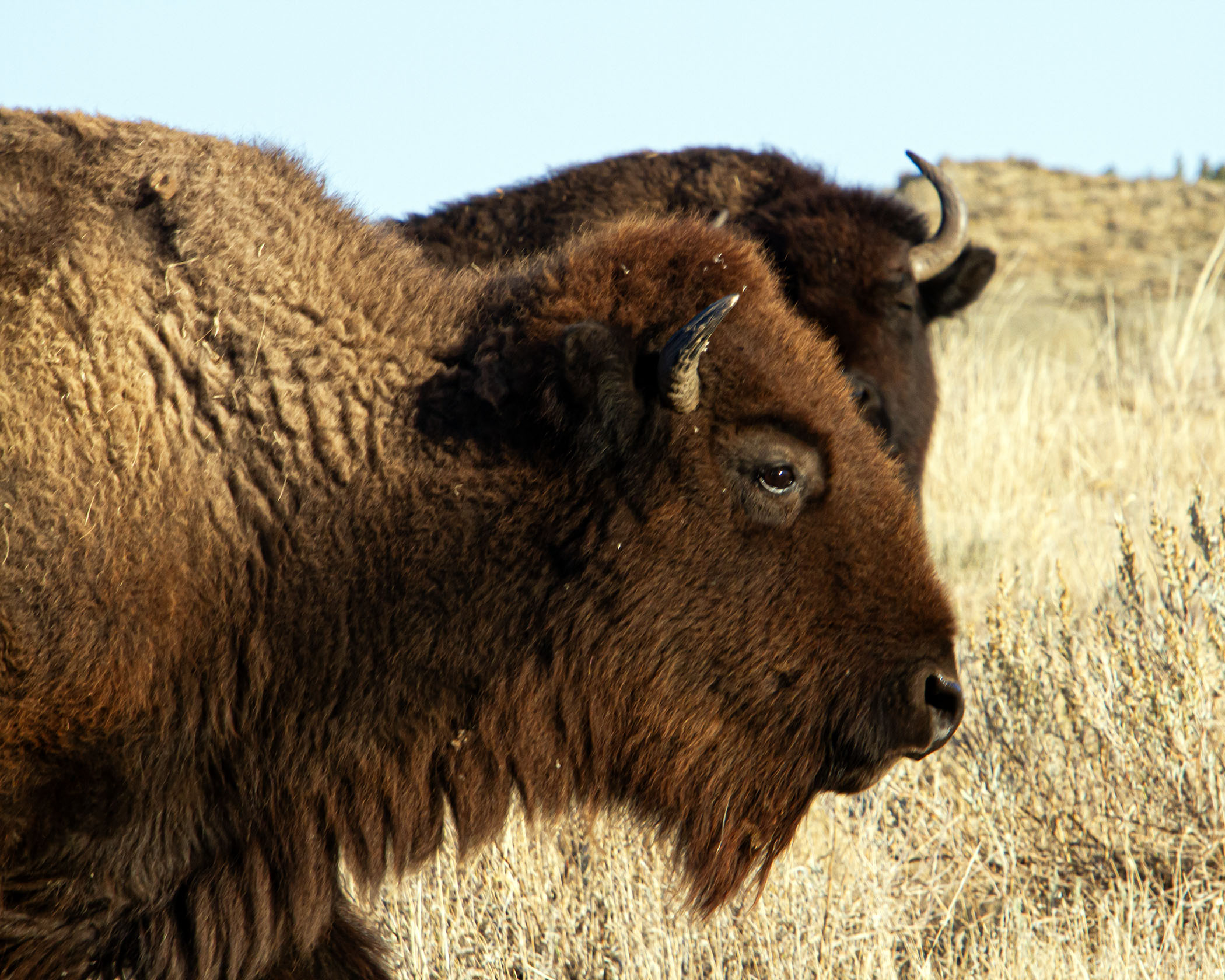
I spent a lot of time driving, but made an extended stop at Theodore Roosevelt National Park in western North Dakota, where I camped out for two nights. During my visit, I had multiple encounters with American Bison (Bison bison), including one memorable moment when my car was almost surrounded as a small herd of bison moved past me on the road.

It was a bit strange for me to take wildlife photos from inside my car, but that definitely was the safest thing to do with these bison. Some of the bulls looked to be as large as my KIA Soul. I noted that there were a good number of calves too, and definitely did not want to mess with a potentially mad mamma bison if I got between her and her baby.

I am still sorting through my images, but I thought I would lead with these little portraits that show some of the personality of the individual bison.

In addition to the bison at the national park, I was able to photograph wild horses, prairie dogs, birds, and even a few dragonflies. You should see some of them in the near future.

American Bison

American Bison

American Bison

© Michael Q. Powell. All rights reserved.
Read Full Post »

I had no idea that Eastern Gray Squirrels (Sciurus carolinensis) liked mushrooms, but this squirrel certainly seemed to be nibbling on one when I spotted him on Wednesday at Green Spring Gardens. I love the way that he was holding the mushroom in his “hands” as he gently chewed on the stem—I think he may have already consumed the mushroom cap.

Squirrel and mushroom

© Michael Q. Powell. All rights reserved.

Read Full Post »

Older Posts »