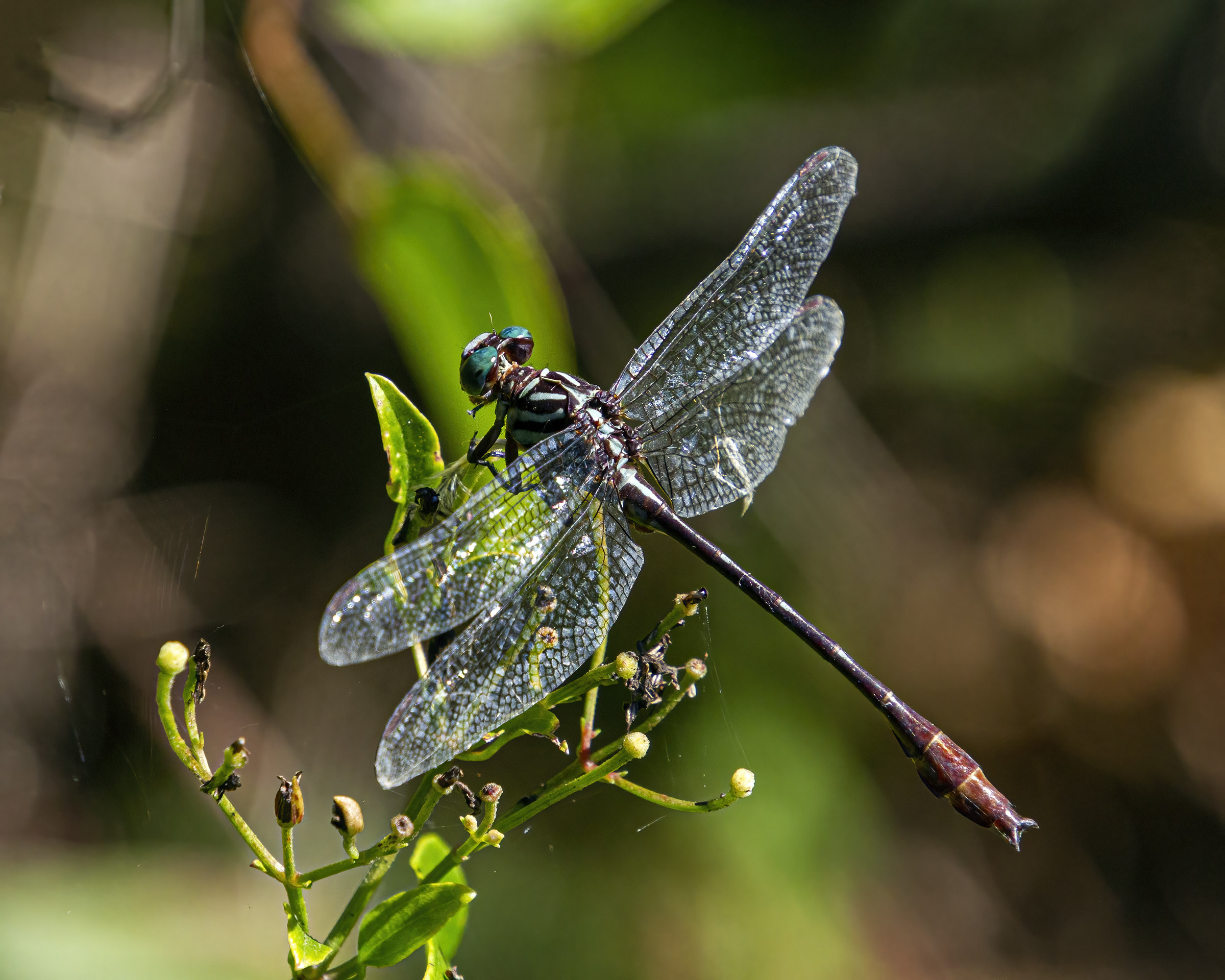
I was absolutely thrilled last Friday to photograph a Russet-tipped Clubtail dragonfly (Stylurus plagiatus) at Occoquan Bay National Wildlife Refuge, a somewhat surprising find this late in the dragonfly season. As I was walking along one of the trails, I encountered a fellow dragonfly enthusiast who was part of a group conducting a survey of butterflies and dragonflies at the refuge. After a brief conversation, we both continued on our way, heading in opposite directions.
A short time later I heard a voice calling out from a distance. I could not understand what was being said, but hurried back down the trail and was delighted to see that my friend had spotted a Russet-tipped Clubtail perched in the vegetation. Russet-tipped Clubtails are a late season species and are seen most often in August and September in my area. Unlike many of the dragonflies that I see regularly that seem to prefer pole-like perches or perch flat on the ground, Russet-tipped Clubtails like to hang from the leaves of vegetation at an angle or almost vertically—members of the genus Stylurus are sometimes called “Hanging Clubtails.”
The dragonfly was cooperative and remained perched as I took photos from several different angles. Before long, the dragonfly took off and our brief encounter ended. I continued on my way, content to know that the end of the dragonfly season, although near, is not here yet.


© Michael Q. Powell. All rights reserved.
 Mike Powell
Who knew there were such varieties of dragonflies? I’ve been fascinated by several varieties I’ve encountered on my walks. Thanks for enlightening us. These are beautiful and intriguing.
Thanks so much for your kind words. I am blessed to live in Northern Virginia where we get some of the northern species and some of the southern ones plus a few species that actually migrate. Dragonflies are such incredible aerial acrobats as well as being fierce predators. As it probably shows, I am utterly taken in by their amazing beauty as well as by their diversity.