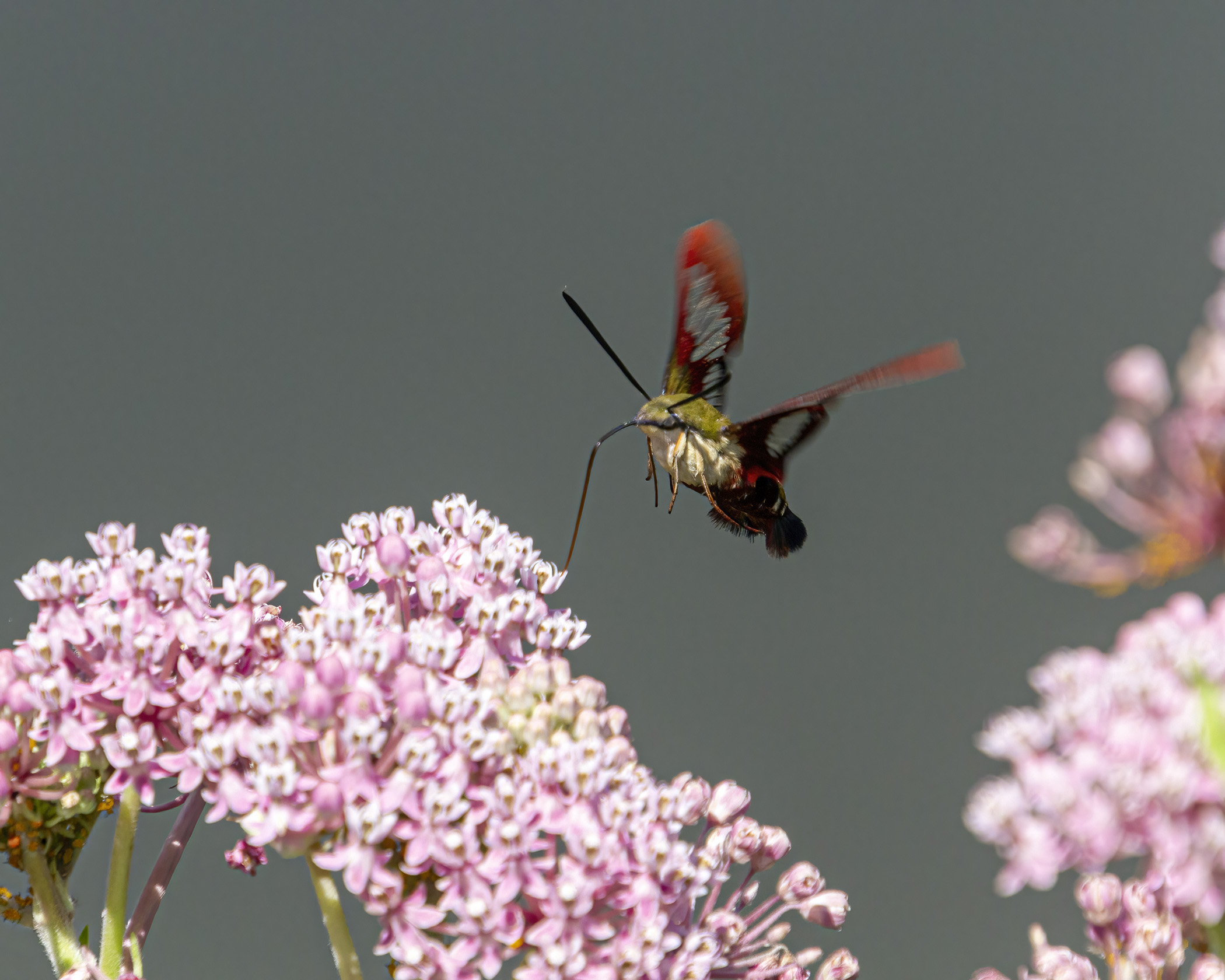
Yesterday I went out with my camera to Jackson Miles Abbott Wetland Refuge, a small nature pond that is overseen by the nearby Fort Belvoir military installation. I was looking for certain dragonfly species and mostly came up empty-handed. However, I was delighted to spot this spectacular Hummingbird Clearwing Moth (Hemaris thysbe) feeding in a patch of milkweed.
Like Hummingbirds, these moths hover in the air while extracting nectar from flower. Unlike hummingbirds that use long, slim beaks to get deep into the center of flowers, hummingbird moths use a long, hollow proboscis to suck out the nectar. The proboscis is normally coiled and is extended only when the moth is ready for action, as you can see in the photo below.
I used a relatively high shutter speed and managed to capture a pretty good view of the “clearwing” that is in the common name of this species. I did not have too much time to maneuver about, but crouched down a bit to isolate the clearwing moth against the backdrop of the pond, rather than risk having it be lost in the clutter of the vegetation.
UPDATE: I felt compelled to post the second photo below. I sort of missed it when I quickly sorted my photos, but the head-on shot really struck me as cool and unusual when I looked through the photos again. I particularly love the raised wing positions in the moment that I captured.

© Michael Q. Powell. All rights reserved.
 Mike Powell
Nice post
great photo!!
Thanks, Molly. The photo was a result of a combination of good fortune in spotting the moth and quick reactions in moving quickly to get some shots.
I am so glad you shared the second photo too because I love the symmetry and the way it focuses the eye on the proboscis and the antenna (?) that look like quizzical eyebrows. I especially love the way you have captured that frenetic movement of the wings in that shot.
Thanks, Laura. I probably should have put the second photo first, because I like it a bit more than the first. As I noted, I kind of missed the second shot when culling my photos. I initially thought it might be out of focus. As you might suspect, a lot of the photos that I took were not sharp, because the moth was moving around quite a bit. The antennae of his species are often described as “club-like” because they are thicker at the edge than at the attachment point.
Nice write up with beautiful pic.
Thanks for your kind words.
Stay connected and stay happy.
A rare find. Love it.
Thanks, Sherry. I am never quite sure how rare they are, but I know that I personally do not see them very often.
So cool!
Fantastic photos, Mike. You had your eyes open, and your camera prepped, and it all paid off with these wonderful images. Excellent work!
Thanks. I try to keep my camera on relatively neutral settings when I am not actually taking photos (I often use exposure compensation when in relatively dark or very light conditions and try to remember to switch it back when moving on) so that I am ready to spring into action when a situation presents itself.