Feeds:
Posts
Comments

Archive for October, 2024

On several of my drives through Theodore Roosevelt National Park in North Dakota I spotted Mule deer (Odocoileus hemionus) with fawns. I was always struck by the proportionally large ears on the youngsters—apparently they grow into them as they age.


deer and fawn

deer and fawn

© Michael Q. Powell. All rights reserved.

Read Full Post »

I captured this shot of a mule deer (Odocoileus hemionus) early in the morning during my recent visit to Theodore Roosevelt National Park in Medora, North Dakota. I woke up before dawn and crawled out of my warm sleeping bag on a frigid morning to drive slowly through the park.

I spotted several small groups of mule deer grazing alongside the park roads and this was my favorite shot of one of them.

© Michael Q. Powell. All rights reserved.

Read Full Post »

After making my way last week through Montana and the panhandle of Idaho, it felt good to finally reach the state of Washington. There were still a few hours of driving to go, including the mountain pass at Snoqualmie Pass at 3022 feet (921 meters), but I felt like I was on the home stretch of my cross-country drive.

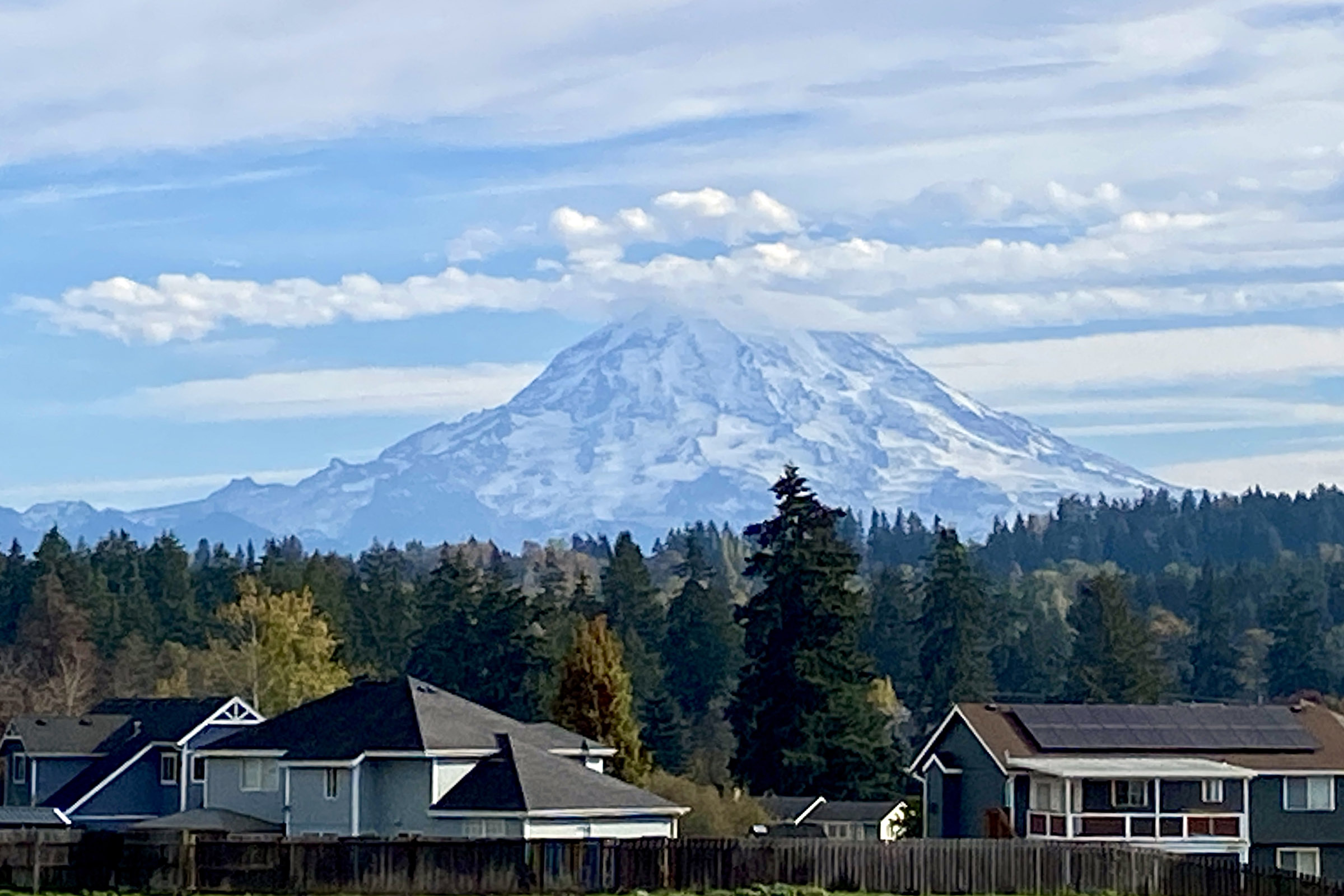
The views were breathtaking as I made my way through the mountains and occasionally I would catch a glimpse of the glacier-capped peak of Mount Rainier. Even through there was a lot of haze, I was able to get a decent shot of the mountain from one of the rest areas along the highway.

With an officially recognized summit elevation of 14,410 ft (4392 meters), Mount Rainier, also known as Tahoma, is the highest mountain in the state of Washington. When conditions are good, the mountain is visible from almost the entire the Seattle/Tacoma area.

Mount Rainier

© Michael Q. Powell. All rights reserved.

Read Full Post »

I got up early to catch the sunrise at Theodore Roosevelt National Park in South Dakota on 13 October during a road trip to visit family. I had spent the previous night tent camping in the park where temperatures dropped down into the 20’s (about minus 3 degrees C). I was warm enough in my little tent, though its outer surface was covered with frost when I first woke up.

It was dark when I started to drive slowly along the roads in the national park, but gradually the rising sun began to illuminate the spectacular landscape with its warm light. Here a couple of images that I was able to capture with my iPhone 11, which did a good job in somewhat difficult lighting conditions.

sunrise in South Dakota

© Michael Q. Powell. All rights reserved.


Read Full Post »

For the next few weeks my postings will be sporadic as I spend time visiting family members. I know that some viewers are used to seeing almost daily posts and I wanted to reassure in advance them that nothing is wrong. I am hoping to be able to give a few updates during this period, if possible, and plan to resume my “normal” schedule in early November.

I spotted this Red-bellied Woodpecker (Melanerpes carolinus) during a visit to Occoquan Bay National Wildlife Refuge last week when the skies were completely cloudy and overcast. The light was limited, so the subject is nor illuminated very well, but I was happy that I was able to capture the texture of the snap on which the woodpecker was perched. If you look closely you can see some small holes in the tree where the woodpecker has been pecking away.

Red-bellied Woodpecker

© Michael Q. Powell. All rights reserved.


Read Full Post »

I was looking for warblers last week when I visited Occoquan Bay National wildlife and this little bird with bright yellow coloration under its tail was one fo the very few that I was fortunate to spot. I don’t know my warblers very well, so my identification of warbler species is often incorrect. Nonetheless I pored over the images in my bird guide and on line and concluded that this might be a female Common Yellowthroat (Geothlypis trichas).

As is often the case, the male of the species is a lot easier to identify with his distinctive black mask, and females tend to me more nondescript. I’d welcome the views of more experienced birders if my identification is wrong. From my perspective, I am happy enough that I managed to capture this shot of the beautiful little bird.

UPDATE: One of my friends on Facebook identified the bird as a Palm Warbler. I really need to work on my identification skills.

Common Yellowthroat

© Michael Q. Powell. All rights reserved.

Read Full Post »

At this time of the year holiday preparations become intertwined at retail stores. I have already seen lots of displays for Halloween and suspect that I will see Christmas decorations for sale as well if I look a little harder. Indigenous Peoples Day and Thanksgiving Day are also part of this autumn blitz.

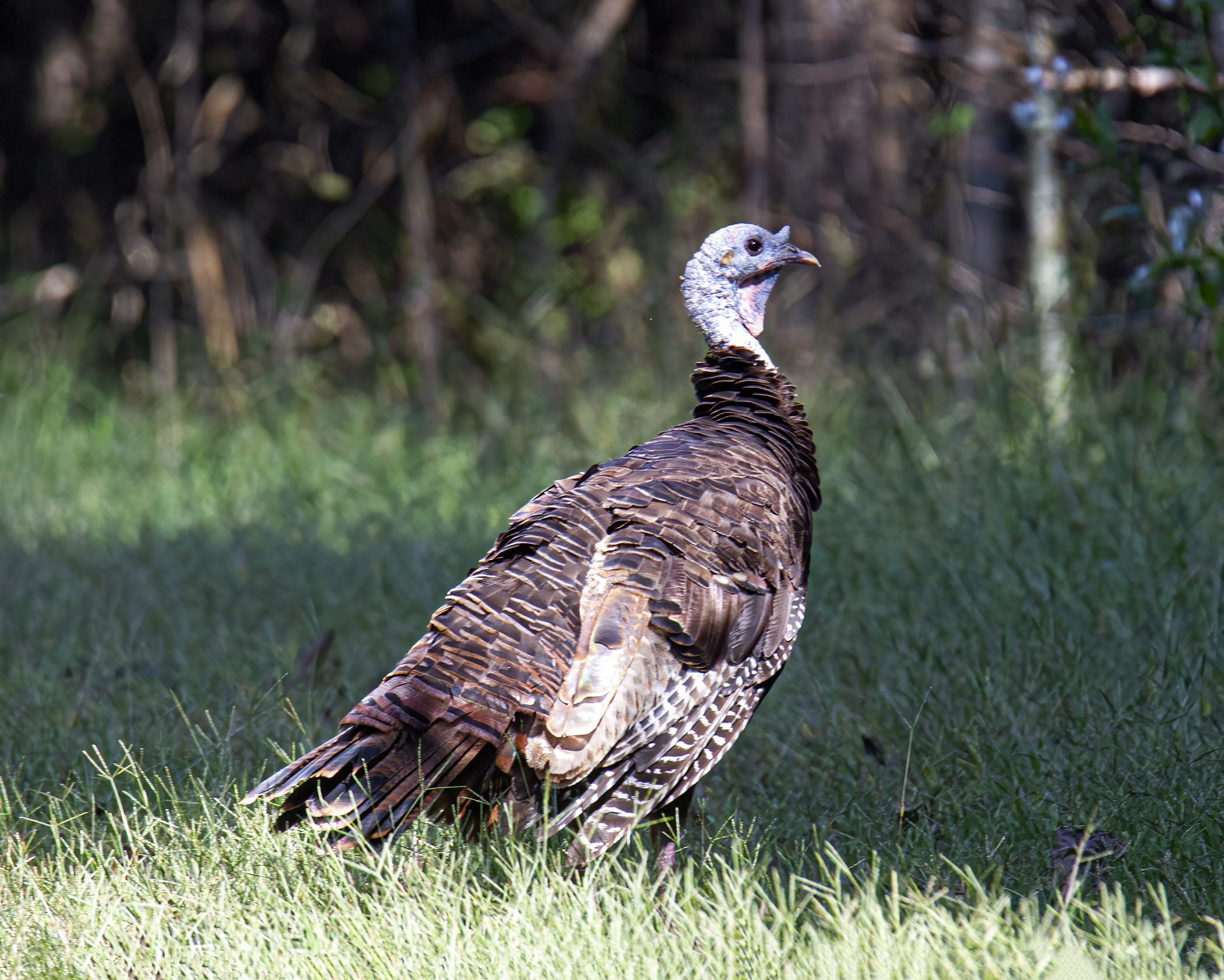
So I guess that it is not that surprising that I immediately thought of Thanksgiving Day when I spotted this Wild Turkey (Meleagris gallopavo) last week at Occoquan Bay National Wildlife Refuge. Turkeys are part of the lore of Thanksgiving and play a central role in the traditional feast, though commercial turkeys no longer bear much resemblance to their wild counterparts.

There are several flocks of wild turkeys at this wildlife refuge and I often encounter them foraging along the trails. When they see me, they usually move slowly into the undergrowth—I suspect that they have grown accustomed to the presence of humans, but do not want to interact with them most of the time. Strangely enough, that’s the same attitude that I display when I am out in the wild with my camera.

Wild Turkey

© Michael Q. Powell. All rights reserved.

Read Full Post »

I was delighted on Thursday to encounter my first Blue-faced Meadowhawk dragonfly (Sympetrum ambiguum) of the season at Occoquan Bay National Wildlife Refuge. A few minutes later I got a peek at a pair of mating Blue-faced Meadowhawks—spring is not the only season for love.

Blue-faced Meadowhawks are one of the prettiest dragonfly species that I have ever encountered. I love the contrast between their turquoise faces and their bright red bodies. Generally I spot them in the early autumn, just as most of the other dragonfly species are starting to disappear.

Blue-faced Meadowhawks will be around for a bit longer and then their “cousins,” the Autumn Meadowhawks will end up as the last remaining dragonflies of the season. In some years I have seen Autumn Meadowhawks as late as mid-December and a fellow photographer spotted one in early January one year. Autumn Meadowhawks also have red bodies, but have brown eyes.

Blue-faced Meadowhawk

Blue-faced Meadowhawk

© Michael Q. Powell. All rights reserved.


Read Full Post »

The weather forecast yesterday showed that there would be some sunshine, a welcome respite after a lengthy period of rainy and/or overcast weather, so I ventured out to Occoquan Bay National Wildlife Refuge. Some other photographers have recently posted photos of warblers there and I thought that I would try my luck, knowing that the still abundant foliage would hamper my efforts to spot them.

As I was walking along on one of the trails, I saw some flashes of yellow, a good indication of a possible warbler. I watched and waited and eventually managed to get a few shots of the bird. I vaguely recalled having seen this species before, but I couldn’t remember what it was. A short time later, I encountered a couple of birders with binoculars. I am usually reluctant to ask for help out in the field, but somehow I managed to overcome my inhibitions and showed them a photo. One of them suggested that it was probably a White-eyed Vireo (Vireo griseus), not a warbler.

When I returned home, I checked my blog and found that I had previously seen White-headed Vireos in the spring of both 2022 and 2o24. In those cases, the eyes of the vireo were much whiter than those of this bird, which somehow made those prior identifications a little easier.

This is a transitional time of the year for me, a time when I try to search for both birds and dragonflies. My head is moving almost continuously as I alternate between scanning the nearby ground area for insects and the more distant trees for birds.

Summer stragglers and migratory birds mean that I never know what I might encounter when I go walking with my camera, so I try to stay alert and ready at all times.

White-eyed Vireo

White-eyed Vireo

© Michael Q. Powell. All rights reserved.

Read Full Post »
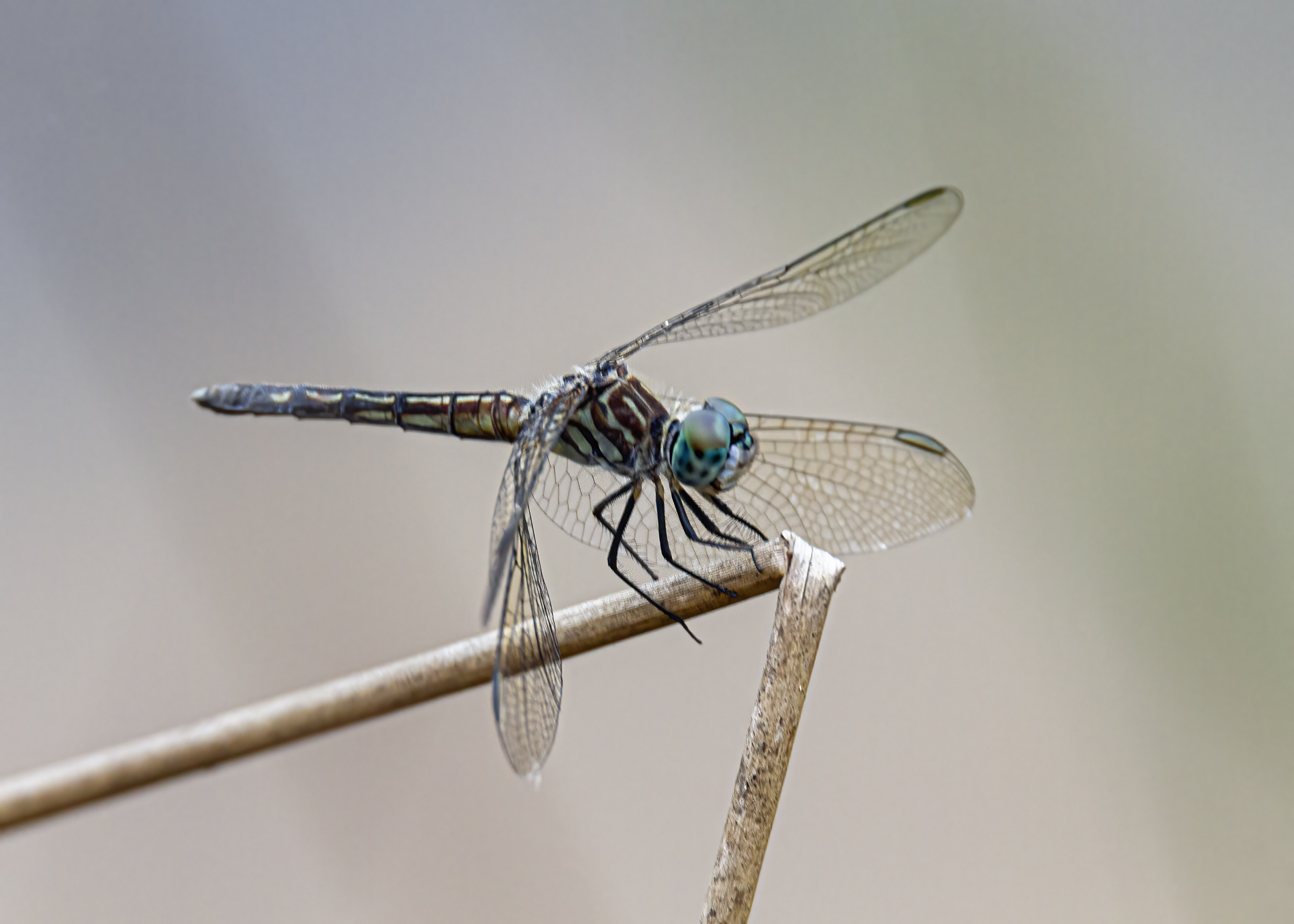
I know that there should be more dragonflies still around, but this past Wednesday, this Blue Dasher (Pachydiplax longipennis) was the only dragonfly that I spotted during a visit to Occoquan Bay National Wildlife Refuge. The day was cool and gloomy with intermittent drizzle, which almost certainly contributed to the relative scarcity of dragonflies. This month the number of dragonflies will continue to drop, but there still should be some Autumn Meadowhawks and Blue-faced Meadowhawks flying into November.

Blue Dashers are one of our most common dragonfly species and are usually among the first species to emerge in the spring and to disappear in the fall. The dragonfly in this photo was perched at the edge of a small pond. I was happy to capture this shot, considering that I had switched to my longer Tamron 150-600mm lens, which sometimes is a bit soft when extended to 600mm. I had changed lens in anticipation of seeing more birds, which largely was not the case that day.

Blue Dasher

© Michael Q. Powell. All rights reserved.

Read Full Post »

It was cool and gray yesterday with intermittent periods of drizzle and I considered staying indoors. However, I had been cooped up inside for almost a week by teh daily rain showers, so I decided to venture out anyways. I did not see very many insects, only one dragonfly and one damselfly, but I did see a good number of birds. Actually, it is probably more accurate to say that I heard a lot of birds—most of them stayed hidden in the still abundant foliage or were visible from a long ways off.

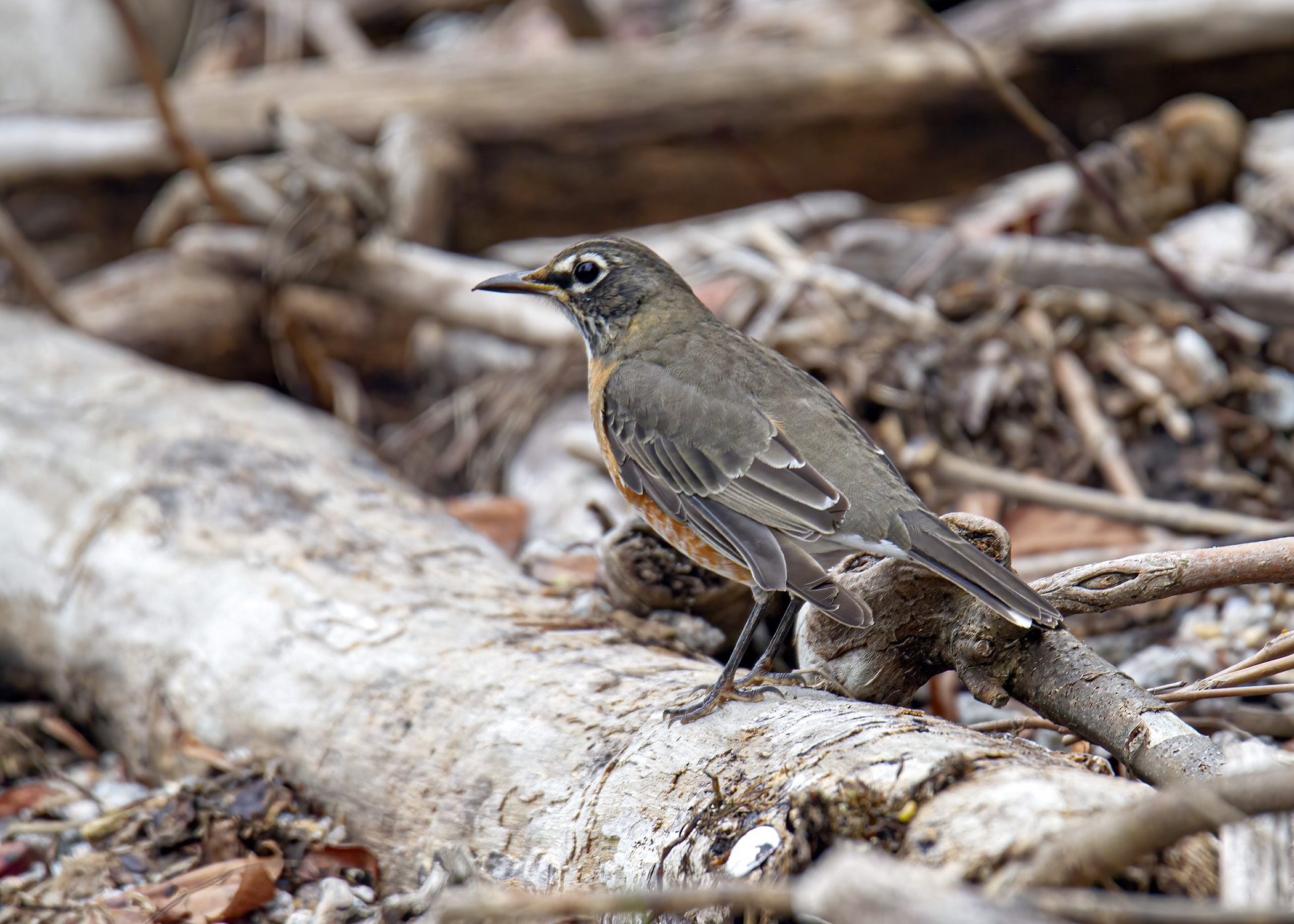
During my time at Occoquan Bay National Wildlife Refuge, I encountered several flocks of American Robins (Turdus migratorius). Growing up in Massachusetts, I tended to think of American Robins as harbingers of spring, but here in Virginia they seem to be present throughout most of the year. I used to refer to thesr birds as simply “robin,” but ever since I started to photograph birds, I have been more careful in identifying them as “American Robins,” in order to distinguish them from European Robins that are somewhat similar in coloration, but quite different in overall appearance.

The American Robin in this photo was busily foraging in the debris on the trail alongside the water. Fortunately the tides had receded a lot since my previous visit to the refuge, so the trail was no longer under water. I love the way that all of the leaves and branches in the image are an almost perfect match for the colors of the bird, giving the shot a nice sense of harmony.

American Robin

© Michael Q. Powell. All rights reserved.

Read Full Post »

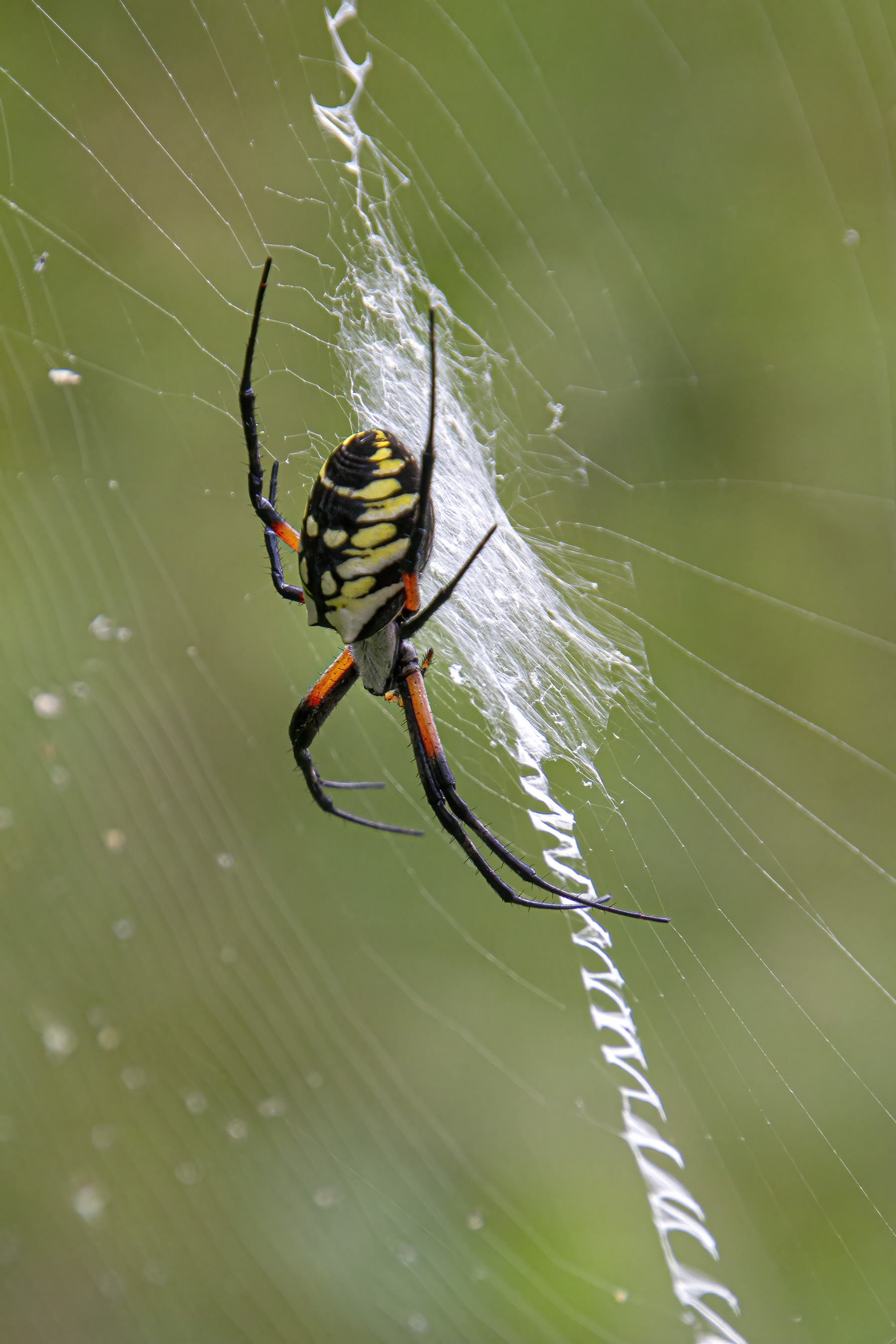
At this time of the year, a lot of Black and Yellow Garden Spiders (Argiope aurantia) show up, like this one that I spotted recently at Occoquan Bay National Wildlife Refuge. One of the features of this species is the distinctive zigzag pattern in the center of their webs.

When a prey lands on the web, the spider moves forward quickly to wrap up its victim in webbing material, as you can see in the second photo. Spiders will often wrap up several victims and leave them on the web for a later snack.

Black and yellow garden spider

spider

© Michael Q. Powell. All rights reserved.


Read Full Post »

The weather has been uncooperative this past month and I’ve spent more time indoors than usual, so I have not been able to take as many bird photos as I have in some other months. Now that the leaves are starting to fall off of the trees, I am hoping that I will have the chance to spot and photograph more birds. As the weather gets cooler, there will also be fewer and fewer insects around, I will inevitably have to switch my focus.

Last week I spotted this Northern Mockingbird (Mimus polyglottos) perched in a nearby tree while I was wading my way through Occoquan Bay National Wildlife Refuge. It was a gray and overcast day and many birds seemed to be sheltering in the trees, hidden by the foliage. This mockingbird was hopping about in the tree and I was happy to capture this shot before it flew away.

Northern Mockingbird

© Michael Q. Powell. All rights reserved.

Read Full Post »