Feeds:
Posts
Comments

Archive for June, 2022

On Tuesday I was thrilled to spot this male Brown Spiketail dragonfly (Cordulegaster bilineata) while I was exploring a marshy area in Prince William County, Virginia. Spiketail dragonflies are quite rare in our area and this was the first one that I have spotted this year.

Brown Spiketails are found only in a specific type of habitat. According to the Dragonflies of Northern Virginia website, Brown Spiketails prefer “clean, small, sunlit, forest streams and seepages” and “perch often and low on grasses and shrubs in clearings, meadow edges and sunny forest edges.” As you can see from the background in these two images, the location where I found this dragonfly was full of ferns.

In case you are curious, spiketail dragonflies are so named because the long ovipositor of the female extends beyond the tip of the abdomen. The females lay their eggs by hovering over shallow water and driving the long ovipositor vertically into the shoreline mud or stream bottom in a fashion reminiscent of a sewing machine. Since these photos show a male, there is no “spike” to see for this spiketail.

I love the striking eyes of this dragonfly and the colorful markings his entire body and was happy to be able to capture such a detailed look at his beauty.
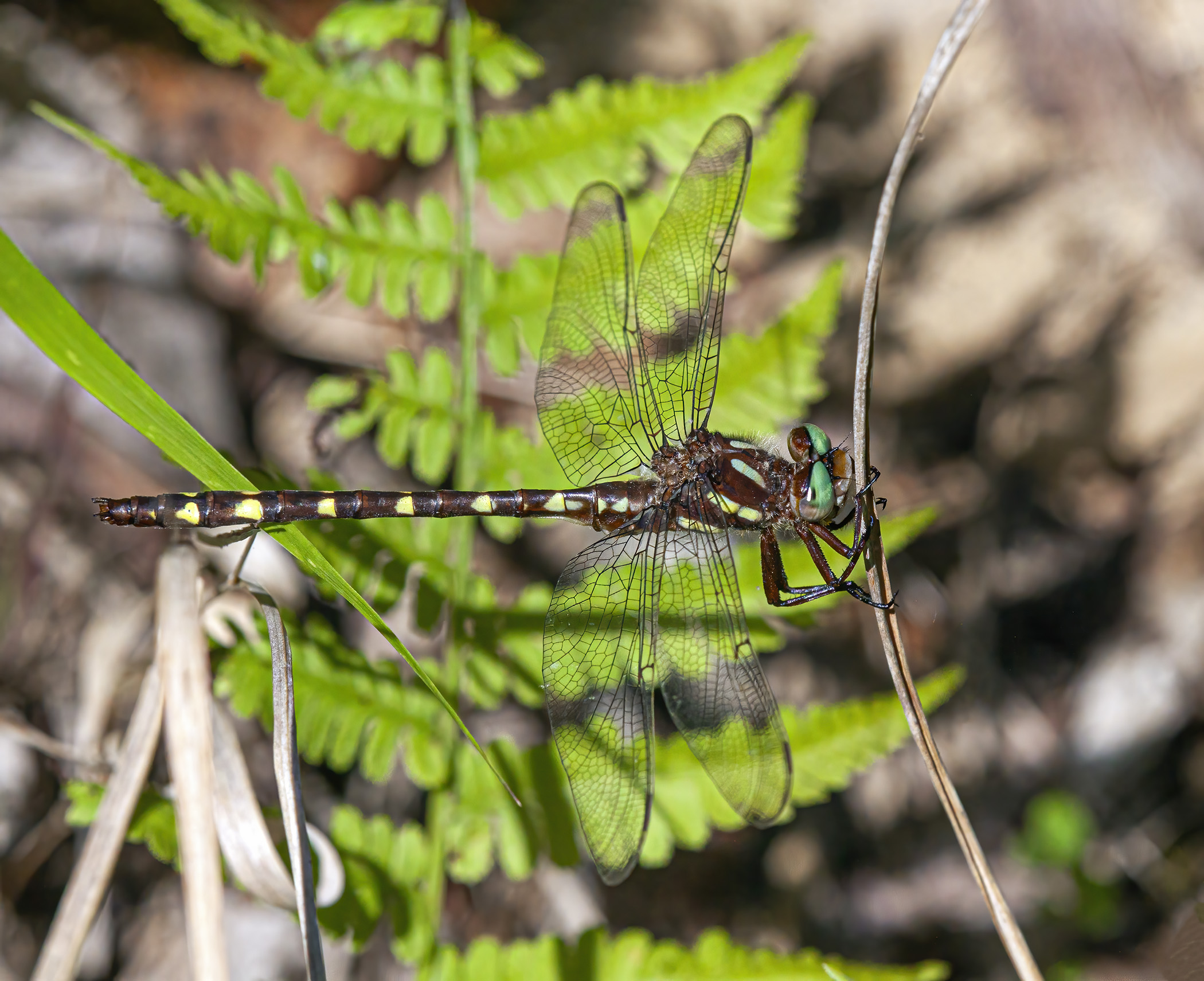
 

Brown Spiketail

Brown Spiketail

© Michael Q. Powell. All rights reserved.

Read Full Post »

I have seen an Indigo Bunting (Passerina cyanea) only a few times in my life, so I was thrilled last week when I spotted one last week at Occoquan Bay National Wildlife Refuge, my second sighting of this species this year. Once again I was struck by the brilliant blue coloration of its feathers—even from a distance the bird’s amazing blue color really stood out.

As I was doing a little research, I was surprised to learn that Indigo Buntings, along with other buntings and grosbeaks, are part of the Cardinalidae family, which I tend to associate with the bright red Northern Cardinals. When I look at the first photo, though, I must admit that the raised crest on the head of the bunting does remind me a bit of a cardinal.

I did not notice it when I took the first photo, but as I was processing the first image I spotted what appears to be a band on the bird’s right leg—I encourage you to click on the image to get a closer look at that leg. There is a bird banding station at this wildlife refuge and several years ago I visited it and watched the fascinating process of bird banding (see my 2018 posting entitled Visit to a banding station). I recall being amazed at the range of sizes of the bands, which allow for the banding of birds even smaller than the Indigo Bunting, which is about 5 inches (13 cm) in length.

I believe that Indigo Buntings remain with us all summer, so I will be keeping my eyes open for them during future visits. However, I couldn’t help but notice how the trees are now covered with leaves and the vegetation is lush, which makes it really hard for me to see small birds, even when I am able to hear them.

Indigo Bunting

Indigo Bunting

© Michael Q. Powell. All rights reserved.


Read Full Post »

« Newer Posts