Feeds:
Posts
Comments

Archive for May, 2022

Some of the coolest looking plants that I saw last Saturday at Meadowlark Botanical Gardens were Japanese Jack-in-the-Pulpit flowers (Arisaema sikokianum). There is something so alien and exotic about this plant that it stopped me in my tracks when I first spotted it.

According to the Plant Delights Nursery, Inc. website, the dark pitcher and two five-lobed leaves of this plant emerge on a 12 inch tall (30 cm) fleshy stalk from an underground tuber in early spring. As the pitcher opens, it reveals a swollen, pure white, protruding spadix that provides a dramatic contrast to the purple of the pitcher.

The Japanese Jack-in-the-Pulpit is closely related to the Jack-in-the-pulpit (Arisaema triphyllum), which, according to Wikipedia, is common to the eastern United States. I checked the range map and the Jack-in-the-Pulpit can be found in Virginia where I live, though I have not yet spotted one. When I looked at photos of the American species, it looks fairly similar to the Japanese variant, but the spadix, the part that is the “Jack” in the name, is darker in color and the pitcher more closely matches the leaves. Check out this blog posting by Steve Gingold to see a beautiful photo of a Jack-in-the-Pulpit growing wild in his area of New England.


Japanese Jack-in-the-Pulpit

Japanese Jack-in-the-Pulpit

Japanese Jack-in-the-Pulpit

© Michael Q. Powell. All rights reserved.

Read Full Post »

I am a bit of a romantic, so my eyes are immediately drawn to the heart-shaped blooms of Bleeding Heart flowers whenever they are present in a springtime garden. Most of the time they are reddish in color, as their name suggests, but they also come in other colors. I spotted these beautiful White Bleeding Hearts (Dicentra spectabilis alba) last Saturday at Meadowlark Botanical Gardens.

I was fortunate to be able to get close enough for the first photo to be able to focus on the delicate shape of a single flower. Somehow the little wings on the hearts make me think of angels or maybe the little cherubs that we associate with Valentine’s Day. The second image gives you an idea of the way that these flowers grow in rows, suspended from tiny filaments from a stalk, twisting and turning in the wind.

Bleeding Heart

Bleeding Heart

© Michael Q. Powell. All rights reserved.

Read Full Post »

A speedy little Barn Swallow (Hirundo rustica) was perched on a paved path at Meadowlark Botanical Gardens last Saturday and I captured this first image as it was taking off. The shot is a little blurry, but I love the the really cool shadow that the swallow was casting onto the ground. The second image shows the same swallow just before it took off and give you a better view of the coloration and markings of a Barn Swallow.

When I first spotted the birds in the final photo, I thought they might also be Barn Swallows, but when I took a closer look and did a little research, I determined that the bird on the outside of the nest was a male Purple Martin (Progne subis) and the one with her head poking out was a female Purple Martin. As far as I can recall, this is the first time that I have photographed this bird species, which is the largest swallow in our area.

Barn Swallow

Barn Swallow

Purple Martin

© Michael Q. Powell. All rights reserved.


Read Full Post »

I love the shape and colors of columbine flowers that appear in many of the gardens that I visit during the spring. According to Wikipedia, the genus name for these flowers Aquilegia is derived from the Latin word for eagle (aquila), because of the shape of the flower petals that are said to resemble an eagle’s claw. The common name “columbine” comes from the Latin for “dove”, due to the resemblance of the inverted flower to five doves clustered together.

I spotted several spectacular columbines during a visit to Meadowlark Botanical Gardens in Vienna, Virginia last Saturday. The purple columbine was in the middle of a flower bed and I could not get very close to it. I was really happy though that I had to shoot from a longer distance away than normally, because I able to capture some of the shadowy shapes of the ferns in the background.

I did manage to get quite a bit closer to the pretty pink columbine. I smiled when I saw a marker that indicated that this variety is called “Strawberry Ice Cream.” I now have an overwhelming urge to buy some strawberry ice, one of the many ice cream flavors that I love.

columbine

columbine

© Michael Q. Powell. All rights reserved.


Read Full Post »

As we were photographing some Spring Snowflake flowers (Leucojum vernum) on Saturday at Meadowlark Botanical Gardens, my dear friend and photography mentor Cindy Dyer noticed what looked like a spider’s leg on the side of one of the flowers and asked me to go around to the other side of the flower to investigate.

Sharp-eyed Cindy was right—I spotted this tiny spider clinging to the side of the snowflake and was delighted that I was able to capture this image of it.

Leucojum vernum

© Michael Q. Powell. All rights reserved.

Read Full Post »

Most warblers forage in the forest canopy and I have to strain my neck to search for them. Palm Warblers (Setophaga palmarum), however, mainly forage on open ground or in low vegetation.  When I saw a flash of yellow in some low bushes last week at Occoquan Bay National Wildlife Refuge, I therefore suspected that it might be a Palm Warbler.

I watched and waited and eventually the bird hopped up onto a branch and I managed to get a clear shot of it. I wasn’t one hundred percent sure that it was a Palm Warbler, but the color and markings looked about right and I could see the rust-colored cap on its head, another identification feature for a Pine Warbler. Some experts in a Facebook forum confirmed that “my” bird is indeed  a Palm Warbler.

The warblers are with us for only a limited period of time in the spring before they continue their migration northward, so I don’t know how many more times I will have a chance to photograph them. At this time of the year, though, colorful flowers are popping up and insects are reappearing, so I won’t suffer from a lack of subjects when the wablers depart.

Palm Warbler

© Michael Q. Powell. All rights reserved.

Read Full Post »

I love the rich color, velvet-like texture, and geometric shape of this beautiful little flower that I spotted yesterday at Meadowlark Botanical Gardens in Vienna, Virginia. I believe that this is a Red Trillium (Trillium erectum). According to Wikipedia, Red Trilliums are also known as wake robin, bethroot, and stinking benjamin.

I was curious about the name “stinking benjamin,” so I searched on-line and learned that Red Trilliums produce fetid or putrid odors purported to attract carrion fly and beetle pollinators. Some describe the odor as similar to that of a wet dog—I did not get close enough to verify personally the accuracy of this assertion.

Red Trillium

© Michael Q. Powell. All rights reserved.

Read Full Post »

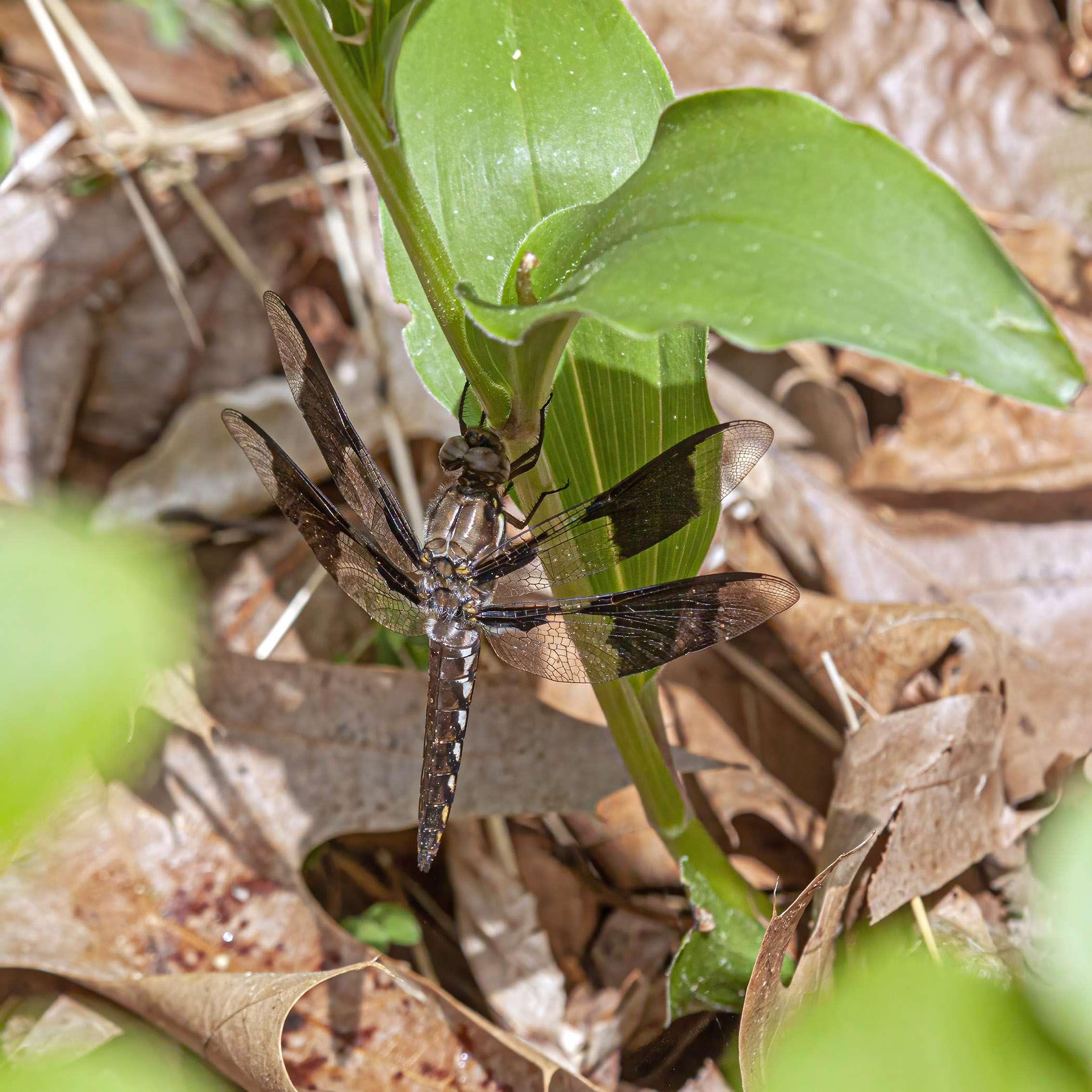
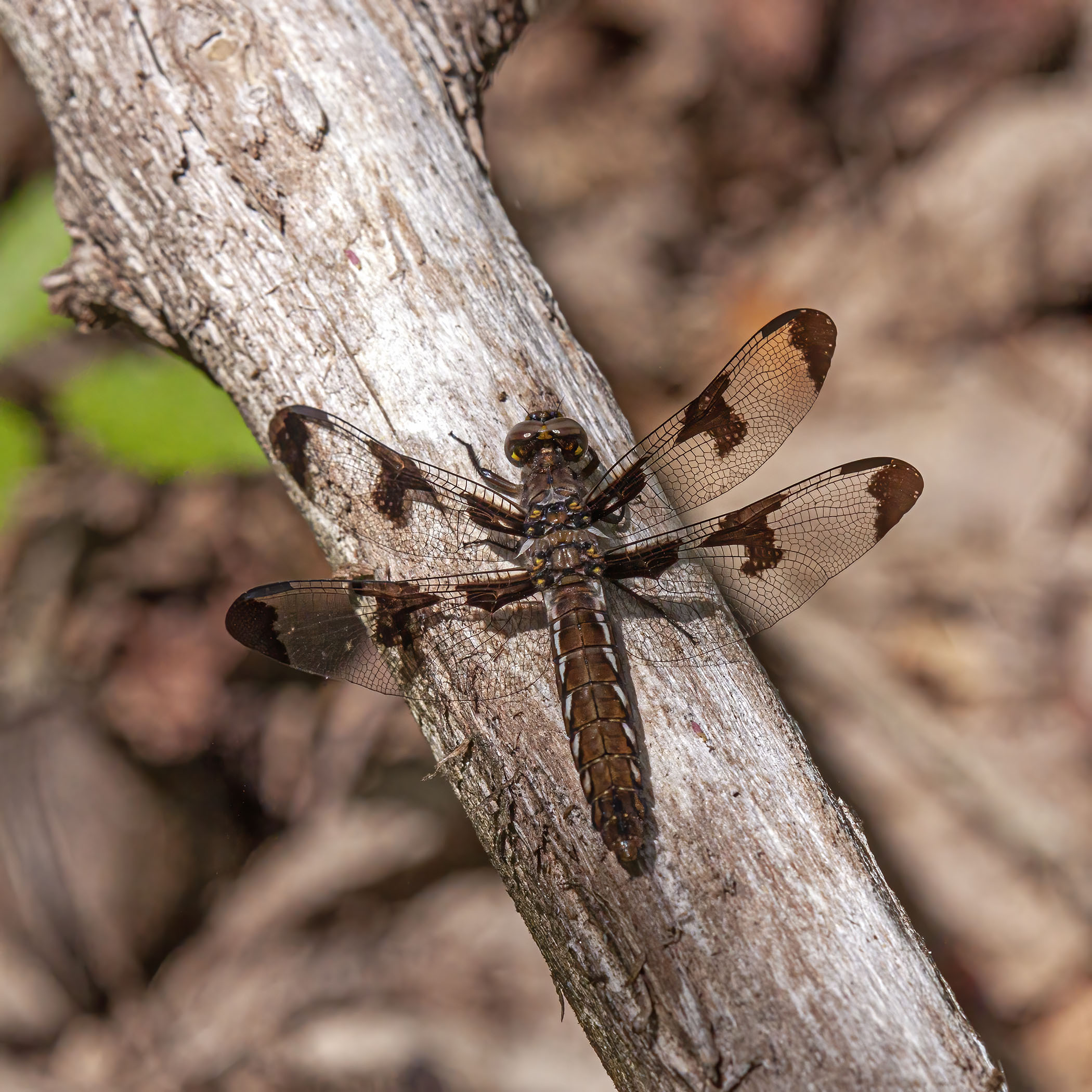
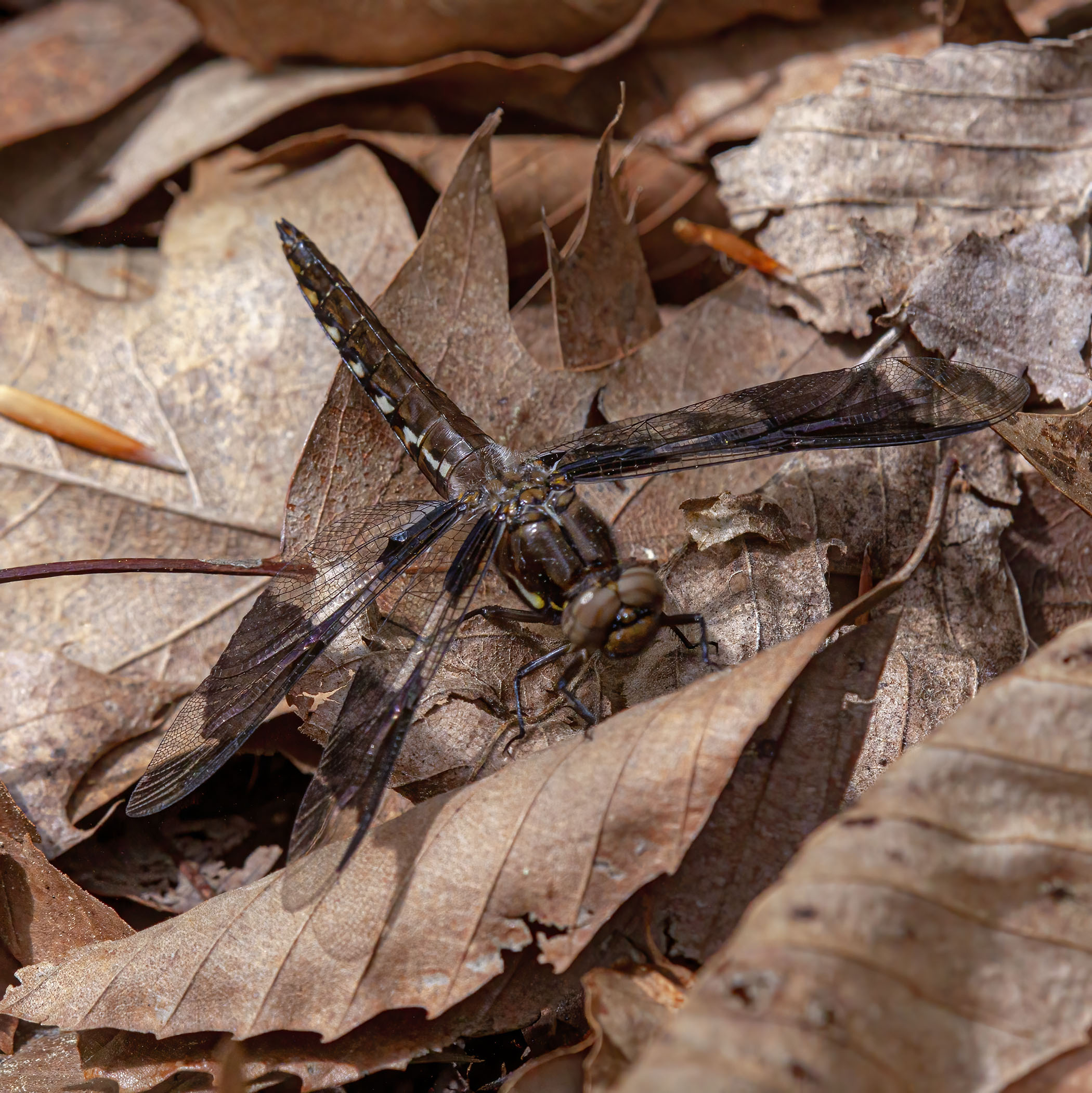
Common Whitetail dragonflies (Plathemis lydia) are probably the most common dragonflies in my area. They are among the first species to appear in the spring and among the last to be seen in the autumn and can be found in a variety of habitats. I photographed my first Common Whitetails of the season last week at Accotink Bay National Wildlife Refuge.

When they are adults, it is easy to distinguish the male Common Whitetails from the females—the males have white-blue abdomens and the females have brown abdomens. Immature males, however, have the same coloration as the females. If you look at the first two photos below, you can see that the coloration and markings on the two dragonflies is quite similar, but the first one is an immature male and the second one is a female.

For Common Whitetails, the first thing I do is to look at the pattern of dark patches on the clear wings. Males have two patches per wing and females have three, including one that extends to the wingtip. This is really easy to see in the first two photos, because the dragonflies were perched above the ground.

Quite often, though, Common Whitetails will perch flat on the ground in the leaf litter, as in the third photo, and it is a little tougher to see the wing markings. As long as you can see a clear wingtip, however, you can tell that it is a male.

There are, of course, other ways to tell the gender of a Common Whitetail, if you can’t see the wings. If you look really closely at the tips of the abdomen (the “tail”), for example, you can see that they are shaped differently—the male’s terminal appendages are more tapered, while the female’s are more stubby in appearance.

I don’t consider myself an expert in dragonflies and my background is not in science, but I have learned about these colorful aerial acrobats over the last ten years of photographing them. Folks sometimes ask me how I can tell the gender of a dragonfly and I think it cool to be able to explain what is going on in my mind when I am trying to figure out what I have photographed. This is especially true when I have photos that show both the male and female of a species, as was the case with these Common Whitetail dragonflies.

Common Whitetail

Common Whitetail

Common Whitetail

© Michael Q. Powell. All rights reserved.

Read Full Post »

« Newer Posts