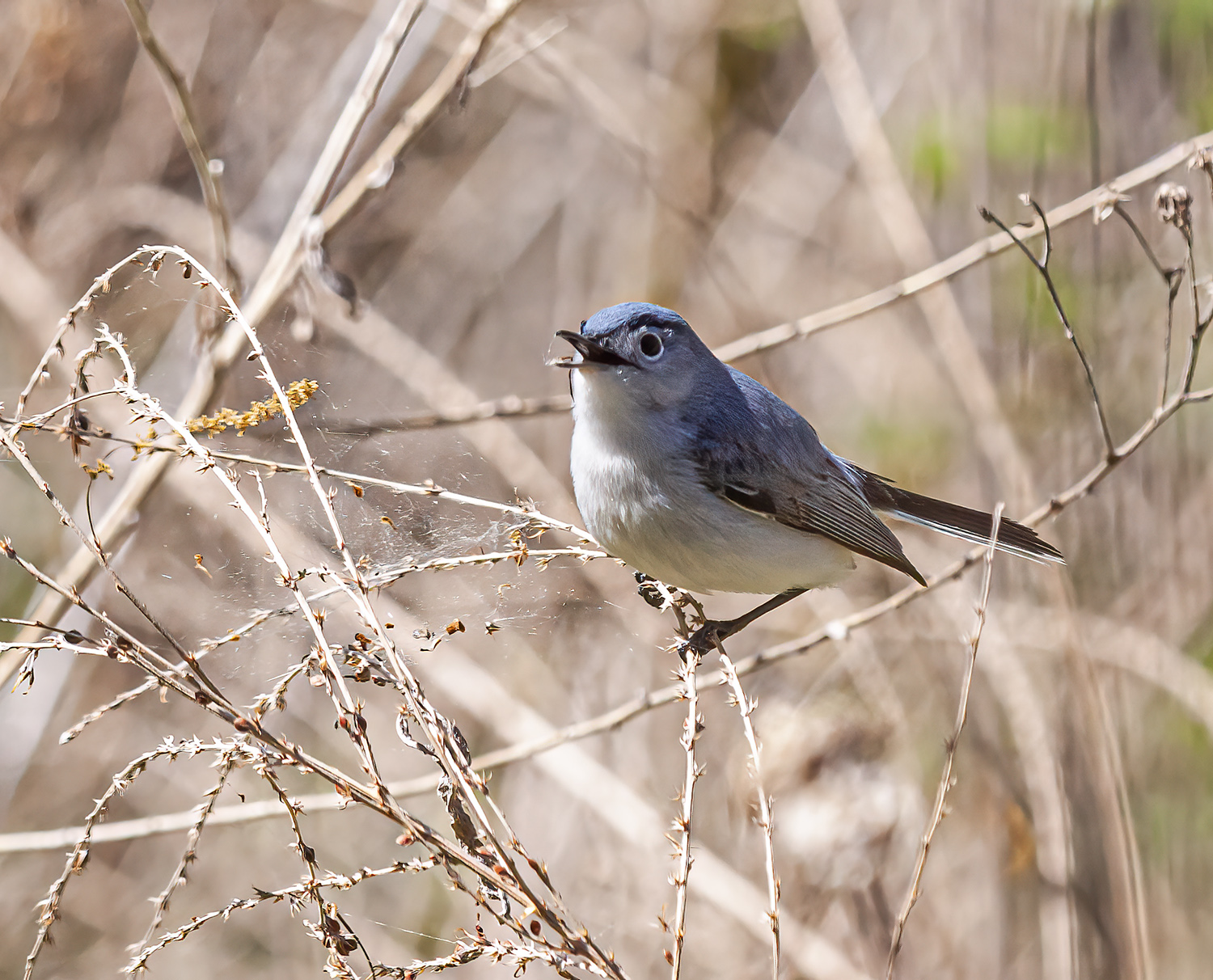
As I was searching in a small field of eye-height vegetation for dragonflies last Wednesday at Jackson Miles Abbott Wetland Refuge, my eyes detected a flash of blue and white and I realized that a bird had joined me in the field. I was shocked to see that it was a male Blue-gray Gnatcatcher (Polioptila caerulea). During my previous encounters with a Blue-gray Gnatcatcher, the bird has always been moving about in the foliage high in a tree.
I sprung into action and managed to get some decent shots of this tiny bird, despite the fact that I was shooting with my 180mm macro lens, the one that I generally use for the macro shots of insects that you see on this blog. The coolest image, I think, is the first one and it was mostly a matter of luck. I had just taken the second shot below when the gnatcatcher took off and I instinctively pressed the shutter release and captured a fun action shot.
So what was the gnatcatcher doing at ground level? As I was was processing my images I noticed that there were old spider webs in most of them. It is most obvious in the final photo, but if you click on the other images, you will see webs to the left of the bird in the penultimate shot (and in its mouth, I think), and also to the right of the bird and a little lower in the second shot (and possibly in the corner of its mouth).
Why would they be messing with spider webs? According to the Cornell Lab of Ornithology website, Blue-gray Gnatcatcher pairs use spiderwebs and lichens to build small, neat nests on top of tree branches and may build up to seven nests in a breeding season. The website also notes that breeding males have a black V above their foreheads extending above their eyes, which you can see quite clearly in the second shot. I wonder if breeding season is begining
I have not spotted any gnatcatcher nests yet this year, but two years ago in late May I took some shots of a nest at the same refuge that show the amazing construction abilities of these little birds. Check out the posting called Baby gnatcatchers? by clicking on the title of the posting or clicking here. The nests are fascinating to examine.



© Michael Q. Powell. All rights reserved.
 Mike Powell
I agree the first photo is the most exciting. It may have been luck to happen upon it but you had to have the skill and talent to act quickly to capture it and you surely did. Thank you. It’s so nice to see something in my mailbox not related to Covid 19.
Thanks, Ann. I don’t go out anywhere near as often as I did in previous years because of the current crisis, but it is good for me to do so periodically for my mental and physical well-being. I manage to capture all kinds of cool things and am really happy to share them with others that are more confined than I am. I am really limiting the time that I watch news because of Covid 19 overload. Have a wonderful week.
Great catch and photography
Wondrous photos! I am SO glad you keep your eyes open to all the life around you and capture it to share with us!
Getting the shot often requires the best lens you have at the moment which is the one on the camera. The first shot with the wing feathers spread is very nice, Mike. That looks to be a difficult setting with so much going on yet you managed some good frames.
Thanks, Steve. That specific location is a tangled mess with flowering bushes and tall wildflowers later in the season. Sometimes I see goldfinches pecking about for seeds there, but I haven’t noticed other birds there before. The 180mm Tamron macro lens I use is a bit heavy, hunts to focus at times, and lacks image stabilization, but often gives good results. Over the years I have adapted to its limitations and feel pretty comfortable with it in my hands. The nice thing is that on my crop sensor camera, the 180mm has a field of view of 288mm, which gives me modest telephoto capability, as you saw here. Like you said, the best lens is the one you have when the opportunity arises.
IS is nice but, in the hands of an experienced photographer like you, isn’t always necessary. Case in point this shot by one of my favorite photographers although in my case that is more for his landscapes than birds. Yours bears a nice resemblance, btw. 🙂
Wow. A slight resemblance, perhaps, but I need the open mouths of baby birds to grab the viewers’ eyes and hearts like he did. It is fascinating to see how he shot into the nest from above.
Well, yes and no. He cut down trees to get into the nests like that. He was not much of a sensitive naturalist at that point in his career and years afterward bemoaned his earlier behavior. It still took skill to make those captures especially with a medium format camera and no telephoto lens. Here’s a short article about what he did as an early adopter of color photography while everyone else didn’t consider it a viable format. He used car headlights and other things for his “flash” lighting outdoors. We’ve got it so much easier now. LOL
That is quite a back story. The results that photographers used to get with what now seems like primitive equipment is quite frankly amazing. We do have it easier in so many ways, but I would hesitate to say that it is easy to get good shots. As you know so well, it often takes hours outdoors in inhospitable weather, sometimes waiting endlessly or walking until your feet hurt, to get the kinds of shots we want. Sometimes we do all that and come home empty-handed. Ah the joys of a nature photographer.
Great portraits of this lovely bird. I especially like the dynamism of the first photo.
Thanks, Laura. I originally thought of posting that as the only image in order to highlight it, but decided to combine it with the info about the gnatcatcher nest in order to educate viewers as well as entertain them. 🙂
I always find it interesting to see images in the context of a series precisely because I feel like I learn something.
Great catch! Especially the first one.
Thanks, Michael. The first one was definitely the “money” shot. 🙂
Impressive!
I like your decision to include other photos along with that first winner and also your background of using your macro lens. I had a reverse experience: One of my favorite crab spider-with-butterfly captures was made from only a few feet away with my 100-300 telephoto, the only lens I had at the time.
It think most of us mentally pigeonhole our lenses into narrow functional categories when, if fact, they are much more versatile than we think. Why not use a long telephoto lens for landscapes or a wide angle lens for wildlife? The only limits are actually our imaginations and occasionally the minimum focusing distance of the lens (and the later can be adjusted by inserting an extension tube). 🙂
Nature Goals! This is nice.
I immediately forwarded this to Benjamin. The enlarged photos when clicked on a second time, thus becoming even larger, are an explorer’s treasure chest! These are stunning captures and I cannot choose a favorite photo! Thank-you, Mr. Mike!
I see that Benjamin’s habit of enlarging the images has stuck with you. I usually make the shots that I post a little larger than necessary specifically to allow viewers to see more of the details, which is especially important if they are viewing the posting on a phone or a tablet, The monitor for my computer is 24 inches diagonally, so I am used to seeing things in their enlarged soze most of the time. As always, I am thrilled that you enjoy the images. (By the way, I really enjoy the fact that you refer to me a Mr. Mike–it reminds me of my responsibility to keep this interesting enough for a curious young person like Benjamin. I suspect, however, that I am actually older than your are. 🙂
Mr. Mike, I strongly suspect that you are wrong about being older than myself. As a Dignified Lady of a Certain Age, I will neither prove nor disprove your statement. As it is also considered ungentlemanly to ask a Lady her age, undoubtedly you would never ask. Thus the answer shall forever remain unknown to both of us. A little mystery is a good thing! Benjamin taught me well, I automatically enlarge your photos! You will forever be our Mr. Mike! Thank-you!
A lovely bird – I like the series
Thanks, Diana.
Nice shots!
Thanks. Any time that I can get a decent photo of these little jittery birds is a victory in my book.
Mr Mike-this is Benjamins mom. He wanted to say he loves this and thank you for showing him these photos. He loves it 100%!
Thanks so much for sharing Benjamin’s reactions. I have always been excited and impressed with his comments on my photos. He has a sharp eye and endless curiosity. I read somewhere that one of the keys to a successful blog is to write with specific viewers in mind. When I am putting together a posting, I try to ensure that it would be interesting and accessible for someone like Benjamin. I thought of him specifically this morning when I posted some photos of a bluebird. I remember so well his observation in the past that there was as much orange on the bird’s body and wondered if we shouldn’t call it an orange bluebird. 🙂
Reblogged this on Wolf's Birding and Bonsai Blog.