Most of us know what it is like to change a lens on a DSLR, but what is it like when you change a lens in one of your eyes? About 48 hours ago, I had surgery to replace the lens in one of my eyes with a plastic intraocular lens (IOL). Cataracts in both of my eyes had advanced to a point where they were interfering with activities such as night driving and both my optometrist and my ophthalmologist recommended cataract surgery.
I am in an interesting situation right now, because one of my eyes has been “fixed” and one of them has not. As a result I can’t help but do a series of before-and-after comparisons by looking at the world one eye at a time.
It’s hard to describe the changes, but it may be a little easier with photographers. Do you remember the first time that you looked at a RAW image? RAW images often look dull and flat. That’s kind of the way that things look in my right (uncorrected) eye. The view is darker, dingier, and has a slight yellow cast. The colors appear desaturated and there is not much contrast.
When I look through my corrected eye, it feels like a RAW image that has been adjusted by a skilled photographer. The whites are pure white, the colors are vibrant, and sharpness and contrast have been tweaked. Interestingly, the colors are a little on the cool side, with a slight blue color cast. One thing I didn’t expect is that objects in my corrected eye are slightly bigger than in my uncorrected eye. I asked my ophthalmologist if the lens he implanted has a magnifying effect and he noted that it did not—the phenomenon I had described was caused by my myopia, which causes objects to look smaller.
Previously I was significantly near-sighted and have needed glasses since I was in the fifth grade. The corrected eye is far-sighted now and my distance vision is amazing—for the first time in my life I was able to drive a car yesterday without glasses. My near vision now is essentially non-existent. I am hoping that it will improve a little bit as my eyes continue the adjustment process, but I fully expect that I will need the kind of reading glasses that I am using at this very moment.
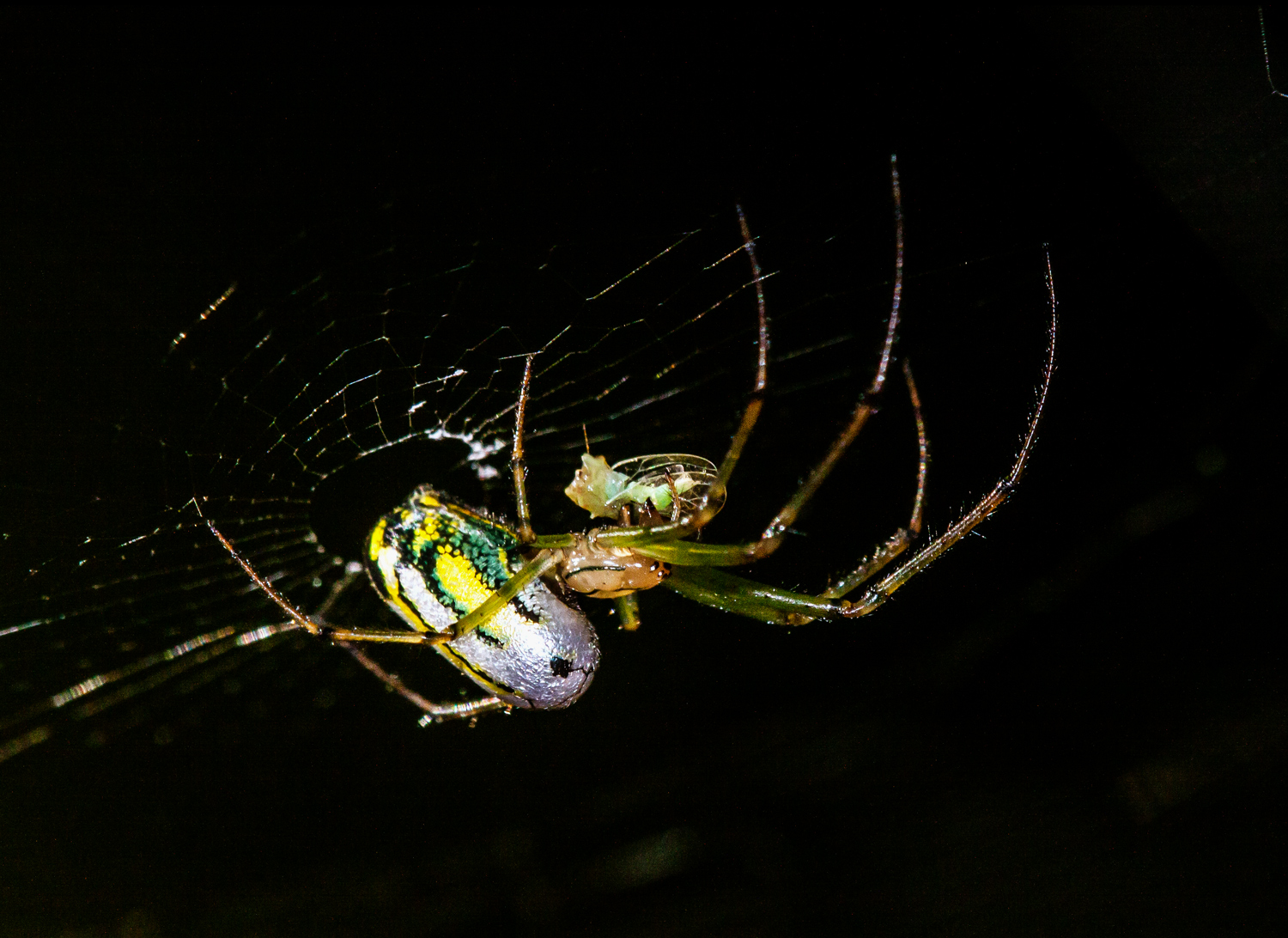
Here is a photo of an Orchard Orbweaver spider (Leucauge venusta) that I took recently. The woods were pretty dark and I was trying to shoot from a relatively short distance away, so I decided to use my pop-up flash. It produced too much glare off of the spider’s shiny body, so I ended up throwing a gray bandana over the flash as a makeshift diffuser. The spider had just captured a prey (I think) and I am pretty happy that I was able to capture as much detail as I did. (Normally I like to be more nuanced when using a flash on close-up subjects, but I think the dark background works well with a spider;)
When I look at the spider with my uncorrected eye, the green and yellow on the spider’s body are pale and dull and the section of the body between the yellow areas appears to be gray. Looking though the corrected eye, however, I see a bright white area in between the bright yellow markings and even the green seems brighter and more intense.
In another two weeks the lens in the right eye is scheduled to be replaced and I’ll probably start to take my newer, brighter world for granted. For now, though, all I have to do is close one eye at a time to see what a difference a change in lens can produce.
© Michael Q. Powell. All rights reserved
 Mike Powell
I found your description striking, Michael; and wish you the best in your continued new vision of the world. Thanks for taking the time to share it.
I’m glad the first surgery went well. Wishing you good luck with the next round, Mike.
Happy for you. There is a big difference for sure. I have had one lens change. Looking forward to the next one. Not “ripe” yet. 🙂
I’m so glad that you can now see your photo subjects with your good eye the way most of your viewers view them. The colors you get from your shots are amazing. Now you can enjoy them also!!!!
Fabulous detail and colour in this spider, Mike! I am pleased your surgery has gone well, and wishing you very well with the next one.
All the best Mike. Great description of the effect of cataract and its correction! As another reader put it, it’s about time you saw the vibrant colours and detail we see in your images!
Incredible photograph, Mike. I wish you all the best with your eye surgeries.
Age has its good and bad points, and we are fortunate that some of the bad things can be corrected. It will not be long before I too will need my cataracts sorted. I’m pleased you have a positive result.
Thanks for your encouraging words, Michael. My eye doctor first detected the start of cataracts about five or six years ago and they eventually progressed to the point where they were a real barrier to night driving–I simply could not read the exit signs. It’s pretty cool that doctors are able to “fix” the problem and give me vision like I have not had in about 50 years, though, like most folks my age, I will almost certainly need reading glasses.
Good analogy, and excellent narrative!
Thanks, Walter. It’s so strange to be in this situation where only one eye is corrected, I am constantly checking the new vision to see where its limits are and comparing one eye with the other.
I’m glad the surgery went well, Mike. You should be able to practice photography for a long time to come.
I just found out I have glaucoma. Hopefully they can slow that down too!
I was diagnosed with glaucoma about 6-7 years before my cataract surgery. We got it under control, and it hasn’t progressed at all — so that’s about a decade of dealing with it. It’s not the issue it was for earlier generations, that’s for sure. Good luck with it!
Thanks very much for that.
I went through the same thing a couple of years ago, including the one-good-eye, one-uncorrected-eye that’s so strange. I wrote about it here, and you might enjoy my look back at the whole process. Much of what you’ve talked about here I mentioned, too — and I posted some pics.
I’m so glad things have gone well to date. I haven’t had a bit of trouble, and don’t anticipate any. It really is miraculous, what medicine can do now.