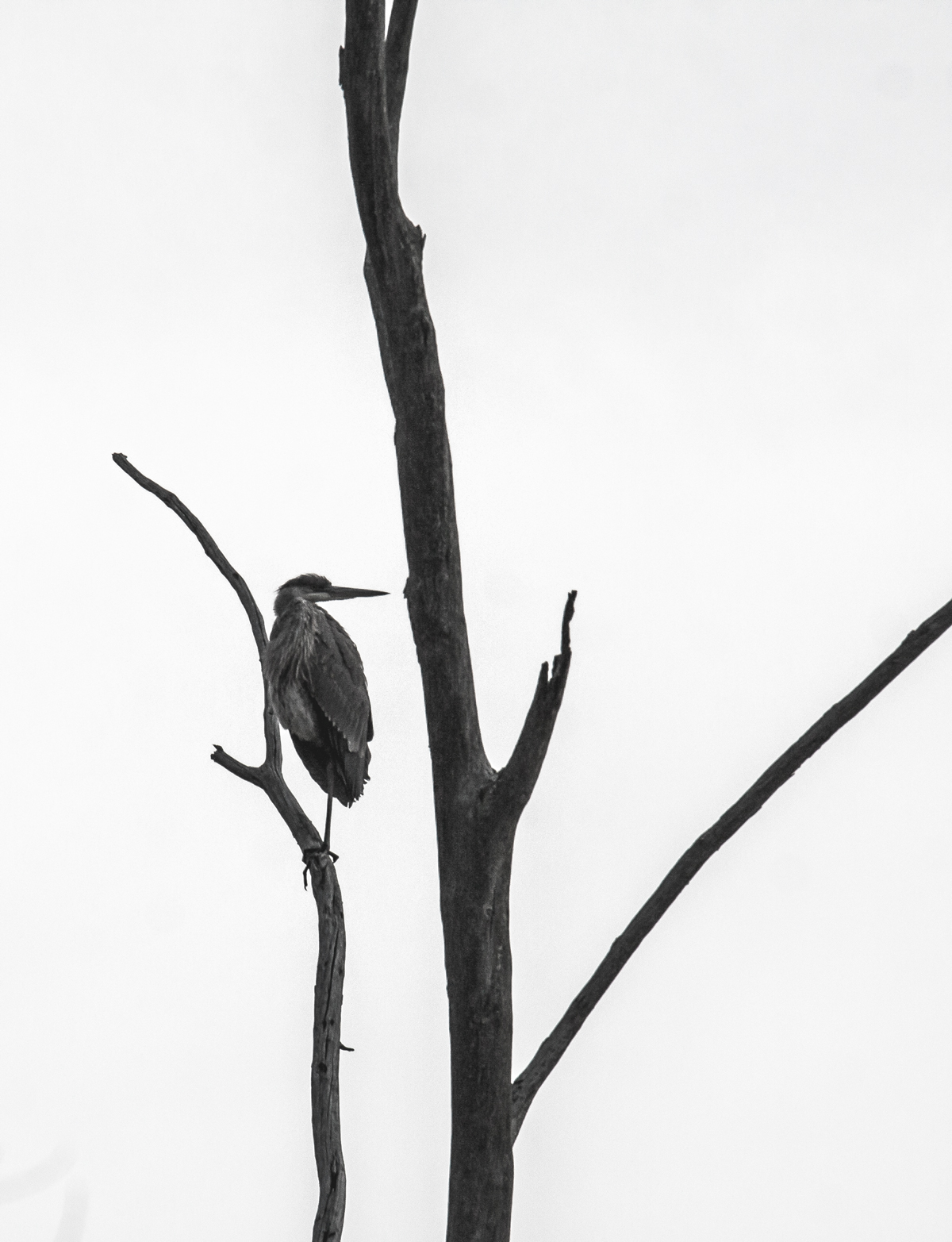
Generally when I see a Great Blue Heron (Ardea herodias) in a tree, it is roosting in a protected location and napping. Early one morning this past weekend at Huntley Meadows Park, however, I spotted this alert heron perched on an exposed dead tree, looking like it was playing the role of a sentinel.
I initially caught sight of the heron from a distance and followed a path in the treeline that let me get almost underneath the heron for some shots. The sky was overcast and there was not much light, causing the background to appear white and the images to be almost monochromatic.


© Michael Q. Powell. All rights reserved.
 Mike Powell
Beautiful Gallery.
Thanks.
My pleasure, Mike. I love good photos.
Beautiful photos, Mike.
Thanks, Dan.
[…] via High heron — Mike Powell […]
I saw a heron in a dead tree a few months ago, looking much like your sentinel. Unfortunately, he was beyond the reach of even my telephoto. I’m glad you were luckier. It’s a really nice photo set.
Thanks. Apparently Great Blue Herons have a much wider array of behaviors than we normally see.
I seen herons in trees before, but I don’t think I’ve ever seen one in monopod stance. Their sense of balance is quite admirable, but I’ll bet he’d have to use both feet if there were a gusty wind.
I have to agree with you, Gary, on the precarious nature of the one-legged stance. I have seen it before, particularly in the winter, and was told by someone that it was a way of keeping the other foot warm, though I am not sure that is the case.
I doubt that as well. Birds’ feet are very poorly vascularized, with little or no muscle; everything works with tendons attached to muscles higher up in the leg. That’s why winter birds are able to tolerate the cold weather and the icy perches so well. And, where the herons are, it doesn’t get that cold anyway.