How quickly can you change gears when a new subject unexpectedly presents itself? Can you make the necessary physical and mental adjustments to take advantage of a fleeting moment?
This past weekend I made another trip to Jackson Miles Abbott Wetlands Refuge at nearby Fort Belvoir, Virginia to search for dragonflies and damselflies. I didn’t see all that many dragonflies, but there seemed to be a lot of damselflies. I focused my attention and my camera on these tiny beauties, attempting to get close enough to fill as much of the frame as I could with them.
As I was getting close-up shots of what I believe is a Variable Dancer damselfly (Argia fumipennis violacea), I caught sight of some motion out of the corner of my eye and turned my head to see what it was. Here’s the subject on which I was concentration before I turned my head.

Looking up into the sky, I noticed a large bird approaching. At first I thought it might only be a seagull, but decided that I should take some shots in case it turned out to be a raptor. Obviously I was not going to have time to change lenses, so I quickly checked my camera settings and pointed my macro lens up into the sky and managed to get some shots of an osprey (Pandion haliaetus) as it slowly flew over the pond.

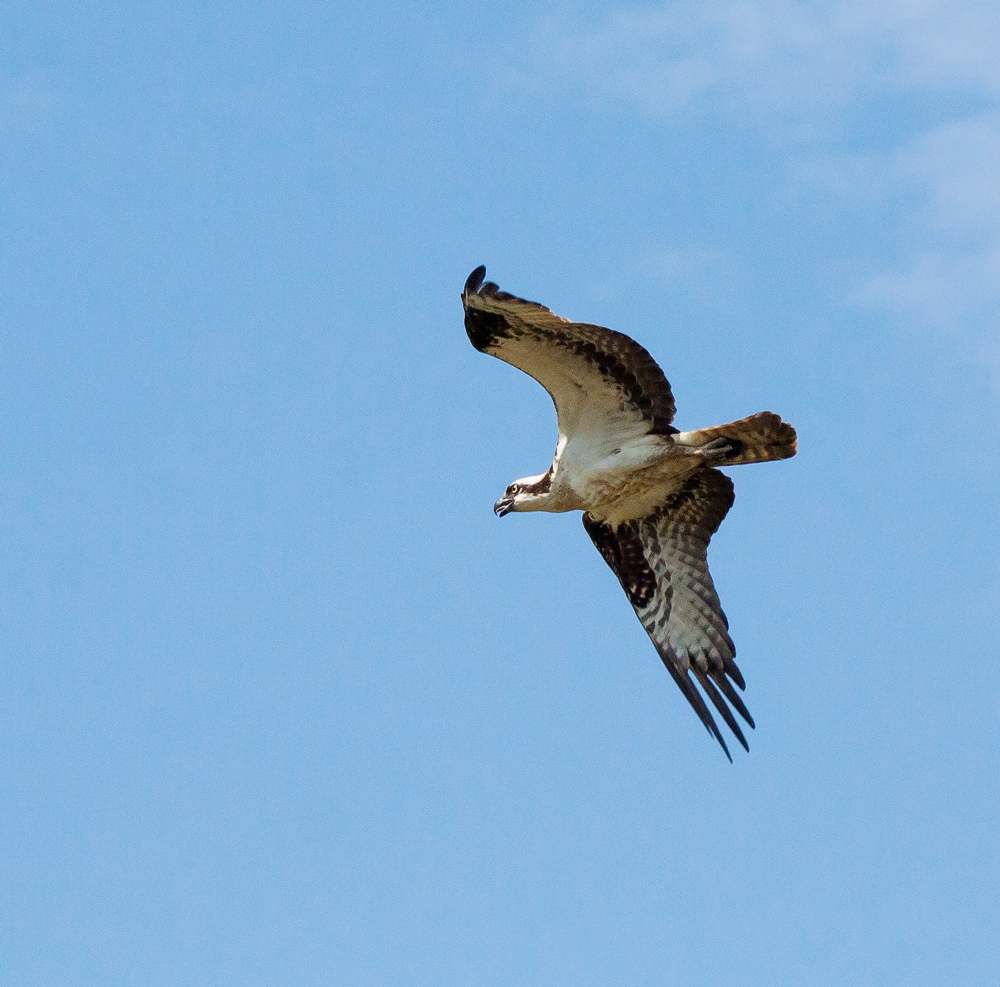
It’s amazing for me to look at these three photos and realize they were all taken at the same location within minutes of each other with the same lens and similar settings. The osprey images were cropped quite a bit more, but the details of the bird held up pretty well.
I tend to think of myself as an opportunistic shooter and this was definitely a case when I tested my ability to react quickly to a new subject. My trusty Tamron 180mm macro lens proved to be pretty capable too. The lens can sometimes be a bit noisy and slow when focusing and it has no built-in image stabilization, but as the osprey images show, it can capture some pretty nice in-flight shots under the right conditions.
© Michael Q. Powell. All rights reserved.
 Mike Powell
Beautiful!
Thanks.
It’s interesting that you were able to do this. I tend to think of macro lenses as only for close-ups, but that clearly isn’t so. The variety among damselflies is pretty amazing, too.
If you look just at the focal length of most macro lenses, most are short to medium telephoto lenses, but most folks don’t use them that way. When I have the macro lens on my camera, I tend to look only at things that are pretty close, to the exclusion of much of the rest of the world. As this photo shows, though, you can shoot birds with a macro lens (and portraits too, I suspect)–it may not be optimal, but it works.
When opportunity knocks 🙂
…or flies by…
What a mix, Mike. Well done!
Thanks, Chris. Maybe I need to start wearing two cameras.:)
Those are excellent macros. I just bought a new camera which would let you see the color of the damselflies eyes, but never would have gotten the osprey in macro mode.
Wow! Lucky you have the power you do with that macro lens–it really can do double duty!
Thanks, Sue. A long macro lens gives me a greater stand off distance for insects and also lets me capture an occasional bird too–bringing both of my favorite subjects within range.
It’s amazing how you find all the different colors!
Thanks, Carol. I just try to keep my eyes open and shoot what I can manage to see.
Reblogged this on Shallow Thinking.