We visit our local parks and wildlife refuges for a short while and return home, forgetting sometimes that many of the creatures we observed live and die within the confines of these small (or not so small) areas. As I wander through Huntley Meadows Park, I see signs of this entire circle of life. Lives have ended and, as we move into spring, new lives are beginning.
Whenever I come across skeletal remains, a clump of feathers, or other evidence of the death of a bird or an animal, I cannot help but wonder how the creature met its demise. Was it a predator, old age, sickness, or starvation? Life can be harsh in the wild, especially in the winter.
As far as I can tell, the animal in the first photo is a raccoon (Procyon lotor). Several months ago a fellow photographer mentioned that he had seen the dead body of a raccoon inside a hollow in the trunk of a fallen tree. I thought that predators would have dismembered the body by now, but instead it seems to be slowly decomposing in its sheltered position.
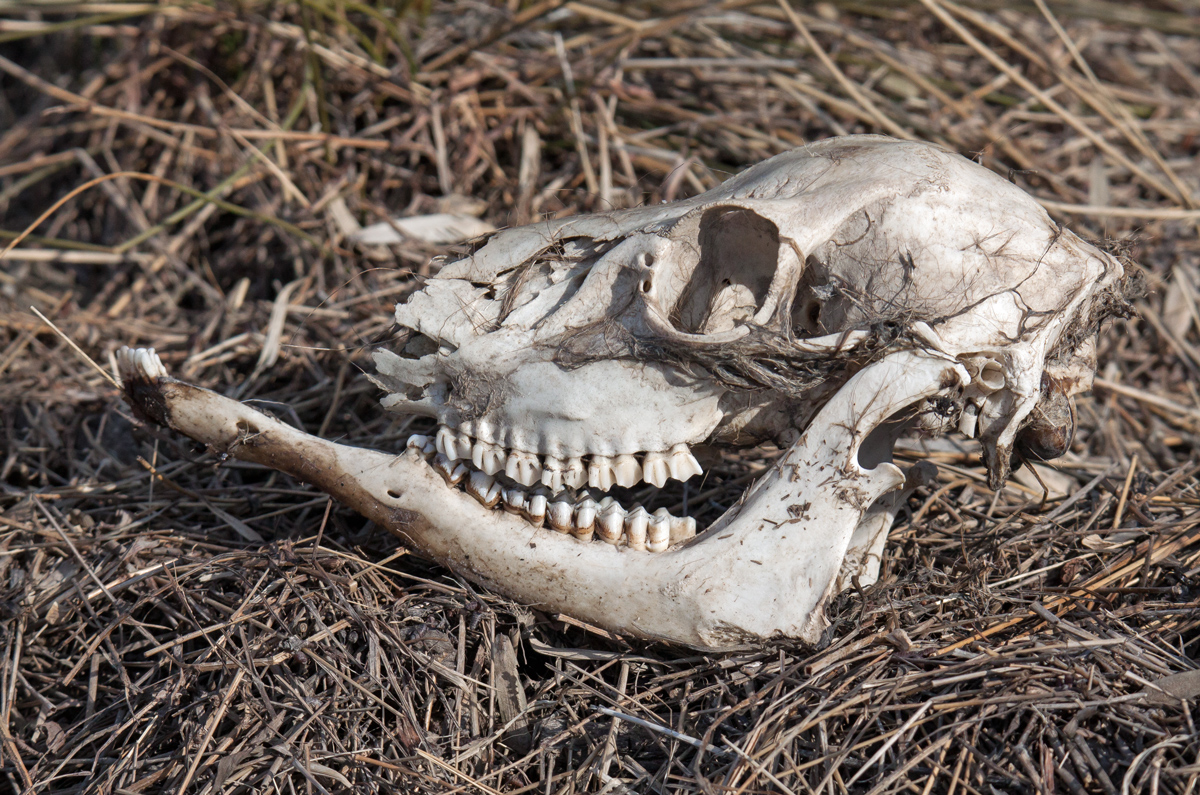
The skull is the second photo is that of a White-tailed Deer (Odocoileus virginianus). Other body parts of the deer were scattered about in the same area where I spotted the skull. There are concerns that the deer population is too high for the park to support, so there is a chance this deer died from starvation.
I know that these photos, especially the first one, are pretty graphic and apologize in advance to those who may have found them to be excessively disturbing.

© Michael Q. Powell. All rights reserved.
 Mike Powell
It is definitely the circle of life and we play such an integral part of our, and their circle.
I have seen plenty of dead and skeletal deer in my life but I have never seen a dead raccoon. Thanks to your photo, I know what to look for. I tend to be quite pragmatic about death and regard it as just the end point of life. I try to focus on the living part and not worry about the death. Although I am an atheist, I also believe that the person or creature ceases to exist at the point of death. All that remains is the carcass. All of which is to justify why my kids and I have a macabre fascination with corpses when we stumble across them. We study them like little forensic scientists, deciding what creature they were, what the cause of death might have been. A few weeks ago we came across the skeleton of a deer and my kids had great fun putting it back together again (not literally) like a grotesque jigsaw puzzle. My husband doesn’t join in because he thinks we are gross but he doesn’t object to the impromptu science and anatomy lessons either.
I’ve been thinking, and can’t remember ever seeing a deer skull when I’m out and about. Leg bones, rib cages, antlers, and such are pretty common, but this is interesting.
Is there a chance the photo of the raccoon shows it upside down? I happen to have three raccoon skulls in a flower pot — two with teeth — and they don’t look quite the same. I finally decided it may be that what appear to be bottom teeth actually are uppers. 🙂
Nobody who spends time with nature should find them offensive. Death is part of life!
[…] Resource: Circle of life, by Mike […]