I am thrilled that I was able to get a shot of a Great Blue Heron triumphantly holding a freshly caught fish and I followed my initial instinct to post that photo. However, I also managed to capture a sequence of shots of the action that led to that culminating moment that I really like that I thought would be fun to share.
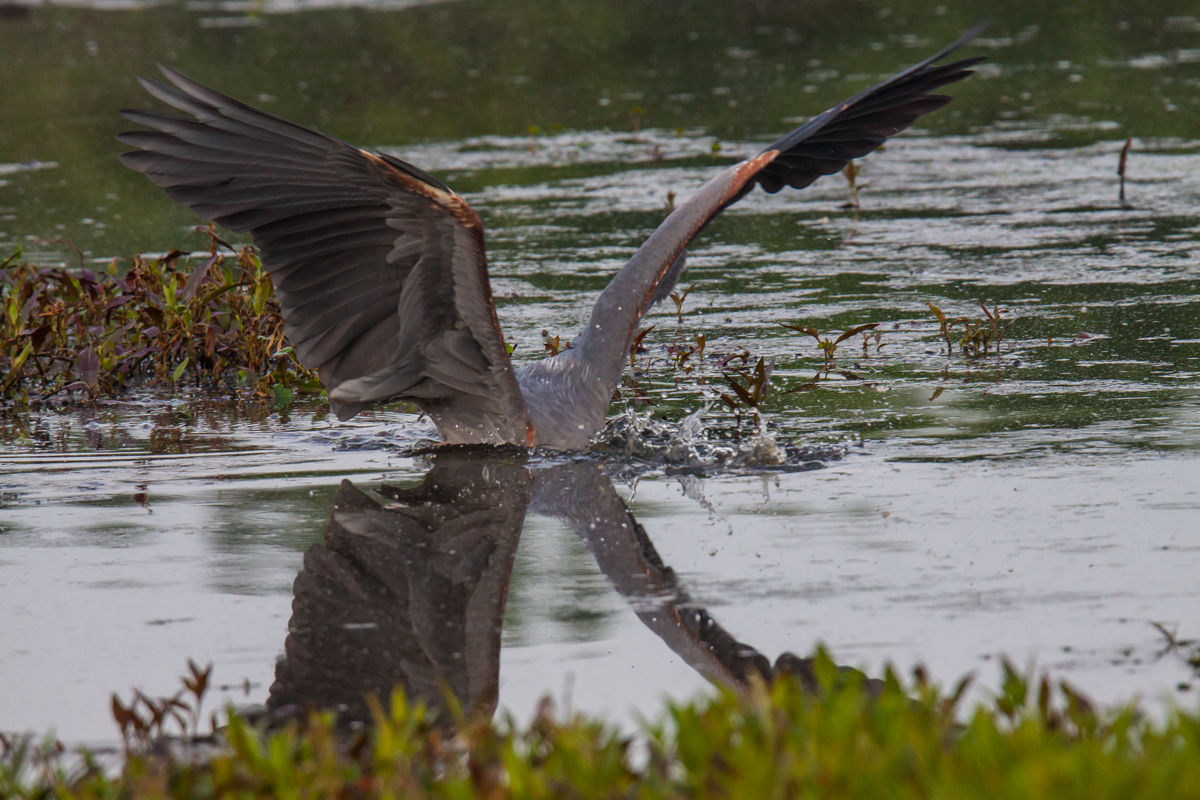
In this first shot, the heron has just made the strike and has plunged its head deep into the water. I am not sure why the heron extended its impressive wings like this, but suspect it was either to generate greater force or to maintain stability.
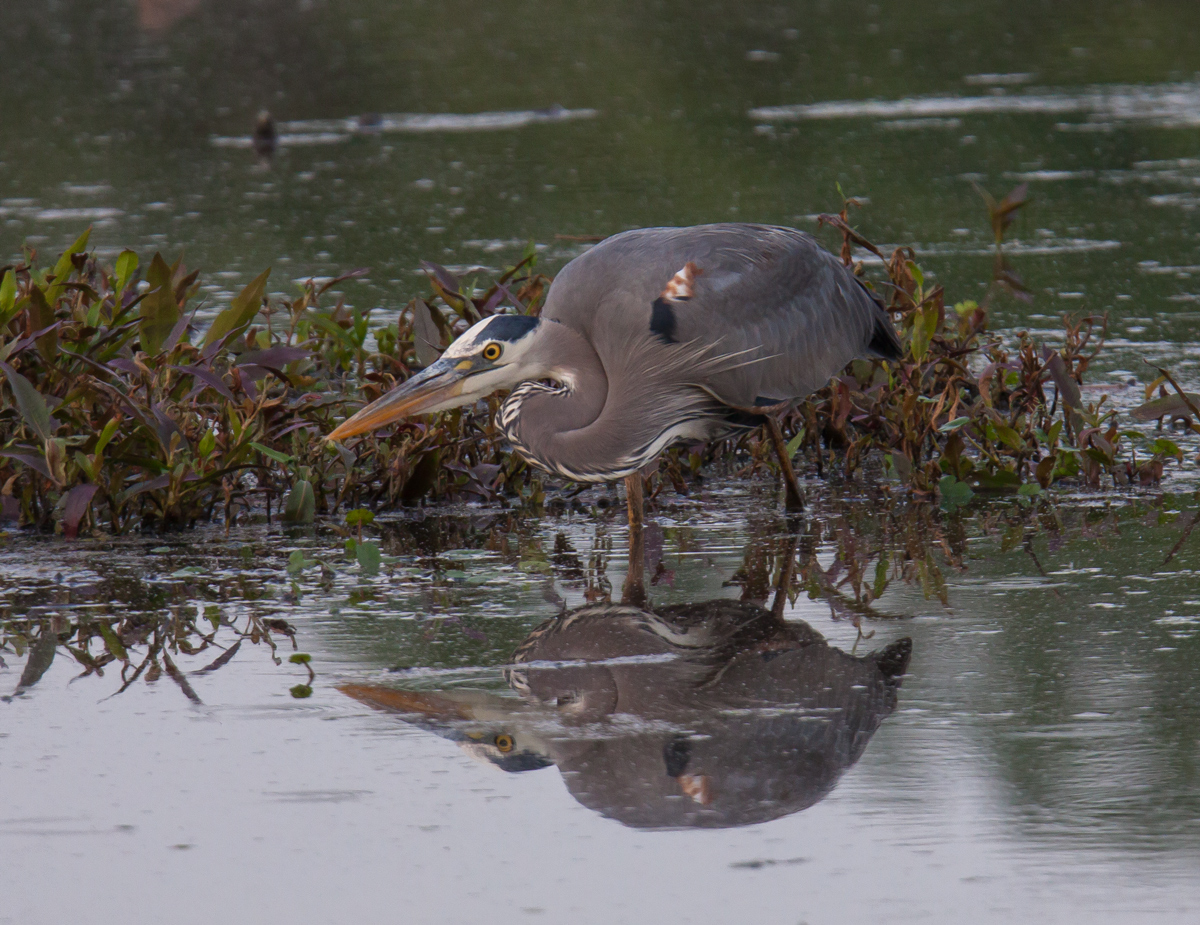
When I first spotted the Great Blue Heron (Ardea herodias), it was obviously focused on finding a fish. When it bent over like this, I suspected that the heron had already spotted one and was tracking it.
Suddenly the heron turned to the side and made the strike that I showed in the first shot. Some of the herons that I have observed in the past have been amazing in their ability to catch fish, but I have seen others, especially the young ones, that would strike repeatedly at branches and floating leaves. As a result, I knew that success was not guarantee and I waited to see how the heron had done. In this next shot, the heron’s head is just starting to reemerge from the water. At that moment it certainly knew if it had a fish in its grasp, but I still was in the dark.

At last the heron lifted its head a bit more and I could see that indeed it had caught a fish. I really like this shot shows the little vortex that was created in the water as the fish is pulled up into the air.

Now, after the fact, it’s easy for me to sit back and analyze what the heron was doing. During the brief moments when I was taking the shots, it was all I could do to concentrate on keeping the heron centered in the viewfinder and hoping that the buffer in my camera would not fill up too quickly as I fired away in burst mode.
© Michael Q. Powell. All rights reserved.
 Mike Powell
Great series of shots, Mike, a fine reward. I’m curious about a detail, though: In your second shot, it looks like there’s an orange and white butterfly, just above the left wing, casting a dark shadow. Something similar is visible in the 3rd and 4th shots, too, but I can’t quite make it out. It appears not to be a part of the wing, but rather on the side of the body. Can you clarify?
I think they are actually feathers. Audobon described them this way, “Upper parts in general light greyish-blue, the elongated tips of the scapulars greyish-white, the edge of the wing, some feathers at the base of the fore-neck, and the tibial feathers, brownish-orange.” (http://www.audubon.org/birds-of-america/great-blue-heron). I’ll check the originals and see if there is anything else.
I zoomed in close, Gary, and as I suspected, it looks like it may just be the wing tips that are the orange and white areas in the photo.
Thanks for taking the time for a closer look!
Nice shots! It does happen quickly and I’m usually too interested in watching to remember that I have a camera.