Last week I added the Common Sanddragon dragonfly (Progomphus obscurus) to the species list at Huntley Meadows Park, the marsh where I spend a lot of time walking and photographing. The park keeps a comprehensive list of species and it appears that this particular dragonfly had never before been observed and photographed within the park.

I came across this dragonfly, which I recognized as some kind of clubtail, when I was hiking through a back area of the park. I was struck by the way the dragonfly was patrolling a small sandy stretch of a creek and kept returning to perches on that little beach. I took quite a few photos of the dragonfly, though I really wasn’t sure of its identity.

The images would have remained unviewed on my computer for several days, but I mentioned my discovery to fellow blogger and photographer, Walter Sanford, who seemed to sense that I had captured something a bit out of the ordinary. He insisted that I send him a couple of images immediately, which I did. Walter tentatively identified the dragonfly as a Common Sanddragon and confirmed the identification with Kevin Munroe, who manages Huntley Meadows Park and is a dragonfly expert.
Kevin has a wonderful website, Dragonflies of Northern Virginia, that is full of fun and useful information about dragonflies in our area. In the section about Common Sanddragons, he notes, “Despite its name, this species is rare in Northern VA. In other parts of the country, where clean, sunny, shallow creeks with plenty of sandy/gravely banks are common, so too are Common Sanddragons. Our urban waterways are too influenced by stormwater, flowing fast and unchecked off impervious surfaces (roads, parking lots, roofs, etc.). This creates deeply incised, eroded banks and streambeds with excess silt, unstable flows.”
As a kind of experiment, I angled a couple of sticks in the sand to see if I could get one of them to perch on the stick. Although they kept returning primarily to the sand, a couple of times one perched on the stick and I got this shot.
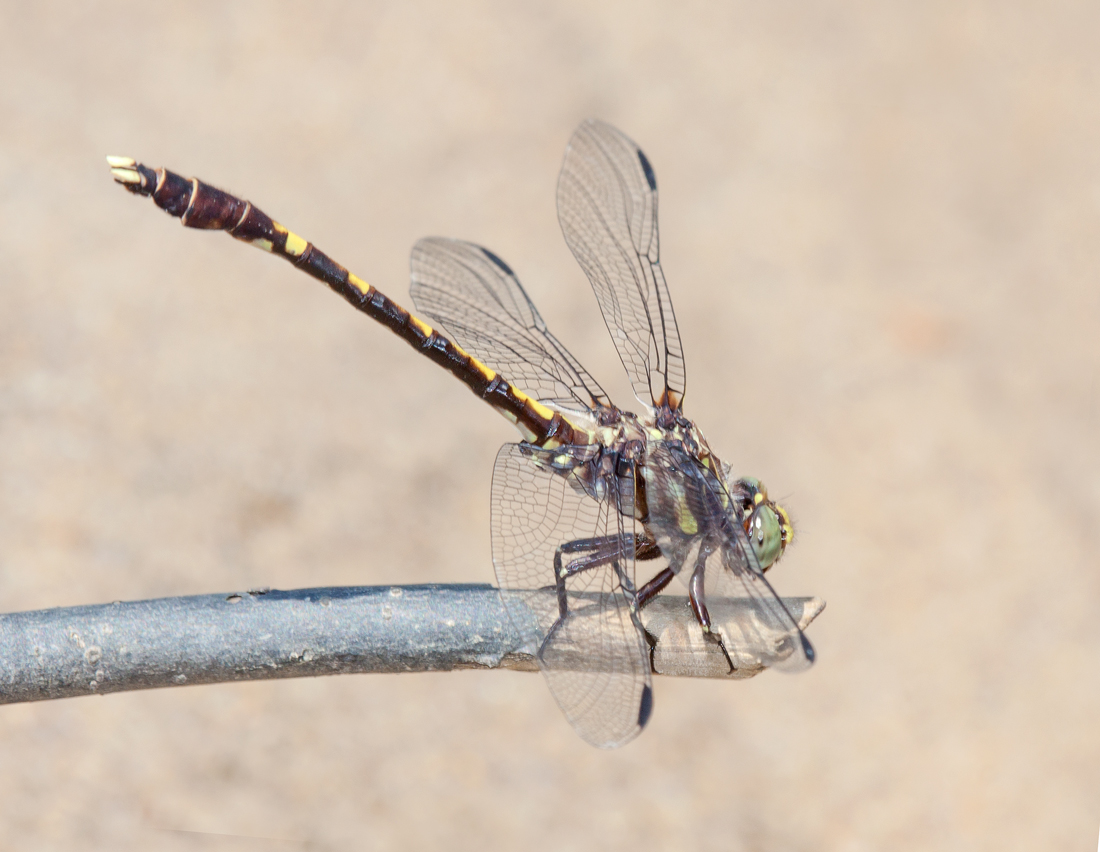
You may have noticed the raised tail in several of the shots. In other dragonflies, the “obelisk” position is a method of thermoregulation, but I am not sure if this is the case here—it might be related to efforts to attract a mate.
© Michael Q. Powell. All rights reserved
 Mike Powell
Good idea with the stick, that’s a great shot.
Great shots, Mike. And what a neat find! I’ve seen male dragonflies do the raised abdomen posture when they are too close to another male, as a kind of threat behavior. But you’re right, most of the time it is probably for thermoregulation..
Nice find, and great photos.
It’s always exciting to find something that isn’t “supposed” to be there. Excellent photos!
Thanks. The park manager has a list of more dragonflies that may be in the park, but have not been spotted. So many of these species, like the plants that you chronicle so wonderfully, need a very specific habitat.
Great photos, great story to go with them
Congratualtions on your discovery Mike. Very nice shots 😀
[…] of the habitat where he saw the dragonfly piqued my curiosity, so I asked him to send me a photo of the unknown dragon. Turns out Mike discovered a Common Sanddragon — a new species of clubtail dragonfly for […]
[…] Mike Powell spotted an unknown clubtail dragonfly at Huntley Meadows Park on 17 June 2014; the dragonfly was positively identified as a Common Sanddragon on 19 June. Common Sanddragons are a species of dragonfly formerly unknown to occur at Huntley Meadows; the good news is there’s a reproducing population of sanddragons at the park, as evidenced by the photos in this gallery. […]
[…] New dragonfly species in the park […]
It is always exciting to add a new species to an area list. Great shots. There are a number of dragonfly species that will come to a stick placed in the ground, and I regularly use this technique to get shots of dragonflies that like to perch low.
Thanks for the info on getting dragonflies to perch–it’s nice to know that the approach works. I only wish that there were a similar “trick” that I could use to photograph dragonflies in mid-air.
[…] Powell and I collaborated to identify a clubtail dragonfly that Mike spotted on 17 June 2014. As it turns out, Mike had discovered a Common Sanddragon (Progomphus obscurus), a new species of […]
[…] Powell and I collaborated to identify a clubtail dragonfly that Mike spotted on 17 June 2014. As it turns out, Mike had discovered a Common Sanddragon (Progomphus obscurus), a new species of […]
[…] one-year anniversary for Mike Powell’s discovery of a new species of dragonfly at Huntley Meadows Park, I revisited the same location where Mike […]
[…] my photography before it became overcrowded with photographers. Check out my June 2014 blog posting New dragonfly species in the park for the details of how I stumbled upon this “new” […]