The beavers at my local marshland park have built a lodge that spills onto a bench on the boardwalk and the entrance to the lodge appears to be in the waters underneath the boardwalk itself. There are signs that the beavers have been actively getting ready for winter with new mud walls and fallen trees each time I visit. I’ve only seen a beaver a few times and it has always been a time of reduced visibility, i.e. early morning or late in the day.
As I was walking back toward the park entrance yesterday evening after taking photos of the sunset, I heard noise near the beaver lodge and saw that a beaver was visible through the brush. I snapped a couple of photos, but realized that ISO 400 would not work, so I cranked up the ISO to 1600, the highest that my camera would go. This was uncharted territory for me, because I had already seen prominent grain when I set the ISO at 800. Even with the ISO set that high, the shutter speed was around 1/15 sec, so I tried to keep my camera on my tripod. The beaver was somewhat preoccupied and did not immediately dive, the normal reaction of a beaver when I see them, so I was able to get some shots of the beaver in action.
In many ways, these are aspirational shots, for they reflect photos that I want to take in the future with better results. I am sharing some of them, however, because I find them to be interesting, poor quality notwithstanding. It will definitely be a challenge to figure out a solution to the dilemma of getting quality shots in limited light.
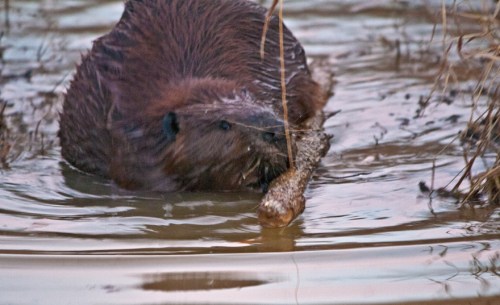
Gathering more sticks for his lodge

Swimming beaver

Beaver with open mouth

Beaver looking at me

Swimming toward the light
© Michael Q. Powell. All rights reserved.
 Mike Powell
Beavers are so hard to get pictures of that I’d be very happy with those pictures. I think I’ve told you before that I spent many cold hours trying to get shots of these critters with no luck-they were much smarter than me. Good job!
Thanks. It is definitely a challenge. The fact that there is a boardwalk right next to the lodge makes it a little easier (but definitely not easy). I appreciate the encouragment.
When you solve that problem, please let me know. It’s really unfortunate that so many creatures get active when it’s just a little too dark to take photos. Nice poses.
Infrared photography? Starlight scopes? I think I’ll just have to be persistent and maybe I’ll get lucky. For now I’m content that I got recognizable images. The bar is now set, albeit at a low level.
Very nice work, Mike–you can surely be proud of these, especially the second one. One option to increase your sensitivity is be to use your exposure compensation and underexpose by a stop or a stop and a half (maybe even two); one stop would let you shoot at 1/30 rather than 1/15 second, and if it’s too dark, you can bring it back by tweaking the histogram in Photoshop. Another option is a faster lens, of course, but that would be a wee bit more expensive.
For the moment I’ll rely on persistence and luck. Thanks for the tips. I use exposure compensation a lot, though my camera lets me add or subtract up to am max of only two f-stops. Newer cameras handle low light better too (I think it’s the processors in the camera) and that may be a more viable option in the near future than a telephoto with F2.8 (which I covet a little).
What a great experience to watch them at work! I am envious.
I’m seen them swimming around a little and moving small branches, but not really “working.” I’d love to see them gnawing on the trees I posted, but suspect that they do that during the middle of the night.
[…] past Saturday I introduced you to one of the local beavers in a posting entitled Beaver at dusk. The photos of the beaver were shot at a very high ISO and were pretty grainy. Yesterday, I was […]