Feeds:
Posts
Comments

Archive for October, 2012

A month ago the National Zoo in Washington, D.C. opened up a newly renovated, $42 million exhibit called the American Trail that highlights species of North American wildlife. The zoo’s website (which contains lots of information about the animals and great photos) notes that the majority of the American Trail species have rebounded after facing serious threats, thanks to the conservation efforts of many organizations, including the National Zoo.

This brown pelican is part of the American Trail exhibit. I don’t think that I had ever seen one live, and certainly not so close up. I love the beautiful colors of this bird and its wonderful pose, and it seemed willing to cooperate when I was taking the photographs.

Brown pelican at National Zoo

Unlike my photos of the red panda and cheetahs, I was not shooting without obstructions—here was a fence between me and the pelican. Following instructions that I read somewhere recently, I got as close to the fence as I could and opened up the aperture (to F5.6 in this case) and the fence seems to have disappeared.

Now that I have taken a few photographs at the zoo and had some success, I think that I will probably add it to my list of local places where I can find interesting subjects to photograph.

© Michael Q. Powell. All rights reserved.

Read Full Post »

It was a dark and cloudy afternoon and the rain was threatening to start at any moment (and eventually did). Even my usual grasshoppers and spiders seemed to have disappeared from sight. I was losing hope that I would find anything interesting to photograph when I stumbled upon a large bee on a bright yellow plant.

It looked like a carpenter bee, but the eyes were unusually light in color. I am pretty sure that it is an Eastern Carpenter bee (Xylocopa virginica) and the white patch on the face indicates that it is a male. There are other photos on-line of carpenter bees with green eyes, but I am not sure how common it is to find one like this. I don’t recall ever seeing one like it before.

Male Eastern Carpenter bee

© Michael Q. Powell. All rights reserved.

Read Full Post »

I photographed this red panda (Ailurus fulgens) this past weekend in Washington, D.C. at the National Zoo. According to Wikipedia, red pandas are native to the Himalayas and southwestern China. Like the better-known giant pandas, red pandas eat mostly bamboo, although they may also eat eggs, insects, birds, and small mammals.

I will probably post a few more shots of this red panda in the next few days, when I have gone through my zoo photos. However, I wanted to make a preliminary introduction of this delightful animal, suspecting that many of you may be unaware of the existence of a red panda. (Previously red pandas were classified in the families of racoons and bears, but now they have their own family and are the only extant species of the genus Ailurus.)

Red panda at the National Zoo

© Michael Q. Powell. All rights reserved.
Read Full Post »

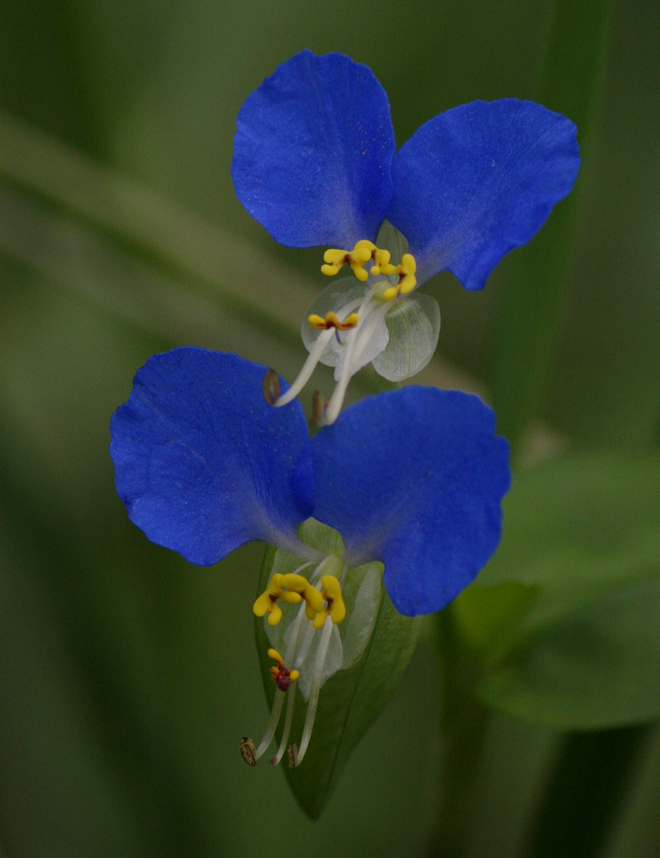
This past weekend some small blue wildflowers caught my eye. They seemed a bit unusual, because they had two large blue petals and what appeared to be smaller white petals. In addition, they had really long stamen.

According to a Wikipedia article, these are Asiatic dayflowers (Commelina communis), a plant native to East and Southeast Asia that has been introduced into the eastern part of the United States. The flowers are used in traditional Chinese medicine and they are used to produce a dye in Japan.

As is frequently the case with wildflowers, there seems to be some debate about whether this is a weed or a flower. Call it what you will, it is a strikingly beautiful plant.

Asiatic dayflower (Commelina communis)

© Michael Q. Powell. All rights reserved.

Read Full Post »

« Newer Posts