The light was starting to fade when I spotted a large insect on a flower. I already had my macro lens on my camera and my tripod was with me, so I thought I’d try to get some shots of the specimen.
To give myself a chance at a decent depth of field, I set the camera at f/18 and then dropped the ISO to 100 for the best possible quality. Finally, I decided to use my pop-up flash (at its lowest setting) to add a little light. I was in aperture priority mode, so I let the camera choose the shutter speed. I figured the shutter speed would be pretty slow, so I used the self-timer to minimize movement. The camera chose an exposure of 30 seconds.
Do you know how long 30 seconds feels as you check the insect to see if he is moving and hope that the wind will not blow? I took a couple of shots and got some pretty good results. Before I show you the entire insect, I’ll show you a close-up of the face. The antennae are amazing and the eyes are pretty cool looking too.

Close-up shot of really cool insect
So, what kind of an insect is this? It is a Yellow-collared Scape Moth (Cisseps fulvicollis). Yes, for those of you interested in collar ID, I realize that it is more orange than yellow, but even Bugguide acknowledges that it would be more appropriate to call it “orange-collared.” You can’t help but notice the amazing antennae with teeth like a comb—the technical term for antennae like this is “pectinate.”
Here is a photo of the entire insect. Sharp-eyes readers will notice that the first photo is merely a blow-up of a portion of this image. You can see the light shadow from the flash, but it seems to have helped reveal an amazing amount of detail. Surprisingly, it looks like neither the insect or the plant moved during the exposure.
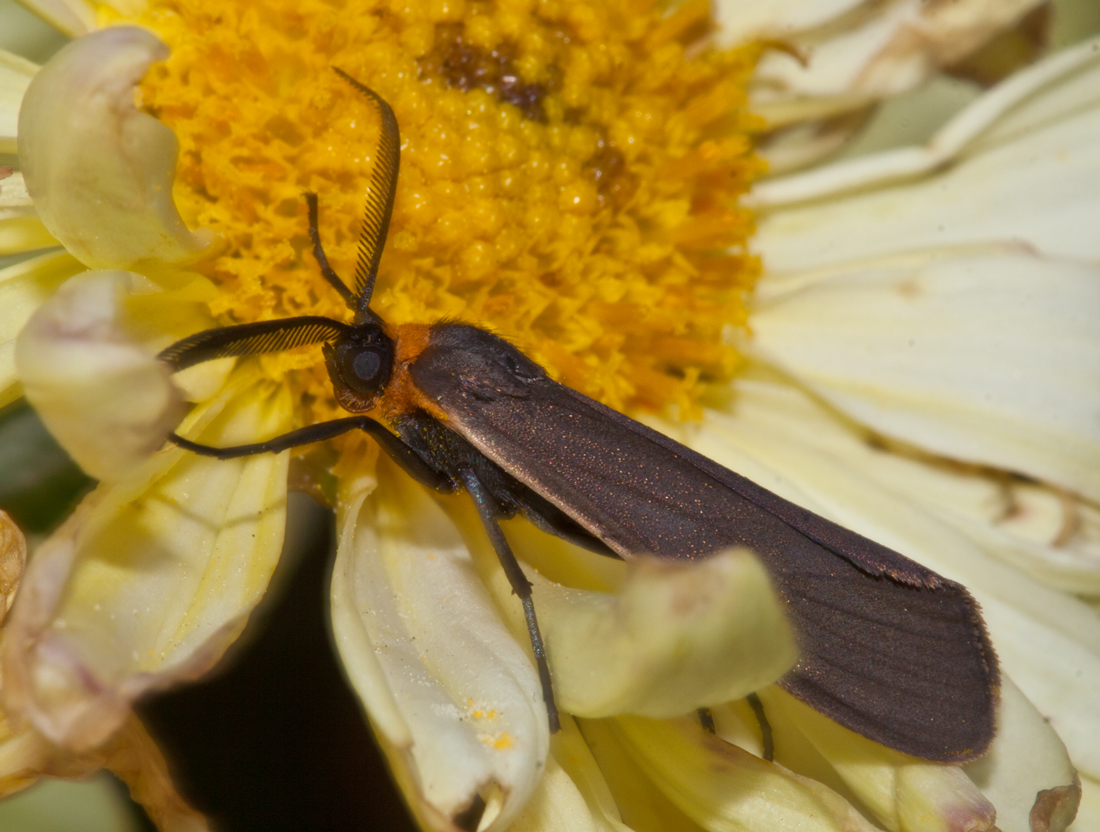
Yellow-collared Scape Moth
I have a lot to learn about using a flash for extra illumination for macro shots, but this image convinced me that it can be beneficial, though I probably need to diffuse the light and use off-camera flash.
© Michael Q. Powell. All rights reserved.
 Mike Powell