Feeds:
Posts
Comments

Posts Tagged ‘thrasher’

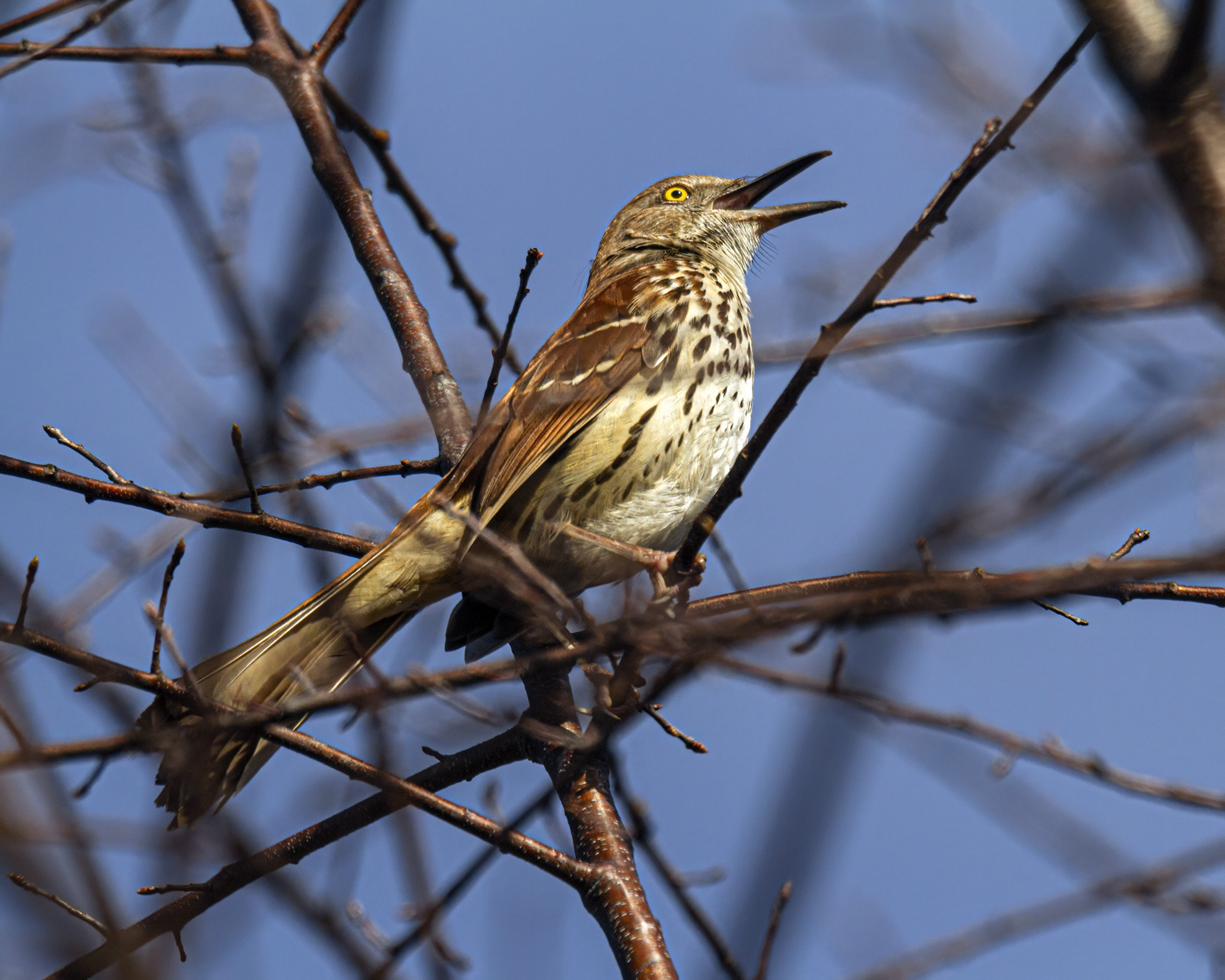
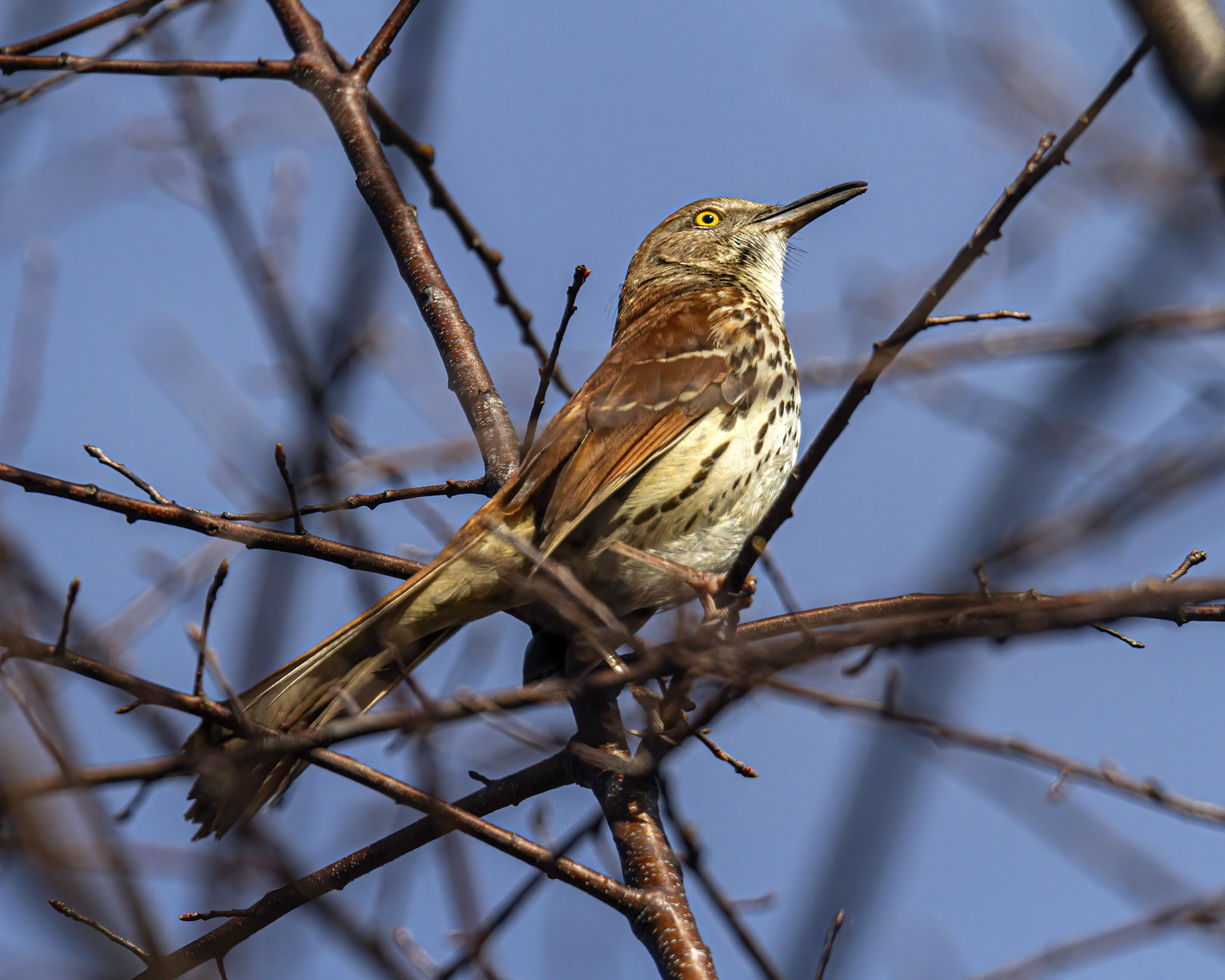
I was delighted to spot this Brown Thrasher (Toxostoma rufum) last week at Occoquan Bay National Wildlife Refuge. I had to move around a lot to get a clear view of its head, though I was pretty sure it was a thrasher when I caught a glimpse of its bright yellow eye and long tail. The Cornell Lab of Ornithology did a great job in describing the challenges of spotting this species, “It can be tricky to glimpse a Brown Thrasher in a tangled mass of shrubbery, and once you do you may wonder how such a boldly patterned, gangly bird could stay so hidden.”

Brown Thrashers are present year round in the southern portions of Virginia, but I think they move north into my area of Northern Virginia during the breeding season. Before long we should have lot of other birds, including warblers, migrating through our area and, of course, dragonflies and other insects will soon reappear. Yesterday  i noted a posting in Facebook with photos of dragonflies that were recently taken in central Virginia. I will probably venture out later today to see if I can spot any dragonflies myself.

Brown Thrasher

© Michael Q. Powell. All rights reserved.

Read Full Post »

When I stepped out of my car on Thursday at Occoquan Bay National Wildlife Refuge, I notice a bird pecking about in the grass at the edge of the parking lot.The lenght of its tail made me think of a Northern Mockingbird, but the coloration was more sparrow-like. As I tracked the bird in my camera’s viewfinder, the bird lifted its head and I caught a glimpse of its bright yellow eye and realized that it was a Brown Thrasher (Toxostoma rufum), a species that I have seen only a few times before.

I really like the basic description of the species on the Cornell Lab of Ornithology website—”It can be tricky to glimpse a Brown Thrasher in a tangled mass of shrubbery, and once you do you may wonder how such a boldly patterned, gangly bird could stay so hidden. Brown Thrashers wear a somewhat severe expression thanks to their heavy, slightly downcurved bill and staring yellow eyes, and they are the only thrasher species east of Texas. Brown Thrashers are exuberant singers, with one of the largest repertoires of any North American songbird.”

Brown Thrasher

© Michael Q. Powell. All rights reserved.


Read Full Post »

“Brown Thrasher” sounds like it could be the name of a heavy metal band.  I was therefore startled by the melodious sounds of the Brown Thrasher (Toxostoma rufum) that I encountered this past Tuesday at Occoquan Bay National Wildlife Refuge. I was entranced by its beautiful song as well as by its stunning yellow eyes. According to the Cornell Lab of Ornithology, “Brown Thrashers, like catbirds and mockingbirds, are mimics with extremely varied repertoires consisting of more than 1,100 song types.” If you click on the link for the Cornell Lab of Ornithology, you will find some samples of the thrasher’s sounds.

In case you are curious, the bird’s name comes from its foraging behavior. Brown Thrashers typically feed on the ground, often in heavy undergrowth, and sweep their bills through the leaf litter and soil with quick, sideways motions.

Brown Thrasher

© Michael Q. Powell. All rights reserved.

Read Full Post »

When I heard loud singing coming from the top of a tree, I glanced up and saw a shape that reminded me of a mockingbird. Looking more closely, I realized that the colors looked more like those of a female Red-winged Blackbird, but the shape of the body and behavior were not those of a blackbird. Although I was pretty far away, I noticed that the bird had startlingly light-colored eyes. What was this bird?

Thanks to its physical characteristics, it was not hard to locate this bird in my identification book when I got home—it is a Brown Thrasher (Toxostoma rufum).  According to the Cornell Lab of Ornithology, “Brown Thrashers are exuberant singers, with one of the largest repertoires of any North American songbird.” The same article notes that some early naturalists thought that the Brown Thrasher’s musical abilities are underappreciated, as compared with the mockingbird, which has received greater acclaim. “Brown Thrasher”  somehow sounds to me like it should be associated more with a heavy metal band than with this pretty bird. Maybe this bird needs a better marketing strategy and a public relations campaign.

The sky was heavily overcast the day I took these shots. Normally I don’t like the look of the washed-out skies, but in this case I really like the effect. One of my Facebook viewers commented that it made the photo that I posted (the first one below) look like an Audubon print.
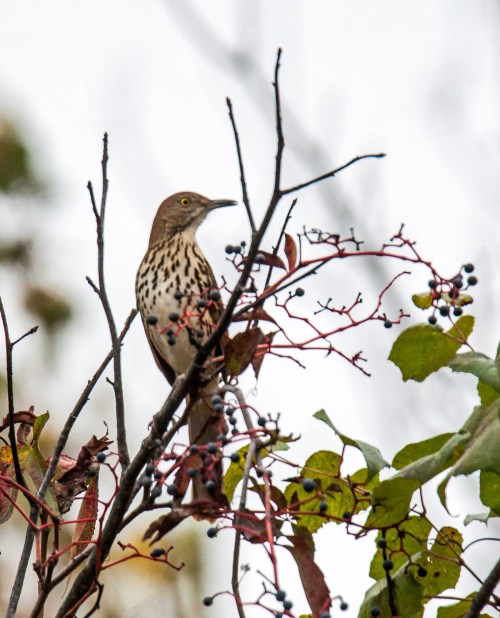
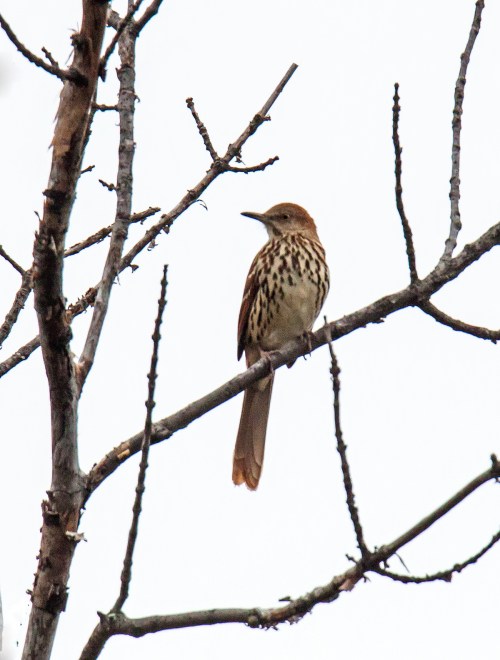
Brown Thrasher

Brown Thrasher

Brown Thrasher

© Michael Q. Powell. All rights reserved.

Read Full Post »