Feeds:
Posts
Comments

Posts Tagged ‘Sweetgum Tree’

This Bald Eagle (Haliaeetus leucocephalus) was partially hidden by tree branches when I first spotted during a recent visit to Occoquan Bay National Wildlife Refuge. I tried to move as stealthily as I could to try to get a clearer view of the eagle, but the eagle detected my presence. I captured this image as the eagle was preparing to take off. The eagle flew downwards from its perch and my view was completely obstructed, so I was not able to capture any in-flight shots of the eagle.

As you can see, many of the trees in my area have buds now. I think this tree might be a Sweet Gum tree, because I can see some of its distinctive spiky seed balls still hanging from the tree.

Bald Eagle

© Michael Q. Powell. All rights reserved.

Read Full Post »

A female Red-winged Blackbird (Agelaius phoeniceus) lifted her head as I approached her last week at Occoquan Bay National Wildlife Refuge, but then went back to work extracting seeds from the spiky sweetgum balls. The seedpods were so numerous that they reminded me of a well-decorated Christmas tree festooned with hanging ornaments.

Red-winged Blackbird

© Michael Q. Powell. All rights reserved.

Read Full Post »

Birds have to work really hard to find food during the cold season. This female Red-wing Blackbird (Agelaius phoeniceus) decided that it was worth her effort to try to extract some seeds from the spiky seed pods of a sweetgum tree earlier this month at Occoquan Bay National Wildlife Refuge.

Some of you may be wondering how this can possibly be a Red-winged Blackbird. After all, this bird is not at all black and her wings are not red. When I first started getting serious about my photography more than 11 years ago, I would often go out shooting with my mentor Cindy Dyer, who loved to photograph flowers and sometimes insects. She rarely photographed birds and I had no experience identifying them.

During one such outing I photographed a bird on a rebar trellis at one a botanical garden. I assumed that it was one of the many types of sparrows that I lumped together as “little brown birds.” When I posted the shots in a Facebook birding forum, I was shocked to learn that it was a female Red-winged Blackbird. (Check out my 27 September 2012 blog posting called “Intense bird” for more details on that adventure, including my first ever shots of a female Red-winged Blackbird. I also remember that 2012 encounter well because I was shooting with a Nikon D300 that Cindy had lent me along with a Tamron 180mm macro lens. I did not switch from Canon to Nikon, but immediately orders the Canon version of the lens, which continues to be one of my favorite lenses.)

I am a lot more knowledgeable about birds now and have reconciled myself to the reality that many species derive their names from the males, who tend to be more colorful in appearance. As most of you know, I love to photograph insects, particularly dragonflies, but they have now completely (or maybe almost completely) disappeared from the scene, so I will be focusing my camera and my attention mostly on birds in the upcoming cold months.

Red-winged Blackbird

© Michael Q. Powell. All rights reserved.

Read Full Post »

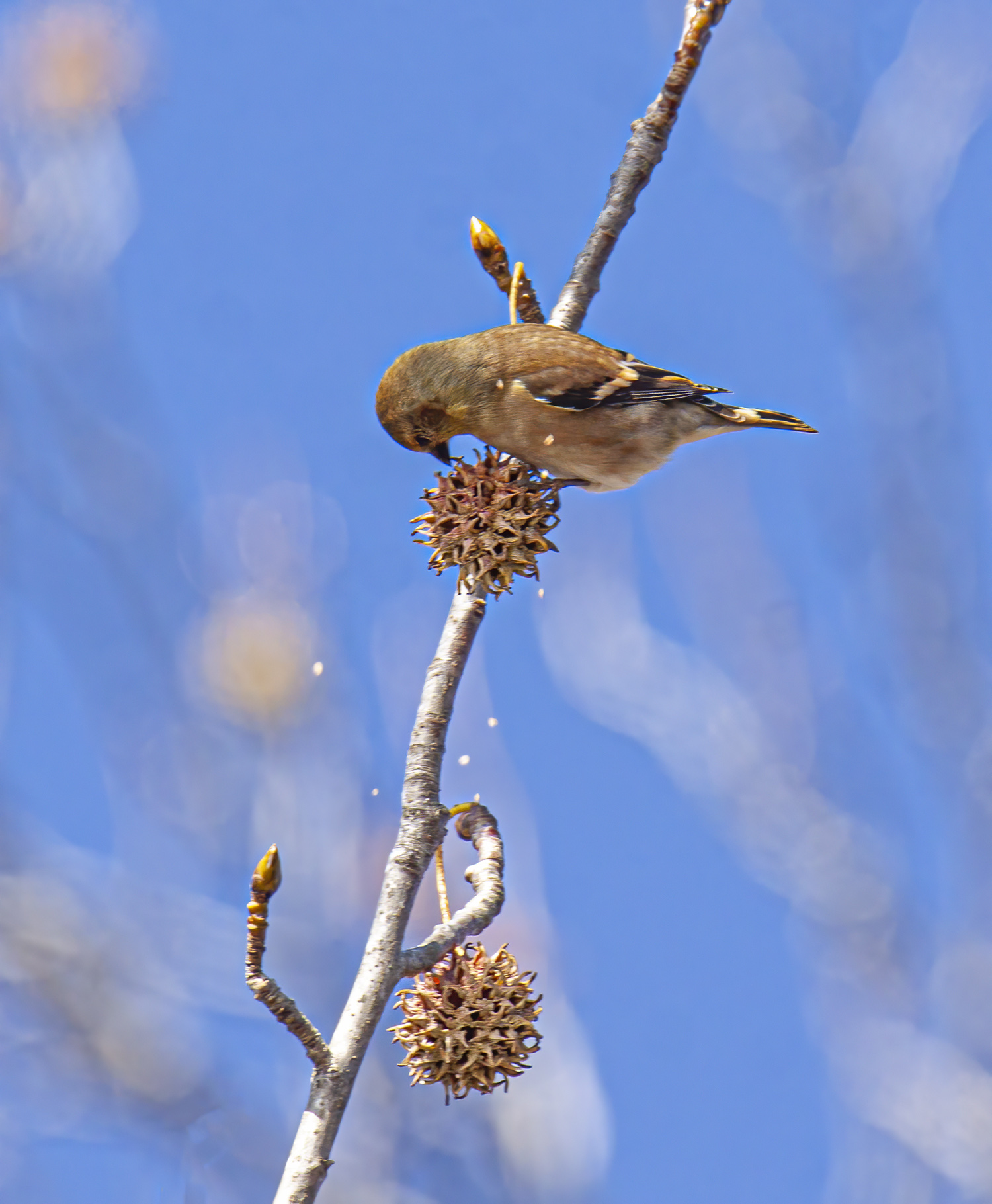
As the weather grows colder, many sources of food begin to disappear and wild creatures have to work harder to find sustenance. On Tuesday I spotted a small flock of American Goldfinches (Spinus tristis) that were busily extracting seeds from the spiky balls hanging from an American Sweetgum tree.

Earlier this month I did a posting that featured a Carolina Chickadee that was also extracting seeds. In that case, the chickadee was actually hanging from the suspended seed balls. The goldfinches seemed to be taking a somewhat safer approach and were clinging to the branches and twisted their bodies to maneuver into the proper position.

As you can see from the first two photos, we finally had a sunny day after a seemingly endless streak of gray days. The bright blue sky really made the yellow feathers of the goldfinches pop—bright colors like these really help to lift my spirits. The final photo seems to have more a wintery feel to it, although it was taken at about the same time as the other two images. It is amazing how a different angle and different lighting can produce images with different vibes.

American Goldfinch

American Goldfinch

American Goldfinch

© Michael Q. Powell. All rights reserved.

Read Full Post »

I generally have trouble identifying trees, but one that I can often pick out is an American Sweetgum tree (Liquidambar styraciflua), thanks to its distinctive spiky balls. At certain times of the year the ground in various part of Occoquan Bay National Wildlife Refuge is carpeted with the spiky seedpods, making walking a bit uncomfortable.

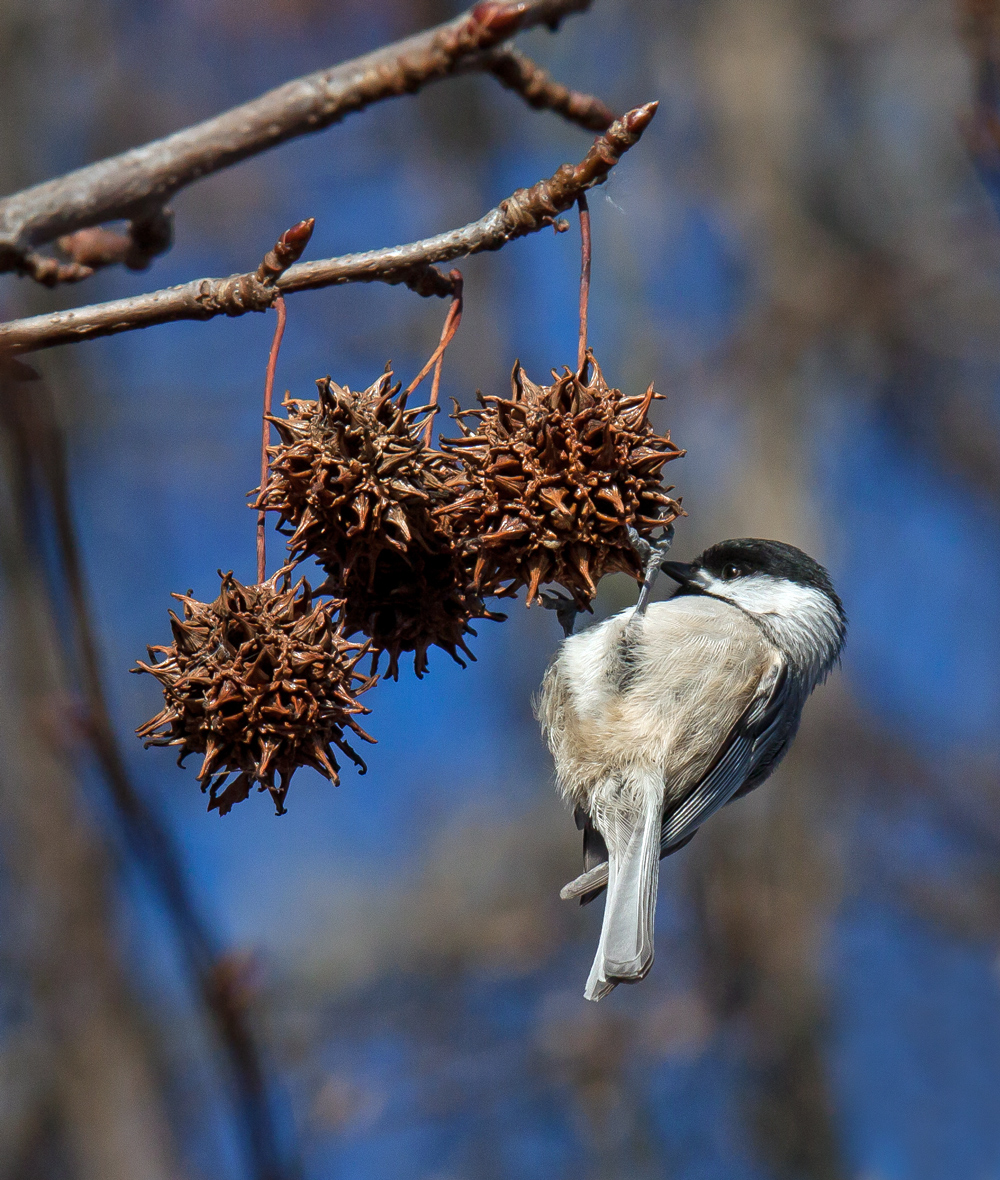
Last Friday I watched a Carolina Chickadee as it extracted seeds from some of the spiky sweetgum balls still hanging from the tree branches. The chickadee would hang from its claws from one of the balls and thrust its beak into the center of the ball. Sometimes the long stem of the ball would sway a bit, but I never saw one give way—either the stem is really strong or the chickadee is really light (or both).

The chickadee was high in the tree, but I managed to capture this cool shot of the little bird in action.


Carolina Chickadee

© Michael Q. Powell. All rights reserved.


Read Full Post »

This Carolina Chickadee (Poecile carolinensis) was busily extracting seeds from the spiky sweetgum seed balls when I spotted it high in a tree on Wednesday at Occoquan Bay National Wildlife Refuge. The chickadee would dangle upside down from the branch to snag a seed with its bill and bring the seed back onto the branch to eat it.

In this image, the chickadee appeared to be eying its next target—the seed ball in the lower left of the shot.

Carolina Chickadee

© Michael Q. Powell. All rights reserved.

Read Full Post »

Seeds from Sweetgum tree seedpods provided much-needed nourishment for some of the small birds in my area, like this Carolina Chickadee (Poecile carolinensis) that I spotted on Thursday at Occoquan Bay National Wildlife Refuge. The chickadee’s acrobatic position reminds me a little of that of a hovering hummingbird. Appearances to the contrary notwithstanding, the chickadee is not levitating—its legs are merely hidden behind its body.

It is pretty amazing that the chickadee can hang with its full body weight from the seed pod and extract seeds without causing the pod to fall from the tree. The delicate touch required reminds me of playing the classic game Operation when I was a child. The game requires you to remove various body parts from a patient using a pair of electric tweezers that buzz if you touch the edges of the cavity opening. (Check out this Wikipedia article if you are not familiar with the Operation game, which amazingly is still in production.)

Carolina Chickadee

© Michael Q. Powell. All rights reserved.

Read Full Post »

It was windy yesterday at Occoquan Bay National Wildlife Refuge, but that did not deter some American Goldfinches (Spinus tristis) from foraging for seeds in the spiky seedpods still hanging from the leafless Sweetgum Trees (Liquidambar styraciflua). The goldfinches were amazing daring and acrobatic in their efforts high in the trees to extract the seeds.

It is a testament to the strength of the stems of the seedpods and the light weight of the goldfinches that the birds were able to place all of their weight on hanging seedpods and poke into their perches with their pointed beaks, as you can see in the first image. The final image shows that the finches knew that there were seeds throughout the seedpods and were willing to turn upside down to reach some additional seeds.

American Goldfinch

American Goldfinch

American Goldfinch

© Michael Q. Powell. All rights reserved.

Read Full Post »

This Carolina Chickadee (Poecile carolinensis) was working hard this past Friday at Occoquan Bay National Wildlife Refuge to get to the seeds inside the spiky pods of a sweetgum tree. I was amazed that the stem of the seedpods was able to support the weight of the little bird, particularly because it had to peck away vigorously to get to the seeds. Eventually the chickadee’s persistence would pay off and it would sit on a branch and really seemed to enjoy the seeds.

It makes me wonder what the seeds taste like.

Carolina Chickadee

© Michael Q. Powell. All rights reserved.

Read Full Post »