Feeds:
Posts
Comments

Posts Tagged ‘Sturnus vulgaris’

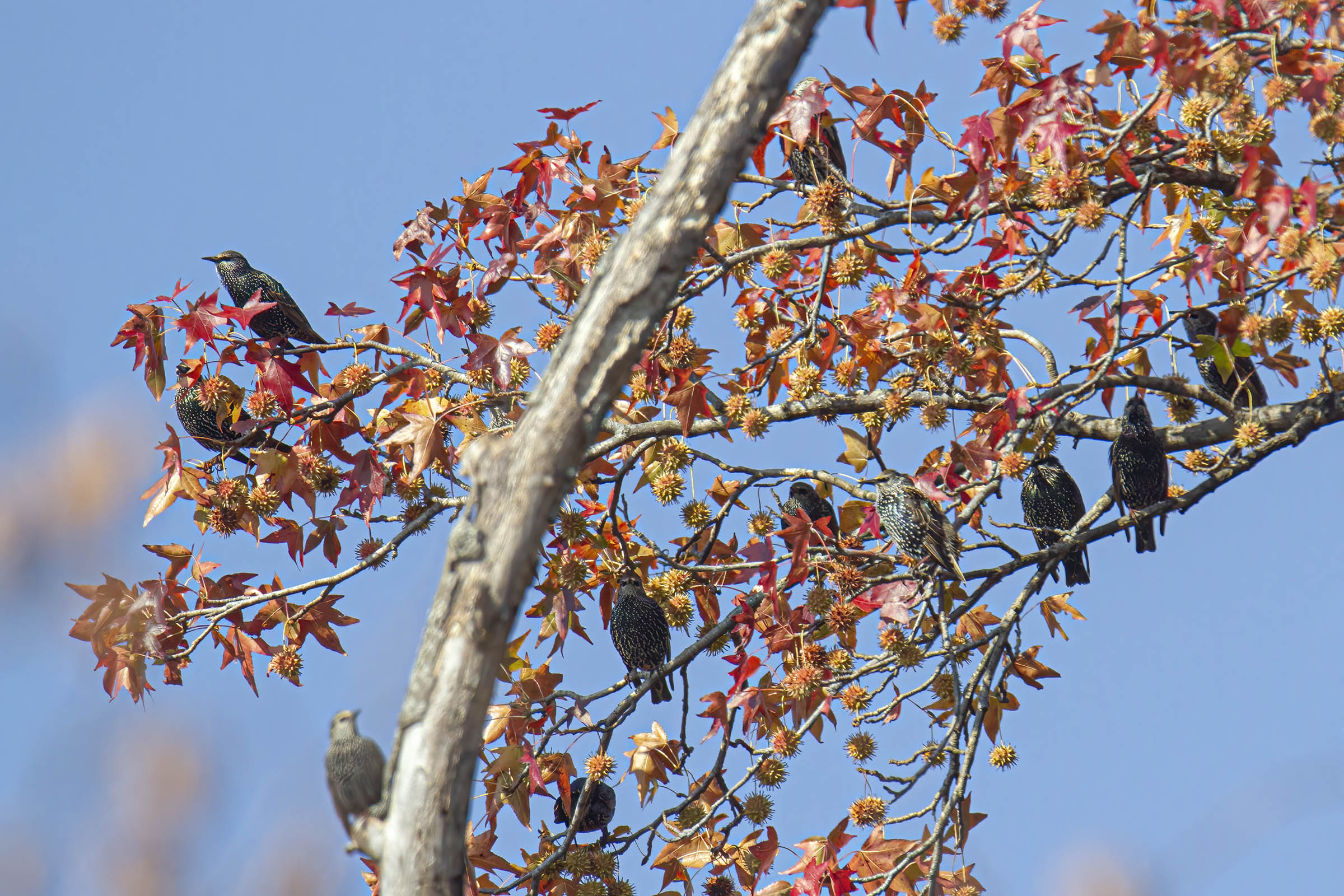
How do you photograph a flock of birds? This past Thursday I visited Occoquan Bay National Wildlife Refuge and observed (and heard) that a sizable flock of European Starlings (Sturnus vulgaris) was moving about in a large expanse of trees. I attempted to photograph clusters of starlings, but as you can see in the final photograph, many of the birds were hidden or shaded by the foliage or were looking away from me.

I decided that a better approach was to concentrate my efforts on getting shots of individual starlings. The first image is one of my favorites from my session with the starlings. The texture of the photogenic snag adds to the visual interest of the image and the starling cooperated by giving me a nice view of its profile. The colorful foliage gives you a sense of the season and of the environment and the two blurry starlings in the background help to balance the image.

The composition of the second image is much simpler—it’s just the bird and its perch. What makes this image interesting for me is the intensity of the starling as it calls out with its mouth wide open, which adds a touch of dynamism to what would otherwise be a static portrait.

European Starling

European Starling

European Starling

© Michael Q. Powell. All rights reserved.


Read Full Post »

A large flock of European Starlings (Sturnus vulgaris) was foraging in the trees at Occoquan Bay National Wildlife Refuge last Friday. Initially I thought that this might be a flock of crows or red-winged blackbirds, but when I zoomed in on the birds and saw their mottled iridescent feathers, I immediately identified them as starlings.

I captured these images as the birds feasted on some unidentified berries, plucking and ingesting them one at a time. I was hoping to get more shots of these birds, but without any visible warning, they all took off at the same time and flew away.

European Starling

European Starling

European Starling

© Michael Q. Powell. All rights reserved

Read Full Post »

During the winter months it is not uncommon for me to see large flocks of European Starlings (Sturnus vulgaris). When the lighting is poor, they appear to be entirely black in color. When the sun is shining brightly, however, I am sometimes able to see the speckles in their feathers and a shiny iridescence that often looks greenish or pinkish in color.

This starling was part of a flock that I spotted on Friday at Occoquan Bay National Wildlife Refuge. The birds were foraging high in the trees and most of them flew away as I approached. This one hung around for a bit longer than the others, allowing me to capture these shots that highlight markings pretty well.

According to the Cornell Lab of Ornithology, “All the European Starlings in North America descended from 100 birds set loose in New York’s Central Park in the early 1890s. The birds were intentionally released by a group who wanted America to have all the birds that Shakespeare ever mentioned. It took several tries, but eventually the population took off. Today, more than 200 million European Starlings range from Alaska to Mexico, and many people consider them pests.”

Another fun fact that I learned on the Cornell Lab of Ornithology website relates to the feathers of this cool-looking bird. “Starlings turn from spotted and white to glossy and dark each year without shedding their feathers. The new feathers they grow in fall have bold white tips – that’s what gives them their spots. By spring, these tips have worn away, and the rest of the feather is dark and iridescent brown. It’s an unusual changing act that scientists term “wear molt.””

European Starling

European Starling

© Michael Q. Powell. All rights reserved.

Read Full Post »

I did not plan to make birding a focus of my trip to Paris, but I can’t help but take shots of them when the occasion arises. I’ve seen lots of gulls and pigeons, some mallards, and a few swans, but so far have not gotten close enough to get shots of them—I have relatively modest telephoto lenses with me on this trip.

The first image shows a crow, what I think is a Carrion Crow (Corvus corone). I am not at all certain about identifying birds in Europe, so please correct me if I am wrong. I photographed this crow and the other birds featured in this posting in the Tuileries Garden, which is located in between the Louvre and the Place de la Concorde.

The second bird is a Common Moorhen (Gallinula chloropus). Several other moorhens were swimming about in a small pond, but this one decided to boldly look for food. Perhaps it was looking for a handout from tourists.

The final birds are Common Starlings (Sturnus vulgaris). This small flock of starlings flew about from place to place. I did not detect any signals, but all of them seemed to take off and land at the same time.

If you have followed my blog for any length of time, you know that I like to photograph anything that catches my eye. Even in a place like Paris, where there appear to be famous landmarks in every direction I turn, I am just as likely to be spending time photographing these modest little birds. I think it would make me a maddening travel companion for a more normal person.

Carrion Crow

Common Moorhen

Common Starlings

© Michael Q. Powell. All rights reserved.


Read Full Post »

A flock of noisy, black-colored birds was active this past weekend at Occoquan Bay National Wildlife Refuge. I initially thought they were blackbirds or grackles, but a closer look showed them to be European Starlings (Sturnus vulgaris), a species introduced into the US from Europe by Shakespeare enthusiasts late in the nineteenth century.

I was intrigued when I saw the reference to Shakespeare and learned the following information about the history of starlings in the United States from the Cornell Lab of Ornithology website:

“All the European Starlings in North America descended from 100 birds set loose in New York’s Central Park in the early 1890s. The birds were intentionally released by a group who wanted America to have all the birds that Shakespeare ever mentioned. It took several tries, but eventually the population took off. Today, more than 200 million European Starlings range from Alaska to Mexico, and many people consider them pests.”

To be or not to be? Whether you like them or not, it looks like European Starlings are here to stay. As for me, I find the dotted pattern on these birds to be quite attractive.


European Starling

European Starling

© Michael Q. Powell. All rights reserved.


Read Full Post »

Starlings are supposed to be common birds, but I never knew what they looked like up close, so I initially had a lot of trouble identifying the odd-looking bird in these photos that I took in early December.

I’m pretty sure now that it is a European Starling (Sturnus vulgaris), a bird that was first introduced into North America in the 19th century by Shakespeare enthusiasts, according to the Cornell Lab of Ornithology. What does Shakespeare have to do with it?

Well, Shakespeare mentions them in one of his plays. Steve Mirsky explained the reference in an article in Scientific American entitled “Shakespeare to Blame for Introduction of European Starlings to U.S.

“In the late 1590s Shakespeare noted the mimicking ability of the starling while writing Henry IV, Part 1. Hotspur is contemplating driving King Henry nuts by having a starling repeat the name of Hotspur’s brother-in-law Mortimer, whom Henry refuses to ransom out of prisoner status. “Nay, I’ll have a starling shall be taught to speak nothing but ‘Mortimer,’ ” Hotspur whines.”

In 1871, a group called the American Acclimatization Society was formed in New York, dedicated to introducing European plants and animals and birds into North America, according to Wikipedia. The group’s chairman was an avid admirer of Shakespeare and is said by some to have desired to introduce every bird mentioned by the playwright.  The Cornell Lab notes that the more than 200 million starlings now in North American are descendants of the original 100 starlings released in New York’s Central Park in the early 189o’s. Yikes!

I am always curious about the origin of bird names and learned from the Cornell Lab that the starlings got their name because their wings are short and pointed, making them look rather like small, four-pointed stars when they are flying.

starling1_blogstarling2_blog

© Michael Q. Powell. All rights reserved

Read Full Post »