Ruddy Ducks (Oxyura jamaicensis) “feed most actively at night, so you’ll often see Ruddy Ducks sleeping during the day, head tucked under a wing and tail cocked up,” according to the Cornell Lab of Ornithology. I spotted a small group of them, including the sleeping male Ruddy Duck in the first photo, on Tuesday at a small suburban pond in Kingstowne, a community only a couple of miles from where I live.
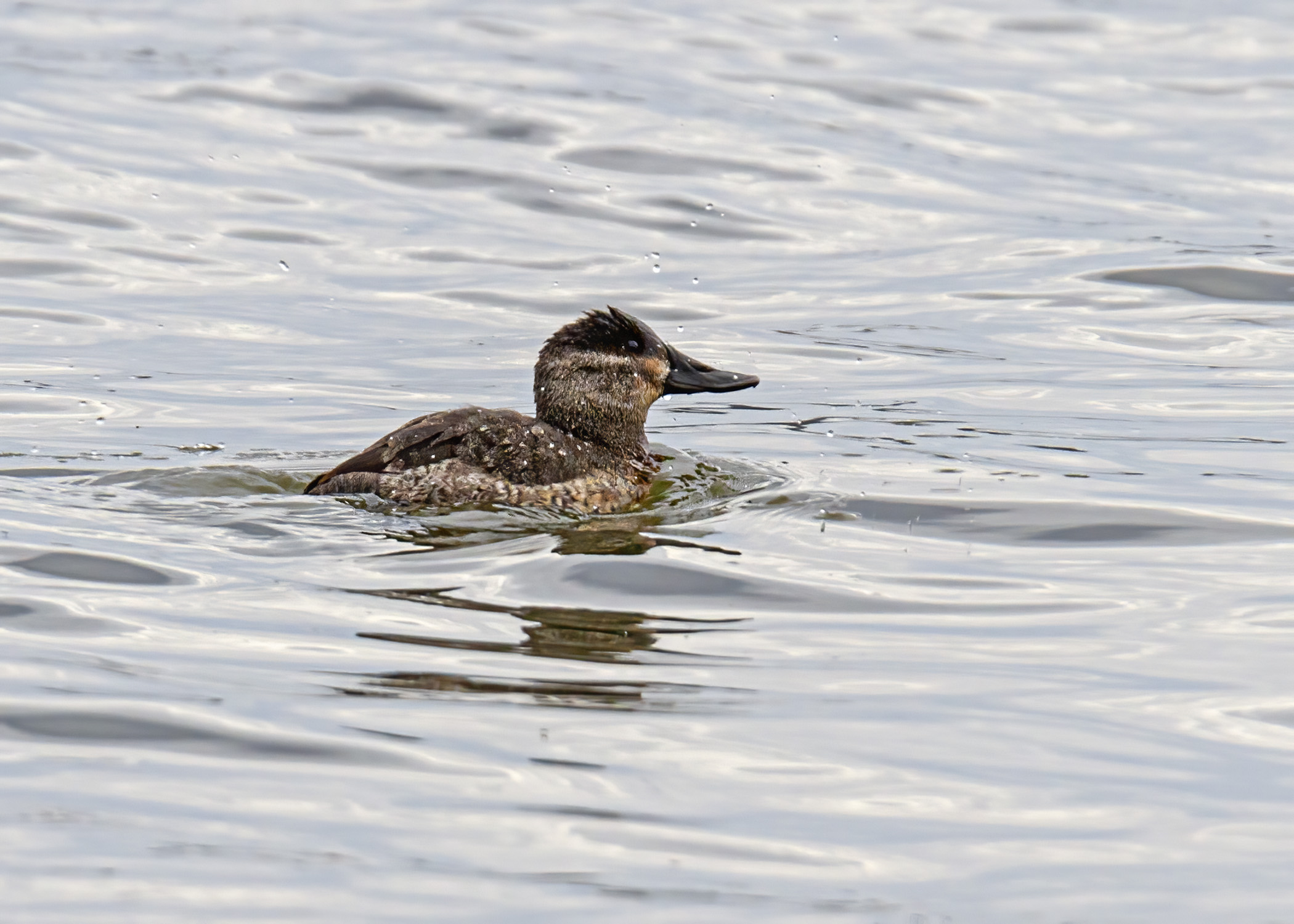
Earlier this month I spotted a much larger flock of Ruddy Ducks in the waters off of Occoquan Bay National Wildlife Refuge. As you can see in the second photo, many of the ducks were sleeping. The ducks were quite a distance from shore, but the bright white cheek patches on some of the males made them easy to identify. Eventually one of the ducks swam a bit closer and I captured the final image—judging from its coloration, this appears to be either a female or an immature male.
I read on-line that the breeding colors of the male are spectacular, with a sky-blue bill, shining white cheek patch, and gleaming chestnut body, but I have never seen Ruddy Ducks during breeding season. As I read further in the entry for the species on the Cornell Lab of Ornithology website, I could not help but chuckle:
“The bright colors and odd behavior of male Ruddy Ducks drew attention from early naturalists, though they didn’t pull any punches. One 1926 account states, “Its intimate habits, its stupidity, its curious nesting customs and ludicrous courtship performance place it in a niche by itself…. Everything about this bird is interesting to the naturalist, but almost nothing about it is interesting to the sportsman.” ”
UPDATE: A sharp-eyed Facebook friend noted that the position of the duck in the first photo is a bit more upright than it would be if he were sleeping and suggested the duck was in the process of grooming.


© Michael Q. Powell. All rights reserved.
 Mike Powell